


The islands off Zadar are close enough for easy day trips yet wild enough to feel like a true Adriatic escape. With ferries, fast catamarans and a growing choice of private and small-group boat tours, you can spend your days swimming in turquoise bays, walking through sleepy stone villages and sailing past the stark cliffs of Kornati and Dugi Otok, then still be back in Zadar’s old town for dinner. This guide focuses on practical, real-world ways to hop between Kornati, Dugi Otok, Ugljan, Pašman and Sakarun Beach, with concrete examples of routes, prices, and what to expect in each season.
Get the latest updates straight to your inbox!
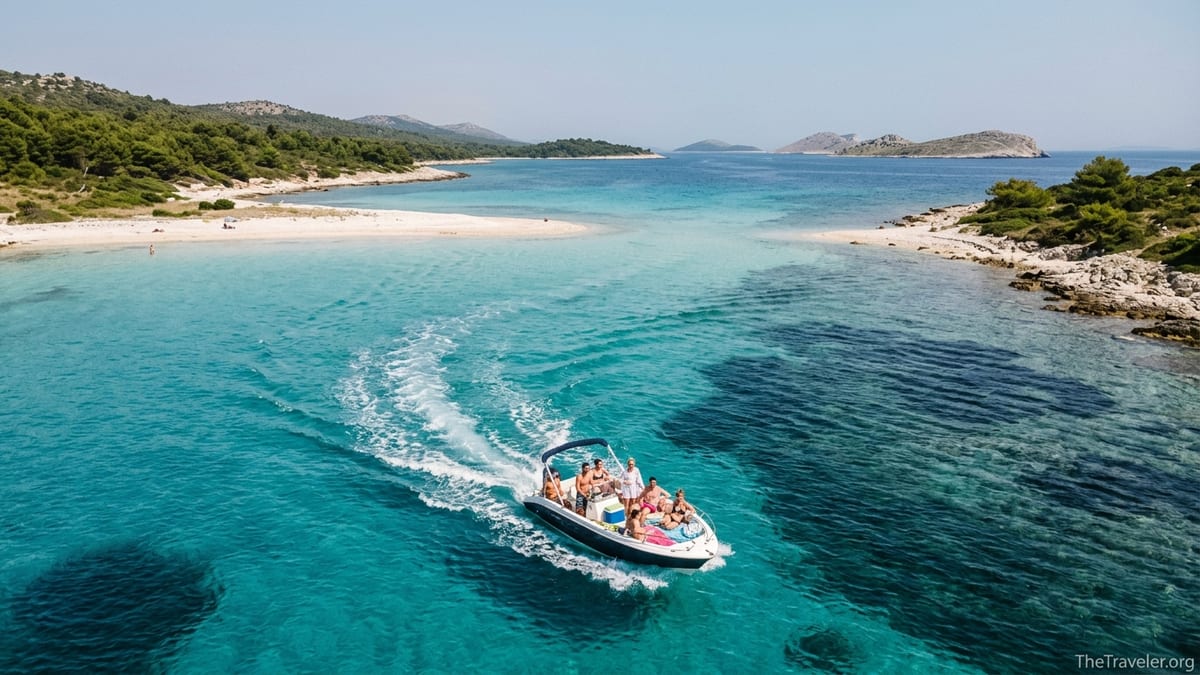
Understanding the Zadar Archipelago
Zadar sits in front of one of the most indented coastlines in Europe, with dozens of inhabited and uninhabited islands forming a natural playground for day trips. The closest islands, Ugljan and Pašman, lie just a short ferry ride from the mainland and feel like Zadar’s “suburbs” across the water, dotted with villages, bike paths and family-run konobas. Further out, Dugi Otok stretches for almost 45 kilometers, home to the sandy curve of Sakarun Beach in the north and the dramatic cliffs of Telašćica Nature Park in the south.
Beyond Dugi Otok lies Kornati National Park, a maze of mostly uninhabited rocky islets where the land appears almost lunar from a distance. Regular passenger ferries do not serve Kornati directly for sightseeing, so most visitors experience the park on organized full-day boat trips from Zadar or nearby marinas. A typical Kornati route will include long cruising sections among the islands, time for swimming in a quiet bay and lunch at a simple waterfront restaurant on an island like Kornat or Žut.
The key to planning island hopping out of Zadar is understanding that there are two very different transport “layers.” Ferries and catamarans like those run by Jadrolinija and regional fast-boat operators link Zadar with the main villages on Ugljan, Pašman and Dugi Otok, and are ideal if you are happy to explore on foot, by bike or by rental scooter once you arrive. Private and small-group tours, on the other hand, give you the flexibility to reach remote coves, caves and beaches where there are no scheduled public boats.
Most visitors mix both options. For example, you might take the public car ferry from Zadar’s Gaženica port to Preko on Ugljan for a low-cost, relaxed day of cycling and swimming, then the next day join a speedboat tour that links Dugi Otok’s Sakarun Beach with a couple of uninhabited islets in the Zadar channel. With some basic planning, you can see a very different side of the Adriatic every day without spending your entire budget on boat hire.
Public Ferries and Catamarans: Ugljan, Pašman and Dugi Otok
The backbone of island hopping from Zadar is the ferry network, particularly the short line to Ugljan. The Zadar to Preko ferry on Ugljan is one of the most frequent in Croatia, with around 20 departures a day in each direction in high season and a crossing time of roughly 25 minutes. Many departures leave from the Gaženica ferry port a short bus or taxi ride from the old town, and walk-on passenger tickets are usually just a few euros each way, which makes it easy to “commute” to and from Ugljan even if you are based in Zadar.
Once on Ugljan you can continue to Pašman, which is linked to Ugljan by a bridge at Ždrelac. Local buses connect Preko with villages such as Kali, Kukljica and Kali’s fishing harbor, but many travelers prefer to rent a bike or scooter from rental outfits near the ferry pier. A realistic day-trip plan is to catch a morning ferry from Zadar, pick up a bike in Preko, follow the coastal road through Kali to the bridge at Ždrelac, then continue to Pašman’s northern villages before looping back for an evening ferry. With calm seas and little traffic out of peak hours, this can be one of the most relaxed days you spend in the region.
Dugi Otok is further but still very manageable. The car ferry from Zadar’s Gaženica to Brbinj on Dugi Otok typically takes around 80 to 90 minutes, with several sailings a day in summer and fewer in shoulder seasons. There is also a fast catamaran route from Zadar’s old town to Božava and Brbinj that cuts travel time and is convenient if you are staying close to the peninsula. In practice, many travelers heading to Sakarun or Telašćica stay a night or two on Dugi Otok, using local buses, scooters or rental cars to get around the long, thin island.
Routes and timetables change between low and high season, and exact departure times vary from year to year, so it is essential to check the latest schedule on Croatian ferry operators’ official timetables before finalizing your plans. In July and August, try to buy tickets at least a day in advance for Dugi Otok if you are traveling with a car, as morning ferries can book out. For Ugljan and the Preko line, foot passengers can usually board without advance purchase, though turning up 20 to 30 minutes early is sensible.
Private and Small-Group Boat Tours from Zadar
While ferries are perfect for getting to the main islands, private and small-group tours from Zadar open up the archipelago’s quieter corners. In recent years, a cluster of local operators based around Zadar’s waterfront and nearby marinas has started to offer flexible speedboat tours that cover Dugi Otok, Sakarun Beach, Kornati and the smaller islets just off the coast. These tours typically depart from Zadar’s city harbor or nearby marinas such as Marina Zadar or Sukošan and run from half-day sessions to full-day adventures of 8 to 10 hours.
For example, a typical private island-hopping speedboat tour for up to 10 to 12 people might cost around 300 euros for a four-hour route focused on closer islands such as Ugljan and Ošljak, and around 500 to 600 euros for an eight-hour route that reaches Dugi Otok or parts of the Kornati area. Fuel is usually either included in the quoted price or charged based on actual consumption, so it is worth confirming this in advance. On board you can usually expect shade, a fresh-water shower, basic snorkeling gear and a cooler for drinks, but not full catering, so many guests bring their own snacks and water.
Shared small-group tours are a good middle ground if a private charter feels expensive. Kornati excursions in a group format often cost roughly 70 to 110 euros per person for a full day, including a simple lunch and entry fees where needed. Dugi Otok and Sakarun Beach group speedboat trips are often in the 80 to 120 euro range per person, depending on whether they combine the beach with stops at sea caves or Telašćica cliffs. In the peak of summer, tours to Sakarun usually depart Zadar around 8:00 or 9:00 in the morning and return by late afternoon, giving you several hours of free time at the beach.
When comparing operators, look closely at how they describe their route flexibility. Some companies run fixed itineraries that follow the same loop every day, while others adjust based on wind, waves and crowding, choosing quieter bays on Ugljan or Pašman if the outer islands are rough. A good rule of thumb is that any route including both Kornati and Sakarun in a single day will require a fast speedboat and a long day at sea, while more relaxed itineraries cover either Kornati and Telašćica or Dugi Otok and the nearer islets. If you are prone to seasickness, a shorter Ugljan and Pašman loop with multiple swimming stops is likely to be more comfortable.
Kornati National Park and Telašćica: Boat-Trip Essentials
Kornati National Park is often described as a sailor’s paradise, and from Zadar it is one of the most popular full-day excursions. A typical Kornati tour departs Zadar or a nearby marina around 8:00, cruises for two to three hours through the outer Zadar islands, then enters the national park via a channel lined with low, stone-dotted hills. Because the park has specific entry regulations and fees for boats, nearly all visitors come on organized tours whose operators take care of permits and routing.
Entrance to Kornati and neighboring Telašćica Nature Park is charged per boat, with prices varying by boat length and by season, and tour companies build these costs into your ticket. When visiting as part of a group, you will not need to purchase separate park tickets, but the higher summer park fees are one reason why Kornati trips tend to cost more in July and August than in May or late September. A realistic expectation is that about half of your Kornati day will be spent cruising, so the experience is as much about the views and island atmosphere as it is about swimming.
Many Kornati itineraries pair the park with a stop in Telašćica Nature Park on Dugi Otok, known for its high sea cliffs and a saltwater lake just inland. On such routes, boats often dock in a bay where you can walk 10 to 20 minutes to viewpoints above the cliffs or down to the lake for a warm, sheltered swim. Wear sturdy sandals or shoes for these walks, as the karst rock is sharp and hot in high summer, and carry at least a liter of water per person because shade is limited.
If your main goal is relaxed swimming in sandy shallows, you might choose a trip that focuses on Sakarun or beaches closer to Zadar instead of Kornati. However, if you want to see the stark, almost treeless Kornati landscape that appears in many photographs of the Croatian coast, a park tour is still the easiest, most straightforward option. Booking at least several days ahead in July and August is wise, especially if you want a smaller boat rather than a large excursion vessel carrying 100 or more people.
Dugi Otok and Sakarun Beach: Reaching the Sand
Sakarun Beach, near the village of Veli Rat on the northern tip of Dugi Otok, has become one of the most talked-about beaches in the Zadar region. It is a broad bay with white pebbles and sand underfoot and shallow, light-turquoise water that stretches far out, which makes it especially popular with families and non-confident swimmers. In July and August you will find floating platforms, beach bars and sunbed rentals, while in May, June, September and early October it is often much quieter, with a more laid-back feel.
You can reach Sakarun in two main ways. The first is by public ferry or catamaran to Dugi Otok, then local transport. One common route is to take the car ferry from Zadar to Brbinj, then drive or take the island bus north to Božava or Veli Rat before continuing on the local shuttle to Sakarun. In summer there is usually a tourist train-style shuttle between Božava and the beach. If you are comfortable driving, renting a car in Zadar for a day and taking it on the ferry can work well for a group, as it lets you combine Sakarun with stops at nearby coves or the lighthouse at Veli Rat.
The second option is to visit Sakarun on an organized speedboat tour from Zadar. These trips typically include several swimming stops en route at sea caves or small bays, plus two to three hours of free time at Sakarun. Because the bay is relatively open, skippers choose their mooring spot based on wind and waves, and may anchor slightly away from the main beach in order to avoid the busiest section. On these tours you will usually jump into the water from the boat and swim to the shore or transfer to a small tender.
In practical terms, Sakarun is at its best first thing in the morning or later in the afternoon, especially in July and August when the middle of the day can feel very crowded and hot. If you are staying on Dugi Otok itself, consider visiting early or late and spending the middle of the day exploring quieter spots such as the nearby coves of Veli Žal or the inland paths around Božava. In shoulder season months like late September or early October, the sea may be cooler but you will often share the beach with only a handful of other swimmers.
Ugljan and Pašman: Easy Island Days from Zadar
For many travelers, the most rewarding day trips from Zadar are actually the simplest. Ugljan, directly opposite the old town across the channel, offers an easy escape with frequent ferries and a relaxed, local feel. The waterfront village of Preko has a small promenade, pebble beaches within walking distance of the ferry and cafes where you can sit and watch the short-distance ferries shuttle back and forth. A popular short outing is to walk or take a quick boat ride to the tiny isle of Galevac, home to a Franciscan monastery and shaded by pine trees.
Further along Ugljan’s coast you will find the fishing village of Kali, known for its tuna fleet, and the resort town of Kukljica at the southern tip, both accessible by local buses or by bike. Between them are small coves with concrete bathing platforms and pebble beaches, rarely as busy as those directly around Zadar. Many Zadar-based boat operators also offer short four-hour private trips that loop around Ugljan and the nearby islet of Ošljak, with two or three swimming stops in quiet bays that are difficult to reach from land.
Pašman, reachable via the bridge from Ugljan at Ždrelac, is quieter still. The short ferry from Biograd na Moru on the mainland to Tkon on Pašman is one of the shortest sea crossings in Croatia, which makes Pašman an appealing base if you have a car and do not mind staying outside Zadar itself. Even if you are not based there, you can cross over from Ugljan to explore the island’s simple beaches and low-key villages such as Tkon and Neviđane before returning to Zadar in the evening.
Because Ugljan and Pašman are so close to the mainland, they are excellent options for shoulder season and days with moderate winds when longer sea crossings might feel too rough. They also work well if you are traveling with young children or older family members who could find an eight-hour speedboat trip to Kornati or Dugi Otok too tiring. You can still build your day around swimming and short coastal walks, but with the option to return to Zadar quickly if weather or energy levels change.
Swimming Stops, Safety and What to Expect on the Water
Almost every boat trip from Zadar, whether public ferry or private speedboat, will build in time for swimming, and the way these stops work is worth understanding. On private and small-group tours, skippers usually choose bays with sheltered conditions and clear water, sometimes near uninhabited islets or under low cliffs. Guests swim directly from the boat, often using a ladder at the stern, and those who prefer to stay on board can sunbathe on deck. On very busy days in July and August, some of the classic spots around Dugi Otok and the outer Kornati islands can be crowded with other boats, so experienced skippers often adjust and steer to quieter coves instead.
Water temperatures in the Zadar area are typically comfortable for swimming from late May through late September, peaking in July and August. Even in high summer, the open Adriatic can feel noticeably cooler than shallow bays like Sakarun or the lagoons of Ugljan and Pašman, so packing a light rash vest or short wetsuit top can extend your time in the water, especially on windy days. Simple snorkeling gear is widely available to rent from tour operators, and visibility is usually excellent, with seagrass meadows, rocks and small fish under the surface rather than coral.
On ferries and catamarans, swimming is not part of the journey itself, but you can build your day around accessible beaches near the landing points. For example, from Preko on Ugljan you can walk 10 to 15 minutes along the waterfront to reach small pebble beaches and concrete sunbathing terraces, while from Božava on Dugi Otok a short walk or shuttle will take you to nearby coves or on toward Sakarun Beach. Always factor in the time needed to get back to the pier, especially in the afternoon when the last ferries and catamarans of the day depart.
Basic safety on the water in Croatia is generally good, but conditions can change quickly, particularly in the shoulder seasons when the Bora or Jugo winds can pick up. Choose operators who provide life jackets, who give a clear safety briefing and who are willing to adjust the route if the forecast suggests rough seas, even if this means skipping a more distant highlight. If you are renting a small boat to pilot yourself, regulations require a valid boat license for most motorboats, and it is strongly recommended that first-time visitors stick to short, nearshore routes around Ugljan rather than attempting crossings to Dugi Otok or Kornati.
Seasonal Planning: When to Go and How to Book
The main island-hopping season from Zadar runs from May to October, with very different experiences depending on when you visit. July and August bring the most frequent ferry and catamaran services, the widest choice of boat tours, and the warmest sea temperatures, but also the largest crowds and the highest prices. During this period, it is common for private speedboats and popular group tours to be fully booked several days in advance, especially at weekends, and beaches like Sakarun can feel lively from mid-morning onwards.
June and September are often the sweet spot for many travelers. Ferry schedules are still reasonably frequent, water temperatures are generally pleasant for swimming, and there is a broad choice of tours to Kornati, Dugi Otok and Ugljan without the peak-season congestion. Accommodation in Zadar and on the islands is usually easier to find at short notice, and restaurants on Ugljan, Pašman and Dugi Otok are less pressured, which enhances the relaxed, island feel. Prices for private boat charters can be slightly lower than in high season, and there is usually more flexibility to customize routes.
In May and October, island hopping is very much possible but requires more planning. Some operators run fewer tours, focusing on dates when the forecast is stable and when they have enough bookings to justify a departure. The sea can feel cool for long swims, though many travelers still swim comfortably on sunny days, and beaches such as Sakarun are far quieter. If your trip falls in these shoulder months, it is smart to remain flexible and to book boat trips with the understanding that routes or dates could shift if a weather system moves in.
Regardless of when you visit, booking strategy matters. For fixed ferry routes like Zadar to Preko or Zadar to Brbinj, checking schedules a week or two before travel and buying tickets a day in advance is usually enough, especially if you are traveling without a car. For private boat tours and the most popular small-group routes to Kornati, Dugi Otok and Sakarun in July and August, consider reserving as soon as you have your accommodation dates confirmed, then reconfirm with the operator a day or two before departure to check meeting points and weather conditions.
The Takeaway
Island hopping from Zadar rewards both planners and wanderers. With a little research into ferry schedules and boat tours, you can combine easy half-day escapes to Ugljan and Pašman with more ambitious full-day journeys to Dugi Otok, Sakarun and Kornati. Public ferries keep costs predictable and give you freedom to explore villages and beaches at your own pace, while private and small-group tours unlock sheltered bays, coves and sea caves that would be otherwise unreachable in a single day.
What makes the Zadar archipelago special is how varied it is within such a compact area. One day you might be cycling between olive groves on Ugljan, stopping at a waterside konoba for grilled fish; the next you could be standing above the cliffs of Telašćica or wading through Sakarun’s pale turquoise shallows. All of this is within a couple of hours of Zadar’s old town, which means you never have to choose between an island-focused trip and time in one of Croatia’s most atmospheric coastal cities.
By thinking about your priorities in advance, whether they are sandy beaches, dramatic cliffs, quiet fishing villages or long days on the water, you can select routes and seasons that suit your style. Travel in July and August for maximum choice and warm seas, or in June, September and early October for calmer, more spacious days. With flexible ferry tickets in your pocket and a trusted local skipper lined up for at least one day, the Zadar islands will quickly feel like an accessible, endlessly rewarding extension of the city itself.
FAQ
Q1. Can I visit Sakarun Beach as a day trip from Zadar without a tour?
You can, but it takes planning. Take the car ferry from Zadar to Brbinj on Dugi Otok, then continue by bus or car to Božava or Veli Rat and on to Sakarun. This is realistic as a long day if you catch an early ferry and are comfortable with bus timings or driving on the island.
Q2. Is it better to see Kornati National Park on a large excursion boat or a small speedboat?
Large excursion boats are usually cheaper per person and feel more stable, but routes are fixed and the experience is less intimate. Small-group or private speedboats cost more but can reach quieter bays, adapt to conditions and avoid some of the crowds. If you are prone to seasickness or prefer more space, a larger vessel can be a safer choice.
Q3. Do I need to book ferries to Ugljan and Dugi Otok in advance?
For Ugljan, foot passengers rarely need advance reservations even in peak season, though arriving early is sensible. For Dugi Otok, especially if you are taking a car in July and August, buying tickets in advance or arriving well before departure is recommended because morning sailings can fill up.
Q4. How much should I budget for a private boat tour from Zadar?
As a rough guide, half-day private speedboat tours to nearby islands such as Ugljan often start around 300 euros for the boat, while full-day routes to Dugi Otok or parts of Kornati typically range from about 500 to 700 euros depending on boat size, fuel policy and season. Splitting the cost between a small group usually makes this much more affordable.
Q5. Are there sandy beaches on Ugljan and Pašman or only pebbles?
Most beaches on Ugljan and Pašman are pebble or rock with concrete bathing platforms, but some coves have sandy or sandy-pebble shallows, especially on Pašman’s eastern side. If true sand is a priority, Sakarun on Dugi Otok or the long, shallow beaches around Nin on the mainland are better known options.
Q6. What should I bring on a Kornati or Dugi Otok boat trip?
Plan for strong sun and changeable wind. Bring a hat, high SPF sunscreen, swimsuit, light cover-up, towel, water shoes if you have sensitive feet, and at least a liter of drinking water per person. Even if lunch is included, packing fruit or snacks is wise, and a light windbreaker can be useful on fast boats.
Q7. Is island hopping from Zadar suitable for young children?
Yes, if you choose routes carefully. Short ferry trips to Ugljan or Pašman and gentle private tours with frequent swimming stops are usually fine for families. Very long days at sea to Kornati or combined routes that cover many islands can be tiring for younger children, so consider focusing on one or two highlights.
Q8. Can I rent a small boat without a license in Zadar?
There are a few low-powered boats that some local renters may allow without a formal license, but for most motorboats Croatian regulations require a valid boat license. If you do not have one, the safest option is to join a guided tour or hire a boat with a professional skipper rather than attempting to navigate the open sea alone.
Q9. Are there restaurants on the islands or should I bring my own food?
On Ugljan, Pašman and Dugi Otok you will find village restaurants, simple taverns and beach bars, though opening hours depend on the season. In Kornati, many coves have seasonal konobas that serve grilled fish and simple dishes but may require reservations in peak months. On most boat trips it is still sensible to bring some snacks and water.
Q10. Is October too late for island hopping and swimming around Zadar?
October is shoulder season: ferries still run, and some tours operate, but schedules are reduced and the sea is cooler. Many people still swim on sunny days, though long swims can feel brisk. If you travel in October, build flexibility into your plans and be ready for some windy or rainy days when boat trips might be rescheduled.