

More news on this day
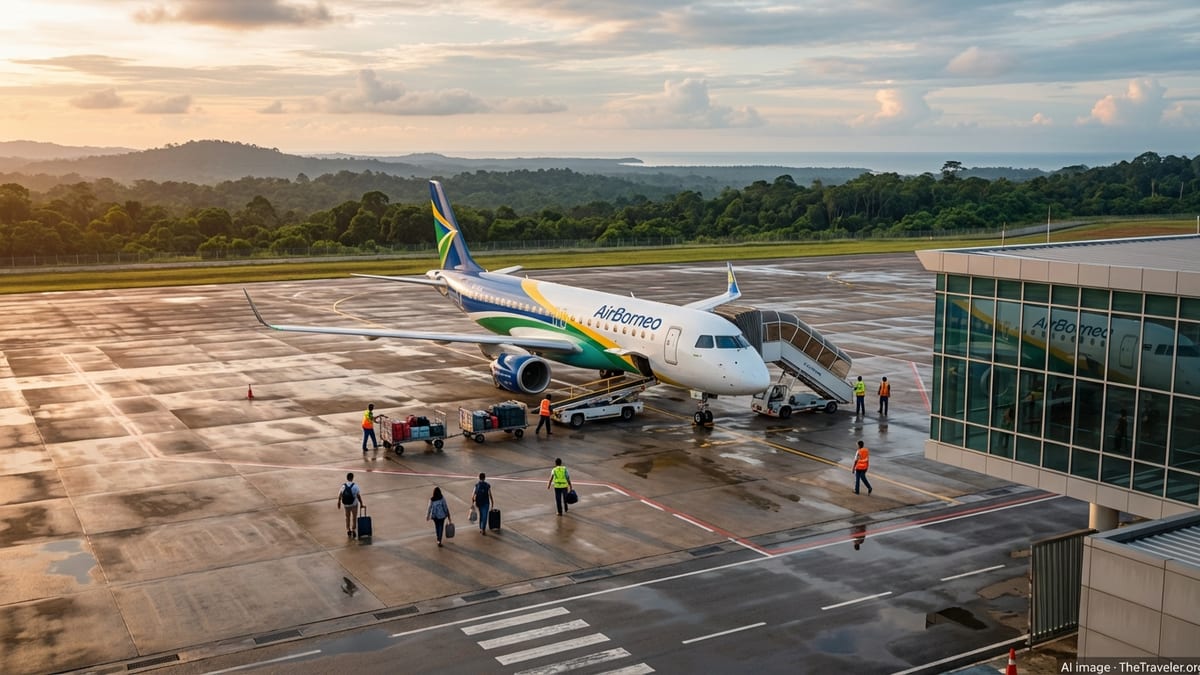
Regional carrier AirBorneo is recalibrating its ambitions for a Bangkok service, as the Sarawak-owned airline focuses on restoring reliability across its domestic network and limiting the impact of worsening congestion and disruptions at major Southeast Asian hubs for Malaysian passengers.
Get the latest news straight to your inbox!
Bangkok Hopes Put On Hold As Speculation Runs Ahead Of Reality
AirBorneo’s possible entry into the Bangkok market has been the subject of growing speculation in Malaysian and Thai aviation circles, particularly after regional media listed the Kuching-based airline among new operators allocated preliminary slots at Bangkok Suvarnabhumi for the winter 2026 to 2027 season. Reports indicate that the carrier was named alongside three other new entrants during an International Air Transport Association slot conference held in the Thai capital earlier in June.
Despite that visibility, publicly available information shows the airline taking a cautious line. In a recent clarification, AirBorneo stated that no formal application has yet been lodged for a Bangkok route and that any such service remains at the planning stage only. The carrier has stressed that international expansion is subject to the usual regulatory processes and that no route, schedule or launch date should be treated as confirmed until official announcements appear on its own channels.
The stance effectively pauses near term expectations of a firm Bangkok launch, even as slot allocations suggest the door remains open for future services once the airline is ready. For now, industry observers see AirBorneo’s position as a signal that it intends to avoid overcommitting capacity into a volatile regional market before its home operations are more robust.
The recalibration also underlines the fine balance smaller regional airlines must strike between seizing growth opportunities and managing operational risk at a time when airport infrastructure and air traffic systems around Southeast Asia are coming under renewed strain from a post pandemic surge in demand.
Domestic Disruptions Trigger Strategic Rethink
The decision to cool immediate Bangkok plans comes as AirBorneo grapples with recent disruptions across its intra Borneo network. Over the past several weeks, passengers on key routes in Sarawak, Sabah and Labuan have reported delays, cancellations and schedule changes, prompting Malaysia’s Civil Aviation Authority to issue a public reminder of consumer rights while it monitors the situation.
Publicly available notices indicate that the airline has attributed the irregular operations in part to concurrent maintenance affecting several turboprop aircraft in its 14 strong fleet, which comprises ATR 72 and DHC 6 Twin Otter types serving mostly rural and intercity routes. While the checks are seen as necessary to ensure long term safety and reliability, the short term effect has been a squeeze on capacity and a more fragile timetable.
In its most recent statements, AirBorneo has framed its immediate priority as “getting the fundamentals right” on existing routes, with a focus on stabilising schedules and restoring confidence among passengers in East Malaysia. That emphasis is consistent with earlier comments from Sarawak state officials and transport planners, who have repeatedly positioned the airline’s core mission as safeguarding connectivity for remote communities and secondary cities.
Industry analysis suggests that pushing ahead aggressively with international launches while domestic operations remain under pressure could have amplified disruption for Malaysian travellers, particularly if aircraft were diverted to new routes before domestic reliability recovered. By slowing the Bangkok timetable, the airline is effectively ring fencing scarce resources for its home market.
Malaysian Travellers Shielded From Wider Regional Travel Chaos
The recalibrated strategy comes against a backdrop of mounting congestion and episodic disruption at major airports across Southeast Asia, including Bangkok, Singapore and Kuala Lumpur, as airlines rebuild networks and add capacity for the peak northern winter and year end holiday periods. Regional aviation data points to rising delays linked to air traffic control constraints, ground handling bottlenecks and weather related issues.
In that context, AirBorneo’s decision to place its immediate focus on Borneo centric routes effectively shields many of its passengers from the most severe knock on effects of regional flight cancellations and missed connections that can arise when services are tightly interwoven with congested hubs. Travellers using the airline primarily for point to point journeys within Sarawak and Sabah are less exposed to the cascading disruption that can occur when long haul and regional banks at major airports falter.
At the same time, aviation analysts note that any eventual AirBorneo service to Bangkok would likely be marketed not only to Sarawak based travellers but also to passengers from Peninsular Malaysia and beyond seeking alternative routings into Thailand. Entering that space while reliability remains uneven at both ends of the route could have added complexity for itinerary planning and customer service, risking reputational damage for a still new brand.
By taking a more conservative approach, the carrier appears to be prioritising resilience for its core domestic clientele over the immediate branding boost that a Bangkok launch might bring. For many Malaysian passengers already frustrated by delays, a period of operational consolidation may be more valuable than a rapid network rollout.
Fleet Upgrades And Phased Growth Still On The Table
While the Bangkok plan is effectively on pause, AirBorneo has not retreated from its broader ambition to become a stronger regional player. According to earlier coverage from Malaysian business outlets and aircraft manufacturers, the airline has placed firm orders for new generation ATR 72 and ATR 42 turboprops, along with purchase options that could support future expansion beyond its current Rural Air Services mandate.
Separate reports from the Singapore Airshow 2026 and local investment briefings indicate that the carrier is preparing to introduce jet operations in the second half of 2026, with a view to opening up links from Kuching to major cities such as Kuala Lumpur, Singapore and selected destinations in North and Southeast Asia. Internal planning documents referenced in public presentations have pointed to a phased rollout, with regional international routes originally flagged for late 2026.
Those timelines now appear more fluid, with the airline signalling that any significant growth spurt will be sequenced behind efforts to normalise on time performance across East Malaysia. Nevertheless, the underlying investments in fleet, technology and training remain in place, suggesting that AirBorneo continues to see itself as a long term connector between Borneo and the wider region, including Thailand.
For aviation watchers, the current pause is therefore interpreted less as a retreat and more as a reset: a chance for the carrier to align its hardware, workforce and regulatory clearances with a realistic pace of expansion, while also taking stock of the infrastructure constraints that are fuelling travel chaos at some of the region’s busiest gateways.
What The Shift Means For Future Connectivity In Borneo
The recalibration of AirBorneo’s Bangkok ambitions carries wider implications for connectivity in Borneo and the surrounding region. Short term, passengers in Sarawak and Sabah are likely to see the airline double down on improving frequencies, reliability and customer communication on existing routes, with regulators and state stakeholders watching performance metrics closely.
Medium term, a more measured approach to international growth could yield a stronger platform for sustained services when Bangkok and other regional destinations eventually come online. By the time any AirBorneo aircraft does appear regularly at Suvarnabhumi, observers expect the airline to have completed most of its fleet renewal, technology upgrades and staff integration following its transition from the former MASwings operation.
The episode also highlights how newer state linked carriers are navigating a more volatile marketplace than their predecessors, where sudden spikes in demand, shifting slot allocations and uneven airport readiness can quickly turn headline grabbing expansion plans into operational headaches. For AirBorneo, the current choice to focus at home first is being read as an attempt to learn from that recent history rather than repeat it.
As the northern winter 2026 to 2027 season approaches, attention will now turn to how rapidly the airline can smooth out domestic schedules and restore passenger confidence. Only once that base is secure, analysts suggest, will the long anticipated Bangkok link move from speculative slot listings to a confirmed place on departure boards.