


When a long-awaited trip collapses into delays, cancellations or missed connections, the next question is often money. Under rules like EU Regulation 261/2004 and UK261, many passengers are entitled to compensation that can reach hundreds of euros per person. But should you pursue that money yourself directly with the airline, or hand the case to a claims company such as AirClaim instead? The choice can significantly change how much cash finally lands in your bank account.
Get the latest updates straight to your inbox!
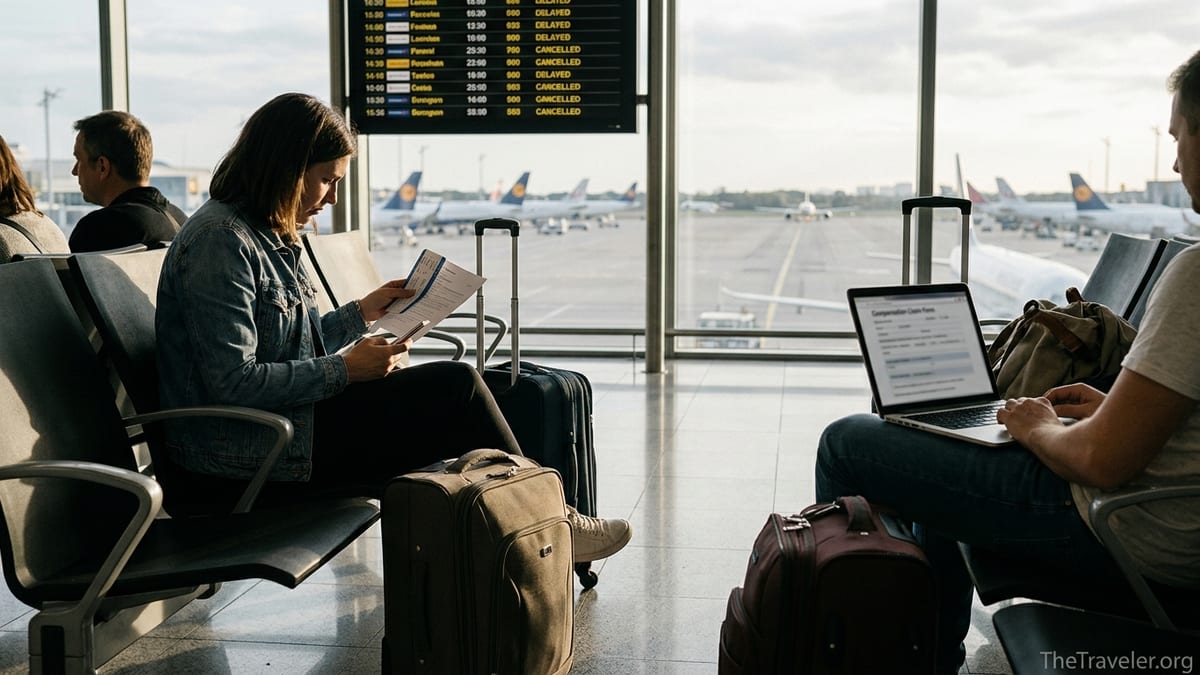
What AirClaim Actually Does, In Plain Terms
AirClaim is a specialist claims company that helps passengers pursue compensation when flights are delayed, cancelled, overbooked or when boarding is denied. It focuses heavily on cases covered by regulations such as EU Regulation 261/2004 and its UK equivalent, where compensation is typically set at flat amounts between about €250 and €600 per passenger depending on distance and delay.
The company operates on a success-fee model. That means you pay nothing upfront and only owe a fee if compensation is actually recovered from the airline. Public information and customer correspondence indicate that AirClaim usually retains around 29 percent of the compensation plus VAT, which brings the effective fee to roughly 35 percent of whatever they recover on your behalf.
To see how this works in practice, imagine a Paris to New York flight on a European carrier that arrives more than four hours late without extraordinary circumstances such as severe weather. Under EU261, that long-haul journey typically qualifies for €600 per passenger in compensation. If AirClaim handles the case and recovers that full €600, their approximate 35 percent fee would be about €210, leaving you with around €390 in your account.
In exchange for that share, AirClaim gathers your documents, checks your eligibility, deals with the airline, drafts legal arguments where needed and in some cases pursues the matter through legal channels. For many travelers this removes a major psychological barrier: they no longer need to argue legal points with an airline or worry about formal letters and deadlines.
How EU261 Compensation Works and Why Amounts Matter
To judge which route saves more money, it helps to understand the compensation system that companies like AirClaim are working with. Under EU Regulation 261/2004, which covers flights departing from the EU on any airline and flights arriving in the EU on EU or UK carriers, monetary compensation is mostly fixed. The standard bands are approximately €250 for short flights up to 1,500 kilometers, €400 for medium-haul flights and €600 for long-haul journeys over 3,500 kilometers, with some reductions when airlines offer rerouting that keeps delays relatively short.
Because these amounts are fixed per passenger, not based on ticket price, even a low-cost fare can generate a significant entitlement. A traveler who paid €60 for a budget flight from Lisbon to Paris might still be entitled to €250 if the arrival delay crosses the three-hour threshold and the cause is within the airline’s control. This is exactly the kind of situation where commercial claims companies market their services: a relatively small ticket that can give rise to a much larger compensation payment.
The fact that compensation is typically a known, flat figure also makes it easier to calculate the cost of using a company like AirClaim. If you know that a particular delay should lead to €400 per passenger, and a claims company charges roughly 35 percent, you can estimate that you will keep about €260 if they succeed. Compare this with what you might achieve by writing to the airline yourself. If you secure the same €400 alone, the airline pays you directly and there is no success fee or commission.
Where things become more complex is when airlines dispute eligibility. They may argue that weather, air traffic control strikes or other exceptional issues mean they do not owe compensation under EU261. At that point a determination might depend on subtle legal interpretations and historic court decisions, which is where a specialist like AirClaim can potentially add value.
Claiming Directly With the Airline: Best-Case and Worst-Case Scenarios
In a best-case direct-claim scenario, a passenger files a straightforward complaint through the airline’s online form and receives a full payout within a few weeks. For instance, consider a traveler flying from Amsterdam to Rome whose flight is cancelled the evening before departure due to a technical fault. The airline’s own notice confirms that the problem was within its control and not linked to severe weather or airspace closure. The passenger submits boarding passes, receipts and a brief explanation through the airline’s website. Three weeks later, the carrier transfers €400 per person to the traveler’s bank account. The total cost in fees is zero.
This is the ideal outcome when dealing directly with the airline, and it does happen, particularly with carriers that have well-structured customer-service systems or are under strict regulatory oversight. Some major European airlines provide dedicated EU261 forms and will process clear-cut cases with minimal back-and-forth when the documentation is solid.
The worst case looks very different. Imagine a long-haul flight from Barcelona to Buenos Aires that arrives five hours late due to an aircraft rotation decision and crew scheduling, issues that are typically considered within the airline’s control. The traveler submits a complaint and is told that the delay resulted from “operational reasons” and extraordinary circumstances without further detail. Multiple follow-ups receive standard replies, or no reply at all, and the one-year limitation period in the relevant jurisdiction slowly approaches.
In this more difficult situation, a direct claim may only succeed if the passenger is willing to escalate. That can include writing formal letters of complaint, citing relevant case-law from EU courts, complaining to the national enforcement body in the country of departure, or even filing a claim in small-claims court. For many occasional travelers, that effort feels disproportionate to the potential €600 gain, particularly if the legal procedures must be handled in a foreign language.
What AirClaim Costs Compared With Other Claims Companies
While this article focuses on AirClaim, it is useful to see how it sits within the broader market of flight-compensation companies. Several well-known firms in Europe operate on broadly similar terms: they assess eligibility, handle all communication and share in the compensation only if they win. These companies generally advertise success fees in the range of about 25 to 35 percent for standard cases, with some adding an extra charge if legal action becomes necessary.
One of the bigger players, AirHelp, publicly lists a standard fee equivalent to 35 percent of the recovered compensation, and an additional 15 percent if legal action is required, all taken only when they succeed. That means a total fee as high as 50 percent in complex cases where court proceedings are necessary. A theoretical €600 compensation could then be reduced to €300 in the traveler’s pocket after all fees are deducted.
Against that backdrop, AirClaim’s approximate 35 percent success fee places it roughly in the middle of the market. For a €400 claim on a medium-haul flight, the traveler might receive around €260 after AirClaim’s fee. For a short-haul €250 claim, the net payout could be about €160. These are still substantial sums compared with ignoring one’s rights entirely, but they are clearly below what a successful direct claim would deliver.
There are also smaller regional claim companies and law firms that may work on slightly different models, such as fixed administrative fees or lower commissions for group bookings. Travelers should be cautious about any operator that demands upfront payments without clear protections, or whose terms make it difficult to withdraw a claim or to see precisely how fees will be calculated.
Where AirClaim May Be Worth the Fee
There are situations where paying a portion of compensation to AirClaim can be a rational, even money-saving, choice when viewed in terms of time, risk and stress. A classic example is a complex multi-leg itinerary on different airlines that results in a missed connection and an overnight delay. Suppose a family of four flies from Warsaw to London and then on to Toronto on a European carrier, with the first leg delayed enough to miss the transatlantic connection. They are rerouted the next day, reach Toronto more than 12 hours late and receive only basic care at the airport.
In that scenario, each passenger may be entitled to long-haul compensation of €600, meaning a potential total of €2,400 for the family. However, the airline may argue that air-traffic control restrictions, crew repositioning or other factors qualify as extraordinary circumstances. Successfully challenging these arguments often requires knowledge of previous court decisions and the ability to demand documentation from the airline, something a company like AirClaim is set up to do more efficiently than most travelers.
If AirClaim manages to secure the full €2,400, its approximate 35 percent fee would come to about €840, leaving the family with around €1,560. While this is clearly less than the theoretical maximum, it is still a meaningful sum to offset hotel bills, meals and missed accommodation in Toronto. For a family juggling work and school schedules, the choice to hand everything to a specialist and accept a reduced payout may feel like an attractive trade.
AirClaim can also make sense in borderline cases where the airline seems unresponsive. A solo traveler might file an initial complaint and receive only generic replies. After a couple of unanswered emails, they may be tempted to give up. Instead, forwarding the case to AirClaim shifts the burden to a party that has both experience and financial incentive to keep pushing, including through legal channels if viable.
When a Direct Airline Claim Usually Saves You More Money
For straightforward cases with clear eligibility, claiming directly with the airline almost always yields the highest net amount, provided you are willing to invest a modest amount of time. Consider a two-and-a-half-hour flight from Berlin to Madrid on a European carrier. The flight finally departs more than five hours late due to a clearly stated technical fault in the aircraft. Staff at the gate acknowledge that EU261 applies and hand out information leaflets about compensation rights.
In this type of scenario, the airline’s responsibility under EU261 is fairly clear. A direct, well-documented claim that references the flight number, date, delay duration and the applicable regulation often leads to a full €400 payout per passenger without much dispute. If you instead assign the case to AirClaim, you can expect roughly 35 percent of that amount to be deducted in fees, which in this example would be about €140 per person. You are effectively paying €140 for a service you likely did not need.
Direct claims also preserve your full flexibility. If the airline initially offers vouchers instead of cash or proposes a partial settlement, you can negotiate directly or escalate to the national enforcement body without having to coordinate with an intermediary. You retain control over any decision to accept or reject a settlement, to file in small-claims court or to involve a consumer protection organization.
Another common direct-claim success story involves group travel. Suppose six friends fly from Dublin to Lisbon for a weekend and suffer a last-minute cancellation that is not due to bad weather or airspace closures. If each of them is entitled to €400, the group total is €2,400. A single well-prepared claim filed by the person who booked the tickets can restore the entire amount. Handing the case to a claims company would likely reduce the group payout by hundreds of euros in fees, even though the legal issues may not be particularly complex.
Practical Money-Saving Strategy: Hybrid Approach
For many travelers, the most cost-effective option is a hybrid approach that starts with a direct claim and only turns to AirClaim or a similar company if the airline refuses or delays unreasonably. Begin by checking your eligibility under the relevant rules, such as EU261 or UK261 for European flights. Many independent consumer organizations publish plain-language summaries of the distance bands, delay thresholds and exclusions, making it easier to confirm whether your case is worth pursuing.
If your claim appears valid, submit it through the airline’s official channels as soon as possible. Provide boarding passes, booking confirmation, photos of departure boards if available, and any written explanation staff gave at the airport. Clearly state that you are seeking statutory compensation under EU261 or the applicable regulation and specify the amount you believe is due. This simple but formal framing often leads to a more serious review by the airline’s customer relations team.
Give the airline a reasonable window to respond in writing, for example 30 to 45 days depending on the jurisdiction and carrier. If you receive a clear denial that you believe is incorrect, or you encounter long periods of silence despite reminders, reassess your options. At that point, involving AirClaim may be a pragmatic next step, especially if the potential payout is high and you are not inclined to escalate to regulators or courts yourself.
This staged method protects your upside. If the airline pays promptly, you keep 100 percent of the compensation. If it resists, you still have the option to bring in AirClaim, accepting the reduced net amount as the price of not abandoning the claim entirely. For travelers who are comfortable with a bit of paperwork but do not want to become part-time legal experts, the hybrid approach strikes a useful balance.
The Takeaway
Choosing between AirClaim and a direct airline claim is ultimately a trade-off between hassle and net payout. In simple, clear-cut cases where the airline is responsive and the legal position is straightforward, claiming directly almost always results in a higher amount in your bank account. A €400 medium-haul compensation paid directly is worth more than the roughly €260 you might receive after AirClaim’s fee for the same case.
Where AirClaim can earn its share is in difficult or high-stakes situations: complex itineraries, unclear causes of delay, unresponsive airlines or cases that may require legal escalation. For a family looking at a potential €2,400 long-haul compensation but facing repeated refusals, paying roughly 35 percent to have a specialist take over can be a rational choice, particularly when time and peace of mind are scarce.
The smartest financial move for many travelers is to start with a well-prepared direct claim, using publicly available guidance to understand their rights. If the airline cooperates, they keep every euro they are owed. If not, AirClaim remains a useful backup option rather than the default. The key is to treat compensation not as a lottery ticket but as a legal right, and to decide consciously how much of that right you are willing to exchange for convenience.
FAQ
Q1. Does using AirClaim reduce the total compensation the airline has to pay?
AirClaim does not change the legal compensation amount; it only changes how much you personally receive after their success fee. The airline typically pays the same statutory amount it would owe under regulations like EU261, but a portion of that payment goes to AirClaim as commission.
Q2. In which situations is a direct airline claim usually better than using AirClaim?
A direct claim is usually better for clear-cut cases where the delay or cancellation was obviously within the airline’s control, the delay threshold is clearly met and the airline provides a straightforward way to submit EU261 or similar claims. In those situations, many travelers can secure full compensation with a couple of well-documented emails or online forms.
Q3. How much does AirClaim typically charge if they win my case?
Publicly available information and customer feedback suggest that AirClaim’s success fee is usually around 29 percent plus VAT, which brings the total to roughly 35 percent of whatever compensation is recovered. The exact percentage may vary with jurisdiction and tax rate, so travelers should always confirm the fee structure before signing.
Q4. What if the airline ignores my direct claim or keeps delaying a response?
If an airline does not respond to a properly submitted claim within a reasonable period, you can first send a polite reminder, then consider escalating to the relevant national enforcement body. If you do not want to deal with regulators or legal processes, handing the case to AirClaim or a similar company is a common next step, accepting that you will share any eventual payout.
Q5. Can I switch to AirClaim after trying to handle the claim myself?
In most situations you can, as long as you have not already signed a settlement or final waiver with the airline. AirClaim will typically ask for details of any previous correspondence and may require you to assign your rights to them so they can act on your behalf. Always read their agreement carefully to understand any exclusivity clauses.
Q6. Are there risks in assigning my claim to AirClaim?
The main financial risk is that you will receive only a portion of any compensation, since a success fee is deducted. There is also a practical consideration: once you grant them power to act on your behalf, you usually should not continue negotiating directly with the airline, to avoid conflicting communications. Choosing a reputable company and reading the terms closely helps manage these risks.
Q7. How long does it take to get paid using AirClaim compared with a direct claim?
Timelines vary widely. Some straightforward cases are resolved within a few weeks, while others can take many months, especially if legal proceedings are needed. This is true whether you claim directly or via AirClaim. The main difference is that with AirClaim you do not personally handle the follow-up, even if the overall duration is similar.
Q8. Is it ever cheaper to accept airline vouchers instead of cash compensation?
Vouchers can occasionally be attractive if they are worth more than the statutory cash amount or come with flexible conditions, but travelers should compare carefully. Cash compensation under regulations like EU261 is a legal entitlement; vouchers are a separate commercial offer. Using AirClaim or claiming directly does not change this basic choice between cash and vouchers.
Q9. Do I need legal insurance if I use AirClaim?
Typically you do not. Companies like AirClaim operate on a no win, no fee model and factor legal costs into their success fee. If they decide to take your case to court, they usually bear the upfront risk of those proceedings. Legal insurance can still be useful for other travel-related disputes, but it is not a requirement for using AirClaim.
Q10. How can I decide quickly whether to try a direct claim before going to AirClaim?
A simple rule of thumb is to consider the clarity of the situation and your own tolerance for paperwork. If the delay clearly meets the legal thresholds, the cause seems to be under the airline’s control and the potential compensation per person is significant, it often makes sense to send a direct, documented claim first. If the airline refuses, or if the case involves complex routing or disputed causes, moving to AirClaim is more likely to be worth the fee.