


More news on this day
Bangkok’s Airport Rail Link faced major disruption on Tuesday after a train derailed inside a maintenance depot shortly after midnight, sharply reducing peak-hour services and prompting emergency recovery efforts expected to restore normal operations by this evening.
Get the latest news straight to your inbox!
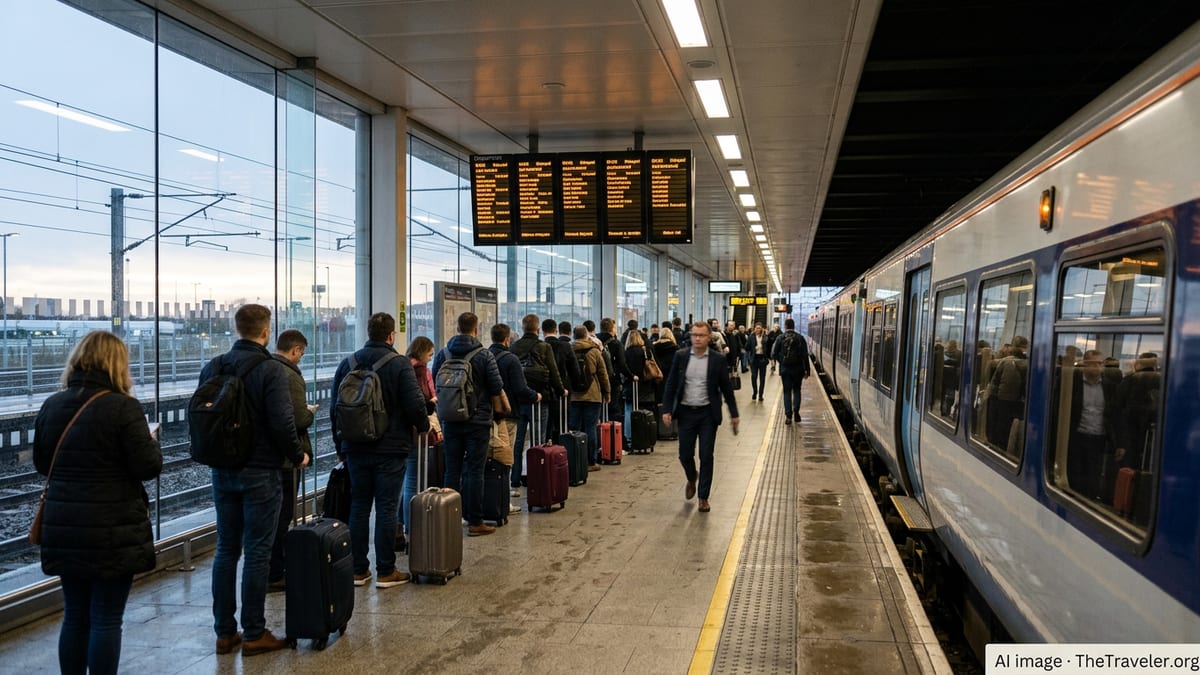
Late-night derailment triggers morning chaos
According to publicly available information from Bangkok-based outlets, the incident occurred at around 12.47 a.m. on Tuesday, 22 July, when a four-car Airport Rail Link train returning to the Khlong Tan maintenance centre derailed at a track switch inside the facility. Initial reports indicate that the third carriage left the rails at low speed, damaging track equipment and blocking one of the main exit routes used to dispatch trains onto the line.
Because the derailment took place within the depot complex rather than on the mainline, no passengers were on board and there were no immediate reports of injuries. However, the position of the derailed carriage created a bottleneck that limited how many trains could leave the yard for the morning rush between central Bangkok and Suvarnabhumi Airport.
Published coverage notes that only a fraction of the usual train fleet could be put into service during the early commuter period, resulting in headways significantly longer than the standard schedule. Some passengers described crowded platforms and extended waiting times at downtown stations as staff attempted to manage queues and direct travellers to alternative routes.
Technical teams began work overnight to stabilise the affected carriage and assess track damage within the maintenance centre. Mechanical inspections and rerailing operations were required before any additional trains could safely move past the damaged switch and onto the mainline.
Reduced train frequencies and makeshift timetable
Service patterns on the Airport Rail Link were heavily modified through the morning and midday periods as operators balanced safety checks with the need to keep at least a minimal connection running between the city and the airport. Reports indicate that one trainset was initially available to shuttle along the route, with a second added once it was cleared to pass the depot bottleneck.
These constraints translated into markedly reduced frequencies, particularly on sections closest to downtown Bangkok, where demand from commuters and air travellers overlaps. Passengers heading to Suvarnabhumi were advised through local media and station announcements to allow extra travel time and, where possible, to shift to alternative modes such as taxis, ride-hailing services or city buses linking to the airport.
Onboard and station staff focused on crowd management as platforms filled far beyond typical weekday levels. Trains that did operate reportedly ran with high load factors, especially in the late morning when both departing tourists and local workers converged on the system.
Despite the disruption, the alignment of the incident within the depot meant that the mainline infrastructure remained largely intact. That factor appears to have been critical in allowing a limited but continuous service to remain in place while recovery teams worked inside the maintenance area.
Emergency buses and supplemental rail options
In response to the shortage of available trainsets, Thai-language coverage states that the State Railway of Thailand coordinated with bus operators to deploy temporary shuttle services linking key Airport Rail Link stations and Suvarnabhumi. These buses were organised to pick up passengers at major interchange points, aiming to relieve pressure on the truncated rail service and provide an alternative for those with flight departures.
Additional diesel railcars were also brought into use on nearby routes to strengthen regional connectivity where feasible, though these measures could not fully replace the capacity of the dedicated Airport Rail Link. Public information channels highlighted that these supplemental services were provided without extra charge to affected passengers, as rail and bus operators sought to mitigate the immediate impact of the derailment.
Staff were stationed at all Airport Rail Link stops to guide passengers toward replacement buses, explain modified train patterns and update travellers on expected journey times. Visual signage and public address systems were used extensively as operators attempted to reduce confusion during the busiest periods of the day.
Transport-focused commentators noted that the swift deployment of bus and rail substitutes reflected lessons learned from earlier infrastructure incidents in Bangkok’s wider rail network, where delays in arranging alternatives had previously drawn criticism from passengers.
Recovery efforts aim for evening normalisation
By early afternoon, engineering teams were reported to have made substantial progress in rerailing the affected carriage and repairing the damaged switch at the Khlong Tan maintenance centre. Cranes and specialised lifting equipment were used to bring the derailed bogie back onto the tracks, followed by detailed inspections of the wheelsets and surrounding infrastructure.
Officials responsible for the line’s technical oversight have been cited in Thai media as indicating that full services could resume by early evening, subject to successful safety checks. This timeframe reflects both the complexity of depot-track repairs and the priority placed on verifying that trains can enter and exit the maintenance area without risk of further incidents.
Once the damaged switch is certified for use, additional trainsets are expected to be released from the depot, allowing the Airport Rail Link to ramp up frequencies toward its normal timetable. Passengers travelling during the late afternoon peak have been advised to continue checking local travel updates, as headways may remain irregular while operators reposition rolling stock and clear residual congestion along the line.
Transport analysts point out that even if the infrastructure is cleared on schedule, it may take several operating cycles for train diagrams and staff rosters to fully stabilise, particularly if any rolling stock requires extended maintenance as a result of the derailment.
Safety, maintenance and system resilience under scrutiny
The incident has prompted renewed discussion in Bangkok about the resilience of airport rail links and the importance of robust maintenance regimes within depot environments. While the derailment was contained within the Khlong Tan facility and did not directly put passengers at risk, observers note that even small failures at critical nodes can quickly ripple through an urban rail network.
Publicly available information on past disruptions in other cities, from Hong Kong to European hubs, highlights similar patterns where low-speed depot or yard derailments triggered hours of service reductions on main passenger corridors. In each case, the availability of replacement buses, the speed of technical recovery and the clarity of passenger communication were central to how the disruption was perceived.
In Bangkok, calls are already emerging in commentary and social media for a detailed technical review of the Khlong Tan track layout, switch maintenance procedures and inspection intervals for rolling stock operating on the Airport Rail Link. Some transport specialists suggest that additional redundancy in depot exit routes or upgraded signalling within maintenance compounds could reduce the risk that a single failed switch limits network-wide capacity.
For now, the priority remains restoring full Airport Rail Link services before the close of business on Tuesday, ensuring that outbound and arriving air travellers can again rely on a predictable rail connection. How effectively operators manage the evening recovery, and how transparent subsequent investigations prove to be, is likely to shape public confidence in one of Bangkok’s most important transport arteries.