


Choosing between Almaty in Kazakhstan and Bishkek in Kyrgyzstan for a first Central Asia trip usually comes down to priorities. Almaty offers a bigger-city feel, better-developed infrastructure and immediate access to ski resorts and high alpine scenery. Bishkek is smaller and more relaxed, with a compact center, leafy Soviet-era boulevards and a straightforward jump to Ala Archa National Park. Both can anchor a rewarding short break, but each suits different travelers and time frames.
Get the latest updates straight to your inbox!
Overall verdict: two strong choices, different strengths
For a first-time visitor to Central Asia with limited days, Almaty generally works better if you want a larger, more polished city, a metro system, wider flight network and very easy access to developed mountain resorts like Shymbulak and the Medeu skating rink. You can land, sleep in a modern hotel, ride a cable car into the mountains and still have time for museums and cafés without arranging complex transport.
Bishkek is the more low-key introduction, with an easily walkable center, generous green spaces, Soviet monuments and a less hurried pace. It is particularly appealing if your main goal is a day of hiking in the mountains at Ala Archa National Park and you do not mind a simpler urban scene with fewer “must see” attractions but a very friendly, lived-in feel.
Neither city is universally better. Almaty wins on flight access, big-city services, cable cars and winter sports. Bishkek wins on ease of orientation, slightly lower everyday costs in many cases, and a more intimate look at post-Soviet daily life. The best choice depends on whether you prioritize polished infrastructure and resort-style mountains, or a softer landing into Kyrgyzstan’s famously welcoming culture.
Many travelers ultimately combine both cities by using the frequent shared taxis and marshrutkas over the Kyrgyz–Kazakh border, but for a short standalone city break there are clear differences that help you choose.
International access and airport-to-city transfers
Almaty International Airport is the main air hub of Kazakhstan and, by passenger volume, the busiest airport in Central Asia. Recent figures put its annual traffic at over 11 million passengers, and the airport is run by the experienced Turkish operator TAV, which has invested in terminals and passenger services. That translates to a broad range of direct connections from Europe, the Middle East and Asia, including services by major Gulf carriers, European airlines and regional low-cost carriers.
Typical off-peak return fares from Western Europe to Almaty in the shoulder seasons often fall in the range that many travelers describe as mid-tier long-haul pricing, with one-stop connections via Istanbul, Dubai or Abu Dhabi. From the Gulf region, nonstop returns can sometimes be found in a lower band, especially on competitive routes operated by carriers from the United Arab Emirates, Qatar or Saudi Arabia, though exact prices vary a lot by date and sale periods. From East and South Asia, Almaty is connected by a mix of national and regional airlines, making it relatively straightforward to add to a wider trip.
Bishkek’s Manas International Airport, now using IATA code BSZ as well as the older FRU, is smaller but still an important regional gateway. It has solid links to Istanbul, Dubai and several Russian cities, plus seasonal or periodic services from other hubs. Return airfares from Europe often require one change and can be comparable to, or slightly higher than, Almaty depending on the route and airline competition at the time you book. From the Gulf, Bishkek is usually reachable nonstop from Dubai and some other regional hubs with prices similar to other mid-haul leisure destinations in Central Asia.
From Almaty Airport to the city center, you can use Yandex Go and similar ride-hailing apps or the city bus. Recent transport guides put the ride-hail price for the 15 to 18 kilometer journey at roughly 2,500 to 7,500 Kazakh tenge depending on time of day and car category, which is broadly around the cost of a mid-length city taxi ride in many European capitals. Official airport taxis have set fares in a higher band. Budget travelers can walk a short distance to the main road and catch bus 92, with published fares for card or phone payment usually in the low hundreds of tenge per ride, so well under the price of a café coffee.
Bishkek’s Manas vs Almaty International: practicalities on arrival
Bishkek’s Manas Airport sits about 25 kilometers north-northwest of the city. Recent local guides describe two main options to reach central Bishkek: Yandex Go or a regular taxi, and municipal bus 153 that shuttles between the airport and the city. With Yandex Go, travelers commonly see quoted prices starting around the lower hundreds of Kyrgyz som for a standard car, while walk-up taxi drivers inside the arrivals hall tend to ask more, often in the middle hundreds or above for the same ride. Those higher quotes are not necessarily scams, but they are targeted at new arrivals unfamiliar with transfer costs.
Bus 153 runs into the city via the train station and bus station, with recent checks indicating departures roughly every 20 minutes in daytime. The fare is low even by local standards, which makes it attractive for solo budget travelers arriving in daylight with manageable luggage. At night, the municipal bus options can become sparse or unreliable, and most visitors arriving on late flights report using Yandex Go or pre-arranged hotel transfers instead.
In Almaty, there is still no rail link from the airport, so all transfers use road vehicles. Besides the app-based taxis and bus 92, current airport guides mention an official taxi counter and pre-booked private transfers which can cost several times more than a Yandex Go ride but offer fixed pricing and meet-and-greet services, useful if you are landing with family or carrying bulky ski gear. The typical driving time from the Almaty terminal to central hotels is 25 to 40 minutes depending on traffic; from Manas to central Bishkek it is often 30 to 45 minutes.
Both airports have ATMs and currency exchange, and in both cities it is worth having some local cash on arrival in case your card does not immediately work in all machines or with every driver. In Almaty, the Onay transport card and its app are widely used for buses and metro. In Bishkek, contactless payments are spreading, but marshrutkas and older buses still sometimes take cash only, so small notes and coins are handy.
City sightseeing: big-city energy vs compact calm
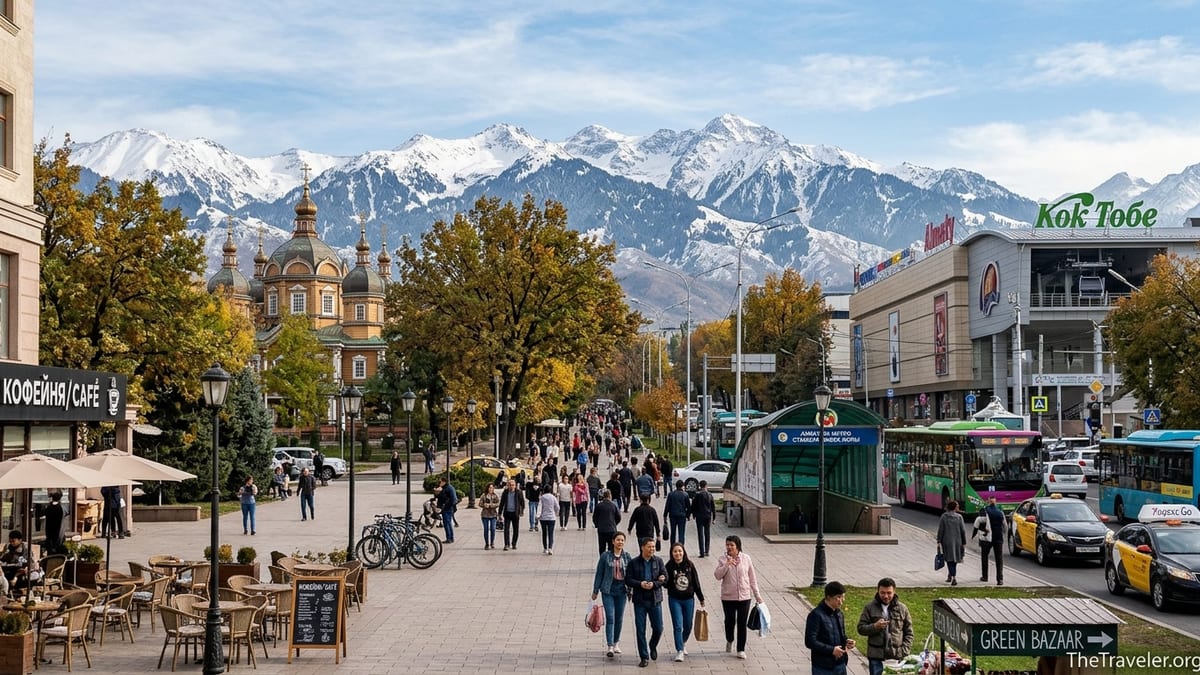
Almaty’s urban attractions reflect its role as Kazakhstan’s largest city and former capital. Panfilov Park is a central landmark, home to the striking Zenkov Cathedral and memorials to Kazakh soldiers of the Second World War. Just beyond, the Green Bazaar offers piles of dried fruits, nuts and local cheese alongside everyday groceries, and provides a lively window into city life. A short ride away, the Kok Tobe hill is reached by cable car or road, offering restaurants, a small amusement area and panoramic views across the city to the mountains.
Almaty also has a cluster of museums and cultural institutions, such as the Central State Museum of Kazakhstan and the Kazakh Museum of Folk Musical Instruments, as well as galleries and performance venues. These give visitors enough structured sightseeing to fill at least a day, and more if you enjoy museums and theaters. The café and restaurant scene is broad, with everything from small laghman and plov joints to international chains and modern coffee bars that accept contactless cards.
Bishkek’s classic city sights are more modest but pleasantly concentrated. Ala-Too Square, framed by government buildings and fountains, functions as the heart of the city and host to national events. The surrounding area holds statues, the State Historical Museum and wide boulevards lined with mature trees. The Osh Bazaar on the western side of the center remains one of the main places to browse spices, produce and everyday goods in a more traditional setting than Almaty’s central markets.
The architectural character of Bishkek is distinctly Soviet, with large apartment blocks, cultural palaces and wide avenues that can feel stark in winter but soften under summer foliage. Parks are plentiful and form part of the daily routine for many residents, so even a short stay can include relaxed walks alongside locals. In comparison with Almaty, there are fewer major museums and headline attractions, which suits travelers who prefer to intersperse light sightseeing with café time and planning for mountain excursions elsewhere in Kyrgyzstan.
Mountains and day trips: Medeu, Shymbulak, Big Almaty Lake and Ala Archa
Almaty is almost uniquely convenient for accessing developed mountain facilities on short trips. The Medeu ice rink, a Soviet-era high-altitude skating complex in a narrow gorge above the city, can typically be reached by public bus or taxi in under an hour from the center. From Medeu, cable cars and road connections link to the Shymbulak ski resort, which in recent seasons has operated modern gondolas, chairlifts, rental shops and restaurants. Ski operations depend on snow and weather, but cable cars usually run outside winter for sightseeing and hiking access, subject to maintenance and seasonal closures that visitors should confirm close to travel.
Big Almaty Lake, a high mountain reservoir with milky blue water, is another classic outing. Official tourism and city transport sources state that there is currently no standard public bus directly to the lake, so visitors either join organized tours, hire a taxi for the day or arrange a private driver. That increases cost but keeps access straightforward for those willing to pay for a car. Road conditions vary with season, and winter visits can involve snow and ice, but the route remains one of the most popular day trips from Almaty.
Bishkek’s headline day hike is Ala Archa National Park, roughly 40 kilometers south of the city in a side valley of the Kyrgyz Ala-Too range. The entrance is usually reached in around an hour by taxi or private car. There is no widely advertised direct public bus into the park gates, so most visitors charter a car or use Yandex Go to the park entrance or to the parking area near the trailheads. Park rules and small entry fees are subject to change, but in practice many travelers still treat Ala Archa as a straightforward independent outing.
Ala Archa offers hiking options from a gentle river walk to steeper trails leading towards glaciers and climbers’ huts, although snow and ice can linger on higher paths well into late spring and return in autumn. There are currently no cable cars or ski infrastructure in Ala Archa, so the experience is more a traditional national park visit than a resort day. Compared with the polished installations at Shymbulak and Medeu, Ala Archa feels wilder and closer to the kind of alpine trekking many people associate with Kyrgyzstan’s longer trips.
Visas and entry rules for key nationalities
Visa policy is an area where Kazakhstan and Kyrgyzstan differ in detail, especially after regulatory changes in 2023 and 2026. For Kazakhstan, current official and legal summaries indicate that citizens of the United States, United Kingdom and most European Union countries can enter visa free for up to 30 calendar days per visit, with a limit of 90 days in any 180-day period. These travelers are also now covered by a new electronic travel authorization framework, but implementation details still rely largely on underlying visa-free rules tied to nationality.
Indian and Iranian citizens benefit from more restricted but still significant visa-free access to Kazakhstan: they may enter for up to 14 calendar days per visit and up to 42 days in total within any 180-day period, provided entry conditions are otherwise met. Chinese citizens currently enjoy visa-free stays of up to 30 days per visit, with a 90-day cumulative limit in a six-month period, under a bilateral agreement that came into force in late 2023. Travelers in all these categories should re-check requirements shortly before departure because Kazakhstan’s Ministry of Internal Affairs periodically refines the list and practical implementation.
Kyrgyzstan has for several years operated a generous visa-free regime for many Western passport holders. Citizens of countries including the United States, United Kingdom and much of the European Union are allowed visa-free entry for tourism for up to 60 days under a government decree on visa liberalization. The exact country list is defined in legal annexes and may expand over time, so travelers should consult the latest information from Kyrgyz consular sources for confirmation before travel.
For Indian and Chinese passport holders, Kyrgyzstan’s rules are more nuanced. Standard policy still requires visas for many nationalities, but there is a specific provision allowing certain Indian and Chinese citizens who hold valid long-term visas for the United States, Schengen Area or selected other destinations to enter Kyrgyzstan visa free for up to 7 days when arriving through Manas International Airport. Interpretation of that rule can vary in practice, and recent inquiries reported by travelers suggest that local authorities sometimes give inconsistent guidance. Until there is clear official consolidation of those exceptions, Indian and Chinese travelers are strongly advised to check directly with Kyrgyz embassies or consulates before relying on airport-only visa-free entry.
Costs: accommodation, eating out and local transport
Accurate prices shift seasonally, but recent hotel and price searches for matched midweek dates provide a reasonable comparison. In Almaty, centrally located budget hostels and basic guesthouses for solo travelers can often be found in a band that, once converted, aligns with what many backpackers would consider mid-level hostel pricing in Eastern Europe. Simple private rooms for two might sit somewhat higher, especially near metro stations or popular neighborhoods. Midrange international or good local three-star hotels in the center tend to land in a moderate nightly rate range, while four- and five-star properties operated by global chains, especially near Dostyk Avenue or in the business districts, command higher prices more similar to mid-sized European cities.
Bishkek generally comes out a little cheaper for comparable standards, especially at the lower end. Hostels and simple guesthouses aimed at backpackers, cyclists and overlanders often advertise beds below equivalent Almaty prices, and modest city-center hotels that are clean but not luxurious can cost less per night than similar properties in Almaty. International brand hotels and newer boutique properties exist but are fewer, so the top of the market is narrower, although nightly rates at that level can still undercut equivalent international chains in Western capitals.
Meals in both cities range from inexpensive canteen-style lunches of plov, laghman or manty to midrange restaurants offering Central Asian and international menus. Street-side shawarma, samsa and café snacks are widely available. In general, visitors report slightly lower restaurant and café prices in Bishkek, particularly in non-touristy areas, though Almaty’s broader dining scene offers more choice at various price points, including high-end venues where bills resemble those in Western Europe.
Local transport is affordable in both cities. Almaty’s metro and bus fares, when paid with the Onay card or app, are pegged at a low flat rate per ride, with cash fares a little higher. Yandex Go rides within the center often cost a fraction of what similar car journeys might cost in major Western cities. In Bishkek, municipal buses, trolleybuses and marshrutkas are also inexpensive, and city-center Yandex Go trips usually come in below a typical Almaty fare once converted, reflecting overall lower costs and shorter distances across the smaller urban area.
Sample two-night budgets for different traveler types
Putting these pieces together, it is possible to sketch approximate two-night budgets, excluding international flights and using recent accommodation and excursion prices as a guide. A budget traveler in Almaty staying in a hostel or simple guesthouse might spend the local equivalent of a modest nightly rate on accommodation, a low-to-middle amount per day on food using canteens and cheaper cafés, and a small amount on metro, buses and a couple of short taxi rides. A self-organized day trip to Medeu and Shymbulak using public transport and lift tickets would form the main one-off expense, bringing the total for two nights and one mountain day into a lower three-figure sum in US dollar terms for most people.
The same budget traveler profile in Bishkek could probably trim accommodation costs somewhat, and spend slightly less on everyday food if using local cafés and fast-food spots. Transport inside the city would remain inexpensive, and a taxi-based round trip to Ala Archa National Park plus park fees would likely consume a similar or slightly smaller share of the overall budget than a full Shymbulak day when lift tickets are factored in. Overall, a careful backpacker could manage two nights and an Ala Archa excursion in Bishkek for a bit less than in Almaty, although currency fluctuations and personal choices make exact sums variable.
For a midrange couple in Almaty, two nights in a comfortable three-star or good local four-star hotel, restaurant meals, coffee stops and a day trip to Medeu and Shymbulak might lift the total comfortably into the mid three-figure US dollar range, again excluding flights. In Bishkek, the same couple could book an equivalent or slightly simpler hotel and still come in under that figure, particularly if they opt for Ala Archa by taxi instead of a structured tour and choose midrange local restaurants over high-end dining.
A comfort-oriented visitor, perhaps prioritizing an international hotel brand, private airport transfers and organized excursions, will see costs rise faster in both cities, but Almaty offers more opportunities to spend on upgraded services: private drivers to Big Almaty Lake, ski passes and gear rental, upscale restaurants and rooftop bars. Bishkek has fewer high-ticket options, so even comfort-focused travelers may find their maximum plausible spend lower unless they begin adding longer excursions elsewhere in Kyrgyzstan.
Walkability, language, payments, air quality and seasons
Both Almaty and Bishkek have walkable cores, but the feel is different. Central Bishkek is relatively flat, laid out on a grid and dense with parks and tree-lined streets, making it easy to cover the main squares, museums and cafés on foot. Almaty’s center is larger and more varied in elevation, sloping from the mountains down to the plains, so some streets can be a little more strenuous to walk. Nevertheless, neighborhoods around Panfilov Park, Dostyk Avenue and the lower cable car station for Kok Tobe are pleasant to explore on foot, with frequent cafés and shops.
Russian remains a common lingua franca in both cities, and English is widely enough spoken in hotels, popular cafés and by younger residents that basic travel tasks are manageable. In Almaty, official signboards on transport and in many public buildings incorporate Kazakh, Russian and some English, especially in metro stations. Bishkek also mixes Kyrgyz and Russian scripts, with less English overall. Translation apps work well for menus and signs, especially when combined with pointing and basic phrases.
Digital payments are more firmly established in Almaty, where contactless cards and mobile payments are accepted in most supermarkets, chain cafés and large restaurants, and the Onay system supports digital ticketing on public transport. In Bishkek, card terminals are increasingly common in supermarkets, malls and modern cafés, but smaller shops, bazaars and some marshrutkas may still operate on a cash basis. Carrying a mix of cash and card is sensible in both cities, particularly for markets, small bakeries and roadside stalls.
Air quality can fluctuate in both Almaty and Bishkek, especially in winter temperature inversions when pollution becomes trapped over the cities. In recent cold seasons, locals and long-stay visitors have reported poor air on some days in both places, with Almaty in particular sometimes appearing in international rankings of cities with elevated particulate levels. Road and weather conditions for mountain excursions also change markedly with the seasons. Winter brings snow and ice to the routes up to Medeu, Shymbulak, Big Almaty Lake and Ala Archa, while late spring to early autumn typically offers the best balance of trail conditions and clear views for hikers.
Who should choose which city, and final comparison
Hikers who want structured infrastructure such as cable cars, ski lifts, rental shops and clear resort signage will likely find Almaty the better first base. A typical pattern is to combine a day at Medeu and Shymbulak with a separate hired-car day to Big Almaty Lake, using the city’s decent choice of outdoor gear shops and supermarkets to prepare. Those who prefer less developed mountain valleys and are comfortable arranging taxis to park entrances may lean towards Bishkek and Ala Archa, especially if they plan to continue into deeper parts of Kyrgyzstan afterwards.
Food enthusiasts inclined towards variety may appreciate Almaty’s broader spectrum of restaurants, from Central Asian staples to Korean, Georgian and European kitchens, with a growing specialty coffee scene. Bishkek has excellent local food and friendly cafés, but the choice is narrower at the top end and more focused on Kyrgyz and broader post-Soviet comfort dishes. Both cities, however, can keep a curious eater busy for several days.
For first-time Central Asia visitors with only three or four days, Almaty’s combination of frequent international flights, modern infrastructure, metro system, large museums and easy resort-style mountain access makes it the stronger all-round choice. The city can feel less immediately “exotic” than some visitors expect, but that can be an advantage if you want a gentle cultural adjustment with plenty of urban comforts. Travelers with a little more time, or with a specific interest in Kyrgyzstan’s landscapes, horse culture and community-based tourism networks, may find Bishkek a more logical first step, especially if they intend to continue to Issyk-Kul, Song-Kul or the south of the country.
For travelers with very limited time, such as a long weekend from Europe or the Middle East, Almaty has the edge for a tightly packed itinerary containing both city life and mountains. For slower travelers or those attracted to quieter capitals and everyday Soviet-era streetscapes, Bishkek offers a softer, less commercial introduction. Many visitors ultimately decide based on flights and onward plans. If airfare or routing makes one of the two significantly easier to reach, that alone can tip the balance without sacrificing a rewarding first taste of Central Asia.
Comparison table and category winners
Flights and access: Almaty wins for overall connectivity. Its airport handles significantly more traffic than Bishkek’s Manas and has a broader network of direct and one-stop options from Europe, the Middle East and Asia. If you are choosing purely on ease of getting there and back on convenient schedules, Almaty generally comes out ahead.
Urban attractions and infrastructure: Almaty again leads, with more museums, a metro network, larger shopping malls, better-developed transport apps and more extensive dining and nightlife. Bishkek is friendlier to those who prefer a small and manageable city center where almost everything is within a short walk, but it simply offers fewer big-ticket sights.
Mountains and day trips: For resort-style mountains with cable cars, groomed ski slopes and a mix of easy and moderate outings, Almaty is the clear winner, thanks to Medeu and Shymbulak and the option of hiring a car to Big Almaty Lake. For a wilder-feeling valley and traditional hiking environment without built-up resort infrastructure, Bishkek and Ala Archa hold their own and may even be preferable for trekkers seeking that vibe.
Costs, ease of use and atmosphere: Bishkek usually edges out Almaty on budget friendliness and ease of orientation, especially for backpackers and lower midrange travelers, and offers a more compact, laid-back atmosphere. Almaty delivers more polished services and options for comfort-oriented travelers, at generally higher but still moderate prices by global standards. On language, payments and basic logistics, both are manageable. Ultimately, Almaty is best for a short, infrastructure-rich first visit and for winter sports, while Bishkek is ideal for slower, budget-conscious travelers and those drawn to Kyrgyzstan’s national parks and culture.