


More news on this day
Delta Air Lines is set to end its nonstop service between New York John F. Kennedy and Washington Dulles on February 10, 2027, removing the only current nonstop option on this specific airport pair and forcing travelers who rely on the JFK–IAD link for domestic and international connections to rethink their routings.
Get the latest news straight to your inbox!
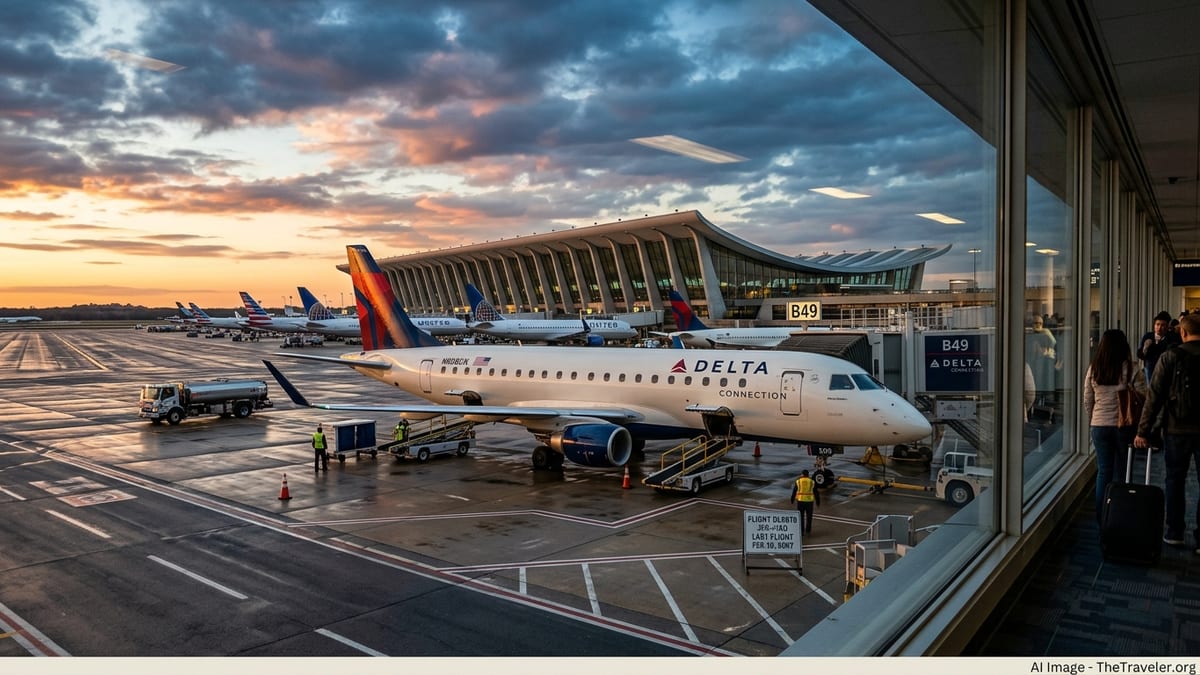
Final date and current schedule on JFK–Dulles
According to current schedule data filed by Delta and published through global timetable providers, the last nonstop Delta Connection flight between New York JFK and Washington Dulles is scheduled to operate on February 10, 2027. From February 11 onward, no nonstop JFK–IAD services are listed by Delta or any other carrier, meaning the route will lose its only direct option based on presently filed schedules.
The route is operated as Delta Connection, most recently using Embraer 175 regional jets and other regional aircraft types under contract carriers. In late 2026 the pattern equates to roughly 13 weekly flights, or about one to two daily nonstops in each direction, tapering toward a single daily frequency in early 2027 before the suspension takes effect.
External schedule analyses using data from OAG and comparable sources indicate that the February 10 service marks the end of more than three decades of Delta operations on this airport pair. Publicly available timetables confirm that tickets remain on sale up to that date, with the JFK–IAD sector then disappearing from Delta’s booking channels and third‑party schedule displays for subsequent travel periods.
What this means for New York–Washington travelers
The confirmed change affects only the JFK–Dulles airport combination rather than the broader New York–Washington market. Other nonstop services linking the two cities, particularly LaGuardia to Washington National and Newark to both National and Dulles, continue to appear extensively in the schedules of multiple airlines. For many point‑to‑point passengers, these alternatives will still provide frequent options between the metropolitan areas.
For travelers specifically using JFK–IAD, however, journey patterns will shift. Typical current flight times on the nonstop sector are around 1 hour 30 to 1 hour 40 minutes. After the route ends, passengers who wish to travel between JFK and Dulles on Delta will generally need to connect through another hub or use surface transport between airports, increasing total journey time and potentially adding cost.
As of mid‑November 2026, no other airline has filed replacement nonstop JFK–IAD services in major schedule databases covering the following 12 months. That means the absence of a direct link reflects the current schedule picture rather than a permanent regulatory or infrastructure constraint, and airlines could still revise their plans before or after February 2027.
Impact on international connections at JFK and Dulles
The withdrawal will be most noticeable for passengers who have relied on JFK–Dulles as a short feeder hop into long‑haul services. On the New York side, JFK functions as a major transatlantic and transpacific gateway, with Delta and its partners operating a large portfolio of intercontinental flights. At Dulles, United Airlines and its Star Alliance partners use the airport as a key long‑haul hub, particularly for transatlantic and some transpacific services.
Ending the JFK–IAD nonstop severs a one‑segment option that previously linked these long‑haul networks in under two hours. Travelers who used the route to connect a Delta long‑haul departure at JFK with a United or Star Alliance arrival at Dulles, or vice versa, will now need to build itineraries around indirect routings, such as connecting via Atlanta, Detroit or another hub, or by combining air and ground transport between different New York or Washington airports.
The specific impact will vary by itinerary. Some travelers might find it more practical to fly into or out of Washington National, which has frequent links to JFK and LaGuardia, or to use Newark when pairing with Dulles. Others may choose to adjust long‑haul departure points entirely, for example by using a transatlantic departure from Dulles instead of connecting to JFK. Current schedules suggest a continued abundance of New York–Washington capacity overall, even as this particular airport pair disappears.
Delta’s remaining New York–Washington services and what to check
While the JFK–Dulles route is due to end, Delta’s broader New York–Washington network remains in place. Filed schedules indicate that three daily Delta Connection flights between JFK and Washington National continue beyond February 10, 2027, alongside substantial Delta capacity linking LaGuardia with Washington National and other Washington‑area airports through its domestic network.
In Washington, Dulles will retain Delta service from several hubs, including Atlanta and Detroit, providing alternative connecting options for travelers who wish to remain within the Delta network while still using IAD. However, none of these routings will replicate the simplicity of the former single‑segment JFK–IAD link for passengers interlining between different carriers or alliances.
As with any future schedule change, travelers are advised to reconfirm timings and routings close to their departure date. Airline schedules for late 2026 and 2027 remain subject to revision, and carriers may yet adjust frequencies, aircraft types or even reintroduce routes as demand and operational conditions evolve. Passengers holding bookings that include JFK–Dulles after February 10, 2027, should monitor their reservations for rebooking options and consider whether an alternative New York or Washington airport, or a rail or coach connection, would best fit their plans.