


By the time our skiff nosed away from the San Pedro town dock, the morning breeze already smelled like a mix of diesel, mangroves, and someone else’s sizzling beach barbecue. I had never fished in Belize before, and certainly not from one of the Caribbean’s most famous sportfishing bases, Ambergris Caye. What followed was a full-day reef fishing and snorkeling charter that doubled as a crash course in local regulations, catch-and-release culture, and what a beginner actually experiences when they book one of these trips.
Get the latest updates straight to your inbox!
Why I Chose Ambergris Caye for a Fishing Day
Ambergris Caye is marketed hard as Belize’s all-purpose water-sports hub, and in person it lives up to the billing. Local guides, the Belize Tourism Board, and fishing lodges all position San Pedro as a launch point for reef fishing, flats and fly fishing, and longer runs to Turneffe Atoll to the south, one of the country’s premier bonefish, tarpon, and permit destinations. From town, you see evidence of this everywhere: narrow skiffs with poling platforms, bigger center consoles rigged with outriggers, and beach chalkboards advertising “reef + snorkel + BBQ” day trips.
I knew I wanted a mixed day that would keep both anglers and non-anglers happy, so I focused on combo reef fishing and snorkeling charters. Operators based in and around San Pedro commonly advertise full-day private trips in the 700 to 750 US dollar range per boat for up to four people, including all fishing gear, bait, snorkel equipment, lunch, and drinks. One example is a reef fishing, beach barbecue, and snorkel charter out of San Pedro listed around 725 US dollars for a full day in the 2025 to 2026 season, gear and lunch included. That gave me a realistic budget target before I started sending inquiries.
Ambergris is also ringed by shallow flats and mangrove edges that appeal to fly fishers chasing the “grand slam” of bonefish, permit, and tarpon. Because this trip needed to be beginner friendly, and because serious fly days often mean early starts and long poling sessions that non-anglers may find monotonous, I decided to keep my first Ambergris fishing experience focused on the reef and nearby patch reefs, with snorkeling stops on the barrier reef itself.
How I Picked the Charter: Private vs Shared Boats
In San Pedro you can choose between shared group tours and private boats. Shared reef fishing trips can cost a bit less per person, but they are much rarer than shared snorkel trips; most fishing is sold by the boat, not the seat. For snorkeling, you can still find scheduled departures to Hol Chan Marine Reserve and Shark Ray Alley in the 45 to 70 US dollar per person range, but those usually do not include any time with lines in the water. For a true fishing day, I quickly discovered that a private charter was the practical option.
I started by emailing and messaging three San Pedro outfits whose offerings looked similar on paper: full-day reef fishing and snorkeling, beach barbecue lunch, and hotel dock pickup. Their base prices clustered in the same range, between roughly 650 and 750 US dollars for a full day for up to four anglers, with an additional fee per person beyond that and a smaller surcharge for pickups far from town. One operator itemized transportation to and from more distant resorts at about 50 US dollars round trip on a reef boat, which aligned with what my hotel concierge had seen guests pay recently.
What ultimately pushed me to a private charter was flexibility. With a private boat, the captain was willing to adjust the schedule around the conditions and our experience level: start with easy reef fishing for snapper and smaller jacks, then switch to snorkeling at a quiet coral garden instead of heading straight into the more crowded sections of Hol Chan if the group preferred. It also allowed my group of four to try both hand lines and rod-and-reel setups without worrying about shortchanging strangers on a tight group schedule.
We settled on a well-reviewed San Pedro-based guide who specialized in family-friendly reef and combo trips. The quoted rate for our full day was just under 700 US dollars, including beer, rum punch, sodas, water, lunch cooked on a nearby beach, all fishing and snorkel gear, and marine park fees. Gratuity and any fish cleaning for restaurant preparation were left up to us. Having those details in writing ahead of time made it much easier to compare options honestly.
Licenses, Regulations, and Protected Species
Before committing, I wanted to be sure we were not accidentally breaking any Belizean fishing rules. Belize has clear national regulations that apply to all recreational anglers, locals and visitors alike, and enforcement on the water has become more visible in recent years. The Belize Fisheries Department publishes regulations and special regulations that spell out size limits, closed seasons, and protected species, and the Coastal Zone Management Authority and Institute manages the sport fishing license system.
For visiting anglers, the key requirement is a valid sport fishing license when you are fishing for recreation. Short-term licenses are sold online through the Coastal Zone Management system or in person at approved outlets on the mainland and islands. Annual licenses require an in-person application at the Coastal Zone office or with an authorized distributor. In practice, many Ambergris Caye guides either help guests obtain short-term licenses prior to departure or factor the license process into their pre-trip briefing. In my case, our operator confirmed by email that the captain would verify licenses and assist with any remaining paperwork before lines went into the water.
Belize law also designates bonefish, tarpon, and permit as fully protected sport species. Fisheries regulations and more recent special regulations documents from 2024 make it clear that no one may take, buy, or sell these species; they are strictly catch and release, and possession is prohibited. The same regulatory framework sets closed seasons for lobster, conch, and some finfish, and it is illegal to harvest grazing species such as parrotfish and tangs. The practical takeaway for a visitor on a reef charter is simple: the guides know what can be kept for lunch and what must be released, and responsible operators build their trips around that.
Our captain underscored this as he idled out of San Pedro’s front dock area. He pointed at the mangrove-fringed shorelines and told us those were classic tarpon haunts, but also stressed that any tarpon hooked had to be fought quickly, kept in the water for photos, and released in good condition. On the reef, he encouraged us to enjoy the sight of parrotfish crunching coral and surgeonfish grazing algae while snorkeling, but made it clear that none of those would ever go into the cooler.
Departure, Gear, and What We Brought
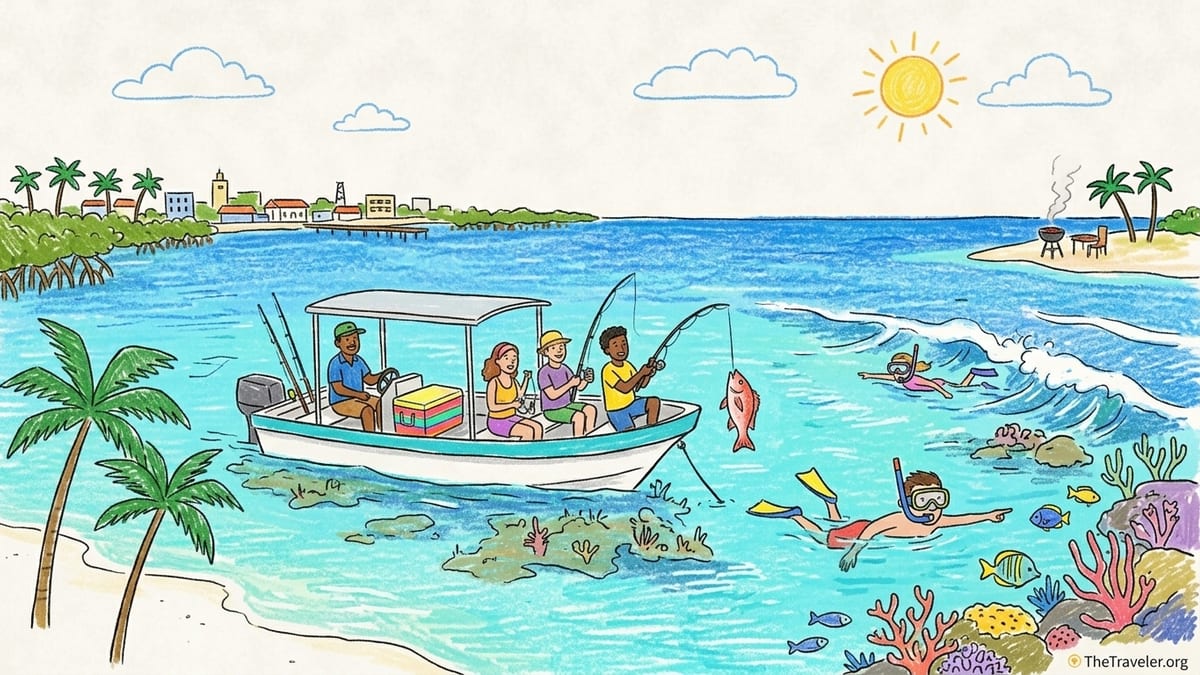
Our day started at 8:00 a.m., a common departure time for full-day charters out of San Pedro. At that hour the sea state inside the reef was calm, with a low chop and light trades ruffling the lagoon. The skiff itself was typical of Ambergris reef boats: about 25 feet long, fiberglass, with a shaded center section, forward casting deck, and a single outboard engine. There were six rod holders, a large insulated cooler, and a simple PVC frame that doubled as a snorkel gear rack.
The charter supplied every piece of fishing equipment we needed. The captain had medium spinning outfits rigged with 20 to 30 pound braided line for reef fishing, along with a few heavier rods for trolling or live-baiting if we wanted to try for something larger. Terminal tackle ranged from small circle hooks and egg sinkers for bottom fishing to wire leaders for barracuda. Fresh bait, mostly sardines and cut ballyhoo, came from a local bait supplier who had met the boat before we left the dock. He also carried a stack of hand lines, which he said many Belizean guests prefer for snapper fishing.
For snorkeling, the boat carried masks, snorkels, and fins in multiple sizes, plus a handful of inflatable snorkel vests. In terms of what we had to bring, the essentials were sunscreen, hats, polarized sunglasses, swimsuits under light clothing, and a dry bag for phones and small electronics. Our guide recommended a long-sleeve rash guard instead of slathering more sunscreen before each snorkel stop, and that proved wise once the midday sun bounced off the white sand and turquoise water.
Food and drinks were mostly handled for us. Chilled water, sodas, and a jug of rum punch waited in the cooler, along with fresh fruit and some basic snacks. Lunch consisted of our morning catch grilled over charcoal on a nearby caye, served with tortillas, rice and beans, and a simple salad that the crew prepared while we swam. I tucked a few motion sickness tablets and extra snacks into my bag, but in practice the supplied provisions covered what we needed.
On the Reef: Weather, Seas, and the Actual Fishing
Once we cleared the last row of moored boats off San Pedro, the captain opened the throttle and aimed north along Ambergris Caye. Seas outside the town harbor were a gentle 1 to 2 feet inside the barrier reef, with the reef crest itself breaking any larger swells from offshore. Even with a light southeast trade wind, the run to our first reef cut was smooth enough that no one had to clutch the gunwales.
Our first stop was a patch of reef in about 20 to 25 feet of water. The captain anchored on the sand edge rather than over the coral heads and rigged us each with small circle hooks, 1 ounce sinkers, and chunks of fresh sardine. His instructions for the beginners were blunt and reassuring: drop straight down, keep the line tight when you feel a tap, and then simply lift the rod and start reeling. Within minutes, the rod tips began to bounce. We brought up a mix of small and medium lane snapper, grunts, and a few jack crevalle, all brightly colored and far more energetic than their modest size suggested.
Throughout the morning the guide moved us along the reef, sometimes anchoring, sometimes slow-drifting with the current to show us slightly different bottom structure. In slightly deeper spots we encountered larger yellowtail snapper and one respectable mutton snapper, which went straight into the cooler for lunch. A sleek barracuda slashed through the spread at one point, slicing a hooked snapper in half and then returning for the rest, which led the captain to tie on a short wire leader and turn it into a proper target. Ten minutes later, one of the rods doubled over and we watched a silver-green barracuda streak through the top of the water column before coming boatside for a careful dehooking.
The seas never built beyond a moderate chop inside the reef, and even our least experienced traveler stayed comfortable. That said, the captain was quick to shift to more sheltered water behind the reef whenever a squall line built up offshore. These micro-adjustments made the whole experience feel less like a test of endurance and more like a relaxed day of variety fishing.
Snorkeling, Catch-and-Release, and Guide Interaction
By late morning, when the bite slowed and the sun climbed higher, we secured the rods and shifted to snorkeling. The captain motored us to a marked section of the barrier reef, briefed us on staying off the coral and watching for the current, and then joined us in the water while his mate stayed topside as a spotter. Visibility was more than 60 feet. We floated over dense stands of hard coral, swirls of sergeant majors, and larger schools of chub and yellowtail snapper that were much less interested in our lines than their morning cousins had been.
Snorkeling added a useful layer to the fishing lesson. Our guide pointed out the grazing parrotfish and tangs that Belize regulations protect entirely and used them as a live example of why reef health depends on herbivores not ending up on the dinner plate. He also had us watch for nurse sharks and southern stingrays in the sand patches, both of which appear regularly on nearby tours to Hol Chan and Shark Ray Alley. The combination of seeing the ecosystem underwater and then returning to baited hooks made the afternoon fishing feel more grounded in place rather than just numbers in a cooler.
As for catch-and-release practices, our particular day did not involve any bonefish, tarpon, or permit. Those species live more on the flats and channels than on the main reef line. Still, the captain carried a dedicated release net, dehookers, and heavy leaders specifically for those fish, and he described past trips where guests jumped smaller tarpon off mangrove points early in the morning before transitioning to reef fishing. In those cases, he said, the fish never came fully out of the water and photos were taken quickly at the side of the boat, in line with the national requirement that these species remain strictly for sport.
Guide interaction made the day. Our captain was patient with beginners, quick to untangle crossed lines, and careful about explaining what he was doing every time he changed rigs or spots. When one of our group battled a particularly strong jack close to the reef, he coached her through keeping the rod tip up and angling the fish away from the coral. He also cleaned the keepers in front of us on the beach at lunchtime, explaining which parts went to the pan and which went back to the sea, so we understood exactly what we were eating.
Was This Trip Really Beginner Friendly?
From a novice’s perspective, the combination of reef fishing and snorkeling out of Ambergris Caye is one of the more approachable ways to experience Belizean sport fishing. The techniques we used, mostly simple bottom rigs and light spinning tackle, required minimal prior experience, and the action was steady enough to keep everyone engaged. No one in our group had ever landed a snapper before that day, but by mid-morning everyone had caught multiple fish and felt comfortable baiting hooks under supervision.
The main physical demands were balance on a moving boat and comfort in the water. Inside the reef, the sea state remained manageable, yet anyone very prone to motion sickness would still be wise to take precautions before departing. Snorkeling required only basic swimming ability because flotation vests were provided, but currents around reef cuts can be noticeable, and the guides’ instructions about staying close to the boat deserved strict attention.
If anything, the biggest surprise for beginners might be the constant transitions: fish a reef edge, move to a new patch, drop lines again, then switch to snorkeling, then back to fishing. This kept boredom at bay but meant paying attention to gear changes and safety briefings. Thankfully, our captain was used to mixed-experience groups and never rushed anyone through the process.
For first-timers who are curious about Belize’s famous flats and fly fishing scene but unsure about committing to a full day on the bow of a skiff, a day like ours functions as an excellent introduction. You see the bonefish and permit habitat as you run along the mangrove shorelines, you learn the basics of local regulations, and you get enough hands-on fishing time to decide whether a dedicated fly day to Turneffe Atoll or nearby flats makes sense on a future trip.
The Takeaway
Walking back along the beach after our charter, still smelling faintly of grilled snapper and sunscreen, it was clear why Ambergris Caye has built such a reputation as Belize’s fishing base. In a single day we experienced accessible reef fishing, clear-water snorkeling on the barrier reef, and a practical lesson in how Belize manages its marine resources through licensing, closed seasons, and protected sport species.
The charter selection process highlighted the value of a private boat for anyone who wants flexibility and a mix of activities. Between approximately 650 and 750 US dollars for a full day for up to four guests, including gear, lunch, and drinks, the price is not insignificant, but it becomes competitive once you compare it honestly with multiple shorter group excursions. Crucially, a reputable operator folds in the logistics, from sport fishing license guidance to ensuring all species kept or released comply with Belize Fisheries Department rules.
As a beginner, I came away energized rather than overwhelmed. I learned enough to respect the complexity of Belize’s fisheries, saw firsthand why bonefish, tarpon, and permit are treated as catch-and-release trophies rather than menu items, and caught fish that fed us within an hour of leaving the water. Next time, I might use Ambergris as a jumping-off point for a dedicated fly trip to Turneffe Atoll, but I would still start any first-time visitor with the kind of reef and snorkeling day we experienced: varied, educational, and very much within reach for someone who has never set a hook in Belize before.
FAQ
Q1. Do I need a fishing license to join a charter from Ambergris Caye?
Yes. Belize requires a valid sport fishing license for recreational anglers, including visitors. Many Ambergris Caye guides help guests obtain short-term licenses through the national system or confirm them before leaving the dock.
Q2. Are bonefish, tarpon, and permit catch and release only in Belize?
Yes. Belize Fisheries Department regulations classify bonefish, tarpon, and permit as protected sport species that must be released. It is illegal to keep, buy, or sell them, and possession is prohibited.
Q3. How much does a full-day private reef fishing and snorkeling trip cost from San Pedro?
Recent examples from San Pedro operators show full-day private reef fishing, snorkeling, and beach barbecue charters typically priced around 650 to 750 US dollars per boat for up to four guests, with extra charges for additional passengers or distant resort pickups.
Q4. What kind of fish can I realistically expect to catch on a reef charter?
On reef and patch-reef trips around Ambergris Caye, visitors commonly encounter snapper species such as lane and yellowtail, grunts, jacks, and occasionally barracuda or mackerel. Your guide will advise which species can be kept for lunch within current regulations.
Q5. Is a reef fishing and snorkeling combo suitable for beginners?
Yes. Techniques on reef charters rely on simple bottom rigs or light spinning gear, and guides routinely coach first-timers. Combined with snorkeling breaks, these trips are designed to keep mixed-experience groups comfortable and engaged.
Q6. What equipment is usually included on Ambergris Caye fishing tours?
Most reputable charters provide rods, reels, terminal tackle, bait, life jackets, and snorkel gear. Many also include water, soft drinks, rum punch, and lunch. You typically need to bring only sun protection, swimwear, and personal items.
Q7. Do I need my own fly rod for flats fishing around Ambergris Caye?
Not necessarily. Dedicated fly fishing lodges and some San Pedro guides can supply suitable fly outfits for bonefish, tarpon, and permit, though experienced anglers often travel with their own rods and favorite lines. Confirm gear availability when booking.
Q8. What happens to the fish we keep on a reef charter?
On many full-day reef trips, keepable fish within legal limits are cleaned by the crew and grilled for a beach barbecue lunch. Extra fillets can sometimes be packaged for guests to take to a local restaurant for dinner preparation.
Q9. How rough are the seas for a typical Ambergris Caye fishing day?
Most reef and inshore trips run inside the barrier reef, where wave heights are generally lower than offshore. Conditions vary with wind and weather, but many days see only light to moderate chop. Those prone to seasickness should still take precautions.
Q10. Can I reach Turneffe Atoll from Ambergris Caye for a day of fishing?
Turneffe Atoll lies south of Ambergris Caye and is widely known for flats and fly fishing. Some specialized operators and lodges can arrange trips from Ambergris, but they involve longer runs and higher costs than local reef charters, so travelers should plan and budget carefully.