


More news on this day
American Airlines is accelerating a shift toward premium-heavy cabins on its narrowbody fleet, adding more first class and extra-legroom seats to smaller aircraft as part of a sweeping interior retrofit and fleet plan aimed at boosting revenue from high-yield travelers.
Get the latest news straight to your inbox!
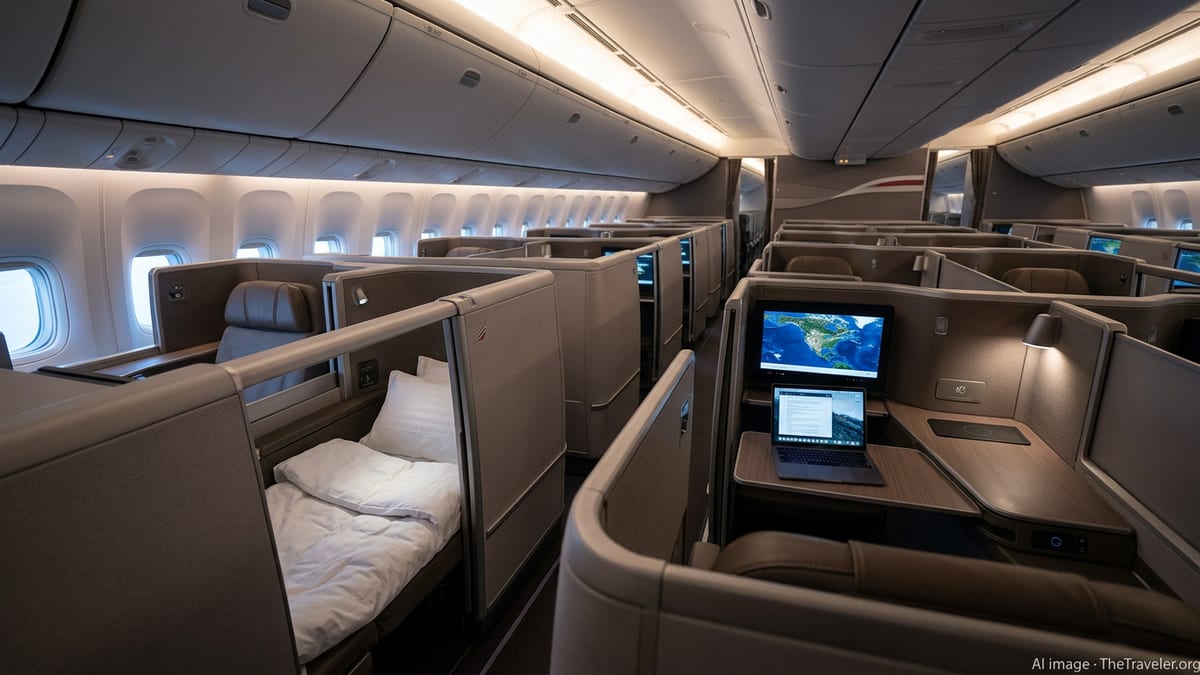
Cabin revamp targets first class and extra-legroom rows
Publicly available information shows that American plans to reconfigure hundreds of single-aisle aircraft so they carry more premium seating toward the front of the cabin. Recent coverage of the program indicates that the airline will install additional rows of domestic first class and expand extra-legroom sections while standard economy capacity remains flat or grows more slowly.
Reports describe a multi-year retrofit of Airbus A319 and A320 jets that will add an extra row in first class, bringing these smaller narrowbodies closer in layout to the airline’s larger workhorses. The updates are expected to be paired with refreshed interiors, including new sidewalls and lighting, as American works to standardize the onboard experience across its mixed Airbus and Boeing fleet.
On larger narrowbodies, such as the Airbus A321neo and Boeing 737 MAX 10, American’s future layouts are also trending more premium. Industry reporting on recent fleet orders notes that forthcoming 737 MAX 10 deliveries will feature a notably larger first class cabin than today’s 737-800 and MAX 8 aircraft, while the A321neo is set to gain more first class seats compared with earlier configurations.
This strategy marks a shift from earlier densification efforts that focused primarily on packing in additional economy rows. With demand stronger at the front of the aircraft, American is now leaning into higher-yield products on the same narrowbody frames that dominate its domestic and short-haul international network.
Seatback screens return as part of narrowbody upgrade
The latest cabin refresh is not limited to seating layouts. According to recent business press reports, American intends to install individual seatback entertainment screens on more than 800 aircraft, reversing an earlier move away from built-in inflight entertainment on narrowbodies. The screens will be added as part of a broader interior modernization that includes power at every seat and updated bins.
The entertainment and connectivity focus mirrors strategies at competitors that have invested heavily in onboard technology to win over frequent flyers. American has already begun offering free Wi-Fi for AAdvantage members on select flights, and the addition of seatback displays positions these refurbished narrowbodies as more attractive options on longer domestic and transborder routes.
Bringing screens back to smaller aircraft also underlines how central single-aisle jets have become to American’s premium aspirations. Rather than relying primarily on widebodies for a differentiated experience, the airline is betting that upgraded A320-family and 737 cabins can deliver a more consistent, higher-value product on routes where large twin-aisle aircraft would not be economical.
For travelers, the combination of more premium seats and better onboard technology on narrowbodies could mean greater choice at the top of the cabin and an improved experience even in extra-legroom or standard economy sections.
New aircraft orders support a premium-heavy narrowbody future
The retrofit push is being reinforced by substantial new aircraft orders. In 2024, American announced deals for 260 additional jets, including Airbus A321neo, Boeing 737 MAX 10 and Embraer E175 aircraft. Company materials linked to that order framed it explicitly as part of a strategy to expand premium seating across narrowbody and regional fleets.
The Embraer E175s, in particular, are set to replace smaller regional jets on key feeder routes into American’s hubs. These dual-class regional aircraft typically feature a genuine first class cabin and high-speed connectivity, making them significantly more premium than the 50-seat regional jets they are pushing out of the network.
On the mainline side, the A321neo and 737 MAX 10 orders give American larger, more efficient platforms that can accommodate expanded premium sections without sacrificing too many economy seats. The airline has signaled that these aircraft will be central to its domestic and transcontinental strategy, including high-demand routes where business travelers are willing to pay extra for more space and amenities.
Industry analysis suggests that by pairing retrofits of existing jets with deliveries of new, premium-capable narrowbodies, American is positioning itself to grow the share of higher-fare seats in its overall mix without dramatically increasing fleet size.
Transcontinental and long-range narrowbodies lead the premium push
American’s move toward more premium seating on smaller aircraft is perhaps most visible on its long-haul narrowbody plans. The forthcoming Airbus A321XLR, a long-range version of the A321neo, is expected to debut with a four-cabin layout that includes business class suites, a true premium economy section and extra-legroom seating in addition to standard economy.
On key domestic transcontinental markets, these new-generation A321s are set to replace the current ultra-premium A321 subfleet, which has long been known for its boutique, business-heavy configuration. While the exact seat counts differ, publicly discussed plans indicate that American intends to keep a strong emphasis on high-yield seats at the front of the cabin, even as it modernizes the product with all-aisle-access business suites rather than older angled or alternating layouts.
Analysts note that this is part of a broader trend among large U.S. carriers to rely more on narrowbodies for missions that previously required widebody aircraft. Advances in range and cabin design have made it possible to offer lie-flat or near-long-haul comfort on single-aisle jets flying coast-to-coast or on select international routes.
For American, that means the line between “small” aircraft and “premium” experience is increasingly blurred. Customers booking on A321neo or A321XLR flights can expect a level of comfort and choice in the forward cabins that was once limited to larger twin-aisle jets.
Competitive and revenue pressures behind the strategy
American’s focus on premium seating in smaller frames reflects both competitive dynamics and financial pressures. Premium cabins typically generate disproportionately high revenue relative to their footprint, and demand for more spacious seating has grown as frequent flyers place a premium on comfort, flexibility and onboard productivity.
Rivals have followed similar paths, expanding domestic first class and extra-legroom cabins and rolling out premium economy across widebody fleets. Industry commentary points out that airlines are increasingly using sophisticated revenue management tools to price a larger number of premium seats, making it more attractive to add capacity at the front of the plane while still protecting yields.
In that context, American’s decision to retrofit narrowbodies and specify more premium capacity on incoming aircraft can be seen as an effort to keep pace with competitors while making better use of its existing fleet. Rather than simply adding more economy rows, the airline is trying to adjust the mix toward seats that command higher fares and appeal to loyalty program members.
As the reconfigured aircraft enter service over the next several years, travelers in the United States and beyond are likely to see more first class and extra-legroom rows on American’s smallest mainline jets, along with refurbished cabins and in-seat entertainment that signal the airline’s determination to compete for premium-conscious flyers on every route, not just on flagship long-haul services.