


More news on this day
American Airlines is adjusting how it compensates stranded passengers with hotel and meal vouchers at the same time a federal rule change is poised to narrow when travelers qualify for those benefits, raising concerns that disrupted fliers could soon face fewer choices and leaner support when things go wrong.
Get the latest news straight to your inbox!
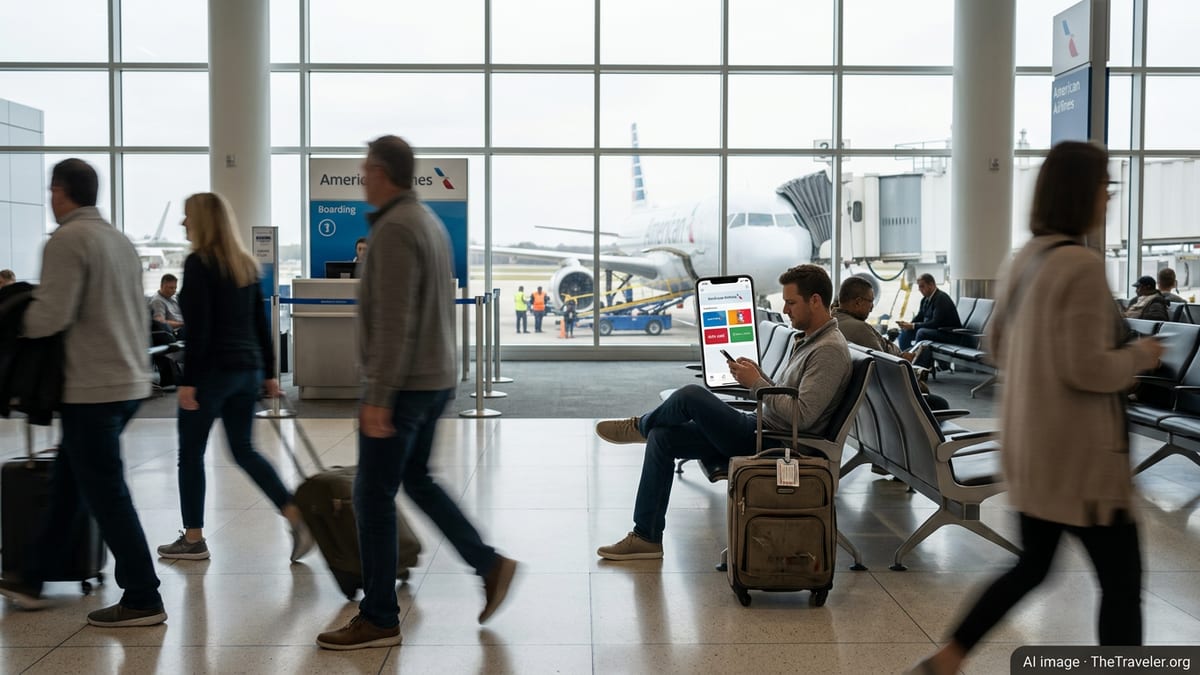
Digital Vouchers Expand, But Choices May Shrink
American has promoted a growing suite of digital tools that push hotel, meal and transportation vouchers directly to passengers’ phones during major disruptions, allowing travelers to bypass airport lines and obtain assistance through the carrier’s app. Publicly available information from the airline’s newsroom in 2026 highlights redesigned disruption banners and self-service options that let eligible customers access overnight hotel stays, food credits and ground transport without waiting for an agent.
At the same time, reports on traveler forums and airline-focused sites suggest that the range and quality of hotel options attached to those vouchers is under pressure. Passengers stranded overnight at large hubs such as Chicago O’Hare and Charlotte in 2026 have described receiving only a handful of hotel choices, sometimes far from the airport and without shuttle service, or discovering on arrival that a property did not in fact have an active contract with American and was already full due to local events.
According to this reporting, internal guidance to frontline staff emphasizes cost control and directs agents to rely on contracted hotels that accept pre-negotiated voucher rates. When those properties fill up during widespread disruptions, the system can generate offers at more distant or budget-oriented hotels, leaving travelers to shoulder additional time and transportation costs even while holding a voucher that is supposed to ease the inconvenience of an airline-caused delay.
American’s published customer service plan continues to state that when a controllable delay or cancellation forces an overnight stay, eligible passengers may receive a hotel room and transportation between the hotel and airport. However, it does not guarantee specific brands, locations or service levels, giving the airline wide discretion over which properties appear in the app or are offered at the counter when irregular operations strain local capacity.
From “Meal Voucher” To “Food/Beverage Credit”
American’s approach to feeding stranded passengers is also evolving. In 2026, frequent flyer publications reported that the airline had quietly renamed its standard delay benefit from a “meal voucher” to a “food and beverage credit,” typically worth 12 dollars for qualifying delays of at least three hours that are deemed within the carrier’s control. An internal memo described in that coverage indicated that the previous name created expectations that the credit would pay for an entire meal, which often is not possible at most airport restaurants.
The new wording aligns more closely with how the credit functions in practice. The amount generally does not cover an entree, drink and tax at many airport concessions, particularly in high-cost hubs, but it can offset part of the bill. The terminology shift reflects growing pressure on airlines to be more precise about what they actually provide when delays are their fault, while also signaling a desire to avoid complaints from travelers who discover that a “meal voucher” does not buy a full sit-down meal.
Earlier in 2026, reports indicated that American had made it easier to distribute these credits by enabling agents to issue them at the flight level, so that an entire planeload of delayed customers could receive digital vouchers at once. The carrier has also been testing automation that sends eligible passengers a food credit directly through the app, rather than forcing them to queue at a service desk. This approach is designed to speed up assistance during peak disruption periods and to reduce staffing bottlenecks when multiple flights misconnect or are canceled.
Despite these improvements, travel industry analyses note that the underlying value of the credit has not kept pace with airport food prices, and the airline retains broad authority to determine whether a delay is controllable enough to trigger a voucher at all. As a result, the updated language and streamlined distribution may make the process feel smoother, but they do not necessarily mean that travelers will receive more generous support in dollar terms.
New Federal Rule Narrows When Hotels And Meals Are Owed
The timing of American’s voucher adjustments overlaps with a significant regulatory shift. Beginning October 19, 2026, a new U.S. Department of Transportation rule modifies how airlines report the causes of certain delays and cancellations, moving ten types of disruptions out of the category considered within a carrier’s control. Travel industry coverage of the rule notes that the reclassified events include some unscheduled maintenance issues, certain medical emergencies, unruly passenger incidents, airport baggage-system outages and aircraft cleaning after a passenger death.
While the change is officially about statistics and on-time performance reporting, consumer advocates and travel media point out that many airline customer service commitments, including those highlighted on the DOT’s public dashboard, are explicitly tied to whether a disruption is classified as controllable. If fewer events fall into that category after October 19, carriers face fewer self-imposed obligations to provide complimentary hotels, meal credits or ground transportation to and from a hotel, even if the practical experience for the traveler still feels like a sudden breakdown in service.
Analyses in outlets such as Condé Nast Traveler, TravelPulse and Parade describe the rule as effectively shifting some costs back onto passengers. For example, once a qualifying maintenance issue is no longer labeled controllable for reporting purposes, airlines may point to that distinction when deciding whether to offer an overnight hotel or simply rebook the traveler and leave lodging to the individual. The Department of Transportation itself has characterized the change as a transfer of value from consumers to airlines in its public documents.
American’s own commitments on the DOT dashboard as of late 2026 still show green indicators for providing meal or meal cash or vouchers and hotel accommodations for overnight controllable cancellations and significant delays. However, because the definition of “controllable” is narrowing, the pool of passengers who actually qualify for those amenities could shrink, even if the checklist of benefits technically remains unchanged.
What Stranded Travelers Can Expect From American Now
For travelers disrupted on American this fall and winter, the practical impact of these overlapping changes is a more complex decision tree. Publicly available guidance indicates that if a delay or cancellation is clearly attributable to the airline and leads to a wait of three hours or more, passengers can still request a food and beverage credit, often 12 dollars, which may arrive as a digital voucher in the app. For overnight stays away from home caused by controllable issues, American’s customer service plan continues to reference hotel rooms and transportation via shuttle or voucher.
The nuance lies in how a given disruption is categorized and what properties are available under American’s contracted hotel program at the time of the incident. Trip reports from recent months describe scenarios where overnight hotel vouchers routed travelers to limited-service properties 20 to 30 minutes from the airport, sometimes without dedicated shuttle service, requiring an additional ride-hailing fare that may or may not be reimbursed. In a few cases, travelers have reported arriving to find that the hotel did not recognize the voucher or had already sold out its rooms to guests paying their own way.
Airline commentators suggest that passengers who can afford it may want to compare the voucher offer with independently booked options, especially in major hubs where airport-adjacent hotels can be significantly more convenient. However, those who choose to book their own room instead of accepting a voucher may find reimbursement difficult unless American has explicitly advised them in writing to do so, since the airline’s published policies focus on direct provision of services rather than after-the-fact repayment.
Against this backdrop, consumer advocates continue to point travelers toward travel insurance policies and premium credit cards that include trip interruption coverage, which can reimburse out-of-pocket hotel and meal expenses when airlines decline to do so. As American refines its digital systems and rebrands its vouchers at the same moment that federal rules narrow the circumstances in which any voucher is offered, stranded passengers increasingly need to understand both the fine print of airline commitments and the backup protections they bring with them when they fly.