


More news on this day
Rail travel on one of Germany’s busiest regional corridors was thrown into chaos after a fire along the Cologne–Düsseldorf line led to the shutdown of services, with a group calling itself “Kommando Angry Birds” now claiming responsibility for what investigators are treating as a deliberate act of sabotage.
Get the latest news straight to your inbox!
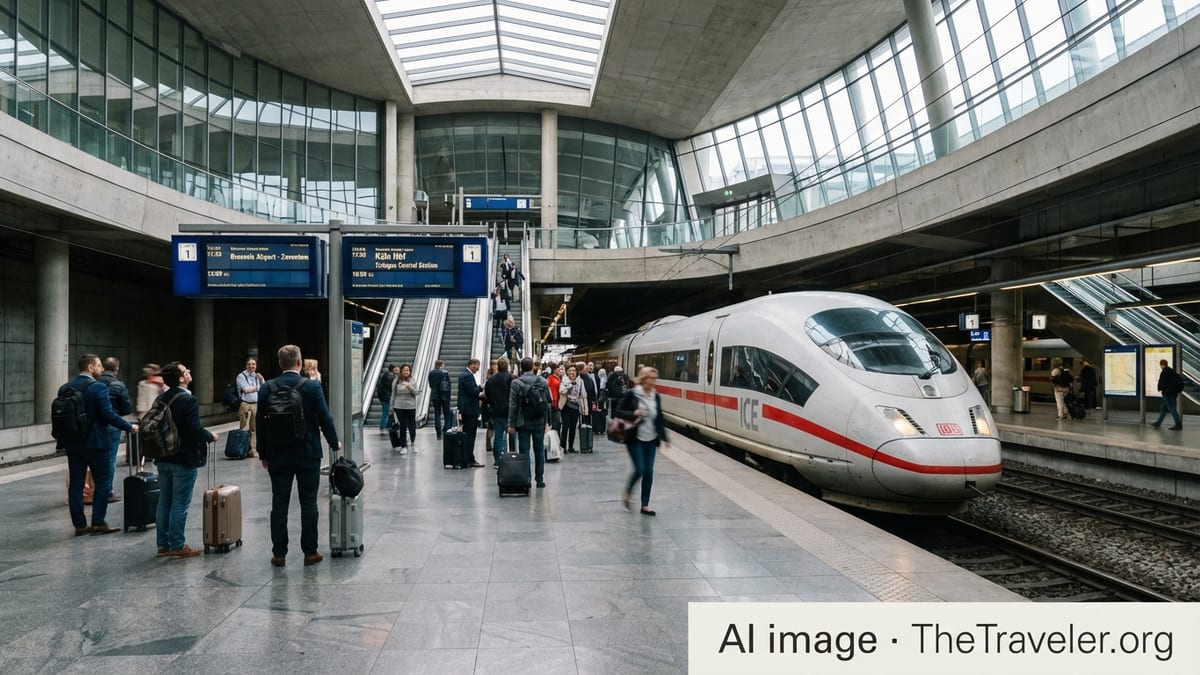
Key corridor closed after trackside fire and suspected sabotage
The disruption began on 11 July 2026, when a trackside fire was reported along the railway between Cologne and Düsseldorf in the state of North Rhine-Westphalia. The incident forced an immediate halt to traffic on the line, which carries dense layers of local, regional and long-distance trains linking two of western Germany’s key urban hubs.
Published coverage in German media describes the blaze as occurring on a railway embankment, damaging signalling and communication infrastructure and triggering automatic safety protocols. Rail operations were suspended on large parts of the route, with sections completely closed for many hours while firefighters brought the blaze under control and engineers began assessing the extent of damage to cables and equipment.
Information released by the rail operator shows that services on the Cologne–Düsseldorf corridor were either cancelled outright, diverted over slower routes, or subject to heavy delays. The shutdown also affected trains continuing onward toward Duisburg, the Ruhr region, and international destinations, underscoring the strategic importance of the corridor in Germany’s wider rail network.
By 12 July, parts of the line were reopened to traffic, but repair work on damaged systems continued under operating restrictions. The operator has warned travelers to expect lingering delays and re-routings as technical teams replace burnt cabling and inspect signalling facilities along the affected stretch.
‘Kommando Angry Birds’ issues claim of responsibility
Soon after the incident, a text claiming responsibility began circulating online, attributed to a left-wing extremist group using the name “Kommando Angry Birds.” According to summaries carried by German outlets, the statement frames the sabotage as a protest targeting industrial infrastructure and links the attack to broader environmental and anti-capitalist motives.
Publicly available reporting indicates that the claim describes the action as deliberate interference with rail operations, allegedly aimed at disrupting what the group portrays as environmentally destructive economic activity. The language in the document aligns with patterns seen in previous extremist tracts that denounce large-scale infrastructure as symbols of fossil-fuel driven growth and state power.
Investigators are treating the letter as a possible confession, but its authenticity has not been independently verified in court. Security experts quoted in earlier analyses of similar cases note that claim letters can be used by unrelated actors seeking attention, and that forensic work is needed to determine whether the authors match any known networks or individuals.
The choice of the “Angry Birds” label reflects a longer trend among clandestine groups of adopting pop-culture inspired pseudonyms for individual cells or “commandos.” In this case, the name appears to have been used before in the context of radical campaigns against rail and energy infrastructure, giving investigators additional material for comparison in their ongoing work.
Pattern of previous attacks linked to ‘Angry Birds’ label
The Cologne–Düsseldorf disruption is not the first time the “Kommando Angry Birds” name has surfaced in connection with interference on German railways. Around a year earlier, a similarly named group claimed responsibility for damage on a major line between Düsseldorf and Duisburg, which also involved attacks on signalling or communication installations and resulted in severe timetable disruption across North Rhine-Westphalia.
Reports from that earlier episode described coordinated tampering with cables and trackside equipment along a heavily trafficked corridor, forcing trains to halt or proceed at restricted speeds. The pattern of targeting critical nodes in the network, rather than individual trains, has drawn attention from rail security analysts, who highlight the relatively high impact such actions can have compared with the modest physical means required.
Beyond Germany, European investigative coverage over the past several years has documented a broader wave of politically framed sabotage and arson attempts against railway infrastructure, sometimes linked to anti-capitalist, anarchist or climate-extremist milieus. These have ranged from cable damage and signal interference to trackside fires, often calculated to cause maximum disruption while avoiding direct attacks on passengers.
The recurring appearance of the “Angry Birds” moniker in texts surrounding some of these incidents suggests that the label has become a kind of signature within parts of this scene, even if the exact composition and continuity of the group remain opaque. Analysts caution that the name may refer to decentralized cells rather than a single, centrally led organization.
Impact on travelers and tourism in the Rhine corridor
The Cologne–Düsseldorf line is a critical artery for both daily commuters and leisure travelers. It links Cologne’s historic center and cathedral district with Düsseldorf’s trade fair grounds and riverfront, and it serves as a backbone connection for onward trips toward the Ruhr area, the Netherlands and Frankfurt Airport. Any prolonged interruption on this stretch quickly ripples through hotel bookings, event attendance and airport transfers.
In the hours after the closure, passengers reported packed replacement services, crowded concourses and long queues at information desks as rail companies scrambled to provide alternative routes. Visitors arriving for weekend city breaks, river cruises on the Rhine or cultural events in Cologne and Düsseldorf faced missed connections and last-minute changes to their itineraries.
Travel advisories published after the incident urged passengers to check schedules repeatedly on the day of departure, allow significantly more time for airport transfers, and consider routing via alternative corridors where possible. Tour operators in the region, accustomed to occasional construction-related detours, were confronted instead with a sudden and security-related disruption that fell outside the usual planning horizon.
For the wider tourism sector in western Germany, the incident arrives at a time of strong summer demand. Industry observers note that while a single episode of sabotage is unlikely to deter visitors in the medium term, repeated attacks on high-profile corridors could gradually affect perceptions of reliability and push some travelers toward private cars or short-haul flights, with knock-on effects for both rail revenues and climate goals.
Security response and debate over critical rail infrastructure
Following the Cologne–Düsseldorf disruption, publicly available information indicates that state security divisions and specialized police units are leading the investigation into suspected sabotage, including the origin of the “Kommando Angry Birds” claim. Forensic teams are understood to be examining damaged installations and collecting traces from the scene, while digital specialists analyze the text of the letter and its dissemination channels.
The case has fed into an ongoing national debate in Germany about the vulnerability of core rail infrastructure to both cyber and physical attacks. In recent years, high-profile incidents ranging from suspected sabotage of communication cables to major software failures in railway communications systems have periodically disrupted large parts of the network, prompting calls for accelerated investment in redundancy and protection of signal and control assets.
Transport policy commentators point out that many key routes, including the Cologne–Düsseldorf corridor, run through densely built-up areas where access to trackside installations cannot be fully sealed off, and where even simple acts such as setting fire to vegetation or damaging exposed cabling can trigger significant operational consequences. This has led to renewed discussion of measures such as improved surveillance, reinforced enclosures for technical cabinets, and faster detection technology for anomalies along the line.
At the same time, civil liberties groups and infrastructure experts caution against overreliance on constant monitoring, arguing that long-term resilience also depends on modernizing ageing assets, diversifying routing options and improving incident management so that localized damage does not paralyze entire regions. For travelers, the Cologne–Düsseldorf sabotage has become the latest reminder that the convenience of high-frequency rail links in Europe’s core tourism corridors increasingly depends on how effectively operators and governments can protect the tracks those trains run on.