


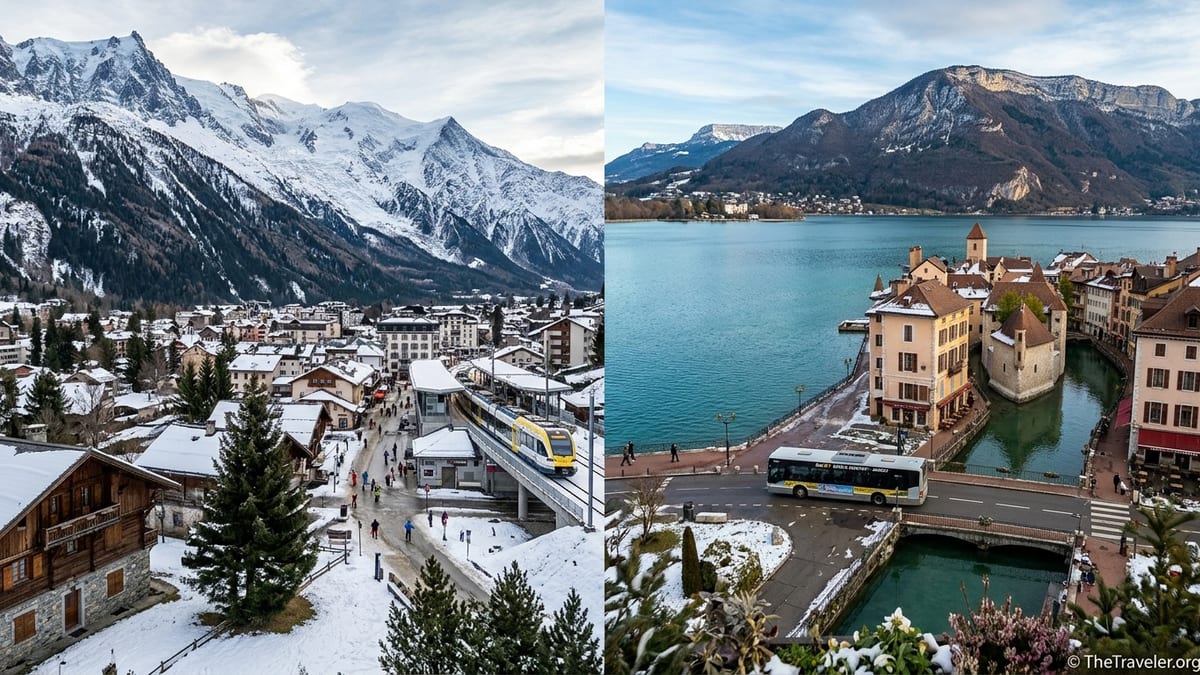
If you have just a winter weekend in the French Alps, the choice between Annecy and Chamonix comes down to lakefront charm versus big-mountain drama. For non-skiers and relaxed city breakers, Annecy is the easier, more walkable base with plenty to do even if lifts close or snow is patchy. Couples seeking a romantic escape will probably get more atmosphere in Annecy’s canalside old town, while families hungry for guaranteed snow and wow-factor mountain views will be happier in Chamonix. For visitors whose number-one priority is being surrounded by towering peaks and glaciers, Chamonix wins outright, provided you accept that some headline cable cars can shut at short notice in bad weather.
Get the latest updates straight to your inbox!
Getting there in winter: trains, buses and realistic timings
Both Annecy and Chamonix are well connected in winter, but the nature of the journey is different. Annecy sits at low altitude beside Lake Annecy, about 40 kilometres south of Geneva as the crow flies, while Chamonix lies deeper into the Mont Blanc valley at over 1,000 metres. From Geneva Airport to Annecy, the simplest winter option is usually bus 272 or a similar regional coach, which runs directly from the airport area to Annecy bus station close to the railway hub. Recent winter timetables indicate a journey time of about 1 hour 20 minutes on a weekday morning departure, plus a few minutes’ walk into the old town, so door-to-door from the arrivals hall to a canalside hotel can be around 1 hour 45 minutes in normal traffic.
Rail is also possible between Geneva and Annecy using the Léman Express cross-border network. Trains and rail-replacement buses link Geneva Cornavin station with Annecy via Annemasse, with services running broadly from early morning to around midnight. Official timetable documents show a combination of train and coach legs in winter, with the total station-to-station time commonly about 1 hour 30 minutes depending on the connection. Add transfers between Geneva Airport and Cornavin, and your real door-to-door time often reaches 2 hours.
For Chamonix, Geneva Airport is the main gateway. Several shuttle operators run direct winter coaches from the airport to Chamonix Sud bus station and central stops, typically in about 1 hour 20 to 1 hour 30 in good conditions according to current transfer guides and operator timetables. Shared shuttles can be very frequent in peak season from mid-December to early April, while scheduled buses operated with SAT Mont-Blanc or similar partners also link the airport and city bus station to Chamonix for starting fares around 19 euros each way as of late 2026.
Travel by train to Chamonix involves at least one change. From Geneva Airport, you first take a short train to Geneva Cornavin, then the Léman Express to Annemasse and onward towards Saint-Gervais-les-Bains. A regional train or Mont-Blanc Express service climbs from Saint-Gervais to Chamonix, stopping at villages such as Les Houches and Les Praz. Recent autumn 2026 schedules show part of this route operating by bus during engineering works, so actual journey times can be 3 hours 30 to over 4 hours door-to-door from the airport. For a winter weekend, most visitors choose the direct bus or shared minibus transfer for simplicity.
Longer-distance access from Lyon and Paris
If you are arriving by train from elsewhere in France, Annecy offers very straightforward rail access. TER regional trains from Lyon Part-Dieu to Annecy run several times a day and can be as frequent as every 30 minutes in some time slots, with journey times often around 2 hours according to the current TER Auvergne-Rhône-Alpes schedules. This makes Annecy easy for a Friday evening departure from Lyon after work, arriving in time for dinner in the old town.
From Paris, Annecy is served by direct high-speed TGV inOui services from Paris Gare de Lyon to Annecy station, via Chambéry and Aix-les-Bains. Rail operators indicate up to several direct services on busy days, with typical journey times a little over 3 hours 40 minutes. Once you step off the train, the walk from Annecy station to the canal-side quarters and lakefront is about 10 to 15 minutes, so you can realistically leave Paris late morning and be enjoying a lakeside promenade by mid-afternoon.
Reaching Chamonix from Lyon or Paris usually involves at least one change. Winter timetables published for the Lyon to Chamonix route show TER trains and occasional through services using a combination of rail and bus between Lyon Part-Dieu, Annecy, La Roche-sur-Foron and Saint-Gervais-les-Bains. Overall travel times can range from roughly 3 hours 30 minutes to over 4 hours 30 minutes, depending on the connection and whether a bus leg is included. Because of this, some Lyon-based travellers prefer to drive or use a private transfer when heading to Chamonix for a very short stay.
From Paris, there are usually winter weekend TGVs to Saint-Gervais-les-Bains, from where you connect to the Mont-Blanc Express towards Chamonix, taking about 45 minutes more. Recent planning guides for the 2026 to 2027 season note direct TGVs from Paris to Saint-Gervais on certain days between mid-December and late March, with overall Paris to Chamonix travel times around 5 to 6 hours when the connection is smooth. An alternative is to take a TGV to Geneva or Lyon then connect with a direct shuttle bus to the Chamonix valley, which can be quicker in practice if your flight or long-distance train is well timed.
Annecy in winter: canals, lakefront strolls and nearby Semnoz
Annecy in winter feels like a compact, walkable French town with a dramatic mountain backdrop rather than a ski resort. The old town’s arcaded streets, pastel façades and narrow canals around the Thiou are atmospheric even on grey days, and many of the key sights are open year-round. The Château d’Annecy, a castle museum overlooking the roofs, typically opens daily apart from some January maintenance periods, while the Palais de l’Isle, the small fortress-like building in the middle of a canal, usually welcomes visitors through most of the winter season with reduced hours.
The lakefront is Annecy’s other signature draw. Even in January, the paved promenade that runs past the Jardins de l’Europe and the Pâquier lawn remains accessible, although paths can be wet or icy after snowfalls. Boat cruises operate on a reduced winter timetable; timetable leaflets from the main lake operator show selected departures from December to April, often at midday or early afternoon. Even if you do not step on a boat, simple pleasures like a hot chocolate at a lakeside café near the Pont des Amours are an easy fit into a winter afternoon.
For snow, you usually need to leave the town itself. Annecy sits at around 450 metres above sea level, and while it does see snowfalls some winters, they may melt quickly at street level. If you visit during a mild spell, you can find bare pavements in town while seeing fresh white snow on the hills above. Semnoz, the small local mountain above the lake at around 1,600 to 1,700 metres, solves that problem. In winter it functions as a family-friendly ski and snow-play area with sledging runs, snowshoe trails and gentle pistes. Road access from Annecy takes roughly 30 to 40 minutes by car or shuttle bus when the road is clear.
Lift passes on Semnoz are significantly cheaper than in major alpine resorts. Current tariffs indicate modest prices for day passes and equipment rental aimed at local families and beginners rather than hardcore skiers. For non-skiers, the main appeal is hiring a sledge, booking a guided snowshoe walk through the snowy forest or simply enjoying panoramic views over Lake Annecy and the surrounding peaks from the plateau. When snow cover is good, you can easily spend a half day here and be back in Annecy for an evening stroll along canals lit with winter illuminations or Christmas lights in December.
Chamonix in winter: Mont Blanc views, big lifts and alpine walks
Chamonix in winter is a true mountain town. The centre is more compact than some people expect, with pedestrian streets lined by gear shops, bakeries and cafés, but its valley setting is steep and enclosed, with glaciers and serrated peaks rising on both sides. Even if you never put on skis, you are constantly aware that this is a high-alpine environment. Snow lies on the pavements more frequently than in Annecy thanks to the town’s altitude of around 1,035 metres and its shaded position between steep slopes.
The flagship experiences for non-skiers are the Aiguille du Midi cable car and the Montenvers railway. The Aiguille du Midi lift climbs from the edge of town to over 3,800 metres in two stages, offering observation terraces over the Mont Blanc massif and access to attractions like the glass-floored “Step into the Void” box. Official information from the lift company and tourist office shows that in winter 2026 to 2027, the Aiguille du Midi is scheduled to operate daily outside clearly defined autumn maintenance closures. Adult return tickets are a major expense, typically well over 70 euros, with family and combined passes available.
Montenvers, reached by a historic rack railway from the centre of Chamonix, takes you to viewpoints over the Mer de Glace glacier and a network of lookouts, galleries and short walks that depend on snow and ice conditions. Winter operating calendars indicate that the railway generally runs through the main winter season, again with specific periods of closure for maintenance. Tickets for Montenvers are somewhat cheaper than the Aiguille du Midi but still count as a significant outing for a family, especially if you add lunch at the mountain hotel or a hot drink at the café.
Crucially, both headline lifts are exposed to weather. The Aiguille du Midi can close at short notice in strong winds, heavy snowfall or very poor visibility for safety reasons, and the operator makes a point of flagging these conditions with notices and real-time updates. High winds can swing cabins on the cables, while low visibility makes it unsafe for staff and visitors on exposed terraces. Montenvers can also temporarily suspend services during heavy snowfalls or avalanche risk, especially if the access paths at the top station are unsafe. This means that a winter visitor to Chamonix should always have a Plan B in case a key excursion is cancelled on the morning of the trip.
Snow, weather and walking conditions in town
The winter climate feels quite different in Annecy compared with Chamonix. In Annecy, at lake level, winters are often cold and damp rather than consistently snowy. You may encounter dustings of snow that turn the canals and castle into a postcard scene, but they can be short-lived, especially if a föhn wind or milder air arrives. Pavements are usually cleared quickly in the centre, though early-morning black ice can linger on shaded alleys and lakeside promenades. For most visitors, warm waterproof shoes with some grip are enough for everyday walking.
Chamonix is noticeably colder and more prone to sustained snow cover at village level. Because the town lies in a narrow, north-facing valley, winter sun can be limited, leading to icy surfaces on side streets and shaded paths. The municipality works hard to grit and clear main routes, but you should still expect packed snow or sheet ice in some places, particularly after overnight freezes. Many regular visitors recommend small slip-on traction devices for non-skiers who plan to walk a lot.
Altitude also matters for comfort. While Annecy sits low enough that most visitors feel no impact, Chamonix’s main town is over 1,000 metres and its lifts rise quickly to 2,000 or 3,800 metres in a single morning. On the Aiguille du Midi in winter, temperatures can easily be 20 degrees colder than in the valley, and the thin air at 3,842 metres can cause shortness of breath or mild headaches. The cable car operator specifically forbids children under 3 years and advises caution for those under 5, as well as people with certain medical conditions. This is an important consideration for families planning which mountain activity to choose.
Weather volatility is greater in Chamonix as well. While a cloudy day in Annecy may simply mean grey skies over the lake, a similar forecast in Chamonix can translate into whiteout conditions on high terraces, making expensive ticketed viewpoints far less rewarding. Planning flexibility is therefore more critical for a Chamonix weekend than for an Annecy stay, especially if your time and budget only stretch to one major paid mountain excursion.
Non-skiing activities: from snowshoeing to spas and cafés
Neither Annecy nor Chamonix require skis to be enjoyable in winter, but they offer different kinds of non-skiing activities. In Annecy, the focus is cultural and culinary. You can spend a morning exploring the Château d’Annecy, an afternoon walking along the lake and through the old town, and an evening sampling Savoyard dishes such as fondue or tartiflette in cosy restaurants near Rue Sainte-Claire. Museums like the Musée-Château and local art spaces provide indoor options on rainy or slushy days, while small independent boutiques add to the relaxed city-break feel.
From Annecy, Semnoz and nearby plateaus allow light winter sports for non-skiers. Rental shops in town and at the mountain provide snowshoes and sledges for day visitors. Marked snowshoe routes on Semnoz are generally designed for beginners and families, with gentle gradients and panoramic viewpoints over the lake, the Bauges and, on clear days, distant Mont Blanc. Because Semnoz is a smaller local area, guided outings and rentals tend to be more affordable than in major alpine resorts, making it easier to experiment with snowshoeing or a toboggan afternoon without a big commitment.
Chamonix, by contrast, is rich in structured activities for non-skiers who still want a strong mountain experience. Snowshoeing guides advertise half-day and full-day outings in forests above Les Houches, along the valley floor or up to balcony paths like those near Flégère, tailored to different fitness levels. Scenic lifts such as the Brévent cable car or Planpraz gondola sometimes offer pedestrian tickets, giving access to panoramic viewing terraces without needing skis, depending on the season’s operating schedule.
In both destinations, cafés and wellness facilities provide refuge from the cold. Annecy’s charm lies in its traditional bistros, wine bars and patisseries around the canals and lake. Chamonix adds modern spa complexes, hotel wellness centres with pools and saunas, and lively après-ski bars frequented by international visitors. For a non-skiing couple, a spa afternoon combined with a leisurely dinner in Chamonix can be as appealing as a day on the slopes, but the overall ambience is more overtly sporty and international than Annecy’s quieter, more local feel.
Where to stay, what it costs and how to get around
Accommodation around Annecy’s old town and railway station suits visitors who like to walk everywhere. Many mid-range hotels sit within 10 minutes’ walk of both the lakefront and the station, so you can arrive by train or bus and never need a car. As of winter 2026, sample prices for a centrally located three-star hotel for a January weekend often fall somewhere around 110 to 160 euros per night for a double room, with breakfast extra. Short-term apartment rentals around the canals and adjacent residential streets can be similar or slightly higher per night for well-rated properties, especially over Christmas and school holidays.
Chamonix offers a denser cluster of lodgings around the central pedestrian streets plus satellite options in Les Praz and Les Houches. Central hotels within easy walking distance of the Aiguille du Midi base station and Montenvers railway can command winter weekend rates of roughly 150 to 220 euros per night for a standard double in January, rising sharply during February school holidays. Les Houches and Les Praz may offer slightly lower prices and a calmer atmosphere, though staying there means relying more on the valley’s train and bus network to reach Chamonix centre and major lifts.
Restaurant prices mirror the tourist profile. In Annecy, a simple lakeside or old-town brasserie might charge around 18 to 25 euros for a main course and 6 to 10 euros for dessert, with a coffee on a terrace costing a few euros. In Chamonix, where visitor demand is intense in winter, mid-range restaurant mains often fall closer to 22 to 30 euros, and mountain restaurants above the valley can be pricier still. A family of four might easily spend 80 to 100 euros on a sit-down dinner in Chamonix without wine, whereas in Annecy you can still find hearty set menus that keep costs a little lower.
Local transport is straightforward in both towns. Annecy is largely flat around the centre, and walking is the default. Buses serve the suburbs, but most winter visitors only use them to reach Semnoz or outlying districts. Chamonix, by contrast, relies heavily on public transport within the valley. The Mont-Blanc Express train and local buses link Servoz, Les Houches, Chamonix, Les Praz, Argentière and Le Tour, and winter tourist information emphasises that it is perfectly feasible to spend a week without a car. For a short weekend, a car is not essential in either destination, though it can be useful for spontaneous trips from Annecy to Semnoz or from Chamonix to quieter trailheads, provided you are comfortable with winter driving and legal snow equipment requirements.
Sample winter itineraries and indicative budgets
For Annecy, a realistic two-day winter itinerary for a non-skiing couple arriving from Geneva on Friday evening might begin with a twilight canal walk and Savoyard dinner near the Palais de l’Isle. Saturday morning could be devoted to the Château d’Annecy and a stroll along the lakefront, followed by a leisurely lunch and a short winter boat cruise if timetables permit. In the afternoon, explore boutiques and cafés around Rue Royale. Sunday might be your Semnoz day, heading up for a few hours of sledging and snowshoeing before returning to town for an early dinner and an evening bus or train back to Geneva.
An approximate two-night budget for this Annecy couple might look like this: return bus from Geneva Airport around 25 to 40 euros per person depending on operator and timing, two nights in a mid-range hotel around 260 euros in total, meals averaging perhaps 60 to 80 euros per day for two if you mix sit-down dinners with lighter lunches, and one paid mountain activity day on Semnoz including transport, basic rentals and perhaps a hot drink for around 80 to 120 euros for two. That yields a rough total in the region of 450 to 600 euros for the weekend, not including shopping.
For a family of four in Annecy, costs naturally rise but remain moderate compared with major resorts. Two hotel rooms or a two-bedroom apartment in the old town might total 320 to 450 euros for two nights in winter outside peak holidays. Add return airport transfers of 100 to 150 euros for the family, food spending of about 120 to 150 euros per day if you choose pizzerias and simple brasseries, and a Semnoz snow day with sledges and hot chocolates that may run to 120 to 160 euros. A safe indicative weekend total for a family could be around 800 to 1,000 euros depending on accommodation choices.
In Chamonix, a two-day non-skiing itinerary for a couple could start on Saturday morning with a visit to the Aiguille du Midi, assuming the cable car runs and conditions are clear. Allow several hours for the ascent, viewpoints and warm-up drinks in the café at the mid-station or summit. Spend the afternoon strolling around town, visiting the Alpine Museum or browsing outdoor shops. On Sunday, ride the Montenvers railway in the morning, weather permitting, or join a guided snowshoe outing if the big lifts are closed. A final coffee and pastry in town sets you up for an afternoon transfer back to Geneva.
Indicative costs for this Chamonix weekend for a couple might include return shared transfers from Geneva at around 80 to 120 euros per person depending on season and booking, two nights in a central three-star hotel at roughly 300 to 440 euros in total, and food spending of perhaps 80 to 110 euros per day if you dine in mid-range restaurants. Add one major paid mountain activity such as the Aiguille du Midi, with current adult return tickets well above 70 euros each, and perhaps a slightly cheaper Montenvers ticket on the second day. Two big lift outings can easily add 180 to 220 euros or more for a couple, bringing the likely total outlay for a Chamonix weekend to around 750 to 1,000 euros before shopping.
For a family in Chamonix, accommodation and lift costs are the main variables. A family room or apartment near the centre may cost 350 to 550 euros for two winter nights, with family transfers from Geneva perhaps 180 to 260 euros total. Food spending could be 140 to 180 euros per day with children, and one flagship lift experience such as Montenvers plus a more budget-friendly valley activity like a half-day snowshoe or ice rink session might together come in at roughly 200 to 260 euros for four. A realistic family weekend budget might therefore fall somewhere between 1,000 and 1,300 euros, acknowledging that choosing the Aiguille du Midi for everyone will push this higher.
Which destination wins for different types of winter traveler?
For mountain scenery, Chamonix is the clear winner. Nowhere else in France offers such immediate access to viewpoints like the Aiguille du Midi terraces, where you stand opposite ice-plastered spires and gaze across to Mont Blanc itself. Even simple walks along the valley floor or rides on the Mont-Blanc Express between Les Praz and Argentière deliver classic alpine vistas that Annecy, beautiful as its lake is, cannot match in winter.
For lake atmosphere and a gentle city-break feel, Annecy takes the prize. Its canals, lakeside promenades and intimate scale create a romantic setting that feels more like a historic French town with mountains attached, rather than a resort. Couples who value long lunches, strolls under arcades and wine bars on cobbled streets more than high-adrenaline activities generally find Annecy more relaxing, especially when Christmas markets and winter lights are in place.
When it comes to snow activities for non-skiers and families, the comparison is closer. Chamonix offers a wider menu of structured snowshoeing, pedestrian-friendly lifts, ice-skating and organised excursions, backed by more reliable snow at village level and on nearby slopes. However, these experiences often carry higher price tags and depend heavily on lift operations. Annecy, with its access to Semnoz, offers simpler, more affordable sledging and snowshoeing that many younger children find perfectly satisfying, even if the setting is less dramatic.
For visitors who do not ski at all, Annecy is generally the safer and more economical choice. Most of its winter attractions are low-cost or free, and their enjoyment does not hinge on clear mountain weather. Chamonix remains highly rewarding for non-skiers who specifically want to see glaciers and high peaks, but it requires a bit more budget flexibility and tolerance for last-minute changes if lifts close. Budget-conscious travelers will usually find their money goes further in Annecy, while those planning a once-in-a-decade alpine spectacle will probably judge Chamonix worth the extra cost and uncertainty.
Finally, from a practical standpoint, both destinations work well without a rental car in winter, but Annecy’s combination of flat streets, compact centre and direct bus links from Geneva, Lyon and Paris makes it particularly convenient for a quick weekend. Chamonix’s dedicated transfer services and valley transport network also remove the need to drive on snowy mountain roads, though the added travel time from major cities is the trade-off. Choosing between them ultimately depends on whether you picture your ideal winter weekend as a lakeside stroll under old stone arches or a coffee on a terrace looking straight up at the glaciers of Mont Blanc.