


More news on this day
The United States is keeping Kuwait under a nationwide Level 3 “Reconsider Travel” warning as of October 23, 2026, with fresh U.S. Embassy alerts in November urging Americans in Kuwait and across the Middle East to exercise “heightened vigilance” in response to escalating Iran‑related threats and recent attacks around the Gulf.
Get the latest news straight to your inbox!
Countrywide Level 3 Advisory Reflects Regional Volatility
The U.S. State Department currently classifies Kuwait as Level 3, “Reconsider Travel,” in an advisory most recently updated on October 23, 2026. That notice applies to the entire country rather than a particular city or governorate and cites regional instability and security risks, including the potential for further missile and drone activity linked to the broader Iran conflict.
The October advisory did not introduce a new warning category for Kuwait but reaffirmed that non‑essential travel should be carefully weighed, particularly for U.S. citizens and dependents. It sits alongside Level 3 guidance from several partners, including Australia and others, which also flag the risk of additional strikes on Kuwaiti territory and the unpredictable trajectory of the regional security situation.
Travelers should note that a Level 3 designation is not an order to leave nor a blanket ban on visiting Kuwait. Instead, it signals that those considering trips should conduct a rigorous risk assessment, review employer or institutional policies and ensure they have clear contingency plans if the security picture deteriorates further.
New US Embassy Alerts Highlight Iran‑Linked Threats
In mid November 2026, the U.S. Embassy in Kuwait issued security alerts warning Americans in Kuwait and elsewhere in the Middle East to maintain heightened vigilance. The alerts highlight increased risks of armed attacks by Iran‑backed Houthi forces and Iranian efforts to target U.S. officials, facilities and other identifiable U.S. interests across the region, not only inside Kuwait.
These embassy messages build on wider U.S. intelligence assessments and recent incidents in the Gulf, including attacks and attempted attacks on military sites and logistics hubs used by American forces. Kuwait hosts significant U.S. military installations and logistics nodes, which other governments such as the United Kingdom, New Zealand, Canada and Australia explicitly identify as potential target areas, alongside U.S. diplomatic facilities and Western‑linked businesses.
The alerts stop short of ordering a departure of private U.S. citizens from Kuwait, and there is currently no announced evacuation directive for the general American community. However, they underscore the need for travelers with U.S., Western or Israeli ties to be especially cautious about movements, routines and the visibility of corporate or governmental affiliations.
Gulf Attacks, GNSS Interference and Air Travel Disruption Risk
The travel risk narrative around Kuwait is increasingly shaped by developments across the wider Gulf, Red Sea and Gulf of Oman rather than conditions inside Kuwait alone. Since early 2026, Iran and aligned groups have carried out or claimed numerous missile and drone attacks on targets in multiple Gulf states, as well as attacks on shipping. Aviation and maritime security bulletins point to a high‑threat environment, with authorities tracking both direct strikes and attempted attacks in airspace used by commercial traffic.
Regulators and industry advisories also warn of satellite navigation (GNSS) interference and related issues affecting aircraft and vessels transiting regional airways and sea lanes. Updated guidance from European and other aviation regulators lists the Kuwait flight information region among several Gulf airspaces where operators should apply heightened caution, tactical rerouting and robust contingency procedures when planning routes.
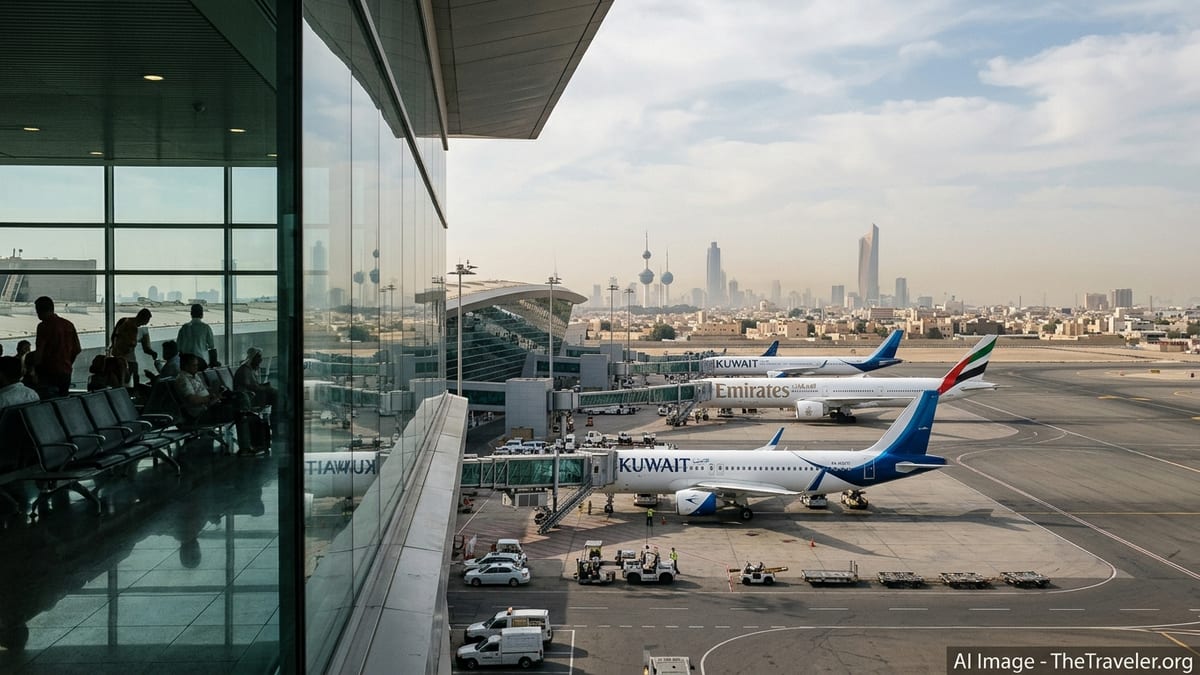
Kuwait International Airport remains open and handling commercial traffic, with national carriers and foreign airlines continuing to operate. However, the airport is situated in a region where renewed missile or drone activity, temporary airspace restrictions, air‑defence measures or debris from nearby incidents can cause sudden reroutes, extended flight times and sporadic delays. Travelers should therefore anticipate a higher probability of last‑minute schedule and routing changes than in more stable regions, even if Kuwait itself is calm at the time of travel.
Who Should Reconsider Travel and Which Areas to Avoid
Given current advisories, U.S. citizens and other travelers with close links to Western governments, defense contractors, energy companies or Israeli entities should scrutinize planned trips to Kuwait most carefully. This includes business travelers visiting U.S. or allied military facilities, logistics hubs, defense‑related sites or offices that are prominently branded with Western or Israeli corporate identities.
Government advisories from the United States, United Kingdom, New Zealand, Canada and Australia all urge people in Kuwait to avoid or minimize time near obvious target locations. These include U.S. and Kuwaiti military bases, large oil and gas facilities, refineries, export terminals, major transport nodes, telecommunication sites, desalination plants, power infrastructure and Kuwait International Airport and its surrounding areas, particularly when tensions spike or following public claims of attacks or retaliation by Iran or associated groups.
Travelers whose plans primarily involve low‑profile business or family visits in residential or commercial districts away from critical infrastructure may face lower direct risk but should still factor in indirect impacts, such as checkpoints, localized lockdowns, demonstrations or route closures that can emerge quickly after regional incidents.
How Travelers Should Prepare in a Rapidly Changing Environment
Conditions in and around Kuwait are changing quickly, and current guidance stresses the need for close monitoring both before and during any trip. Prospective visitors should review the latest Kuwait travel advisory on the U.S. State Department site, read recent security alerts from the U.S. Embassy in Kuwait and check current advice from their own national foreign ministry for any additional restrictions or evacuation guidance.
On the aviation side, passengers should track notifications from airlines and booking platforms closely, paying attention to schedule changes, reroutings via alternative hubs and revised minimum connection times through the Gulf. It is prudent to reconfirm flight status and routing on the day of departure and again at layover points, as airspace and flow‑control decisions can be taken at short notice in response to new attacks or intelligence.
Employers, nongovernmental organizations and educational institutions sending staff or students to Kuwait should ensure travelers are enrolled in embassy alert systems, have access to secure communications, and receive up‑to‑date security briefings that cover the specific neighborhoods, facilities and routes they will use. Both organizations and individual travelers should plan for the possibility of postponement, rapid itinerary changes or an early departure if the security situation, advisories or air connectivity shift materially between booking and travel dates.