


More news on this day
Oman Air and SalamAir have announced a fresh expansion of their reciprocal codeshare, saying the strengthened partnership now links 42 Oman Air destinations and 37 SalamAir routes through Muscat International Airport, effectively creating a combined network while preserving their distinct full service and low cost business models.
Get the latest news straight to your inbox!
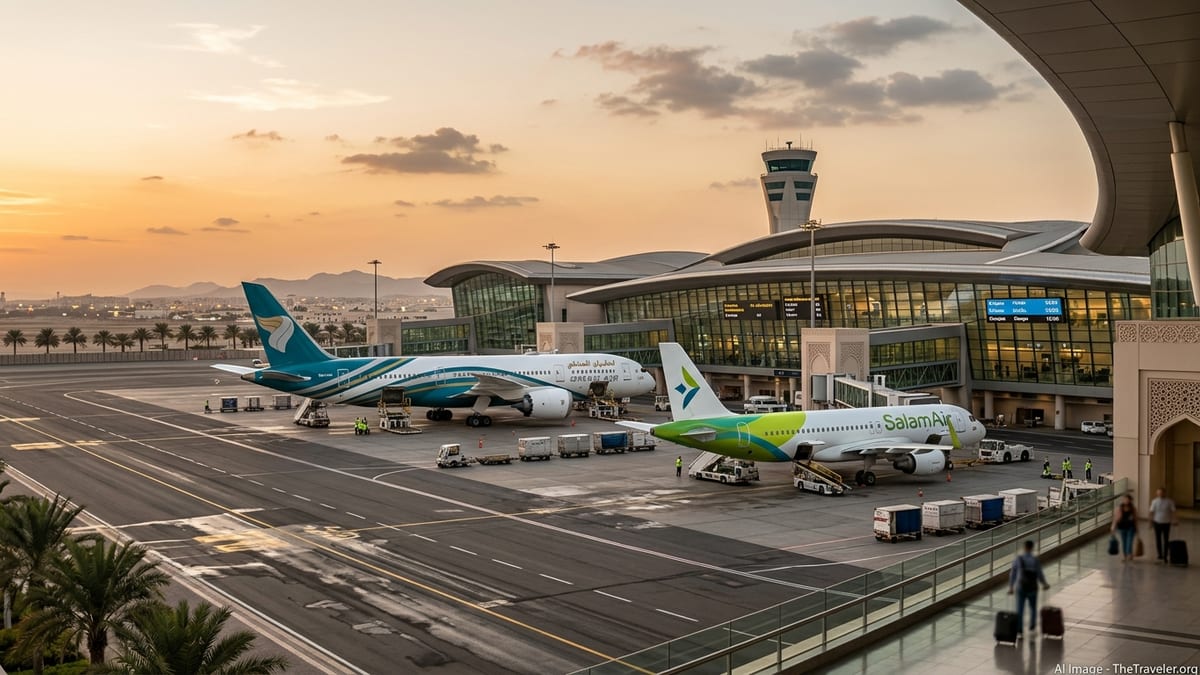
Codeshare deepens as Muscat is positioned as shared hub
In statements dated 18 November 2026 from SalamAir and 19 November 2026 from Oman Air, the two carriers confirmed that their long running cooperation has entered a new phase focused on Muscat as a joint connecting hub. The carriers describe the partnership as part of broader efforts to “optimise” their complementary networks and expand access across Africa, Asia, the Middle East and Europe via Oman’s main gateway.
Under the existing arrangement, Oman Air’s WY code is placed on eligible SalamAir flights, while SalamAir’s OV code appears on selected Oman Air services. Each airline can sell seats on the other’s operated flights through its normal booking channels, allowing passengers to buy itineraries that combine both brands on a single ticket across participating routes.
Both airlines stress that the latest step builds on successive phases of cooperation developed since 2020 and expanded from mid 2024, but now more explicitly frames Muscat International Airport as the central transfer point for an integrated full service and low cost offering within Oman’s national aviation strategy.
What the combined network means for travelers
For passengers, the immediate change is in connectivity rather than a visible merger of the two companies. The codeshare currently spans 42 destinations on Oman Air’s network and 37 on SalamAir’s, creating what the airlines present as a de facto network of 79 points that can increasingly be linked on through itineraries via Muscat, subject to the specific routes included in the agreement.
In practical terms, this allows travelers to pair Oman Air’s longer haul and premium regional services with SalamAir’s shorter haul and typically lower cost routes on one ticket, where available. For example, a journey originating on an Oman Air flight from Europe or South Asia can be ticketed to continue on a SalamAir service to a secondary destination in the Gulf or wider region, booked through either airline’s channels when the codeshare applies.
The airlines say they are prioritising improvements to connection timings, booking flows and handling of transfer passengers in this new phase. However, they have not yet published a detailed list of 2027 schedules or new connection banks, and travelers are advised to check current booking engines for specific city pairs and minimum connection times before finalising itineraries.
Separate brands, distinct products and rules
Despite the closer network integration, Oman Air and SalamAir continue to operate as separate airlines with different service concepts. Oman Air positions itself as a full service carrier, with features such as premium cabins, inclusive catering and a wider range of airport services on many routes. SalamAir remains a low cost airline, generally built around unbundled fares where extras like baggage, seat selection and onboard meals may be charged separately.
Because of this, passenger experience and entitlements still depend on the operating carrier for each segment, even when flights are sold on a single through ticket under a partner’s code. Current rules mean that lounge access follows the rules of the airline whose lounge is being used and is not automatically extended to sectors operated by the partner, so travelers should not assume lounge entry on SalamAir operated legs simply because they hold Oman Air status or are flying on a WY coded ticket.
Similarly, baggage allowances and service policies can differ between the two airlines, and the announcements do not indicate any full harmonisation of these rules. Travelers booking mixed itineraries should therefore look carefully at the conditions displayed during booking and in their confirmation, especially where a low cost sector is combined with a full service leg.
State ownership and role in Oman’s aviation strategy
The codeshare expansion follows the Omani government’s completion of its acquisition of SalamAir in late March 2026, a move officials framed as part of plans to create a more integrated national aviation ecosystem alongside flag carrier Oman Air. Government statements at the time emphasised tighter coordination between the two airlines’ networks and a reduction in unnecessary overlap, while committing to retain both brands and their distinct operating identities.
In their November 2026 announcements, Oman Air and SalamAir explicitly link the strengthened partnership to Oman Vision 2040 and the National Aviation Strategy 2040. The carriers present the combined network as a tool to boost inbound tourism and business travel, improve connectivity at Muscat and enhance the overall efficiency of Omani aviation without consolidating the airlines into a single entity.
Officials and the airlines also point to potential operational efficiencies over time, such as better use of aircraft capacity and more coordinated planning between commercial, network and operations teams. These ambitions remain forward looking, and no specific fleet changes or joint operational structures have been detailed in connection with this codeshare announcement.
What travelers should watch next
Looking ahead into 2027, Oman Air and SalamAir say they will continue to refine connection times at Muscat, expand the range of destinations available under the codeshare and explore additional “growth opportunities” using their combined networks. They have not, however, announced a merger, a joint frequent flyer programme or automatic alignment of benefits such as priority services or through check of baggage across all itineraries.
Before booking, travelers who want to take advantage of the expanded partnership should confirm whether their chosen route is currently operated under codeshare, check the operating carrier for each leg and review the applicable baggage rules, change and refund conditions, and lounge arrangements. As schedules for 2027 are finalised, it will also be worth revisiting each airline’s booking engine or timetable to see which new city pairs and connection patterns have actually been implemented.
For now, Muscat’s role as a shared hub for a full service and a low cost airline is becoming clearer through this broadened codeshare. How far that integration extends into concrete timetable changes and aligned passenger benefits will become apparent as the next phase of cooperation is rolled out.