


Antigua, Guatemala sits in a highland valley ringed by dramatic volcanoes, including Agua, Fuego and Acatenango. The town has become the main base for organized volcano experiences in the region, from half-day walks on Pacaya to demanding overnight treks high on Acatenango. This guide focuses on planning and safety rather than glorifying risk. Conditions, rules and access can change quickly, so all details below must be reconfirmed with official sources and reputable operators close to the date of your hike.
Get the latest updates straight to your inbox!
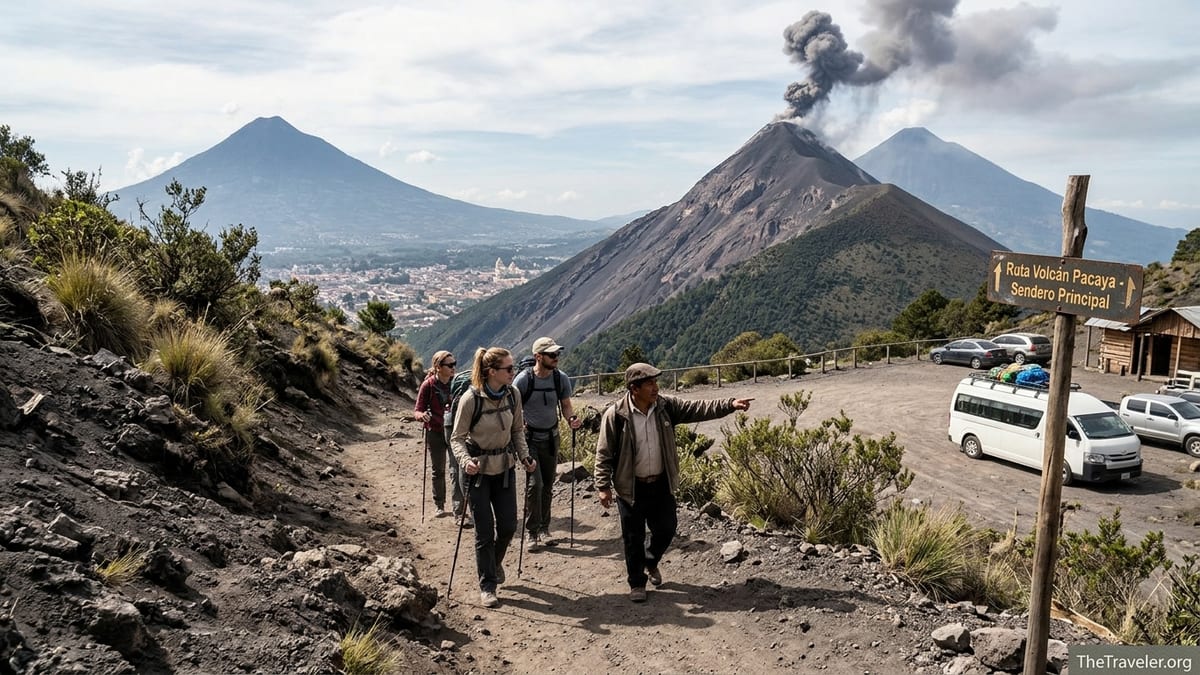
Antigua’s Volcano Setting and How Tours Are Organized
From central Antigua you can see Volcán de Agua rising directly to the south, while the twin mass of Acatenango and the very active Fuego stand to the west. Pacaya lies further to the southeast. Most commercial volcano tours use Antigua as their hub, with early-morning or mid-afternoon pickups from hotels or central meeting points and transport by minibus to trailheads in surrounding villages. Typical drives to Pacaya or Acatenango take about one to one and a half hours in normal traffic.
Local authorities, including the national park agency and disaster-management and geological services, monitor volcano activity and sometimes require closures or restrict access to certain zones. In parallel, municipalities that administer access roads and park gates can introduce their own rules, for example on whether unguided ascents are allowed. This means that tour operators may adjust itineraries or cancel departures at short notice in response to official advisories.
Travelers choosing between Pacaya, Acatenango and easier viewpoints should think first about fitness, altitude tolerance and comfort with basic mountain conditions, then about time and budget. Reputable operators publish sample itineraries, but these are approximate. You should confirm current departure times, permitted routes, group sizes, required equipment and park fees directly with an operator and, where possible, check recent notices from the Guatemalan tourism and protected-areas authorities.
As of late 2026, Pacaya remains the most consistently offered hiking option from Antigua, while Acatenango is usually available as a more strenuous overnight or long day hike when activity levels and local regulations allow. Vehicle-accessible viewpoints and short walks near Antigua, such as the Cerro de la Cruz lookout and hilltop leisure parks in the surrounding hills, provide alternatives for families, cautious travelers or those with limited mobility.
Tier 1: Shorter Volcano Experiences such as Pacaya
Pacaya is typically marketed as a half-day hike from Antigua, suitable for reasonably fit travelers who may not be regular hikers. Operators commonly offer morning and afternoon departures. Morning trips often leave Antigua around 6:00 to 7:30, returning early to mid-afternoon. Afternoon departures usually leave around midday to early afternoon and return after sunset if conditions permit. Including driving and check-in, you can expect to be away from Antigua for roughly six to seven hours, though actual schedules vary by company and traffic.
The usual Pacaya route begins from a village trailhead on the flanks of the volcano and climbs on a mix of paved path, dirt and volcanic ash. The path is steady rather than technically difficult, but loose underfoot in places and can feel steep for travelers not used to hiking. Many tours state hiking times of around 1.5 to 2.5 hours up and a bit less coming down, with total elevation gain in the hundreds of meters rather than over a thousand. Some local guides offer horses for part of the ascent at additional cost, which can be useful for those who get tired on the way up, though rules on where animals are allowed may shift.
Pacaya is part of a national park, and there is a per-person entrance fee collected at the official gate. Tour listings and park guides frequently show that this fee is separate from tour prices, and that rates are updated periodically. Because fees and payment methods can change, you should verify the current park entrance cost and whether it is included in your tour price at the time you book, and again a few days before departure. Recent guidance has also emphasized that visitors must stay on marked trails and obey instructions from official and community guides.
Pacaya has had periods when its summit and lava fields were inaccessible due to activity or safety concerns. Recent tours tend to focus on viewpoints overlooking active vents or recent lava flows, rather than walking directly on fresh lava. Any mention of seeing lava fountains, flowing lava or eruptions should be treated as a possibility, not a promise. Volcanic activity varies from day to day and even hour to hour, and operators cannot guarantee visible lava. Before you commit, check the latest safety advisories from Guatemala’s disaster agency and geological service, and ask operators how they adjust routes when activity increases or ashfall is present.
Tier 2: Demanding Overnight Hikes on Acatenango
The classic Acatenango experience is a two-day, one-night trek from Antigua to a high camp on Acatenango’s upper slope, with views of neighboring Fuego’s eruptions when conditions are clear and activity allows. Most group tours collect participants in Antigua between roughly 6:30 and 9:00 in the morning, drive for about an hour to the trailhead village, then begin the ascent late morning. Hikers typically reach established camp areas in the mid to late afternoon after five to six hours of steady climbing with breaks.
Typical group tours quote a total elevation gain in the region of 1,300 to 1,500 vertical meters from trailhead to camp, with camp altitudes commonly reported around 3,500 to 3,750 meters above sea level. The optional pre-dawn push to the summit gains additional height to reach just under 4,000 meters. These heights mean that even fit travelers can feel the effects of altitude, including shortness of breath, headache or disturbed sleep. Spending at least a night in Antigua, which sits around 1,500 meters, before the climb, and ideally doing an easier acclimatization walk such as Pacaya, reduces but does not remove the risk of altitude discomfort.
Group itineraries usually include an afternoon and evening at camp watching Fuego across the saddle, followed by a very early start on day two, often around 3:30 or 4:00 in the morning, to hike from camp to the summit for sunrise. After descending back to camp for breakfast, groups continue down to the trailhead and drive back to Antigua, normally arriving late morning or early afternoon. Some operators may offer a same-day Acatenango ascent and descent for strong hikers, but this compresses altitude exposure and effort into a single long day and is not appropriate for everyone.
Equipment standards, group sizes and what is included vary significantly between operators. Well regarded companies generally provide transport, local guides, campsite infrastructure, tents and sleeping bags, and often main meals. Higher-end or private tours may include warmer-rated sleeping bags, thicker mattresses and smaller group ratios. Budget tours may expect you to carry communal food, water and camping gear yourself, and some use basic tents or older sleeping bags. Before booking, ask specific questions about maximum group size, the temperature rating and condition of sleeping bags, whether extra layers, gloves and hats are available to rent, and how much weight you are expected to carry.
Real Risks on Acatenango and How to Prepare
Acatenango is physically demanding. The trail is steep, dusty or muddy in places, and can be slippery on volcanic sand. You will likely be hiking for several hours at sustained gradients, often with a loaded backpack. Reasonable baseline fitness, including the ability to manage continuous uphill walking at altitude, is essential. If you are unsure, speak candidly with your operator about your experience on previous hikes and ask how they handle slower hikers or people who struggle on the way up.
Cold is one of the main challenges on Acatenango. Nighttime temperatures at camp can drop close to or below freezing, particularly in the dry season. Windchill makes it feel even colder, especially during the pre-dawn summit push. Many travelers underestimate how cold it will feel. At a minimum, you should plan to have a moisture-wicking base layer, insulating mid layers such as fleece, a windproof and preferably waterproof outer shell, warm hat, gloves, thick socks and a headlamp with spare batteries. Confirm which of these items you must bring from home and which can be rented in Antigua, and check that rental stock is in good condition.
Altitude-related illness is another real risk. While most healthy people can complete the hike with only mild symptoms, anyone with heart or lung conditions, uncontrolled high blood pressure, or a history of serious altitude problems should consult a medical professional before attempting Acatenango. Regardless of health status, pacing yourself, drinking adequate fluids and avoiding alcohol before the trek all help. If you develop severe headache, nausea, confusion, or breathing difficulty at rest, you should descend with a guide. Ask operators how they are trained to recognize and respond to altitude sickness and what their protocol is for evacuations or early descent.
Finally, Acatenango sits beside an active volcano. Eruptions of Fuego are frequent, and, although most tours are run from a safe observational distance agreed with authorities, there is inherent unpredictability. In past years, authorities have temporarily suspended Acatenango or Fuego-side access during heightened activity, sometimes at short notice. Before committing to a booking, check recent news and advisories regarding volcanic activity, ask operators how they receive official updates during the trip, and accept that there is never a guarantee of seeing spectacular eruptions. A responsible operator should be clear that safety decisions are driven by official restrictions, not by pressure to deliver dramatic views.
Who Should and Should Not Attempt These Hikes
Pacaya and similar short volcano hikes are generally appropriate for reasonably fit travelers who are comfortable walking uphill for an hour or two at a time. People who exercise regularly, do occasional day hikes or are used to walking on uneven ground usually manage Pacaya without major difficulty. However, anyone with knee problems, significant balance issues or cardiac or respiratory conditions should discuss the plan with both their doctor and their operator, and consider whether a horse-assisted ascent or a non-hiking viewpoint might be safer.
Acatenango, by contrast, is best suited to fit hikers or active travelers who have some experience with full-day mountain walks and are prepared for basic camping at high altitude. Those with limited hiking background can still succeed with determination and good support, but the experience will likely feel very hard. People with known heart or lung disease, poor circulation, severe asthma, or recent major surgery are generally advised to avoid high-altitude, overnight volcano hikes unless explicitly cleared by a physician who understands the conditions involved.
Travelers uncomfortable with basic hygiene, simple mountain toilets, or sleeping in close proximity to others in shared tents may also find Acatenango more stressful than rewarding. Nighttime noises from Fuego, barking dogs in nearby communities and the cold can disturb sleep. Families with younger children should be particularly cautious. While some operators accept teenagers on Acatenango, age minimums vary and younger children are usually better served by Pacaya or easier viewpoints close to town, where evacuation is simpler and exposure to cold and altitude is less severe.
If you are pregnant, have poorly controlled chronic illness, significant mobility limitations or a history of serious altitude illness, the conservative choice is to skip both Pacaya and Acatenango and focus on low-altitude viewpoints around Antigua. In these cases, you can still enjoy the volcanic landscape visually, without taking on the physical and environmental stresses of high-altitude hiking.
Non‑Hiking Volcano Viewpoints and Safer Alternatives
Not every traveler to Antigua needs or wants to spend long hours on a steep trail. Several accessible viewpoints and hilltop parks around the town offer impressive volcano panoramas with little or no hiking. The classic in-town option is Cerro de la Cruz, a hillside cross reached by a short, stepped path above the northern edge of Antigua. Local authorities have, in recent years, maintained a visible security presence during the day, and the path is usually considered safe in daylight, though visitors are still advised to go in small groups, keep valuables discreet and avoid visiting before sunrise or after dusk.
Beyond town, private recreational parks and viewpoints on the ridges above Antigua offer vehicle-accessible terraces, restaurants and sometimes activities like swings, ziplines or small cable cars. These places are typically reached by shuttle or taxi from Antigua, followed by only a few minutes of walking. Examples include fantasy-themed hill parks and countryside complexes in the highlands above town. Because offerings, opening hours and access rules change regularly, and some sites have introduced or removed activities in recent years, you should confirm current operation, transport options and safety guidance directly with your accommodation or a local tour agency.
For many travelers with limited mobility, traveling with small children or recovering from illness, these viewpoints provide a satisfying way to appreciate the volcano scenery without the commitment of Pacaya or Acatenango. From elevated terraces you can often see Agua dominating the skyline and, on clear days, catch views of Fuego’s ash plumes in the distance. You remain close to shelter, food, bathrooms and transport, which significantly lowers overall risk compared to remote mountain camps.
Even for fit hikers, combining a short city viewpoint like Cerro de la Cruz with a half-day outing to a hilltop park can be a good alternative if volcanic activity or personal circumstances rule out more serious hikes during your stay. These lower-commitment options also allow you to adjust plans at the last minute based on weather, air quality or official alerts without losing substantial nonrefundable tour costs.
Practical Planning, Verification and Costs
Across all three tiers of experience, you should treat any figures you hear for hiking times, altitudes, fees and prices as approximate. For Pacaya, most recent tours quote total durations of five to seven hours door to door, with actual trail time of three to four hours. For Acatenango, most overnight itineraries suggest five to six hours hiking up to camp on day one, one and a half to three hours up and down to the summit on day two, and three to five hours descending to the trailhead, depending on conditions and group pace. These ranges can shift with weather, trail erosion and changes in starting point, so confirm specifics before you go.
Tour prices also span a wide range. Shared Pacaya tours including transport and guiding but excluding park entrance commonly cluster in a moderate range per person, while Acatenango overnight trips can vary from budget group tours to premium small-group or private climbs costing several times more. Some operators include all meals and gear in the price, others charge extras for walking sticks, warmer jackets, gloves or private porter services. When comparing options, ask for a detailed breakdown of what is and is not included, including whether national park entrance fees, local community contributions and guide tips are part of the upfront cost.
Crucially, hard numbers such as current park fees, trailhead access charges or regulated maximum group sizes should be checked as close to your departure date as possible with primary or operator-managed sources. Official tourism and protected-area agencies sometimes revise rules, for example on mandatory guiding, vehicle access restrictions or temporary closures due to eruptions, landslides or weather events. Reputable operators update their listings but may lag behind rapid changes by a few days, so a brief cross-check with an official information source can catch last-minute alterations.
In recent years there have been incidents and fatalities on volcano hikes in Guatemala, often linked to exposure, falls, health issues and unexpected changes in volcanic behavior. Rather than being alarmed, use this knowledge to prepare. Choose operators that emphasize safety training, guide certification and contingency planning. Share accurate health information with your guide, carry appropriate clothing and equipment for cold and wet conditions even if the forecast looks benign, and keep your itinerary flexible enough to respect cancellations or reroutes based on official safety advice.
Choosing the Right Volcano Experience for You
For first-time hikers or travelers who are unsure how they will respond to altitude, a Pacaya day trip or a combination of in-town viewpoints and an accessible hilltop park is usually the most sensible option. You will still experience volcanic landscapes, views of surrounding peaks and, conditions permitting, some volcanic activity in the distance, without committing to an overnight stay above 3,000 meters. This path also allows you to test your comfort with local guiding, group tours and terrain before considering something harder on a future visit.
Fit but not highly experienced hikers who are comfortable with full-day exertion and basic camping may find Acatenango a highlight of their time in Guatemala, provided they prepare properly and book with a safety-conscious operator. Taking a day to acclimatize in Antigua, packing or renting genuinely warm clothing and keeping expectations realistic about views and weather will make the trip more enjoyable. Remember that the goal is a safe mountain experience, not chasing the most dramatic possible eruption footage.
Serious trekkers used to altitude and multi-day mountain conditions will likely view Acatenango as challenging but manageable, and may opt for smaller-group or private tours to set a faster pace or customize the experience. Even for this group, respect for local rules and conditions is essential. Unguided ascents that ignore closures or deviate from approved routes can put both visitors and local rescuers at unnecessary risk. Experienced hikers can also benefit from supporting local guiding communities and learning about the cultural context of these mountains.
Families with children and travelers with limited mobility will often have the best experience focusing on Tier 3 options: Cerro de la Cruz, vehicle-accessible viewpoints and gentle walks near town. If older teenagers in the family are keen on volcano hiking, Pacaya with a private guide, flexible pacing and the option to turn back early is usually a more measured choice than Acatenango. In all cases, the safest and most rewarding trip is one that matches the slowest and least experienced member of your group, not the strongest.
Summary Comparison and Final Safety Reminder
For quick reference, it is helpful to think in terms of traveler profiles. A first-time hiker might pair Cerro de la Cruz and an accessible hilltop park on one day, then, if feeling confident, join a Pacaya tour with the possibility of hiring a horse for part of the climb. A fit but not highly experienced traveler could choose Pacaya first to gauge how their body handles altitude and terrain, then, if that goes well and conditions are favorable, consider Acatenango with a reputable operator. A serious trekker may go directly to Acatenango, ideally still allowing a day in Antigua beforehand to acclimatize.
Families with kids often do best with short, structured outings. Cerro de la Cruz, a guided city walk that includes viewpoints, or a shuttle to a nearby hilltop leisure park provide engaging experiences with straightforward logistics. Parents of teenagers who are eager for more adventure may add Pacaya if everyone is comfortable with walking uphill for several hours. Travelers with limited mobility or significant health concerns should prioritize vehicle-accessible viewpoints and relaxed scenic stops where help and transport are close at hand.
Across all profiles, the key message is the same. Volcanoes are dynamic, high-consequence environments. Any plan you make in advance should be treated as provisional. A few days before your intended hike, recheck current conditions with official tourism and disaster-management sources, confirm details with your chosen operator, and be prepared to accept changes or cancellations made on safety grounds. Eruptions, weather, landslides or updated regulations can all alter what is possible at short notice.
If you approach Antigua’s volcanoes with respect, realistic expectations and proper preparation, they can be a memorable part of your time in Guatemala. Choose the tier of experience that honestly matches your fitness, health and appetite for rough conditions, and always let current, verified safety information guide your final decision.