


More news on this day
A convergence of powerful typhoons, constrained airspace and resurgent summer demand has pushed Asia’s busiest aviation corridors into fresh turmoil in 2026, with widespread delays and cancellations rippling across Hong Kong and mainland China and straining the region’s role as a key transit hub.
Get the latest news straight to your inbox!
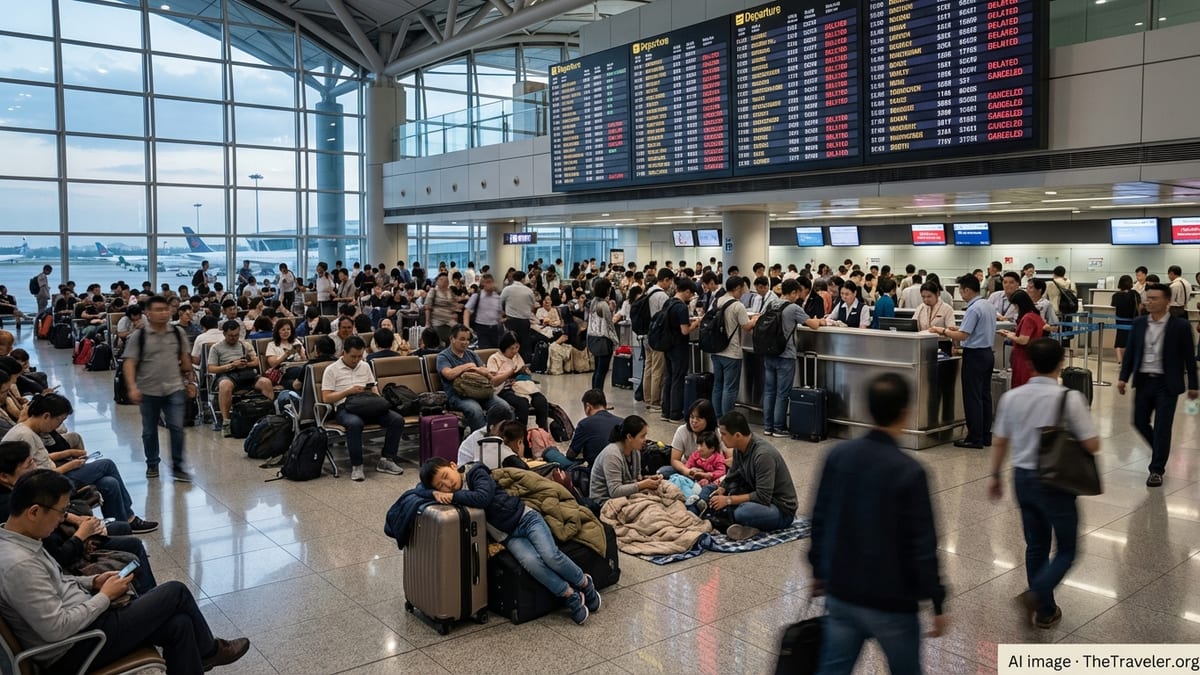
Summer Storms Turn Asia’s Busiest Corridors Into Bottlenecks
Published coverage across the region indicates that Hong Kong and coastal China have endured one of their most disruptive summer travel periods in recent years, as successive tropical systems battered key air corridors in July and August 2026. Severe Tropical Cyclone Dolphin and Typhoon Bavi both forced large-scale schedule changes on routes linking Hong Kong with mainland China, Taiwan and Japan, driving up same-day delays and cancellations at already busy airports.
Reports from Hong Kong highlight that dozens of cross border flights were scrubbed or rescheduled in early August as Dolphin swept across the South China Sea, with high speed rail services to the mainland also curtailed. As Bavi intensified in mid July, regional media counted more than 130 cancellations on routes connecting Hong Kong to nearby Asian cities, underscoring the vulnerability of short haul networks to fast moving storms over congested airspace.
Airport Authority Hong Kong advisories describe how the operator activated typhoon protocols as Tropical Cyclone Noul approached in late July, preemptively adjusting airport operations in coordination with airlines and other stakeholders to keep runways and apron areas safe. These layered typhoon events compressed large volumes of disruption into a matter of weeks, setting the stage for the wider Asia aviation network crisis now playing out across the region.
Further north, mainland hubs along the eastern seaboard contended with their own storm driven disruption. Data compiled by travel and aviation outlets on recent tropical systems such as Maysak point to thousands of delayed flights and more than a hundred cancellations in a single day across Chinese airports, a level of strain that has knock on effects for Hong Kong and other international gateways that depend on tight connections to mainland feeder traffic.
Structural Constraints Expose Fragility in the Hong Kong China Air Link
Beyond the weather, structural limits in the air traffic system between Hong Kong and the mainland are magnifying delays. Publicly available technical descriptions of the region’s airspace note that traffic between Hong Kong and mainland China is heavily funneled through a small number of high altitude corridors, with at least one key airway handling a significant share of northbound and southbound flows. Aviation analysts have long pointed to this narrow routing as a chronic source of congestion when schedules are full or when storms force rerouting.
Travel and flight tracking communities describe how aircraft between Hong Kong, central China and Northeast Asia often make long detours along prescribed coastal corridors or around military controlled zones. These routings lengthen flight times and leave limited slack to absorb delays when thunderstorms or typhoons shut down segments of the network. Once traffic banks are pushed out of sequence, holding stacks build up rapidly over Hong Kong and adjacent mainland terminals, creating a knock on wave of missed connections.
The pressure is compounded by strong post pandemic demand that has restored traffic at Hong Kong International Airport to levels close to the pre crisis era. Airport Authority reports for the 2025 to 2026 financial year highlight sustained passenger growth and the opening of Terminal 2 as part of a three runway system designed to reinforce Hong Kong’s hub status. While the new capacity has improved throughput on the ground, the airspace above remains tightly managed and is still vulnerable to bottlenecks when regional weather or military activity constrains routing options.
On the mainland side, route data compiled by schedule specialists show that Chinese carriers have periodically trimmed services to Hong Kong and Macao in 2026, with some routes temporarily suspended and overall weekly flights from the mainland into Hong Kong cut by nearly a fifth during parts of the second quarter. These adjustments reflect both operational pressures and shifting demand, but they also signal that airlines are struggling to maintain reliability in a network where even minor disturbances can cascade.
Airlines Adjust Schedules as Delays Pile Up
Individual carriers in the Hong Kong market have responded to the volatile operating environment with targeted schedule cuts, capacity shifts and new operating procedures. Hong Kong Airlines filings for May and June 2026 show that the carrier reduced overall one way departures from Hong Kong by just over 4 percent, trimming frequencies on routes to major mainland cities such as Beijing, Hangzhou, Nanjing and Shanghai as well as key regional destinations like Seoul and Sydney. The data underline how airlines are attempting to build more resilience into their timetables by pulling back marginal flights.
Chinese airlines have also rebalanced their Hong Kong networks, with aviation schedule databases indicating a series of suspensions and reductions on secondary city links in the second quarter of 2026. Routes such as Qingdao Hong Kong were paused for several weeks, and the aggregate number of weekly one way flights from mainland China to Hong Kong dropped from the mid 300s to under 300, a cut of almost 20 percent. These moves have reduced connectivity for some travelers but may help carriers recover more quickly when storms or airspace constraints hit.
Performance data for individual Hong Kong based airlines suggest that punctuality has been volatile through late July and August, even as most flights still operate. One prominent on time performance tracker shows that a major local carrier recorded delay rates ranging between roughly 23 and 40 percent of its flights over recent weeks, with average delays for late flights stretching from around 36 to more than 100 minutes depending on the week. The figures point to a network under strain that nevertheless continues to move large numbers of passengers each day.
Flag carrier Cathay Pacific has focused on incremental reliability and safety improvements following a widely publicized communication lapse on a long haul flight from Hong Kong in early July. According to press releases from Hong Kong’s Civil Aviation Department and official news portals, the incident did not involve equipment failure but prompted the airline to enhance monitoring procedures, review crew training and refine reporting mechanisms. Regulators have signaled they will continue to monitor implementation of these measures as traffic volumes rise.
Extreme Weather and Climate Trends Add New Uncertainty
The 2026 disruption across the Hong Kong mainland aviation axis is part of a broader pattern of weather related stress on global air travel. International analyses of this year’s northern hemisphere summer point to overlapping pressures from extreme heat, stronger storms and tight labor and infrastructure capacity, all combining to leave passengers more vulnerable to delays and cancellations across multiple regions.
In East Asia, typhoons remain the most visible driver of sudden disruption, but changing storm patterns and heavier rainfall are challenging existing operating assumptions. Hong Kong Observatory bulletins for South China coastal waters in late August highlight repeated warnings for strong winds and high seas associated with tropical cyclones, a backdrop that forces airlines and airports to adjust schedules with limited notice. Each warning period triggers a chain of rerouting decisions and recovery flights that can reverberate through the dense web of China domestic and international services.
At the same time, global industry reports on aviation and sustainability warn that hotter average temperatures can erode aircraft performance on takeoff, particularly at land constrained airports like Hong Kong that rely on precisely timed departures to maintain throughput. When combined with already congested airways into mainland China, these operational constraints make it harder for airlines to catch up once they fall behind, reinforcing a cycle in which one day’s storm becomes several days of residual delay.
Travelers heading into the region in the coming weeks face an environment in which schedules may look robust on paper but remain exposed to sudden change. Industry observers suggest that flexible itineraries, longer connection windows and close monitoring of weather and airline advisories are becoming essential strategies for passengers navigating Asia’s most crowded skies during this unsettled summer.
Regional Connectivity Tested as Hong Kong Strives to Hold Hub Status
The current wave of disruption is testing Hong Kong’s long term ambition to consolidate its status as a leading international aviation hub for the Chinese mainland and the wider Asia Pacific. Airport Authority Hong Kong’s latest annual review emphasizes that the three runway system, new Terminal 2 facilities and multimodal links such as the Hong Kong Zhuhai Macao Bridge are designed to attract more transit traffic and streamline cargo flows, particularly on routes connecting the mainland to the rest of the world.
Yet the events of mid 2026 show how quickly that hub strategy can be challenged when regional connectivity is interrupted. When mainland flights are delayed or cancelled en masse by storms like Maysak, Dolphin or Bavi, transit passengers miss onward connections at Hong Kong and airlines are forced into complex reaccommodation exercises. Mainland schedule reductions and typhoon driven cancellations amplify the risk that some travelers will reroute via competing hubs in Seoul, Singapore or the Middle East in search of more predictable journeys.
Policy focused commentary from regional aviation forums notes that Hong Kong, the mainland and Macao have been working to deepen cooperation on air traffic management, with a high level meeting in Xi’an in May 2026 underscoring efforts to improve coordination across flight information regions. While details of specific airspace changes remain limited, this kind of collaborative planning will be central to easing choke points and mitigating the effects of future weather and demand shocks on the shared aviation network.
For now, the combination of tropical storms, constrained airspace and rapid demand recovery has created a difficult summer for airlines and passengers alike across Hong Kong and mainland China. The months ahead will reveal whether incremental schedule adjustments, infrastructure investments and closer cross border coordination can prevent similar network wide crises from recurring as Asia’s aviation recovery continues.
Airport Authority Hong Kong advisory on Tropical Cyclone Noul
Regional coverage of Typhoon Bavi flight cancellations
Mainland China Hong Kong service reductions in 2Q 2026
Hong Kong Airlines schedule cuts for May June 2026
Civil Aviation Department review of communication loss incident