


More news on this day
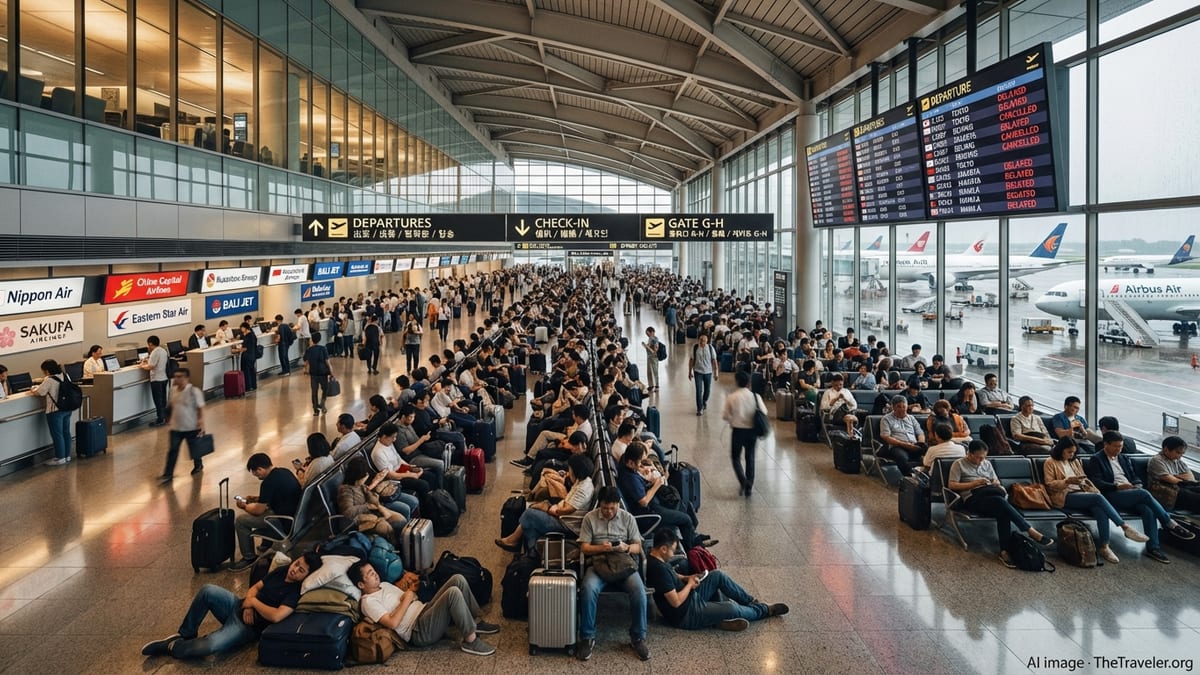
Thousands of travelers across Asia faced widespread disruption as real-time aviation data showed 4,504 flight delays and 278 cancellations in a single day, with congestion and knock-on effects rippling through key hubs from Beijing and Shanghai to Delhi, Jakarta, Dubai and Hong Kong.
Get the latest news straight to your inbox!
Disruptions Concentrated at Major Asian Gateways
Data compiled from live aviation trackers and regional reports indicates that the latest wave of disruption has clustered around some of Asia’s busiest airports, where dense schedules leave little slack when problems arise. Beijing Capital, Shanghai Pudong, Guangzhou Baiyun, Jakarta Soekarno Hatta and Manila Ninoy Aquino were among the major hubs reporting elevated levels of late and cancelled services, according to airport performance dashboards and disruption maps focused on the Asia region.
An Asia-wide disruption map maintained by a global flight-tracking platform shows multiple airports operating in what it classifies as a minor to moderate disruption band, where a combination of average delay minutes and cancellation counts pushes scores above normal operating conditions. While the majority of flights continue to depart, even a single-digit percentage of affected services translates into thousands of passengers facing missed connections, extended ground time and unplanned overnight stays.
Recent analysis by travel and aviation outlets highlights how quickly numbers escalate once delays accumulate across several large hubs on the same day. One regional roundup of conditions at 21 major airports on a recent weekday, including Beijing and Dubai, recorded more than 3,300 delayed flights and just over 280 cancellations in less than 24 hours, underscoring how sensitive tightly timed schedules are to regional shocks.
On top of this, earlier in August a separate disturbance day tracked by aviation-watch publications logged 4,501 delays and 210 cancellations concentrated at major Asian gateways such as Shanghai, Delhi and Jakarta, demonstrating that spikes of this scale are becoming a recurring stress test for carriers and airports.
Weather, Geopolitics and Operational Strain Drive Irregular Operations
Publicly available airline status pages and regional travel advisories point to a familiar mix of catalysts behind the current bout of irregular operations. Seasonal weather systems over East and Southeast Asia continue to prompt rolling schedule adjustments, with several carriers warning of potential delays and cancellations on routes touching airports prone to heavy rain, low visibility and strong winds at this time of year.
At the same time, heightened geopolitical tensions in parts of the broader region have disrupted airspace usage and routings. A recent travel advisory for the Gulf region, for example, detailed delays and cancellations at Dubai and Abu Dhabi as airlines adjusted operations amid renewed fighting affecting Middle Eastern air corridors. Those bottlenecks intersect with long-haul flows between Asia, Europe and North America, amplifying knock-on delays at connecting hubs further east.
Operational pressures within Asia’s aviation sector add another layer of fragility. After a strong rebound in air travel, carriers have restored large portions of their pre-pandemic schedules, with Chinese airlines alone carrying more than 150 million passenger trips in a two-month summer period, according to recent industry data. Even as airlines pursue high utilization to recover revenue, staffing and aircraft availability constraints can limit flexibility when weather or airspace disruptions occur.
Industry analysts have also noted ongoing structural shifts in regional networks. Recent coverage of the China Japan market, for instance, pointed to the cancellation of thousands of planned flights on that corridor over the summer, as demand softened and capacity was redeployed to other Asian destinations. The resulting concentration of traffic on fewer routes and hubs can magnify the impact when those nodes experience localized disruption.
Hubs from Beijing to Dubai Shoulder the Biggest Impact
The brunt of the disruption has fallen on a cluster of high-volume airports that act as transfer points for both regional and intercontinental traffic. Aviation intelligence platforms monitoring airport performance in real time show that large hubs such as Beijing Capital and Guangzhou Baiyun, each handling hundreds of daily movements, have experienced elevated delay metrics over recent days compared with typical running averages.
In Southeast Asia, Manila and Jakarta continue to feature prominently in disruption tallies when weather and air traffic flow restrictions collide with already congested infrastructure. Commentary from airport performance trackers has repeatedly flagged extended average delay minutes at these gateways during peak travel days, with some days recording more than 20 minutes of average arrival delay and a noticeable uptick in late departures.
To the west, Dubai International and Abu Dhabi’s Zayed International remain critical junctions for Asia-bound and Asia-originating passengers. Recent reporting from the United Arab Emirates described a spate of flight delays and cancellations at both airports, with long-haul services to Europe, Asia and the Middle East affected as airlines rerouted or rescheduled services in response to shifting security conditions.
Across the broader region, these operational hotspots combine to produce the kind of large, headline-grabbing figures seen in the latest disruption snapshot, where 4,504 delays and 278 cancellations translate into thousands of disrupted journeys and sizable reaccommodation challenges for airlines and airport ground teams.
Knock-on Effects for Travelers Across Asia and Beyond
For travelers, the statistical picture translates into practical complications. High delay volumes at hub airports cascade down to secondary cities as aircraft and crews arrive late, eroding connection buffers and forcing rebookings. Aviation data providers have documented instances where a delayed widebody arrival during the morning wave triggers rolling delays across multiple narrowbody departures scheduled to use the same aircraft later in the day.
Intra-Asia itineraries are particularly vulnerable, as many passengers rely on tight connections through mega-hubs such as Hong Kong, Singapore, Bangkok, Dubai or Doha to reach secondary destinations. Even when a flight ultimately departs, shifting departure slots and flight times can mean missed onward legs, longer journeys or last-minute rerouting via alternate gateways.
Long-haul travelers connecting between Asia and Europe or North America face similar uncertainty when regional disruption interacts with congested long-range corridors. Travel forums over recent days have featured reports of extended flight times and schedule adjustments on trans-Pacific and Europe Asia services, as airlines manage adverse weather and airspace constraints.
Given the scale of the numbers involved, consumer advocates continue to highlight the importance of checking live flight status directly with operating carriers and monitoring regional aviation advisories, particularly on days when disruption indicators across Asia trend higher than normal.
Airlines and Airports Adjust Playbooks as Disruption Becomes Frequent
With large disruption days now appearing multiple times in a single season, airlines and airports in Asia are refining their playbooks for managing such events. Capacity adjustments on underperforming routes, particularly in politically sensitive markets, have freed up aircraft that can be redeployed to stronger corridors, though this can also reduce redundancy when irregular operations hit favored destinations.
Some carriers have expanded the use of dynamic scheduling tools and closer real-time coordination with air traffic management to optimize pushback and arrival times, aiming to reduce time spent in holding patterns or on crowded taxiways. Airport operators, meanwhile, are investing in expanded stands, upgraded terminal facilities and enhanced passenger information systems to ease pressure during peak disruption windows.
Nevertheless, the scale of recent figures, with 4,504 delays and 278 cancellations recorded in a single day across Asia, underlines how exposed the region’s aviation network remains to sudden shocks. As travel demand stays robust into the final months of the year, industry observers expect further days of elevated delays and cancellations, reinforcing the need for flexible travel planning and close monitoring of conditions on the ground.
Flightradar24 Asia airport disruption map