


More news on this day
Air travel across Asia is facing another punishing disruption cycle as operational data points to 496 flight cancellations and around 2,642 delays in a single day, snarling schedules from Guangzhou and Hong Kong to Dubai and Tokyo and affecting carriers including Royal Jordanian, Air India, Qatar Airways and a wide mix of regional airlines.
Get the latest news straight to your inbox!
Disruptions Concentrated at Guangzhou, Dubai and Tokyo
Publicly available flight tracking and aviation operations dashboards indicate that the latest wave of cancellations and delays is concentrated around some of Asia’s busiest nodes, with Guangzhou Baiyun International, Dubai International and Tokyo’s dual airports bearing a significant share of the impact. These hubs handle dense banks of departures that connect regional routes into long haul services, so relatively small schedule shocks quickly spill over into connection banks.
Data snapshots for the disruption window show clusters of cancellations on services linking mainland Chinese cities with the Gulf, including routes that feed into Dubai and other United Arab Emirates gateways. Flights between Guangzhou and major Gulf and Southeast Asian hubs appear prominently in cancellation tables, reflecting both weather related constraints and knock on effects from earlier airspace restrictions in the wider region.
In Japan, published coverage of daily airport performance points to elevated delay levels at Tokyo Haneda and Narita, with some ripple effects at Osaka and regional airports. When large origin and destination markets such as Tokyo and Hong Kong fall behind schedule, aircraft and crews arriving late from one leg are unable to turn around in time for subsequent rotations, forcing airlines to cancel or consolidate services to reset their networks.
Hong Kong has also featured repeatedly in recent weeks in disruption tallies that combine cancellation and delay counts across Asian hubs. Reports tracking day to day operations highlight how even modest numbers of cancelled flights at Hong Kong International can lead to gate congestion and rolling delays as airlines juggle arrival and departure slots for wide body aircraft serving Europe, North America and the Middle East.
Royal Jordanian, Air India, Qatar Airways and Regional Carriers Affected
The latest figures form part of a broader pattern that has been building across the first half of 2026, with a growing list of airlines caught up in recurrent schedule shocks. Long haul and network carriers such as Royal Jordanian, Air India and Qatar Airways appear among those experiencing cancellations or significant delays on services linking Asian hubs with the Middle East, South Asia and beyond.
Royal Jordanian’s connections between the Levant and major Asian gateways are particularly exposed when Gulf or Chinese airspace becomes constrained, as aircraft that would normally rotate through Dubai or nearby hubs may be held on the ground or rerouted, disrupting onward legs. Publicly available information on Asia Middle East operations shows that when long haul flights are cancelled or heavily delayed, the same aircraft cannot be redeployed for regional sectors, prompting airlines to trim frequencies temporarily.
Air India, which has been rebuilding its international network, features in several recent disruption round ups covering delays and cancellations at Indian and Gulf airports. Asia wide operational tallies for recent days show Indian hubs such as Delhi and Mumbai appearing alongside Guangzhou, Shanghai, Dubai and Tokyo in charts of delayed and cancelled services, underscoring how closely linked these markets have become.
Qatar Airways and Gulf based competitors are also affected when Middle East airspace closures or congestion intersect with weather or traffic restrictions over East Asia. Publicly available analyses of recent disruption periods describe scenarios in which aircraft allocated to Doha or Dubai rotations are left out of position in Asia, leading to cancellations on return legs and to schedule thinning on feeder routes that bring passengers from cities such as Guangzhou, Bangkok or Tokyo into Gulf hubs.
Weather, Airspace Constraints and Tight Schedules Drive the Numbers
While no single trigger explains the precise figure of 496 cancellations and 2,642 delays, aviation analytics and prior disruption reports point to a combination of factors that have repeatedly stressed Asia’s air travel system in recent months. Seasonal storms across parts of China and Southeast Asia, occasional low visibility at coastal airports and convective weather near major hubs frequently slow departures and arrivals, reducing the effective capacity of already busy runways.
In parallel, airspace adjustments tied to military exercises, geopolitical tensions and longer term rerouting around sensitive zones have reduced flexibility for airlines planning optimal routings between Asia, the Middle East and Europe. Analyses of recent airspace closures in the Gulf and surrounding regions show that diversions and elongated flight paths can add hours to block times, consuming crew duty limits more quickly and leaving less slack in aircraft rotations.
Operational commentary from earlier disruption days stresses that Asia’s aviation recovery has brought traffic back toward or above pre pandemic levels, but airline and airport staffing, spare aircraft availability and maintenance capacity have not always kept pace. This means that when a weather event or airspace restriction forces widespread holding patterns or extended turnaround times, airlines have limited capacity to absorb the shock without cancelling flights outright.
Network modeling shared by industry analysts indicates that high volume gateways such as Guangzhou, Hong Kong, Shanghai and Tokyo operate with tightly timed waves of departures that rely on aircraft arriving within narrow windows. Once delays begin to stack up, airlines may resort to cancelling entire rotations in order to prevent knock on disruption spilling into the following day, which is reflected in the elevated cancellation totals now emerging from Asia wide data.
Passengers Confront Missed Connections, Rebookings and Rising Fares
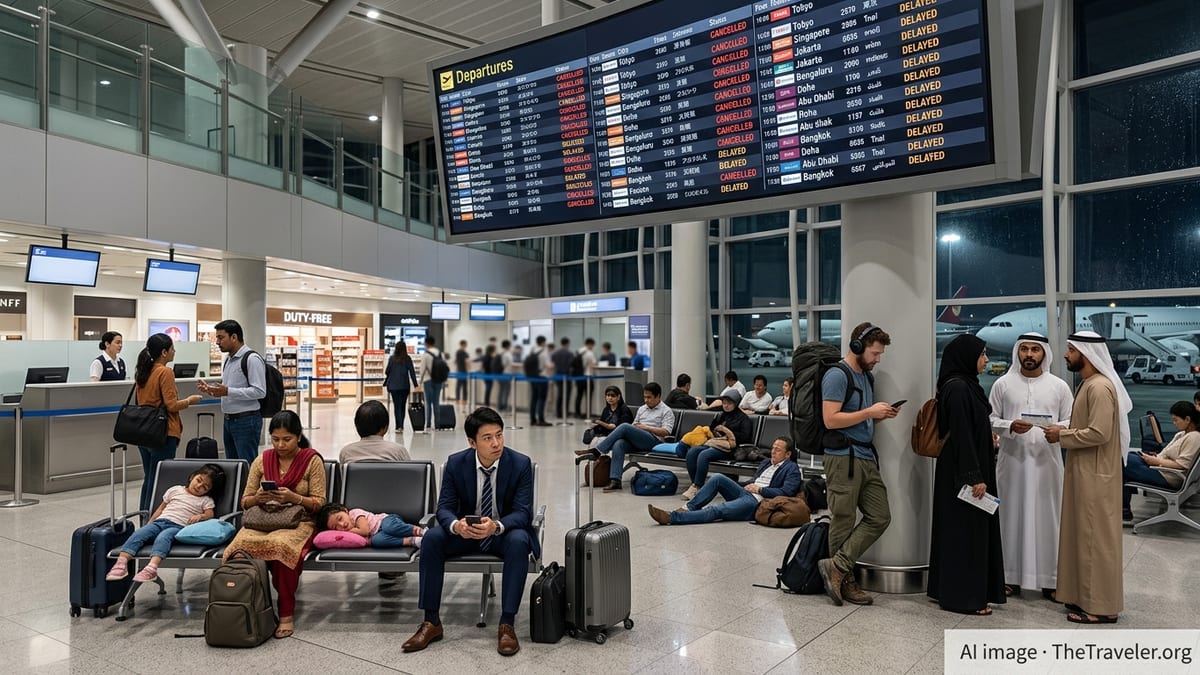
For travelers, the statistics translate into missed connections, overnight airport stays and a scramble for remaining seats on alternative routings. Recent travel coverage of disruption days across Asia describes passengers at Guangzhou, Hong Kong, Dubai and Tokyo facing long lines at rebooking counters as airlines work through backlogs created by earlier cancellations.
According to publicly available guidance from airlines and airports, affected passengers are being encouraged to monitor flight status closely through carrier apps and departure boards, to arrive at airports earlier than usual during periods of heightened disruption and to be prepared for last minute gate or schedule changes. Advisories also emphasize the importance of keeping travel documentation and booking references readily accessible to speed up rebooking or refund processing if flights are cancelled.
Industry analysts note that when several hundred flights are cancelled across the region within a short time frame, available seats on competing carriers and alternative routings can be exhausted quickly, driving up last minute fares. This is particularly acute on trunk routes linking China, Hong Kong, Japan and the Gulf, where business and visiting friends and relatives traffic remains strong and capacity has not fully caught up with demand after previous cutbacks.
Travel insurance specialists and consumer advocates frequently highlight the role of comprehensive coverage in such scenarios. Publicly accessible advisories recommend that passengers retain documentation of delay or cancellation notices, boarding passes and receipts for meals or accommodation, which may be required when filing insurance claims or seeking compensation under applicable regulations or airline policies.
Prospects for Stabilization Remain Uncertain
Although some recent disruption episodes in Asia have eased within a few days as weather systems move on and airspace constraints are adjusted, operational data from the first half of 2026 suggests a recurring pattern of strain. Waves of cancellations and delays continue to sweep through the region’s network, with daily tallies frequently running into the hundreds for cancellations and several thousand for delays.
Capacity planning by airlines in China, Japan, India and the Gulf points to gradual fleet and frequency growth over the coming months, which may eventually provide more slack for operations to absorb shocks. However, analysts caution that until staffing levels, air traffic management systems and slot allocation processes fully align with rising traffic volumes, individual disruption events are likely to continue producing outsized effects.
For now, passengers planning to connect through Guangzhou, Hong Kong, Dubai, Tokyo and other heavy traffic nodes are likely to face an elevated risk of schedule changes, particularly during peak travel periods or when weather and airspace constraints coincide. Travel planners advise building in longer connection times where possible, considering earlier departures on critical itineraries and maintaining flexible accommodation and ground transport arrangements at destinations.
As Asia’s aviation sector continues its complex recovery and expansion, the latest figures on cancellations and delays underline how interconnected the region’s hubs have become. A disruption cluster in one corner of the network can rapidly cascade through Guangzhou, Dubai, Tokyo and beyond, affecting airlines from Royal Jordanian and Air India to Qatar Airways and a wide array of regional carriers in a single day.