


More news on this day
Thousands of travelers across Asia are facing major disruption today as aviation data indicates that 691 domestic and regional services, alongside a further 3,492 international flights, have been cancelled in Thailand, the United Arab Emirates, Japan, Hong Kong, Malaysia and mainland China, snarling operations for carriers including Cathay Pacific, Emirates, Japan Airlines and Etihad at key hubs such as Dubai, Bangkok and Beijing.
Get the latest news straight to your inbox!
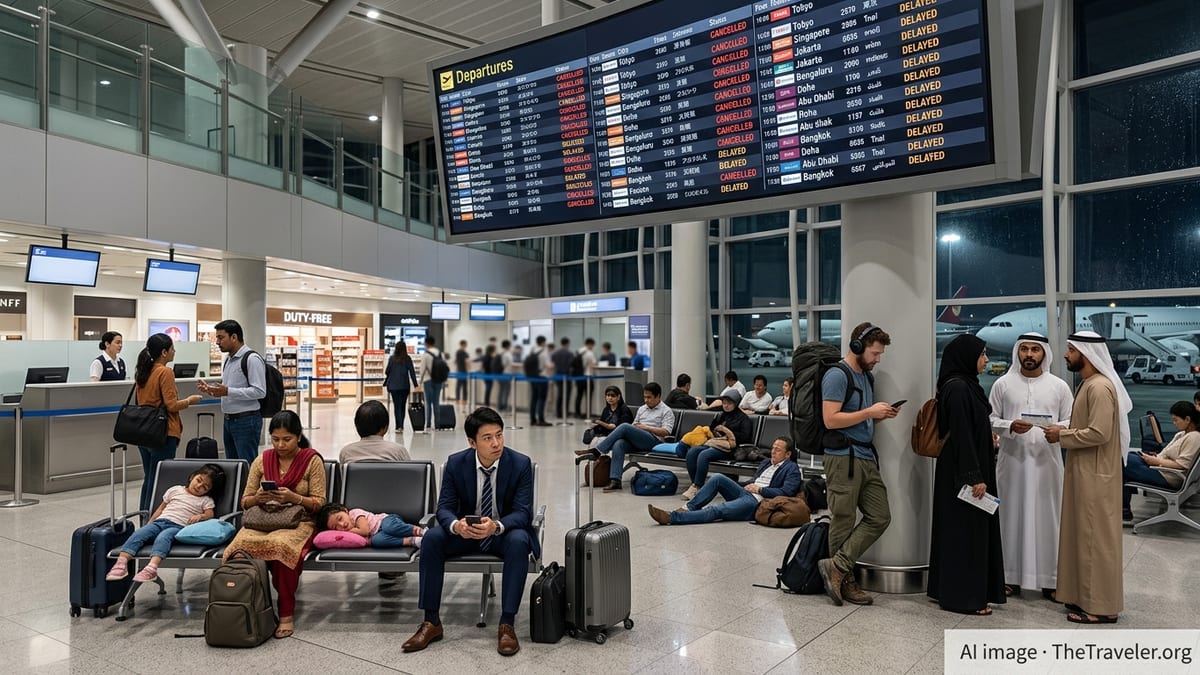
Major Asian Hubs Struggle With Sweeping Cancellations
Publicly available flight-tracking dashboards and airport operational updates show a sharp spike in cancellations concentrated at large regional hubs, with Dubai International, Bangkok Suvarnabhumi, Hong Kong International, Beijing Capital and other busy gateways all reporting clusters of grounded services. While figures vary by source, aggregated data points to a combined 691 cancellations affecting shorter intra-Asia and domestic sectors, and roughly 3,492 scrapped international flights touching the six affected countries and territories.
Operational notices from airports in Thailand indicate that both Bangkok Suvarnabhumi and Don Mueang are seeing cuts across full-service and low-cost airlines, disrupting itineraries that link Southeast Asia with North Asia and the Middle East. In China, schedule boards at major airports such as Beijing and Shanghai show dozens of flights listed as cancelled or undefined, signaling ongoing rescheduling by both local and foreign carriers.
In Hong Kong, where Cathay Pacific and its low-cost affiliate HK Express typically funnel traffic between mainland China, Japan, Southeast Asia and the Middle East, real-time status boards highlight a pattern of short-haul cancellations to regional destinations. Similarly, in Japan, updates from major carriers and airport status pages reflect trimmed frequencies on key links to Hong Kong, mainland China and Southeast Asia, amplifying the knock-on effects across the wider network.
Across the United Arab Emirates, operational summaries for Dubai and Abu Dhabi show a fluid situation, with scrapped departures and arrivals rippling through long-haul corridors that connect Asia with Europe, Africa and North America. Although many flights remain in operation, the elevated cancellation count is enough to create pockets of severe congestion in terminals and transit areas.
Flag Carriers Under Pressure From Network Disruptions
The cancellations are hitting some of Asia and the Gulf’s best-known airlines particularly hard. Flight-status feeds for Cathay Pacific indicate a series of scrubbed regional services between Hong Kong and cities such as Bangkok, Kuala Lumpur and selected mainland Chinese gateways, affecting both point-to-point passengers and those connecting onward to Europe, North America and Australia.
In Japan, Japan Airlines is contending with schedule changes on international routes linking Tokyo and Osaka with Hong Kong, China and Southeast Asia. Public information on its international operations portal highlights a need for travelers to recheck bookings close to departure, reflecting the volatility in available capacity and last-minute aircraft and crew reallocations.
Gulf carriers are also caught in the turbulence. Emirates and Etihad, which normally move large numbers of passengers between Europe, Asia and Oceania via Dubai and Abu Dhabi, are managing disrupted patterns as cancellations in Bangkok, Hong Kong, Tokyo, Beijing and Kuala Lumpur ripple back into hub banks in the UAE. Airline advisories and schedule notices suggest that some passengers are being shifted to alternative departures or rerouted via different Asian gateways where capacity remains.
Other regional and national carriers in Thailand, Malaysia and China are trimming their own schedules, either by cancelling selected rotations outright or consolidating departures. This creates a multi-layered disruption: when a flag carrier cancels a long-haul leg, travelers often seek seats on regional operators to reconstruct itineraries, but those same regional operators are also adjusting their timetables, reducing the pool of available alternatives.
Knock-On Impacts For Passengers Across Continents
For the traveling public, the immediate impact is a wave of missed connections, involuntary stopovers and extended layovers across Asia and the Gulf. Reports from airline channels and airport information desks indicate that many affected passengers are being rebooked onto later flights within the same day where space allows, but on heavily trafficked routes options can be days away, particularly in premium cabins and during peak travel periods.
Online rebooking tools and mobile apps for major carriers such as Cathay Pacific, Emirates and Japan Airlines are shouldering much of the demand, with travelers urged by airline communications and help pages to manage changes digitally whenever possible. In some cases, passengers are being offered the choice of date changes, rerouting via secondary hubs, or partial refunds when the remaining journey no longer meets their needs.
Transit passengers find themselves especially exposed. Those who began their journeys in Europe or North America and expected seamless same-day connections in Dubai, Bangkok, Hong Kong or Beijing are encountering arrival boards filled with cancellations, forcing overnight stays and visa considerations in countries that may not have been part of the original itinerary. Families and business travelers alike are sharing accounts of scrambling to secure hotel rooms near airports that are already operating at high occupancy.
Travel insurers and credit card travel-protection programs are likely to see a rise in claims for delay-related expenses, from meals and emergency accommodation to replacement tickets purchased when airline-provided options prove too slow. Policy wording varies widely, and consumer advocates routinely advise passengers to keep detailed records of receipts, boarding passes and cancellation notices when disruption reaches this scale.
Airports Test Contingency Plans As Operations Remain Fluid
Airports across the affected region are leaning on contingency playbooks designed for irregular operations. Terminal managers in large hubs such as Dubai, Bangkok, Hong Kong and Beijing typically respond to mass cancellations by adjusting gate assignments, expanding queuing space at transfer counters and working with airlines to redirect passenger flows away from overcrowded areas. Public announcements and display boards are being updated frequently, and many airports are emphasizing the use of mobile apps and self-service kiosks to reduce lines.
Ground-handling teams are under pressure to reposition aircraft, manage stray baggage and coordinate catering and cleaning schedules that may change multiple times as flights are retimed, swapped or withdrawn. Each cancellation often triggers a series of associated tasks, from offloading and re-sorting luggage to arranging towing slots and stand changes in already congested apron environments.
Retail and hospitality operators inside terminals are also experiencing the effects. Extended dwell times for stranded passengers can boost demand at restaurants, lounges and shops, but staffing and supply chains are not always calibrated for sudden surges. In some hubs, travelers are reporting long lines for basic services such as food, showers and power outlets, particularly in common waiting areas outside premium lounges.
Despite the scale of disruption, airports and airlines are signaling through their public channels that operations remain ongoing, with the majority of scheduled flights still departing. The challenge lies in the concentration of cancellations in specific time banks and routes, which can transform a manageable irregular-operations scenario into a severe bottleneck at certain hours of the day.
What Travelers Can Do If Their Flight Is Affected
For travelers caught up in today’s disruption, aviation and consumer guidance consistently underline a few practical steps. The first is to monitor flight status closely through official airline apps, websites and airport flight-information pages, rather than relying solely on third-party booking platforms or general search results that may lag behind real-time operational decisions.
Passengers whose flights are cancelled or significantly delayed are generally advised to initiate rebooking through digital channels before approaching airport counters, where queues can quickly grow during large-scale disruptions. Many airlines now allow same-day self-service changes, including alternative routings via different hubs, directly within their apps, which can secure scarce seats more quickly than waiting in line.
Travelers on complex itineraries that involve multiple carriers or separate tickets may need to contact each airline individually, as protection and reaccommodation policies differ. Those with time-sensitive commitments are often encouraged by consumer groups to consider purchasing back-up options on other airlines where financially feasible, then seeking partial refunds or travel credits from the original carrier if policies permit.
Finally, experts in travel planning typically recommend building greater flexibility into future long-haul journeys that rely on major transit hubs in regions prone to operational volatility. This can include longer connection windows, overnight stopovers by design, and the use of travel insurance products that explicitly cover missed connections and extensive delays, all of which can reduce the personal impact when thousands of flights across a continent are suddenly pulled from the skies.