


More news on this day
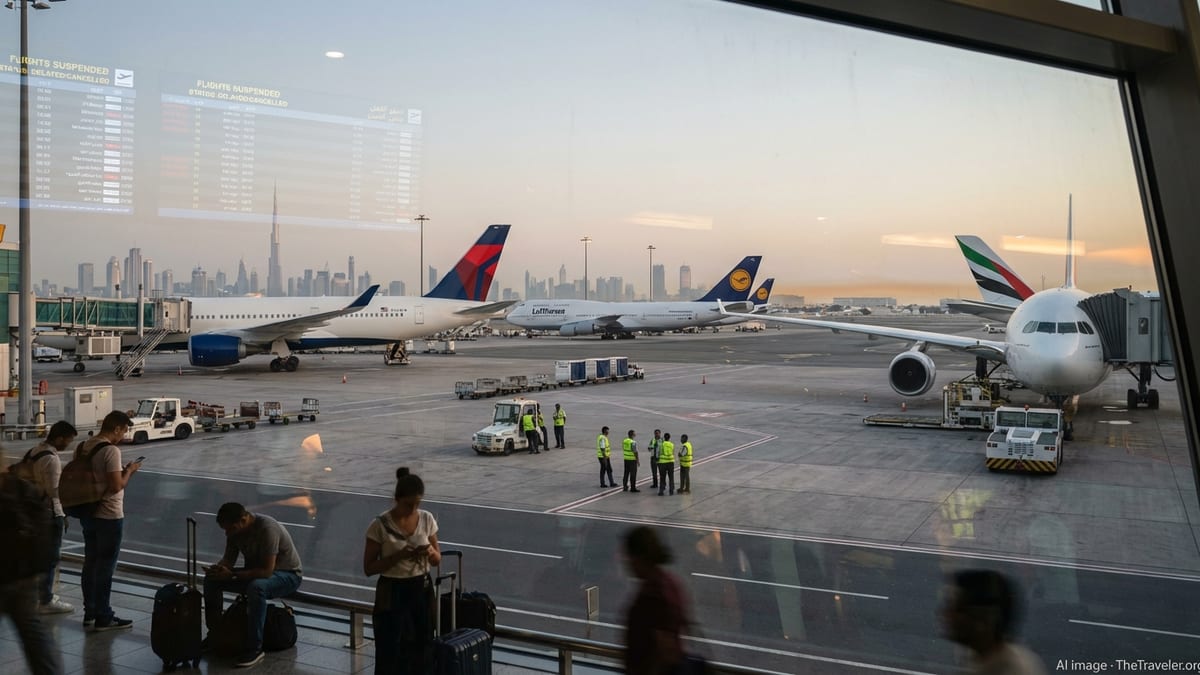
More than 21,000 flights have been canceled worldwide since late February as the escalating conflict centered on Iran shutters key Middle Eastern hubs, disrupts long-haul corridors and triggers what analysts describe as the biggest shock to global aviation since the pandemic.
Get the latest news straight to your inbox!
Conflict Turns Regional Skies Into a Global Chokepoint
Publicly available data from aviation trackers and industry analyses indicate that the current wave of cancellations began on 28 February 2026, when strikes involving the United States, Israel and Iran led to rapid airspace closures across much of the Gulf and Levant. Authorities in Iran, Iraq, Israel, Syria, Kuwait, Qatar and the United Arab Emirates imposed full or partial restrictions on civilian overflights, while security concerns rippled into neighboring states.
Dubai International, Doha’s Hamad International and Abu Dhabi’s Zayed International, three of the world’s most important long-haul hubs, have all seen large portions of their operations curtailed or temporarily suspended at various points. Reporting from regional outlets notes that Dubai, in particular, has suffered physical damage during hostilities, forcing airlines to divert traffic to secondary airports and alternative waypoints.
Industry briefings referenced by business and travel media estimate that more than 21,000 flights have been canceled across West Asia alone since the start of the conflict, with wider global cancellations now several times higher as knock-on schedule changes take effect. Routes that previously relied on direct transits over Iran and Iraq have been redrawn via the Arabian Sea, Egypt and Central Asia, turning the Middle East into a chokepoint for air traffic between Europe, Asia, Africa and Oceania.
Recent analysis from sector bodies highlights how exposed the system is to disruption in this region. Prior to the war, roughly one in ten global passengers connected through Middle Eastern hubs each year, making any prolonged closure or capacity cut there immediately visible in global delay and cancellation statistics.
Airlines Slash Schedules and Redraw Long Haul Networks
Carriers across Europe, Asia and North America have reacted by axing flights in and out of the Gulf, suspending services to conflict-adjacent destinations, and rerouting long-haul sectors that once depended on direct overflights of Iranian and Iraqi airspace. Coverage in aviation trade publications and general business media points to widespread schedule cuts by airlines such as Emirates, Qatar Airways, Etihad, Lufthansa, Air France-KLM, British Airways, Cathay Pacific, Singapore Airlines and several Indian operators.
One analysis focused on the Gulf region calculates that over 21,000 flights that would normally touch West Asian airspace have already been removed from schedules, from short regional hops to trunk routes linking Europe with India, Southeast Asia and Australia. These figures capture both outright cancellations and prolonged suspensions where airlines have parked capacity or redeployed aircraft to other parts of their networks.
Where flying remains possible, routes are often significantly longer. Reports describe Europe to Asia services detouring south over Saudi Arabia, the Red Sea and the Horn of Africa, or taking more northerly arcs through Central Asia when corridors are available. Industry experts cited in published research suggest that rerouting a single intercontinental flight can add 90 to 120 minutes to block time, consuming sharply more fuel and complicating crew scheduling, aircraft rotations and maintenance windows.
Low cost and leisure carriers with thinner financial buffers have in many cases simply withdrawn from the region for now. Full service operators are prioritizing essential connectivity and repatriation traffic, often operating skeletal schedules or one-off special flights, while continuing to avoid the most sensitive airspace even when formal restrictions are relaxed.
Passengers Face Higher Fares, Longer Journeys and Patchy Information
For travelers, the cancellation of more than 21,000 flights has quickly translated into stranded passengers, soaring prices and confusing, fast-changing itineraries. Travel-disruption platforms and passenger-rights organizations report a surge in cases linked to Middle East routings, as customers struggle to secure refunds, reroutings or overnight accommodation during extended waits.
Analyses in business and airline-industry media indicate that long-haul fares touching the region have climbed by 15 to 35 percent compared with pre-conflict levels. Several reports attribute the rise to a combination of longer flight paths, higher fuel costs and additional war-risk insurance premiums, some of which are being passed on to passengers as surcharges.
Even travelers with no plans to visit the Middle East are feeling the effects. Because so much Europe–Asia and Asia–Africa traffic has historically transited Gulf hubs, the removal of that capacity is tightening seat availability on alternative routings through southern Europe, North Africa and Central Asia. That, in turn, is contributing to busier airports, heavier loads and higher fares well beyond the immediate conflict zone.
Consumer advocates quoted across multiple outlets urge passengers to monitor airline apps and airport departure boards as close to departure as possible, with some carriers making late adjustments to routings and departure times as airspace conditions shift. They also note that while compensation rules can be complex in cases involving security-related disruption, airlines are generally expected to offer rerouting or refunds and to provide basic care such as meals and hotel rooms when travelers are stranded overnight.
Rerouting and Fuel Shock Squeeze Airline Finances
The operational upheaval has coincided with a sharp spike in jet fuel prices, compounding the financial strain on airlines. Sector-focused research and business reporting describe fuel benchmarks for aviation climbing far above early 2026 levels after the conflict disrupted crude supply chains and critical refinery infrastructure in the Gulf.
According to publicly available industry estimates, fuel, which typically accounts for around a quarter of an airline’s operating costs, has in some cases risen to close to half, once higher prices and extra burn from detours are factored in. Each additional hour spent in the air on a long-haul sector translates to thousands of dollars in extra fuel and crew expenses, magnified across fleets that operate hundreds of flights per day.
At the same time, grounded aircraft generate little revenue. Analyses from aviation consultancies suggest that a single day of severe disruption at a large hub can wipe out hundreds of millions of dollars in lost ticket sales, cargo revenue and airport commercial income. With parts of the Middle East’s hub system constrained for weeks rather than days, airline balance sheets are facing a prolonged test that some observers compare to the early months of the pandemic.
Airlines are attempting to manage the shock by trimming marginal routes, deferring capacity growth, and shifting widebody aircraft to markets less exposed to the conflict zone. However, the scale and unpredictability of airspace closures make it difficult to plan ahead, leaving network planners to work on shorter planning horizons than usual and to rely heavily on real-time risk assessments.
How the Crisis Could Reshape Global Aviation Maps
Beyond the immediate tally of 21,000 canceled flights, industry specialists and economic analysts are increasingly focused on how the conflict could permanently alter the geography of long-haul travel. Commentary from think tanks, trade bodies and financial analysts points to several possible medium-term shifts in response to the vulnerability revealed by the current crisis.
One widely discussed scenario involves airlines diversifying away from an overreliance on a handful of Gulf megahubs. Carriers might strengthen point-to-point links between Europe and Asia that bypass the Middle East entirely, expand partnerships with hubs in southern Europe, North Africa or Central Asia, or build up new transfer points in locations perceived as less exposed to sudden closures.
The disruption is also accelerating conversations about risk management in commercial aviation. Insurance requirements, military-to-civilian coordination in conflict zones, and the thresholds at which airlines decide to avoid particular flight information regions are all under renewed scrutiny. Observers note that, following the lessons from the Russia–Ukraine war and earlier incidents involving aircraft overflying active conflict areas, many operators are now choosing more conservative routings even when regulators technically allow overflights.
For travelers, that may mean living with longer routings and structurally higher fares on some intercontinental journeys, even after formal ceasefires or political agreements are reached. With the conflict still fluid as of May 2026 and airspace restrictions evolving week by week, the only certainty for now is continued volatility, as airlines, airports and passengers adapt to a sky over the Middle East that looks very different from just a few months ago.