


More news on this day
Asia’s aviation network is experiencing a sharp spike in disruption, with publicly available flight-tracking data indicating that 6,866 flights have been delayed and 383 cancelled across major hubs in a single operating day, rippling through schedules from Southeast Asia to Northeast Asia and the Gulf.
Get the latest news straight to your inbox!
Major Hubs From Bangkok to Tokyo Face Operational Strain
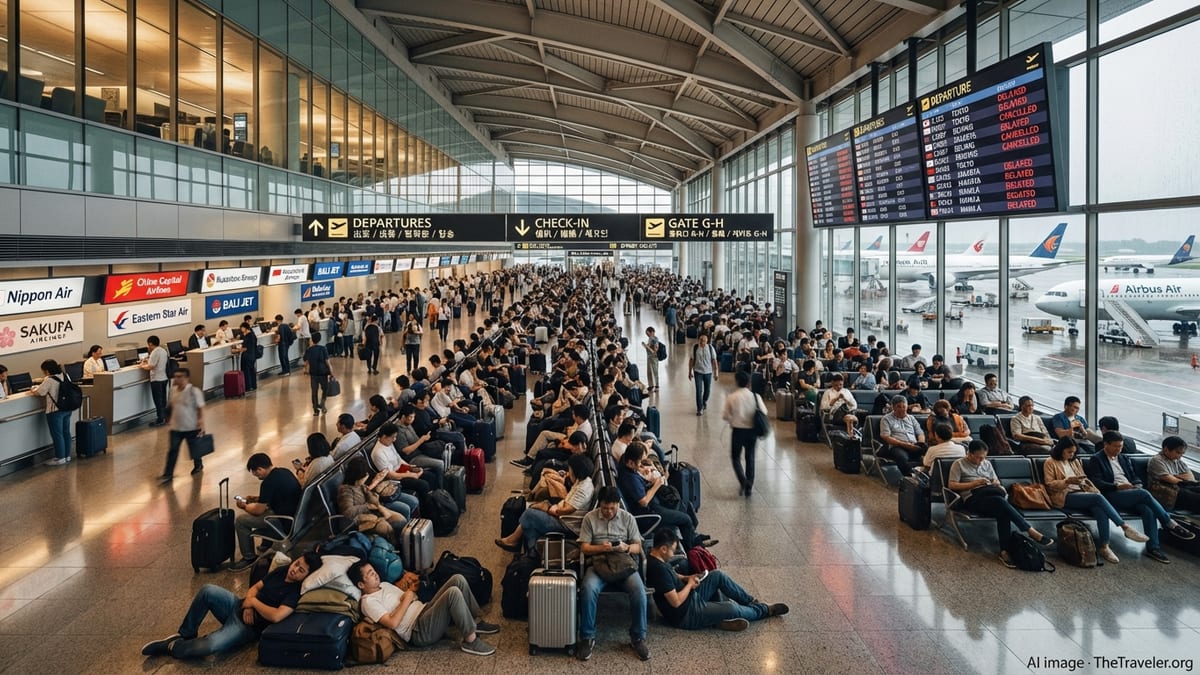
Flight-disruption dashboards tracking Asia’s airports show an unusually heavy concentration of delays and cancellations at key regional hubs, including Bangkok, Singapore, Hong Kong, Seoul, Tokyo and several major Chinese coastal cities. The latest compiled figures of 6,866 delayed departures and 383 cancellations point to an intense operational squeeze that has left departure boards crowded with late-running flights.
Bangkok’s Don Mueang and Suvarnabhumi airports, both vital connectors for low-cost and full-service carriers, are among the worst affected, with a high share of departures pushed back well beyond scheduled times. Singapore Changi and Hong Kong International, normally regarded as some of the world’s most efficient airports, are also registering elevated disruption indices, reflecting both a large volume of late-running flights and a smaller but impactful number of cancellations.
In Northeast Asia, data for Tokyo’s Haneda and Narita airports, together with Seoul Incheon, show widespread knock-on delays following earlier weather systems and airspace constraints that forced airlines to compress schedules and reroute aircraft. Several Chinese airports, particularly those serving major manufacturing and tech hubs, are reporting dense mid-day and evening congestion, amplifying minor schedule slippages into wider network delays.
While most services eventually depart, the sheer scale of today’s late operations across multiple hubs means passengers are facing missed connections, extended time on the ground and last-minute gate changes, creating a visibly strained travel experience at some of the region’s busiest terminals.
Weather, Airspace Reroutes and Tight Crewing Fuel the Disruption
Published coverage across Asian and international outlets links the latest surge in delays to a combination of heavy seasonal weather, evolving airspace restrictions in parts of West Asia and persistently tight crew and aircraft availability. Recent typhoon activity in the western Pacific has already triggered waves of cancellations and diversions in Japan, Taiwan, southern China and the Philippines, leaving some carriers with aircraft and crew out of normal position.
In parallel, official advisories on parts of West Asia’s airspace have led many long-haul operators to adopt longer routings between Europe and Asia. Publicly available flight-path data shows these deviations adding significant block time to key corridors, compressing turnaround windows at onward hubs in South and Southeast Asia and reducing the slack in daily schedules.
Airlines are also managing the lingering effects of tighter duty-time rules and lean staffing models introduced during and after the pandemic. Industry reports on earlier disruption episodes in India and other markets highlight how even modest weather or technical issues can escalate rapidly when crew reserves are thin and aircraft utilization is high. The current pattern of widespread delays coupled with a smaller number of outright cancellations is consistent with networks operating very close to their operational limits.
Aviation-analytics firms have repeatedly noted that Asia Pacific carriers are flying near or above pre-pandemic volumes, while still rebuilding resilience in maintenance supply chains and spare-part availability. Today’s figures suggest that this fragile equilibrium is being tested by a cluster of simultaneous weather and airspace pressures.
Passenger Impact: Missed Connections, Rebookings and Overnight Stays
The human impact of 6,866 delayed and 383 cancelled flights is playing out across check-in halls and departure gates, where travelers are contending with rolling delay estimates and rapidly changing boarding information. Reports from affected airports describe long queues at transfer counters as passengers attempt to salvage missed connections onto Europe, North America and intra-Asia routes.
For those on cancelled services, airlines are relying heavily on digital channels for rebooking, steering passengers toward mobile apps and self-service kiosks rather than traditional counters. Published guidance from low-cost and full-service carriers in the region indicates that standard options include free date changes within a limited window, re-accommodation on the next available flight and, in some cases, travel-credit vouchers for future use.
Overnight disruption is emerging as a particular concern at hubs where hotel capacity near the airport is already tight. Previous large-scale disruption events in Asia have shown that sudden spikes in stranded passengers can quickly saturate nearby accommodation, leaving some travelers to spend the night in terminal seating areas. With multiple hubs facing elevated disruption on the same day, that pattern is likely to be repeated in pockets across the region.
Travel-insurance providers and consumer-rights groups are urging passengers to document delays and cancellations carefully, as entitlement to meals, hotel stays or partial refunds depends heavily on local regulations and the precise cause of the disruption. Where severe weather or airspace issues are involved, compensation frameworks can differ markedly from cases linked to airline operational or staffing problems.
Airlines and Airports Adjust Schedules and Capacity
In response to the mounting delays, airlines operating across Asia are trimming late-evening rotations, consolidating lightly booked services and selectively cancelling flights on shorter routes to protect long-haul operations. Publicly available schedule data shows a series of same-day timetable adjustments at several carriers, particularly those with large bases in Bangkok, Kuala Lumpur and major Chinese cities.
Airport operators are meanwhile adjusting runway and gate allocations to prioritize congested banks of international departures. Some hubs are extending operating hours at security and immigration checkpoints to handle surges of passengers arriving after prolonged delays, while ground-handling firms redeploy staff to gates with large numbers of disrupted travelers.
Analysts note that the relatively modest number of outright cancellations compared with the much larger pool of delays suggests airlines are attempting to preserve network connectivity wherever possible. However, this strategy can lead to a rolling pattern of late departures that persists well into subsequent days, particularly if weather systems or airspace constraints do not ease.
Operational data from previous disruption waves in the region shows that recovery can take several days even after the initial trigger has passed. With Asia’s peak summer and holiday travel periods approaching, the latest figures are prompting questions about how quickly carriers can restore punctuality without sacrificing much-needed capacity on popular routes.
What Travelers Can Do as Disruptions Continue
With flight-tracking dashboards signaling an elevated risk of further delays into the next operating cycles, passengers with upcoming travel in Asia are being urged by airlines, airports and travel agents to prepare for changing itineraries. Public advisories consistently recommend checking flight status frequently on official airline channels, enabling app notifications and arriving early at the airport, particularly for journeys involving tight connections.
Industry guidance suggests that travelers build extra buffer time into itineraries that rely on same-day connections through busy hubs such as Bangkok, Singapore, Hong Kong or Seoul. Where possible, booking longer layovers can reduce the chance of missed onward flights when the first leg is affected by airspace rerouting or departure congestion.
Passengers are also encouraged to familiarize themselves with fare conditions and disruption policies before departure. Many Asia-based carriers now outline, in accessible online summaries, how they respond to severe weather, technical issues and airspace restrictions, including typical options for rebooking, vouchers or refunds. Understanding these frameworks in advance can help travelers make faster decisions if their flight is among the 6,866 delayed or 383 cancelled in the current disruption cycle.
While today’s numbers highlight the vulnerability of Asia’s densely scheduled aviation networks to overlapping shocks, they also underscore the importance of real-time information, flexible planning and realistic buffer times for anyone flying through the region’s major hubs in the coming days.