


More news on this day
Travelers across Asia and the Middle East are facing another difficult day on May 17, 2026, as operational data and real-time monitoring indicate 2,463 flights delayed and 174 cancelled, disrupting tight hub connections in Thailand, the United Arab Emirates, Singapore, Malaysia, South Korea, China and beyond.
Get the latest news straight to your inbox!
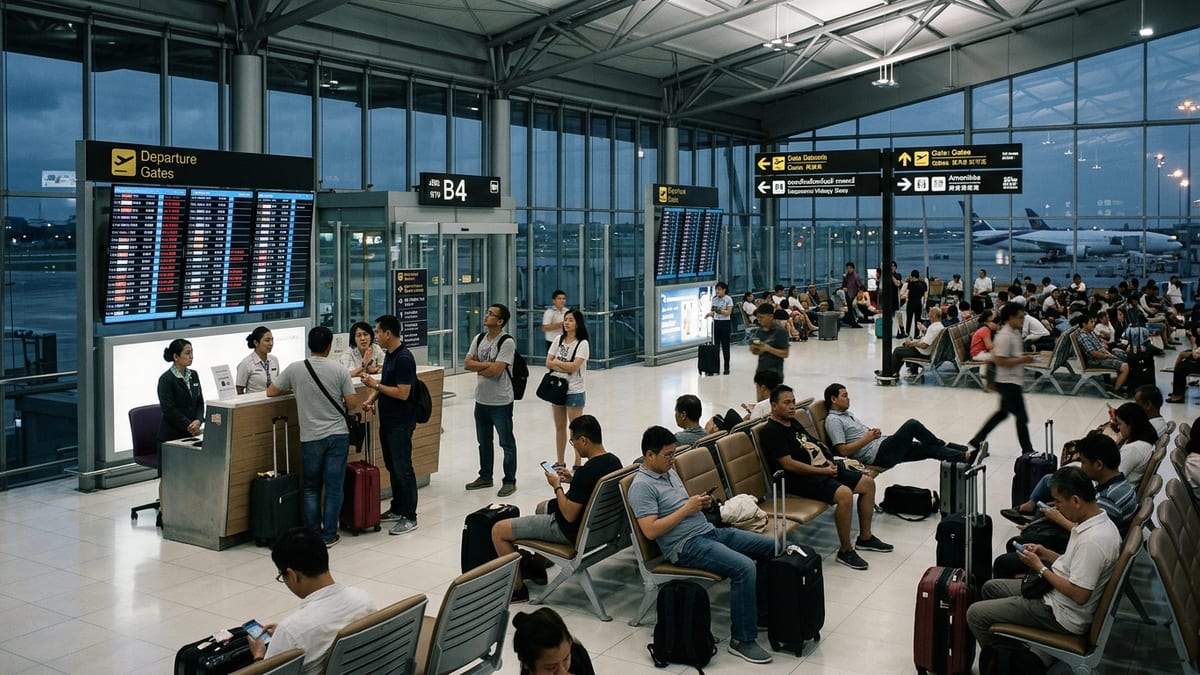
Regional Hubs Strain Under Mounting Operational Pressure
Aggregated flight-tracking and airport operations data for May 17 show a fresh wave of disruption across key Asian and Gulf gateways, with delays and cancellations clustering around major banks of departures and arrivals. The impact is being felt most acutely at large transit hubs, where even moderate schedule slippages can quickly cascade through tightly timed connection banks.
In the United Arab Emirates, Dubai International continues to rebuild traffic after earlier capacity constraints and infrastructure challenges, leaving the hub especially sensitive to weather, airspace restrictions and knock-on effects from previous days. Published operational updates in recent weeks have highlighted how a reduced margin in runway and terminal capacity can lead to disproportionate congestion when conditions deteriorate, contributing to today’s elevated delay totals.
Across East and Southeast Asia, airports in Thailand, Singapore, Malaysia, South Korea and China are experiencing similar pressure. High spring travel demand, ongoing aircraft and crew rotations, and residual schedule adjustments from earlier disruptions have combined to create a fragile operating environment in which relatively small issues can trigger widespread timetable changes.
Today’s figures of 2,463 delayed flights and 174 cancellations sit below the most extreme disruption days seen in the region this year but are still significantly above typical mid-May patterns, according to comparisons with historical punctuality data and recent industry reporting.
Emirates, Singapore Airlines, AirAsia and Asiana Among Affected Carriers
Major network and low-cost airlines are again on the front line. Flight-status boards, tracking services and recent schedule updates indicate that Emirates services through Dubai, Singapore Airlines departures from Changi, AirAsia flights across Southeast Asia and Asiana-operated routes out of Seoul are all contending with longer ground times, revised departure slots and, in some cases, outright cancellations.
For Emirates, any disruption at Dubai International has an outsized effect on global connectivity, given the carrier’s reliance on tightly timed connections across Europe, Africa, the Americas and Asia. Recent weeks have seen several waves of schedule adjustments and selected cancellations on long-haul routes as the airline balances aircraft availability, airspace constraints and infrastructure recovery, magnifying the impact of today’s delays for passengers relying on one-stop itineraries.
Singapore Airlines, which generally maintains a strong record for on-time performance, has nonetheless had to navigate a more volatile operating backdrop in 2026. Publicly available information shows the carrier already refining fleet plans and product rollouts in response to supply chain factors, and on days like today that leaves less flexibility to absorb crew or aircraft rotations when upstream flights run late.
In the low-cost segment, AirAsia’s dense network around Southeast Asia means delays at one hub can rapidly ripple into multiple short-haul sectors in Thailand, Malaysia and neighboring markets. Meanwhile, Asiana, which is gradually moving toward a merger with Korean Air, continues to operate a significant share of traffic through Seoul, where banks of regional flights feed into trunk routes across Northeast Asia, amplifying the effect of schedule shocks.
Bangkok, Singapore, Seoul and Dubai See Knock-On Connectivity Risks
Bangkok, Singapore, Seoul and Dubai are among the airports where today’s disruption is most visible for connecting passengers. These hubs are designed around wave-like schedules, with large numbers of arrivals funnelling into short connection windows before a similarly dense bank of onward departures. When early-inbound flights are delayed, tight connections vanish, forcing mass rebookings at check-in counters and transfer desks.
In Bangkok and Kuala Lumpur, regional travelers heading to secondary cities across mainland Southeast Asia report longer queues and departure boards dominated by revised timings. Even when flights ultimately depart, extended taxi times, air traffic flow restrictions and late-arriving inbound aircraft are combining to push many services beyond their scheduled slots.
At Singapore Changi, a mixture of regional and long-haul operations is contributing to the strain. Real-time boards show individual flights still operating close to schedule, but the cumulative effect of small delays across multiple banks has led to heavier-than-normal crowding at some gates and security checkpoints, especially during the morning and late-evening peaks when transit volumes are highest.
In Seoul and Dubai, similar patterns are playing out. High reliance on connecting traffic means that missed onward flights often trigger complex re-routing across alliances and interline partners. Travelers on itineraries incorporating multiple carriers, such as combinations of Emirates with Asian partner airlines, or Asiana with other regional operators, are particularly exposed when a single sector in the chain is cancelled or heavily delayed.
Weather, Airspace and Infrastructure Interact to Drive Disruption
While today’s disruption does not appear to be driven by a single major incident, analysts point to a blend of contributing factors that mirror patterns seen in earlier 2026 events. These include localized weather systems affecting specific hubs, temporary airspace restrictions in certain regions, and ongoing work to restore or expand airport capacity after earlier infrastructure impacts.
Recent commentary from passenger-rights organizations and aviation data firms has underscored how quickly delay levels can escalate when safety-related constraints or route closures overlap with already tight summer-style schedules. Case studies from other hubs this year have shown that when airport operations are running close to their theoretical maximum, even modest storms or short-notice airspace changes can leave airlines with few viable options to swap aircraft or crew at short notice.
Several major airports in the Gulf and Asia are also in the midst of phased construction and facilities upgrades, reducing spare gate and runway capacity during certain periods of the day. When combined with peak-season demand, this can create choke points for arrivals and departures, particularly for widebody fleets operated by global network carriers such as Emirates and the larger Asian flag airlines.
China’s large domestic market adds a further layer of complexity. With hundreds of daily flights feeding into and out of major hubs like Shanghai and Beijing, local restrictions, flow-control measures or convective weather in one region can quickly propagate along busy corridors, ultimately affecting international connections to Southeast Asia and the Gulf later in the day.
What Today’s Numbers Mean for Travelers Planning Asia Trips
The elevated figures of 2,463 delays and 174 cancellations across Asia and the Middle East today underscore the importance for travelers of building more resilience into their itineraries during 2026. Industry observers increasingly recommend longer self-connection windows, flexible tickets where feasible, and careful attention to minimum connection times at complex hubs such as Dubai, Singapore, Bangkok and Seoul.
Travel-planning resources note that disruptions of this scale can lead to overnight misalignments between aircraft and crews, increasing the risk that timetable changes persist into subsequent days. Even passengers flying tomorrow on routes not directly affected today may find their flights operated by aircraft arriving late from disrupted sectors, or by crews approaching duty-time limits that require last-minute substitutions.
For those already on the move, publicly available guidance from airlines and airports emphasizes the value of monitoring flight-status tools, enrolling in carrier notifications and checking airport advisories before departing for the terminal. On intense disruption days like May 17, 2026, small adjustments such as arriving earlier, carrying essentials in hand baggage and being prepared for rebooking queues can materially improve the travel experience.
For now, today’s figures place this latest wave of disruption among the more serious operational challenges to hit Asian and Gulf aviation this spring, though still short of the record-setting chaos reported on some earlier days this year. With the summer peak approaching, the pattern emerging from events like today suggests that both airlines and travelers will need to remain nimble as the region’s air traffic system continues to operate close to its limits.