


More news on this day
Hundreds of air travelers across China, Indonesia and Japan faced extended airport stays and missed connections after a wave of cancellations and delays rippled through major Asian carriers, disrupting more than 800 flights in a single operational cycle.
Get the latest news straight to your inbox!
Wide Network Disruptions Across Key Asian Hubs
Operational data compiled from flight-tracking services and regional aviation reports indicates that at least 110 flights were cancelled and around 765 were delayed across several major Asian markets, affecting both domestic and international routes. The disruption has particularly impacted services in and out of China, Indonesia and Japan, three of the region’s busiest air travel markets.
Carriers involved in the latest wave of irregular operations include Air China, Hainan Airlines, China Eastern, Garuda Indonesia, Batik Air, Japan Airlines, ANA Wings and Shanghai Airlines. Together, these airlines form a dense network of routes connecting primary hubs such as Beijing, Shanghai, Jakarta and Tokyo with regional and long haul destinations, meaning isolated schedule changes quickly translated into widespread knock-on delays.
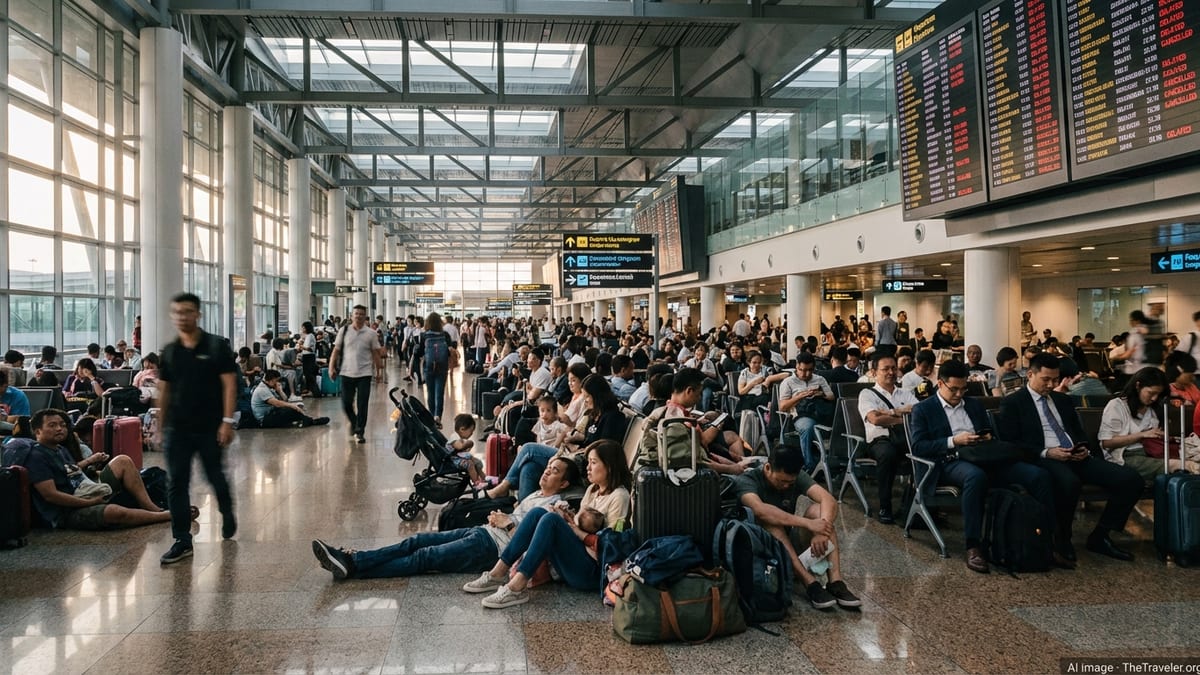
Publicly available airport boards and flight-monitoring dashboards showed clusters of late departures and arrivals throughout the day, with some aircraft pushed back by several hours. The scale of the disruption left departure halls crowded with travelers waiting for rebookings, meal vouchers or overnight accommodation, while arrival areas saw a growing number of stranded passengers trying to reassemble broken itineraries.
Although the number of outright cancellations was significantly lower than the volume of delays, the operational pattern pointed to aircraft and crew being out of position, making it harder for the airlines involved to stabilize their schedules once the first wave of delays had taken hold.
Passengers Stranded From Shanghai to Jakarta and Tokyo
Travelers in China reported some of the most acute disruption, with major hubs such as Beijing Capital, Shanghai Pudong and Guangzhou Baiyun seeing rolling delays and a concentration of cancellations. Coverage focused on Shanghai described multiple leading Chinese carriers scrapping or postponing more than 100 flights over a single day as schedules buckled under operational strain.
In Indonesia, Garuda Indonesia and Batik Air experienced their own waves of irregular operations, affecting trunk routes between Jakarta, Surabaya, Denpasar and other key domestic destinations, as well as selected international services. For holidaymakers heading to Bali and business travelers returning to Jakarta, even short delays created a knock-on effect where onward connections and hotel plans were thrown into uncertainty.
Japan also felt the impact, with regional operator ANA Wings and mainline Japan Airlines adjusting operations on select services. Tourism advisories tracking recent weather-related disruption in Japan have already flagged intermittent suspensions and delays on domestic networks serving Tokyo, Osaka and regional cities, and the latest disruptions added a new layer of uncertainty for visitors trying to move between urban centers and resort areas.
Because many itineraries in Asia involve multiple segments stitched together on separate tickets, stranded passengers in all three countries often found themselves responsible for navigating missed connections on different carriers, sometimes across separate booking platforms or travel agencies.
Weather, Congestion and Operational Constraints Blamed
While specific causes vary by route and carrier, publicly available information from airlines and tourism advisories points to a combination of adverse weather, airspace congestion and operational constraints as the primary drivers of the current disruption. Recent weeks have seen tropical systems and seasonal storms sweep across parts of East and Southeast Asia, forcing airlines to reduce schedules, reroute aircraft or introduce extended ground holds for safety reasons.
In Japan, travel bulletins have highlighted the effect of typhoon activity on domestic and international flights, with hundreds of services canceled or heavily delayed as carriers adjusted operations around Tokyo, Osaka and Kyushu. Similar patterns of weather disruption have been reported at Chinese coastal airports, where strong winds and heavy rain can quickly reduce runway capacity and slow airport operations.
In crowded airspace such as the corridors linking Beijing and Shanghai or the routes in and out of Jakarta, even temporary reductions in capacity can cause a cascade of knock-on delays as subsequent flights wait for available gates, crews or departure slots. Once aircraft and crew rotations are disrupted, airlines can struggle to restore normal operations within the same day, especially when fleets are already running close to full utilization.
Industry analysts note that lingering staffing and fleet pressures since the pandemic, combined with resurgent demand for travel in 2026, have left many operators with limited slack in their systems. As a result, a bout of severe weather or an airport systems issue can more easily tip an otherwise manageable situation into a region-wide disruption.
Knock-on Effects for International Connections
The disruption has not only affected point to point travelers within Asia, but also those connecting from long haul services to regional flights operated by the affected carriers. Hubs such as Shanghai Pudong, Beijing Capital, Tokyo Haneda, Tokyo Narita and Jakarta Soekarno Hatta are vital transfer points for itineraries linking North America and Europe to secondary cities throughout East and Southeast Asia.
With 110 flights cancelled outright, many travelers with tight layovers found that their onward legs simply did not operate, triggering last minute rebookings or forced overnight stays. Even where flights eventually departed, delays of more than one or two hours were often enough to cause missed onward connections, particularly for passengers traveling on separate tickets or mixing full service and low cost carriers.
Online accounts from recent weeks already describe passengers grappling with missed connections following weather-related delays on some of the same carriers now experiencing fresh disruption. These cases illustrate how even when a primary long haul sector arrives close to on time, a delayed or retimed regional leg can upend entire itineraries, especially when ticketing rules limit rerouting options onto alternative airlines.
Given the volume of transfer traffic funneled through these hubs, industry observers expect that the operational consequences of the latest cancellations and delays will continue to ripple outward for at least another full scheduling day, as airlines attempt to reposition aircraft and crew to restore standard patterns of service.
What Travelers Can Do if Their Flight Is Affected
For travelers currently in Asia or due to fly in the coming days, aviation specialists recommend closely monitoring flight status in the airline’s own app or on official channels, rather than relying solely on third party aggregators or airport boards. Because schedules can change multiple times in quick succession, push notifications from carriers often provide the earliest indication of retimings or cancellations.
Passengers whose flights have been cancelled are generally advised to initiate rebooking or refund processes as early as possible. Many carriers in the region, including those involved in the latest disruption, publish special waivers during widespread irregular operations, allowing date changes or refunds without additional fees, although specific conditions vary by airline and fare type.
Travel experts further suggest allowing longer connection times when routing through weather sensitive hubs, particularly during seasonal storm periods, and considering travel insurance products that explicitly cover delays, missed connections and additional accommodation costs. For complex itineraries involving multiple airlines or separate tickets, having documented proof of delays and cancellations can also be important when seeking compensation or reimbursement later.
While the latest wave of disruption underscores the vulnerability of tightly scheduled networks in Asia’s busiest air corridors, it also highlights the value of contingency planning for travelers. Flexible dates, early morning departures and conservative connection windows can significantly improve the chances of reaching the final destination on schedule when operational problems arise.