


More news on this day
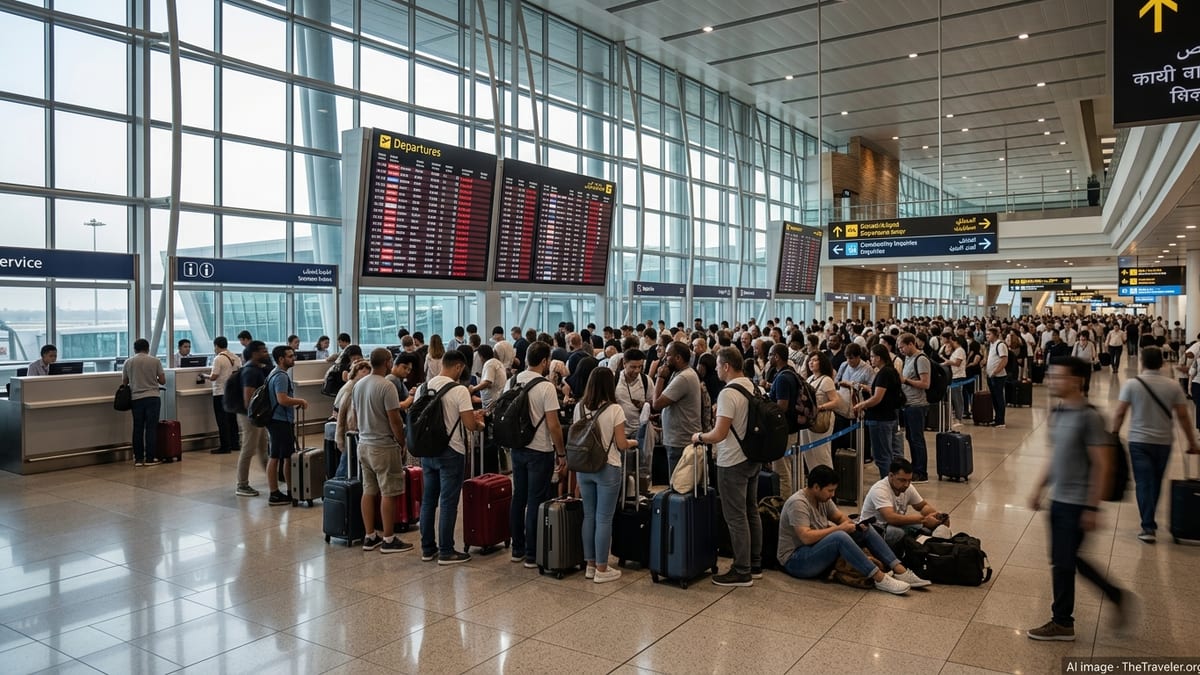
A fresh wave of aviation disruption across Asia has snarled operations at 39 airports and affected roughly 4,000 flights in a single day, as a mix of severe weather, airspace constraints, and operational bottlenecks triggers cascading delays for millions of travelers.
Get the latest news straight to your inbox!
Network-Wide Turbulence Hits Key Asian Hubs
Flight-tracking and disruption dashboards indicate that delays and cancellations are concentrated at some of Asia’s busiest hubs, with ripple effects extending across the region. Live disruption maps for Asia show elevated delay levels at airports serving major population centers and long haul connections, including large Chinese, Indian, Japanese, and Southeast Asian gateways.
Recent monitoring of disruption indices for Asia highlights how even moderate cancellation numbers can combine with high delay percentages to overload terminal and runway capacity. Airports that typically handle thousands of daily movements are struggling when a significant share of departures and arrivals are pushed back by 30 minutes or more, creating queueing on taxiways and around stands.
Publicly available coverage of the current episode notes that more than 3,600 flights have been delayed and over 470 canceled across 39 airports, pushing the total number of disrupted flights to around 4,000. These figures align with broader August and September patterns in which several days have already exceeded the 4,000 flight disruption mark across Asia, underscoring the fragility of the region’s aviation recovery.
The scattershot nature of disruption across dozens of airports makes it difficult for passengers to anticipate where problems will surface next. Travelers are increasingly reliant on airline apps, airport displays, and real time trackers to keep pace with rapidly shifting departure boards.
Weather, Haze and Congested Airspace Combine
Reports from regional aviation outlets and travel advisories point to a convergence of weather, airspace, and operational challenges behind the latest disruption surge. Seasonal storms and convective weather systems are producing repeated ground stops and flow restrictions at coastal and inland hubs, especially during peak afternoon and evening departure waves.
In parts of Southeast Asia, cross border haze linked to forest and peatland fires in Indonesia has further reduced visibility and tightened operating minima. Coverage of the current pattern notes that airports from Jakarta and Kuala Lumpur to Singapore and parts of the Philippines have experienced intermittent holding patterns and longer spacing between arrivals, feeding directly into delay statistics.
At the same time, several major air corridors remain constrained by lingering airspace restrictions tied to geopolitical tensions and security concerns. Industry analyses over recent months describe how closures or partial closures of airspace in and around West Asia force long haul flights between Asia, Europe, and North America to detour, consuming extra fuel and narrowing schedule buffers. When this interacts with localized thunderstorms or ground handling constraints at Asian hubs, on time performance can deteriorate rapidly.
These compounding pressures are occurring at a time when many airlines are already managing tight fleets and high load factors. Earlier schedule filings showed some carriers trimming frequencies on select Asia routes to manage costs and operational risk, but traffic recovery has continued to push demand close to or beyond 2019 levels at many airports.
Major Carriers Struggle to Keep Schedules Intact
Published disruption tallies for the current episode show that large network airlines based in China, India, and Southeast Asia are carrying much of the burden. One detailed breakdown of delays and cancellations across 39 airports indicates that Chinese mainline carriers alone account for hundreds of delayed and nearly 100 canceled flights, reflecting the central role of their hubs in intra Asian and intercontinental traffic.
Indian carriers operating dense domestic and regional schedules have also been heavily exposed. Past single day snapshots of Asia wide disruption, cited in recent analyses, have highlighted how Delhi, Mumbai, and Bengaluru can each log hundreds of delays when convective weather or airspace restrictions coincide with peak travel periods. When those same carriers are now also contending with longer routings on some international legs, punctuality becomes even harder to maintain.
Low cost and hybrid carriers are not immune. Short haul networks built on rapid turnarounds are particularly sensitive to ground handling slowdowns, slot compression, or crew duty time limits. Once early morning flights slip behind schedule, aircraft and crew rotations can remain out of position for the rest of the day, adding to the overall count of disrupted services across the 39 affected airports.
Airports themselves face resource constraints as they attempt to absorb surges of delayed passengers. Terminal congestion, stretched security and immigration lines, and pressure on baggage systems have all been recurring themes in recent coverage of Asia’s aviation performance.
Passengers Face Longer Journeys and Limited Options
For travelers, the immediate effect of the latest disruption wave is longer and less predictable journeys. Air travel rights organizations tracking Asia’s summer and early autumn performance have documented days with several thousand delayed flights and hundreds of cancellations, often involving missed connections, overnight stays, and significant schedule changes for passengers.
Public guidance from consumer advocates and travel industry analysts continues to emphasize practical steps for those caught in the disruption, including monitoring airline apps, enabling flight alerts, and checking eligibility for assistance or compensation where applicable. While compensation regimes in Asia vary widely by jurisdiction, some travelers on international itineraries may have recourse under foreign regulations, depending on the operating carrier and routing.
Rebooking can be particularly challenging when 39 airports across multiple countries are simultaneously affected. With many flights operating near capacity, spare seats on alternative departures are limited, and some passengers are being re accommodated via indirect routings that add extra stops or overnight layovers. Those traveling through key hubs with onward connections to Europe, the Middle East, or North America may also find that long haul segments are fully booked for several days.
Analysts note that disruption at this scale has knock on financial implications for airlines, airports, and passengers alike. Extra fuel burn on diversions, overtime for staff, hotel and meal vouchers, and lost productivity for business travelers all add to the economic cost of a single day in which roughly 4,000 flights fail to operate on time.
Asia’s Aviation Recovery Tested by Repeated Shocks
The latest surge of delays and cancellations adds to a series of disruption spikes that have tested Asia’s aviation system throughout 2026. Industry reports from the past few months describe multiple days with more than 2,000 delayed flights across the region and at least two days crossing the 4,000 disruption threshold, illustrating how quickly fragile schedules can unravel when exposed to external shocks.
Traffic data from airport groups in Asia Pacific and the Middle East shows that many hubs are now handling passenger numbers close to or above pre pandemic benchmarks, even as they navigate higher fuel prices, supply chain constraints, and slower aircraft deliveries. This mismatch between strong demand and constrained capacity leaves little margin for error when storms, haze, or airspace closures emerge.
Analysts argue that the experience of 2026 is likely to accelerate investments in air traffic management modernization, weather forecasting tools, and airport resilience projects. Airlines are also reassessing schedule padding, fleet deployment strategies, and contingency planning for days when multiple hubs are simultaneously under strain.
For now, however, travelers across Asia are feeling the immediate impact of a regional system pushed to its limits. With 39 airports and around 4,000 flights disrupted in the latest wave, the episode serves as another reminder that aviation’s post pandemic rebound remains highly exposed to both natural and man made shocks.
Nomad Lawyer: Asia Flight Disruptions September 2026
AirMedia24: Asia Flight Disruptions August 2026