


More news on this day
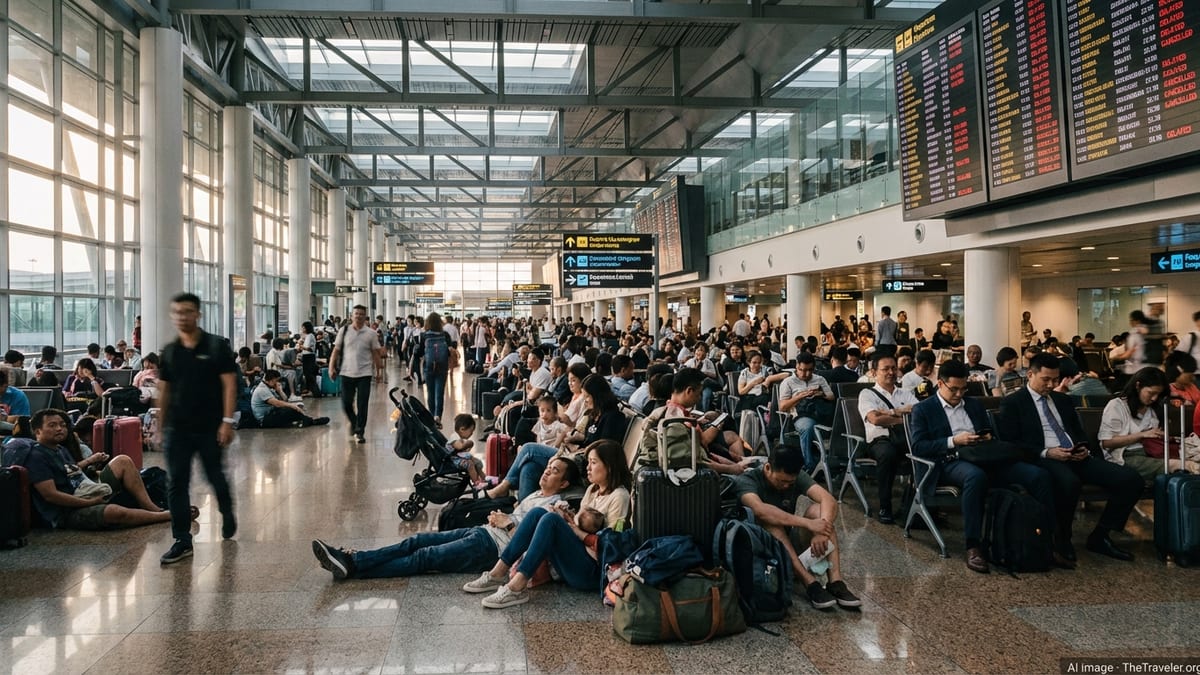
Hundreds of travelers across Asia faced long airport waits and missed connections as flight-tracking disruption dashboards showed a region-wide surge totaling 3,744 delays, with knock-on effects spreading through tightly timed domestic and international networks.
Get the latest news straight to your inbox!
Where the biggest bottlenecks showed up
Public disruption maps used by travelers and airlines indicated that the day’s impact was not evenly distributed. Large hub airports that handle dense banks of departures and arrivals tended to amplify delays as aircraft, gates, and crews fell out of sequence.
On an Asia-focused airport disruption snapshot, Jakarta’s Soekarno-Hatta International Airport appeared among the most affected airports by cancellations, while other major hubs in the region also posted elevated delayed-flight counts, including Delhi Indira Gandhi International Airport, Taipei Taoyuan International Airport, Shanghai Pudong International Airport, Shenzhen Bao’an International Airport, Kuala Lumpur International Airport, and Hong Kong International Airport.
For passengers, the practical problem in these hub environments is that even modest departure slips can erase tight connections. A flight that pushes back only slightly late can still arrive significantly behind schedule once taxi queues, gate holds, and airborne flow restrictions stack up across multiple sectors.
Indonesia’s ash-driven disruptions still reverberating
A key recent factor in the region’s operational volatility has been volcanic ash from Indonesia’s Anak Krakatau. Published coverage described widespread schedule disruption tied to ash conditions, including temporary closures at airports serving Greater Jakarta and surrounding regions.
Indonesia’s Transportation Ministry published notices indicating that Soekarno-Hatta, Halim Perdanakusuma, and other affected airports reopened in early September 2026 after ash-related restrictions, while monitoring continued based on volcanology updates and aviation safety coordination. Separate published reporting described large numbers of flights affected and passengers stranded during the closure window.
Even once airports reopen, recovery can remain uneven. Aircraft and crews may be out of position, and airlines often prioritize restoring longer-haul services and high-demand routes first, which can leave some short-haul frequencies consolidated, retimed, or canceled as schedules are rebuilt.
Why thousands of delays can occur without one single trigger
Delay totals in the thousands typically reflect multiple simultaneous constraints rather than a single failure point. Weather, runway throughput limits, air-traffic flow initiatives, and gate availability can each reduce an airport’s effective capacity, and the impact can cascade across a carrier’s network as inbound aircraft arrive late for their next leg.
Asia’s busiest corridors are particularly sensitive to “rotation delays,” where an aircraft is scheduled to operate several segments in one day. A late first sector can compound into multi-hour delays by evening if the airline has limited spare aircraft or if crew duty time limits begin to bite.
When flights are full, the passenger impact often becomes more severe. Rebooking options can disappear quickly, and the next available seats may not be until the following day, increasing the odds of overnight waits, hotel needs, and rerouting via alternate hubs.
What travelers can do right now to reduce disruption risk
During mass delay events, timing and verification matter. Travelers can reduce wasted trips to the terminal by checking status the night before, again on the day of departure, and once more before leaving for the airport, since retimes and aircraft swaps can occur late in the recovery cycle.
When information conflicts, airline apps and official airport channels generally update gate changes, revised departure times, and cancellation notices faster than third-party summaries. Travelers connecting through a hub can also monitor the inbound aircraft assigned to their flight, since a late inbound is often the earliest warning that a delay may worsen.
For those already at the airport with a tight connection, proactive rebooking to a later flight can sometimes be a better outcome than waiting for an automatic misconnect, especially when onward flights are limited. When seats exist, rerouting through a less congested hub can also help, though options tend to shrink quickly on widespread disruption days.
What to watch over the next few days
After a major disruption, the story often shifts from cancellations to residual delays. Airports may appear fully open while still operating behind schedule due to backlogged departures, late-arriving aircraft, and uneven fleet and crew positioning across the region.
Travelers should also watch for rolling retimes, where flights remain active but depart significantly later than originally scheduled. Those shifts can affect hotel check-in plans, ground transport timing, and onward connections, particularly for late-night flights that slip past midnight.
In the near term, recovery tends to improve fastest on routes with multiple daily frequencies, where airlines have more flexibility to swap aircraft or rebook passengers. Thin routes and some long-haul services may take longer to stabilize because there are fewer replacement options if disruptions repeat.