


More news on this day
Asia’s air travel network is facing another bout of severe disruption, with operational data showing 212 cancellations and 6,639 delays in a single day as monsoon rains and storm systems sweep across key hubs from Jakarta and Bangkok to major airports in China and Japan.
Get the latest news straight to your inbox!
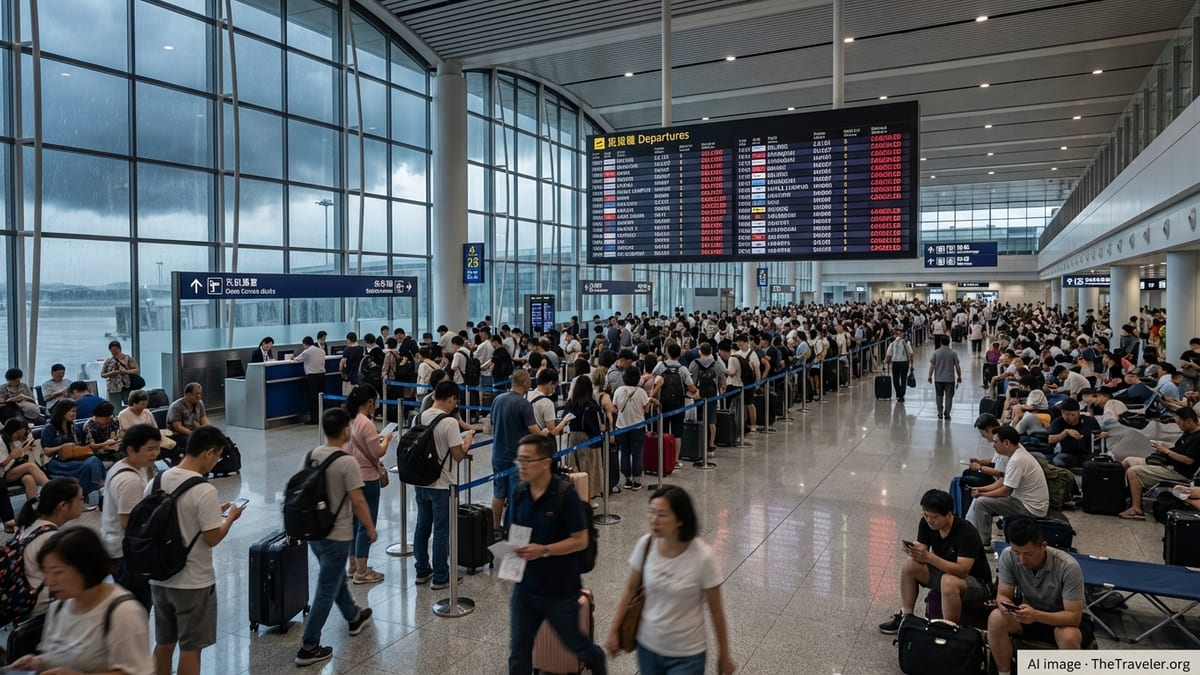
Monsoon Rains and Typhoon Activity Converge on Busy Hubs
Publicly available performance data and aviation tracking reports indicate that the latest spike in disruption is closely tied to intensifying monsoon rains over South and Southeast Asia and lingering impacts from Typhoon Dolphin in parts of East Asia. A wetter than usual southwest monsoon over much of the region has brought sustained heavy downpours, low visibility and temporary runway constraints at several major gateways.
Regional climate outlooks for June to August 2026 projected a near to stronger than average southwest monsoon over most of Southeast Asia, conditions now reflected in the frequency of weather-related delays at airports from Mumbai and Delhi to Bangkok and Jakarta. In parallel, Typhoon Dolphin’s landfall and subsequent weakening over eastern China earlier in August triggered precautionary suspensions and phased resumptions of flights at several coastal airports, leaving networks more vulnerable to further weather shocks later in the month.
These overlapping systems have reduced operational flexibility across Asia’s busiest corridors. When thunderstorms or cloudbursts roll in over a hub that is already close to capacity, holding patterns, diversions and incremental ground delays accumulate quickly, creating the type of single-day totals now being reported: more than 200 cancellations and well over 6,000 delays spread across dozens of airports.
Jakarta and Bangkok Shoulder a Large Share of Disruption
Among Southeast Asia’s hubs, Jakarta Soekarno Hatta International Airport and Bangkok’s Suvarnabhumi Airport emerge prominently in recent disruption tallies. Airport performance data for Soekarno Hatta compiled over August show daily cancellations repeatedly exceeding 150 flights during the most heavily affected period, peaking at 212 cancellations on 16 August 2026 as storms moved across western Indonesia.
Bangkok’s main international gateway has faced its own prolonged strain. Monthly performance overviews for Suvarnabhumi, combined with regional disruption analyses, point to thousands of cancelled departures across the month, with several late-August days approaching 200 cancellations each. The city’s twin-airport system, including Don Mueang International Airport, has experienced waves of knock-on delays as arriving aircraft and crews struggle to return to schedule once weather windows close unexpectedly.
Independent aviation and travel trackers that aggregate data across the region highlight one particularly difficult mid-August day when 212 cancellations and 6,639 delays were logged across Asia. On that day, Jakarta and Bangkok were joined by airports in China, Japan, the Gulf and elsewhere in Southeast Asia, underlining how a handful of weather cells moving over core hubs can trigger wide-ranging ripple effects.
China, Japan and Gulf Hubs Amplify the Ripple Effect
Beyond Southeast Asia, heavily trafficked hubs in China and Japan have played a significant role in the scale of disruption. Earlier in the summer, storm systems over southern and eastern China led to nearly 7,000 flight disruptions across multiple days, particularly at Guangzhou Baiyun, Shanghai Pudong and Beijing Capital. Those airports remain central nodes in the region’s network, so any renewed weather issues quickly propagate delays along long-haul and regional routes.
In Japan, Tokyo Haneda has repeatedly appeared near the top of daily delay rankings when storm bands brush the Kanto region. On some of the worst days, the airport has recorded hundreds of delayed departures, with domestic and regional carriers absorbing the bulk of schedule slippage as they shuttle traffic between secondary cities and international gateways.
The Gulf’s role as a connector between Asia, Europe and North America means that congestion there can magnify problems for travelers transiting the region. Aviation and passenger-rights organizations tracking recent events describe how strong thunderstorms and typhoon-related rerouting in Asia have led to late arrivals at Middle Eastern hubs, compressing connection windows and adding secondary delays for passengers who may not have originated in Asia but whose itineraries depend on Asian sectors running on time.
Structural Strain Meets Seasonal Weather
While monsoon conditions and storm systems are the immediate triggers, several assessments of the current disruption highlight structural factors within Asian aviation that turn challenging weather into multi-day operational crises. Over the past two years, airlines across the region have ramped capacity aggressively to meet resurgent demand, but investments in runway, apron and air traffic control capacity have not always kept pace at the fastest-growing hubs.
Industry-focused coverage notes that many airports now operate with limited scheduling slack during peak hours, leaving little margin when heavy rain or crosswinds force temporary reductions in movements per hour. In such an environment, even a few hours of ground stops or arrival metering can push dozens of flights into rolling delays, particularly on short-haul routes where aircraft are scheduled for multiple turns per day.
Slot-management data from airports well beyond the immediate monsoon belt, including Sydney, show how carriers are adjusting networks in response to higher fuel prices, regional conflicts and changing demand patterns. Those shifts can concentrate traffic on certain city pairs and time bands, increasing the likelihood that when weather does intervene, the number of disrupted flights will be counted in the thousands rather than hundreds.
What Travelers Can Expect in the Coming Weeks
Passenger-facing guidance from travel platforms and compensation services suggests that elevated disruption risk is likely to persist across parts of Asia until the regional monsoon weakens and tropical storm activity diminishes. Historical patterns and current climate outlooks indicate that heavy rain and thunderstorms can remain frequent in several South and Southeast Asian markets into September, especially around coastal and low-lying urban areas.
Travel advisories recommend that passengers scheduled to fly through Jakarta, Bangkok, major Chinese hubs, Tokyo, or Gulf connectors build extra time into itineraries, monitor flight status through airline apps and independent trackers, and pay close attention to rebooking and care policies. For itineraries touching the European Union or involving EU carriers, passenger-rights frameworks may offer compensation in some situations, although many weather-related disruptions fall outside mandatory payout rules.
For now, the figure of 212 cancellations and 6,639 delays on a single day stands as a snapshot of how quickly Asia’s interconnected aviation system can become strained when seasonal weather intersects with dense scheduling. With demand still robust and infrastructure under pressure, observers expect that managing similar waves of disruption will remain a central challenge for airlines and airports across the region through the remainder of the rainy season.
Asia Flight Disruptions Hit Jakarta, Bangkok and Regional Hubs
Asia Flight Disruptions August 2026: Causes, Airlines Affected, Passenger Advice