


More news on this day
Air travel across the Middle East has been hit by a fresh wave of disruption, with regional airports collectively recording 1,261 delayed flights and 59 cancellations in a single day, highlighting the ongoing fragility of global routes that rely on Gulf and Levant hubs.
Get the latest news straight to your inbox!
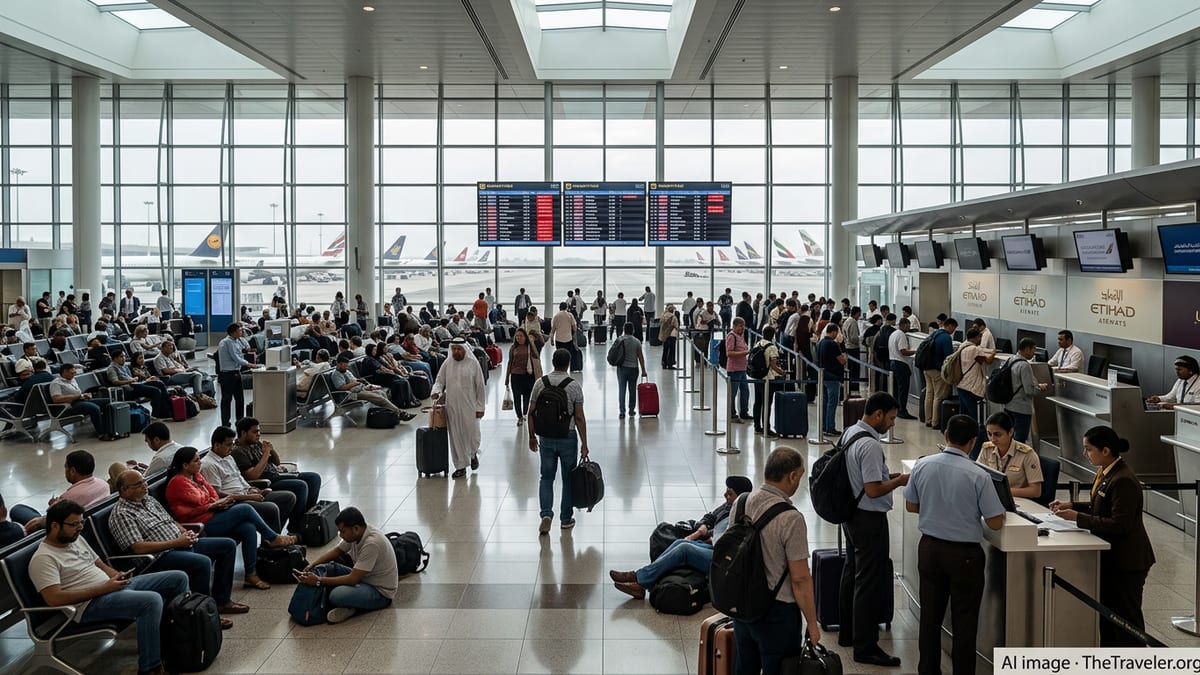
Delays Concentrated at Key Gulf and Levant Hubs
Operational data compiled from regional airport dashboards and flight tracking platforms shows that the latest spike in disruption is clustered around key hubs in the Gulf and eastern Mediterranean. The figures, aggregating departures and arrivals over a 24 hour period, indicate that Bahrain International Airport accounts for a significant portion of the delays, while airports in Kuwait, the United Arab Emirates and Israel also report elevated disruption levels.
Published coverage on disruption monitoring sites describes a pattern in which long haul services are held at gates or delayed on arrival, creating knock on effects for regional connections. Even where cancellations remain lower in absolute terms than during the most intense periods of airspace closure earlier in 2026, the cumulative impact of 1,261 delayed flights in a single operating day is substantial for both passengers and airline networks.
Reports indicate that some carriers have opted to consolidate frequencies, operating fewer but fuller services to maintain connectivity while preserving crew and aircraft availability. Others are prioritizing core trunk routes to Europe and Asia, trimming secondary destinations that offer less flexibility for rebooking when schedules unravel.
Tracking dashboards referenced by consumer facing claims services show that delay rates at several Middle East airports have periodically climbed into double digits in recent weeks, with the latest 59 cancellations adding to an already stretched operational environment for regional airlines.
Airspace Restrictions and Security Concerns Continue to Drive Disruption
The current disruption cannot be separated from the broader security backdrop that has affected Middle East aviation throughout 2026. Reports from aviation intelligence providers note that widespread airspace closures earlier in the year led to a sharp reduction in flights to, from and within the region, forcing airlines to adopt longer routings that increase block times, fuel burn and crew duty complexity.
According to recent analytical reports, key flight information regions over Iran, Iraq and neighboring states have alternated between full closure and tightly controlled access since late February. Even when airports themselves remain open, airlines are often required to detour around restricted zones, stretching schedules and reducing the buffer time that carriers normally rely on to absorb minor delays before they cascade through the network.
Industry digests tracking the economic impact of the Iran conflict describe the episode as one of the most severe shocks to Middle East connectivity since the pandemic. In some weeks during March, regional flight volumes were reported to be down by more than half compared with pre conflict baselines, with hubs such as Dubai, Doha and Abu Dhabi operating at reduced capacity and some carriers sending aircraft to storage while they reassessed demand and safety constraints.
Although many routes have since been reintroduced, the operating environment remains sensitive to renewed flare ups, sporadic drone incidents and temporary airspace restrictions. Each new security alert or localized incident raises the risk of additional delays and tactical cancellations, as airlines and air navigation service providers adjust routings in real time.
Passenger Experience: Long Queues, Missed Connections and Limited Options
For travelers, the latest tally of 1,261 delays translates into longer queues at security and immigration, crowded departure gates and a higher risk of missed onward connections, especially at banks of late night departures that are common at Gulf hubs. Coverage from regional outlets and travel industry bulletins describes passengers facing extended waits for rebooking, with some itineraries requiring overnight stays or rerouting via alternative hubs in Europe or South Asia.
Consumer advocacy and claims platforms that monitor compensation eligible disruptions in the region report an uptick in cases across several Middle East based and European carriers operating through Gulf and Levant airports. While many of the delays are linked to airspace restrictions and security measures that fall outside normal compensation regimes, affected travelers are still entitled in many jurisdictions to basic assistance such as meals, accommodation and rebooking when they are stranded away from home.
Publicly available guidance from travel rights organizations stresses the importance of monitoring airline apps and airport information screens rather than relying solely on social media posts during disruption events. In practice, however, large scale delay clusters like those recorded in the latest 24 hour period can overwhelm call centers and lead to inconsistent information between channels, further adding to passenger frustration.
Travel industry advisories encourage passengers connecting through the Middle East over the coming weeks to allow more generous minimum connection times, consider earlier departures on the first leg of long itineraries, and review travel insurance coverage for schedule disruption and missed connections before departure.
Network and Economic Impact for Airlines and Airports
Beyond the immediate inconvenience for travelers, persistent disruptions on the scale of 1,261 delays and 59 cancellations in a day have material implications for airline operating costs and airport efficiency. Aviation analytics firms tracking schedule changes across the Middle East estimate that longer routings and holding patterns have added significant unplanned fuel consumption since the onset of the crisis, at a time when elevated oil prices are already squeezing margins.
Reports from airline and airport associations suggest that carriers in the region have adjusted capacity by trimming frequencies on some Europe–Asia corridors and pausing expansion plans on marginal routes. This recalibration is reflected in traffic statistics that show a decline in total flights compared with early 2026, even as load factors on remaining services remain relatively high.
For airports, irregular operations translate into more complex stand allocation, pressure on terminal infrastructure and disrupted staff rosters. Industry briefings highlight that even when the number of outright cancellations is lower than during previous peaks, a very high volume of delayed departures can reduce runway throughput and extend turnaround times, which in turn keeps arriving aircraft waiting on taxiways and compounds the disruption.
Executives quoted in public financial filings and investor presentations over recent months have highlighted the Middle East aviation crisis as a key variable in their forward guidance, noting that uncertainty around airspace access and potential further flare ups continues to weigh on growth forecasts for long haul demand between Europe, Asia and Africa.
Outlook: Prolonged Volatility and What Travelers Should Watch
Analysts following the region broadly agree in published commentaries that Middle East aviation is likely to face a prolonged period of volatility rather than a swift return to pre conflict normality. While the current day’s figure of 1,261 delays and 59 cancellations represents a snapshot rather than a fixed pattern, it fits within a broader series of disruption events, including earlier days in which several hundred delays and dozens of cancellations were recorded at Gulf and Levant hubs.
Intelligence updates aimed at tour operators and corporate travel managers recommend close monitoring of airspace advisories, airline schedule changes and insurance coverage language as the situation develops. Several updates issued in July noted that, even during periods described as relatively stable, airlines continued to avoid certain airspace corridors and warned customers of potential last minute changes to departure times.
For individual travelers, publicly available guidance suggests a handful of practical steps: booking through tickets on a single carrier or alliance where possible, enabling app notifications, keeping contact details up to date with airlines and considering routing options that provide additional alternatives if a Middle East hub experiences a fresh wave of disruption.
The latest spike in delays underscores how tightly interconnected global aviation remains with developments in Middle East airspace. With many Europe–Asia itineraries still relying on one or more regional hubs, any new operational shock in the Gulf or Levant is likely to ripple quickly across time zones, affecting passengers far from the immediate conflict zone.
Middle East Air Travel Hit by 1,261 Delays and 59 Cancellations
AirHelp: Middle East Flight Delays and Cancellations