


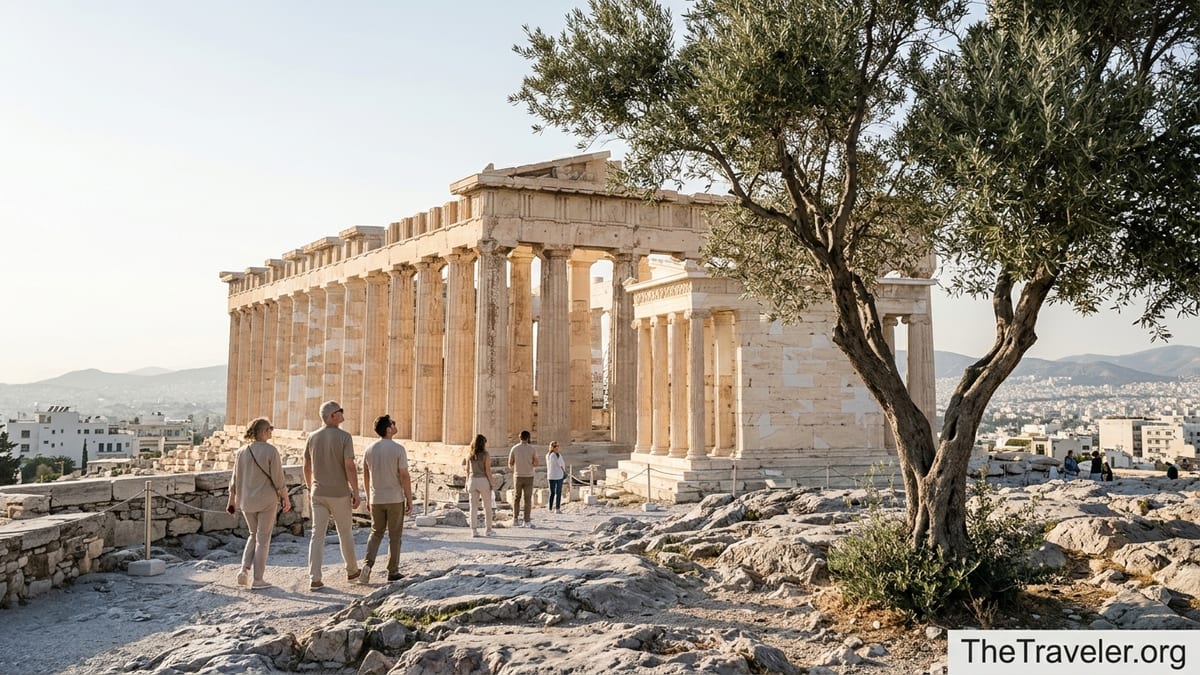
For many travelers in Greece, the first real encounter with Athena is not in a textbook, but on a sunlit walk up to the Acropolis in Athens. The marble columns of the Parthenon, the carved owl souvenirs in the Plaka, even the olive trees clinging to rocky slopes all trace back to this complex goddess of wisdom, strategy, and civic life. Understanding Athena does more than enrich a museum visit. It reveals how ancient Greeks imagined intelligence, fair war, craftsmanship, and urban life, and why her presence still shapes some of the most visited sites in the country today.
Get the latest updates straight to your inbox!
Athena at a Glance: Who She Is and Why She Matters
Athena is one of the twelve Olympian gods, best known as the Greek goddess of wisdom, war strategy, crafts, and the protection of cities. Ancient writers describe her as the favorite daughter of Zeus, born in a dramatic scene where she sprang fully armed from his head, already an adult and ready for counsel and battle. Unlike deities focused on raw force or passion, Athena stands for intelligence applied to real problems: how to defend a city, plan a campaign, build a ship, or govern fairly.
In contrast to Ares, who personifies chaotic and brutal warfare, Athena represents disciplined tactics and justifiable conflict. Her soldiers are those who defend walls, plan ambushes carefully, and fight for civic order rather than personal glory. When travelers today look up at the fortified Acropolis of Athens or walk the defensive walls of ancient sites like Mycenae, they are seeing the material world that her worshippers felt needed her protection.
Athena is also a virgin goddess, often called Athena Parthenos, “the maiden Athena,” which is the title that gave the Parthenon its name. This did not mean she was distant from human life. On the contrary, in Homer’s epics she intervenes constantly: advising Odysseus, steadying the hand of Achilles, or supporting clever, resilient heroes over reckless brutes. For visitors exploring the National Archaeological Museum in Athens or the museum at Delphi, statues and vase paintings often show her leaning forward, spear in hand, as if about to offer advice.
Above all, Athena is a city goddess. She favors the organized, self-governing community over the lonely hero in the wilderness. That is why her main shrines, from the Parthenon in Athens to the temple of Athena Lindia on Rhodes, rise over urban centers and harbors rather than hidden forest groves. When you stand on a city acropolis and look out over houses, markets, and ports, you are seeing the landscape in which Athena’s presence was most strongly felt.
Wisdom and Strategy: Athena’s Mind at Work
Athena’s wisdom is not simply book learning or philosophy. It is practical intelligence: the ability to read a situation, anticipate consequences, and act at the right moment. In Homer’s Odyssey, she helps Odysseus disguise himself as a beggar to retake his home, showing that cunning and patience can be more powerful than brute strength. Travelers will notice pottery scenes in the Acropolis Museum where Athena stands beside heroes, almost like a general leaning over a campaign map.
Her strategic side made her the patron of statesmen and planners. In democratic Athens, leaders who argued cases in the law courts or debated in the Assembly did so under her notional protection. When modern visitors walk through the ruins of the Agora in Athens, with its stone speaker’s platform and remains of public offices, they are effectively walking through Athena’s civic laboratory: a place where strategy was applied not only to war but to trade routes, alliances, and laws.
This aspect of Athena remains vivid in the way Greek guides explain sites to visitors. At the hill of Pnyx, where citizens once met to vote, local guides frequently frame discussions around Athena’s values of reasoned debate and collective decision-making. For a visitor, hearing how speeches here once weighed whether to go to war with Sparta or fund a new fleet makes Athena’s role as a strategist feel directly tied to stones underfoot.
Even today, some modern institutions quietly echo her symbolism. Greek universities and law schools often display statues or reliefs of Athena with her helmet and owl, signaling a commitment to knowledge and clear thinking. A traveler walking through the campus of the National and Kapodistrian University of Athens or passing law courts in central Athens may spot her image carved above doors, a reminder that the ancient goddess of reason still stands watch over modern education and justice.
Goddess of War, But Not of Bloodlust
Although heavily armed in art, Athena is not primarily a goddess of slaughter. She presides over “just war” and measured defense. Literary sources repeatedly show her trying to restrain rage on the battlefield, favoring tactics that minimize unnecessary loss. Visitors who compare statues of Athena and Ares in the National Archaeological Museum can see the contrast: he often appears restless and aggressive, while she stands poised and controlled, spear grounded, shield ready but not raised in fury.
In the Trojan War cycle, Athena supports Greek heroes but often does so by giving advice rather than direct force. She inspires the creation of the Wooden Horse and guides key warriors at pivotal moments. For modern travelers, this dimension is often explained at sites like Troy in present-day Türkiye, where local guides contrast Athena’s strategic thinking with the raw, sometimes pointless violence that also marks the story.
Archaeological sites across Greece showcase real-world military structures tied in spirit to Athena’s careful war. The long walls between Athens and its port of Piraeus, whose traces you can still follow in certain neighborhoods, were engineering solutions to keep the city supplied during siege. Fortified peaks like the acropolis of Corinth or the citadel at Tiryns rely on layout and planning more than sheer brutality. These are landscapes where Athena, as a planner of defenses, would have felt very much at home.
Festivals in her honor also reflected this side. During the ancient Panathenaic procession in Athens, which modern travelers can roughly trace when walking from the Kerameikos cemetery up to the Acropolis, citizens carried weapons and shields but within a religious and civic framework. This was not a display of conquest abroad but of readiness and unity at home, a public performance of the kind of ordered martial strength that Athena favored.
Patron of Crafts, Weaving, and Skilled Hands
Athena also governs crafts, especially weaving, metalwork, and the technical skills that keep a city functioning. One of the most famous myths tells of Arachne, a mortal weaver who boasted she could outdo the goddess. Athena challenged her to a weaving contest; when Arachne’s tapestry criticized the gods, Athena reacted with fury, and Arachne was ultimately transformed into a spider. This story underscores how seriously Greeks took craftsmanship and respectful competition, a theme that still resonates when visitors watch weavers at work in modern workshops around Greece.
Travelers can see Athena’s craft side most clearly in museum galleries filled with decorated pottery, bronze armor, and carved marble. The Acropolis Museum, the Archaeological Museum of Heraklion, and the museum at Olympia all display helmets, shields, and intricate reliefs that would have fallen under her patronage as a goddess of technique and design. Standing in front of a finely engraved bronze cuirass or a delicately painted krater, visitors are seeing the kind of mastery that Athena was believed to inspire.
Weaving in particular was central to her worship. During the Panathenaic festival in Athens, a specially woven robe called a peplos was carried in procession and offered to a great cult statue of Athena. Today, while the ancient textiles are gone, some craft studios in neighborhoods like Plaka or in island towns such as Chania on Crete sell handwoven textiles based on classical patterns. Guides often point out that these geometric borders and meander motifs trace back to techniques and aesthetics tied symbolically to Athena’s loom.
Beyond weaving, Athena was thought to guide shipbuilders, carpenters, and even early architects. When visitors climb the scaffolding on guided tours that explain the ongoing restoration of the Parthenon, they learn how modern engineers study the precision of the original masons: invisible curvature in steps, subtle corner adjustments in columns. This level of problem solving, combining math and craft, is exactly the kind of skilled intelligence that the ancients attributed to Athena.
Guardian of Cities: From Athens to Regional Sanctuaries
Athena’s identity as a city protector is most vividly embodied in Athens itself. According to myth, she competed with Poseidon to become patron of the city. He offered a saltwater spring, while she produced an olive tree, promising food, oil, and wood. The citizens chose her gift, and the city took her name. On the Acropolis today, near the Erechtheion, guides still point out a small olive tree symbolizing that mythical original, and travelers often pause there for photos and shade, tying a legendary story to a living plant.
The Parthenon, dominating the skyline of modern Athens, functioned both as her temple and as a treasury for the city. Inside once stood a gigantic gold and ivory statue of Athena Parthenos, attributed in antiquity to the sculptor Phidias. Although the original is lost, visitors can see smaller Roman copies in museums such as the National Archaeological Museum or at sites in Italy, giving a sense of the gleaming figure that once watched over the Athenian citizen body.
Athena, however, was not confined to Athens. Travelers across Greece encounter her in other urban centers. On Rhodes, the remains of the sanctuary of Athena Lindia overlook the coastal town of Lindos and its harbor, a commanding position that reflects her role as guardian of seafarers and traders. In Sparta, the so-called Bronze House of Athena once stood as a major temple, its bronze-plated walls catching the sunlight. While the structure is now ruined, the site still offers a sense of how seriously even militaristic Sparta took her protection.
For modern visitors, tracing these sanctuaries can become a thematic itinerary: a journey from Athens to regional sites where Athena watched over citizens, sailors, and rulers. Local tourism offices and licensed guides often build multi-day routes that include the Acropolis, the ancient Agora, Lindos, and Mycenae, allowing travelers to experience firsthand how Athena’s civic and protective roles spread across the ancient Greek world.
Athena Among the Olympians and in Modern Culture
On Olympus, Athena occupies a special place as counselor and strategist. Even Zeus, king of the gods, is depicted in some stories as listening to her advice. She often acts as a mediator or problem-solver in disputes among gods and mortals, and unlike several other deities, she is not usually ruled by jealousy or personal passion. In literature and art, she appears again and again at key turning points: guiding Perseus against Medusa, advising Herakles, and supporting Jason and the Argonauts in later traditions.
Compared to other goddesses, Athena combines what might seem like opposites. She is martial yet moderate, intellectual yet deeply involved in daily urban life, eternally maiden yet constantly present in stories about marriage laws, inheritance, and civic identity. Travelers who visit different sanctuaries in Greece quickly see how this complexity allowed city-states to adapt her image. In some places she appears primarily as warrior, in others more as wise protector of law courts, and elsewhere as a patroness of craft guilds and artisans.
Her influence carries forward into modern times in subtle ways. The name Athena appears in company logos, university emblems, and cultural institutions in Greece and abroad, signaling trust in wisdom and strategy. Tour companies in Athens sometimes adopt the owl, her sacred bird, as a symbol on brochures and tour buses, promising knowledgeable guides and thoughtful itineraries. Bookshops near the Acropolis sell modern novels and historical studies that retell her myths, while local jewelry stores craft pendants of her owl or her helmet for visitors to take home.
Even popular culture far from Greece continues to draw on Athena’s image. Films, novels, and television series about Greek mythology often portray her as the calm, intelligent counterweight to more impulsive gods. For a traveler standing in front of an Athena statue in a museum, recognizing these modern echoes can make the ancient marble feel familiar, as if the goddess has never really left the stage.
Experiencing Athena on a Trip to Greece Today
For travelers who want to connect Athena’s myths with real-world locations, Athens is the obvious starting point. A typical visit might begin at the Acropolis, where an early morning entry ticket allows you to walk up the ancient pathway before the main crowds. As you step through the Propylaia gateway and see the Parthenon to your right and the small Temple of Athena Nike perched on a bastion, you are quite literally entering her sacred precinct. Licensed guides on site often offer one to two hour tours that weave together architecture, ritual, and myth.
After the Acropolis, the Acropolis Museum gives context to Athena’s story, with original sculpture from the Parthenon and other temples displayed at eye level. Here travelers can see carved scenes of gods and citizens taking part in the Panathenaic procession, and fragments of the great shield that once decorated her chryselephantine statue. A café with glass walls looks back up at the Acropolis rock, allowing visitors to reflect on how the goddess’s domain dominated both skyline and imagination.
Beyond central Athens, day trips and short island hops deepen the picture. A ferry to Aegina or a drive to Sounion, where the Temple of Poseidon crowns a headland, lets visitors compare the sea god’s domain with Athena’s urban stronghold. On Rhodes, walking up to the acropolis of Lindos in the late afternoon, as the sun slants over the harbor, brings travelers to another of her high-point sanctuaries. Here, the foundations of an ancient temple to Athena Lindia share space with medieval fortifications, illustrating how successive cultures kept fortifying the very spots the Greeks associated with her protection.
Travelers interested in crafts can seek out workshops that echo Athena’s skills. In neighborhoods like Psyrri and Plaka in Athens or in old quarters of cities such as Nafplio, small studios sell handwoven textiles, bronze replicas of helmets, and ceramic pieces inspired by ancient designs. Asking artisans about the myth of Arachne or Athena’s role as patron of smiths often sparks conversations that blend history, personal experience, and pride in living traditions.
The Takeaway
To understand Athena is to understand a particular Greek ideal of intelligence: sharp, disciplined, and always directed toward practical challenges. She is the goddess who plans defenses rather than celebrates conquest, who values craftspeople as much as warriors, and who binds her identity to cities and shared public life instead of private passion. For travelers, this makes her one of the most accessible ancient deities, because her world overlaps so strongly with sites that remain central to modern Greece.
Whether you are watching the sunrise from the steps of the Parthenon, tracing defensive walls along a hillside above a harbor, or talking with a weaver in a small island shop, Athena’s presence is never far away. Her myths explain the olive trees that dot the landscape, the owls on museum gift-shop shelves, and the emphasis Greek guides place on debate, law, and civic pride. Approaching Greece with Athena in mind turns a trip into more than a series of photo stops. It becomes an encounter with an enduring idea of wise strength that still shapes how people here imagine their cities, their skills, and their future.
FAQ
Q1. Who was Athena in Greek mythology?
Athena was one of the twelve Olympian gods, the daughter of Zeus, and the goddess of wisdom, war strategy, crafts, and the protection of cities, especially Athens.
Q2. How is Athena different from Ares, the god of war?
While Ares represents violent, chaotic battle, Athena embodies strategic, disciplined warfare and defense. She favors planning, diplomacy, and just causes over raw aggression.
Q3. Where can travelers today best experience Athena’s legacy?
The Acropolis and Acropolis Museum in Athens are the most vivid places to experience her legacy, but important sanctuaries also stand at Lindos on Rhodes, in Sparta, and at other city acropolises.
Q4. What are Athena’s main symbols?
Common symbols of Athena include the owl, representing clear-sighted wisdom, the olive tree, her gift to Athens, as well as helmet, spear, and shield, reflecting her strategic warlike side.
Q5. Why is the Parthenon so closely linked to Athena?
The Parthenon was Athena’s principal temple on the Acropolis of Athens. It housed a monumental statue of Athena Parthenos and served as a religious, political, and financial center for the city.
Q6. Did Athena really protect individual heroes in myths?
Yes, in Greek stories she often mentors and protects heroes such as Odysseus, Perseus, and Herakles, guiding them with advice, clever plans, and sometimes direct divine assistance.
Q7. How was Athena honored in ancient Athens?
She was honored with regular sacrifices and especially with the Panathenaic festival, a major celebration involving a citywide procession, athletic contests, and the offering of a woven robe to her statue.
Q8. Is Athena connected to crafts and everyday skills?
Very much so. Athena was patroness of weaving, metalwork, shipbuilding, and other technical crafts. Ancient artisans saw her as the source of skillful hands and clever design.
Q9. What modern reminders of Athena can travelers notice in Greece?
Travelers can spot her image on university emblems, law courts, shop signs, and tourist brochures, often represented by an owl or helmet, signaling wisdom, culture, and thoughtful guidance.
Q10. How can understanding Athena enrich a trip to Greece?
Knowing Athena’s stories helps travelers see deeper meaning in sites like the Acropolis, city walls, and craft workshops, turning ruins and souvenirs into part of a larger story about wisdom and civic life.