


Athena, goddess of wisdom and war strategy, is everywhere in Greece. You see her on museum pediments, drachma coins in glass cases, and souvenir owls in Monastiraki Market. Yet behind the statues and souvenirs lies a web of vivid stories: a goddess born from Zeus’s skull, a patron of cunning heroes, a rival to sea gods and boastful mortals, and a protector linked to owls, snakes, and the olive tree that still shades modern Athens. This guide unpacks Athena’s mythology in a way you can carry with you as you walk the Acropolis or leaf through a museum catalogue back home.
Get the latest updates straight to your inbox!
Athena’s Extraordinary Birth from the Head of Zeus
Most Greek gods arrive with a conventional divine childhood. Athena does not. According to classical poets such as Hesiod, she begins as the unborn child of Metis, a goddess of wise counsel and Zeus’s first consort. A prophecy warns that Metis will bear a daughter and then a son destined to overthrow Zeus. To avoid his father’s fate, Zeus swallows Metis whole while she is pregnant, hoping to contain both mother and child within himself.
The plan only half works. Some time later, Zeus is seized by a ferocious headache. On the banks of the river Triton in some versions, he calls for help. The smith god Hephaestus strikes Zeus’s skull with an axe, and from the split head Athena springs forth fully armed, shield on her arm and helmet on her brow, shouting a war cry that shakes Olympus. Ancient writers treated this as more than a bizarre birth story. Athena emerges literally from Zeus’s mind, which helps explain her role as the embodiment of strategic intelligence and disciplined force rather than blind aggression.
You can see this myth translated into stone at the Acropolis Museum in Athens. The reconstructed east pediment of the Parthenon once showed the gods reacting to Athena’s birth above the city. The original figures are fragmentary today, but the museum’s interpretive displays walk visitors through how Athenians imagined that explosive moment. For many travelers, it is their first encounter with Athena not just as a statue, but as a narrative presence shaping how the city understood itself.
Even outside Greece, the image of a fully armed goddess leaping from a god’s head has traveled far. In major collections such as the British Museum in London and the Louvre in Paris, you will find red-figure vases where artisans from the 5th century BCE paint Zeus seated in pain while a miniature, armored Athena emerges from his skull. Seeing these side by side with the marble statues in Athens underlines how widely her birth story circulated in the ancient world.
Goddess of Wisdom, Strategy, and the City
Athena’s unusual origin shapes her domains. She is not a goddess of raw battle frenzy; that role belongs to Ares. Instead, she rules over intelligent warfare, tactics, and the discipline that keeps soldiers in formation. At the same time, she is patron of crafts such as weaving and metalwork, and of rational thought itself. Her temples stand in city centers, and her protection focuses on the organized life of the polis rather than on wild mountains or forests.
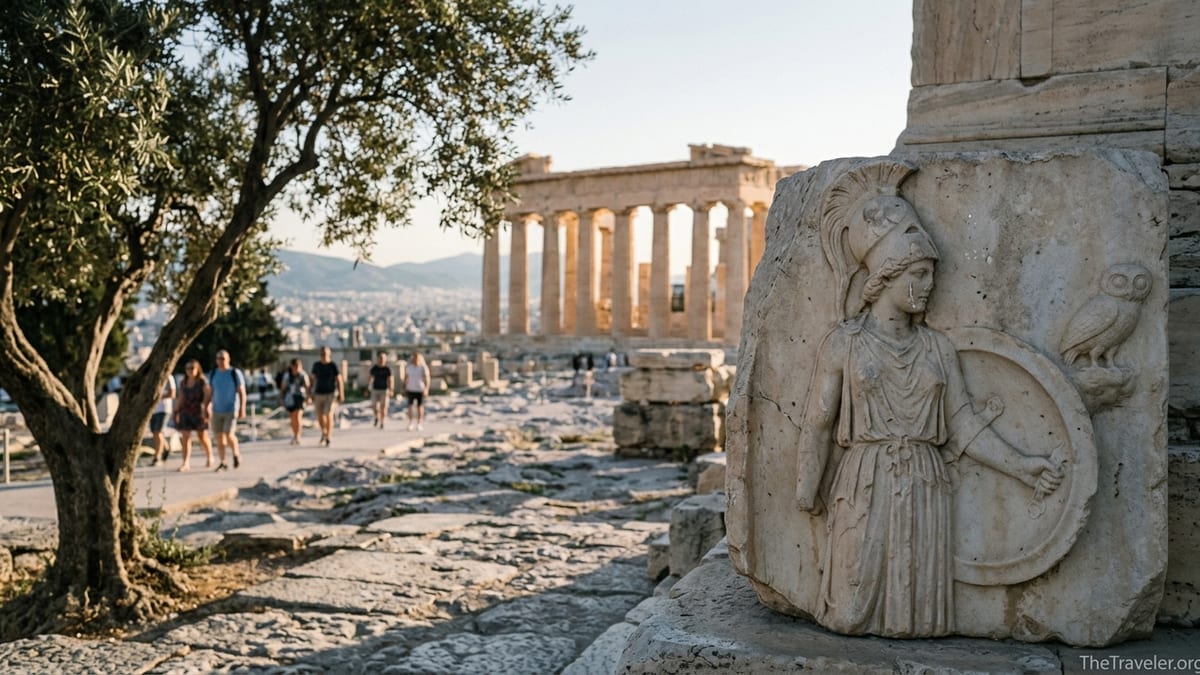
The most famous story linking Athena to a real landscape is her contest with Poseidon for control of Attica. When the new city on the rocky hill needed a divine patron, both gods offered gifts. Poseidon struck the ground with his trident and produced a saltwater spring or, in some versions, the first horse. Athena planted the first olive tree. The citizens chose her gift: a practical source of oil, food, and wood. The city took her name, becoming Athens, and the olive tree became one of her enduring symbols. Travelers today can visit an olive tree in the Erechtheion courtyard on the Acropolis, presented as a descendant of Athena’s mythical gift.
This myth is not just a charming origin story. It hints at the values Athenians claimed for themselves. Choosing Athena’s olive over Poseidon’s wave or warhorse meant choosing steady prosperity and civic order over sudden force. When you stand on the Acropolis and look down at the dense city and the Saronic Gulf, you are literally seeing the landscape where this divine rivalry was imagined to unfold, between the sea power of Poseidon and the urban, agricultural wisdom of Athena.
In art, Athena’s city-centered character appears in her standard image: helmeted, often with a spear and shield, wearing the aegis, a fringed goat-skin or shield bearing the Gorgon’s head. On Roman-era statues such as the Piraeus Athena now in the Archaeological Museum of Piraeus, you can see the careful rendering of her Corinthian helmet, breastplate, and the subtle presence of snakes and owls as additional symbols. These physical details make her instantly recognizable, even for visitors with little background in mythology.
Athena and the Heroes: Odysseus, Perseus, Heracles and More
Athena is not confined to lofty theology; she appears inside the most famous Greek adventure stories as a hands-on adviser. In Homer’s Odyssey she is almost a co-protagonist, guiding Odysseus over ten years of wandering. She encourages his son Telemachus to leave Ithaca and seek news of his father, disguises Odysseus as a beggar when he reaches home, and helps him plan the ambush of the suitors who have overrun his palace. When you read the poem with an eye on Athena, it becomes a study in her particular kind of intelligence: patient, strategic, and merciful to those who respect the gods.
Her role extends beyond Odysseus. In the myth of Perseus, Athena provides the hero with a polished shield so he can view Medusa’s reflection and decapitate her without turning to stone. Later she sets Medusa’s severed head into her aegis, sharpening its power to terrify enemies. Travelers can trace this story in museum galleries from Athens to Berlin, where black-figure amphorae depict the bearded hero, winged sandals flashing, while Athena stands to one side, serene and heavily armed, presiding over his success.
Athena also supports Heracles, the greatest of Greek strongmen. On painted vases and carved metopes from temples such as the one at Olympia, she stands near him during his labors, sometimes simply watching, sometimes holding out a helmet or offering advice. Her presence helps frame Heracles’s brute strength within a moral and strategic framework. Even in the story of Jason and the Argonauts, Athena appears as a kind of maritime engineer, helping to design the ship Argo and ensuring it is seaworthy for the perilous voyage in search of the Golden Fleece.
If you are planning a mythology-focused journey, it is easy to build an Athena-and-heroes trail. In Athens, the National Archaeological Museum displays pottery scenes from the Odyssey and Perseus cycle where she appears. In Naples, the National Archaeological Museum holds frescoes from Roman villas in southern Italy that reinterpret these Greek myths, again with Athena in her familiar armor. Standing before these objects, you can see how ancient viewers were meant to understand heroism: not as raw power alone, but as power allied with divine wisdom.
Rivalries and Moral Lessons: Athena Against Gods and Mortals
Athena’s stories are full of rivalries, yet they rarely show reckless anger. Instead, they work like case studies in what happens when mortals or even other gods challenge the boundaries of wisdom. Her contest with Poseidon for Athens sets up a long-running tension between the goddess of strategy and the god of the sea. Other tales deepen this contrast. In some accounts, the two deities clash again over coastal sanctuaries or maritime disasters, reflecting the real tension in Attic life between reliance on seaborne trade and the need for secure, ordered cities.
Her rivalry with Arachne illustrates a different kind of boundary. Arachne is a mortal woman so skilled at weaving that she boasts she can surpass Athena herself. The goddess appears, often disguised as an old woman, to warn her against such pride. When Arachne persists and even depicts the love affairs of the gods in her tapestry, Athena responds. Depending on the version, she either destroys the tapestry and strikes Arachne, who then hangs herself, or she directly transforms Arachne into the first spider, condemned to weave forever. For modern visitors strolling through Greek collections in Berlin or Florence, where loom weights and spindle whorls from ancient houses are on display, this story gives a moral charge to everyday tools of the craft.
Medusa’s connection with Athena is more complex. Early versions of the myth present Medusa as a monster from the start, but later Roman writers describe her as a beautiful woman violated in Athena’s temple by Poseidon. Enraged at the desecration of her sanctuary, Athena transforms Medusa’s hair into snakes and makes her face deadly to behold. Some readers see this as punishment aimed at Medusa, others as a tragic attempt to reclaim the sanctity of the sacred space. Either way, Athena’s subsequent act of placing Medusa’s head on her aegis draws the victim and the goddess into a single, unsettling symbol.
Even among the Olympians, Athena can stand apart. In the story of the Judgment of Paris, she appears as one of three goddesses competing for the golden apple that will go to the fairest, alongside Hera and Aphrodite. Paris ultimately chooses Aphrodite, gaining the love of Helen but setting the stage for the Trojan War. Athena becomes one of Troy’s most determined divine enemies. For travelers exploring sites like Troy in modern Turkey or browsing the Trojan War galleries in major museums, this rivalry between wisdom, power, and desire provides a lens for reading countless scenes of battles and sieges.
Sacred Animals and Symbols: Owl, Snake, Olive and Aegis
Athena is rarely depicted alone. Even when statues show her as a solitary figure, small details at her feet, on her shoulders, or along the rim of her shield evoke her sacred animals and symbols. The most recognizable companion is the owl, specifically the little owl that once nested in large numbers on the Athenian Acropolis. In classical art the bird perches on Athena’s arm or beside her helmet, embodying sharp nocturnal sight and the kind of wisdom that can see through darkness and deception.
You will meet this owl repeatedly in Athens. Ancient silver coins known as tetradrachms often show Athena’s head on one side and an owl on the other. The Acropolis Museum and the Numismatic Museum both display originals, and modern gift shops sell replicas in bronze, silver, and even printed on cotton tote bags. Holding one in your hand connects directly to the ancient Athenians who paid soldiers and bought food with coins stamped with their goddess’s emblem.
The snake is another of Athena’s sacred creatures. On statues such as the lost chryselephantine masterpiece of Athena Parthenos, recreated in modern full-scale copies at museums in Nashville and elsewhere, a serpent curls behind her shield. Ancient authors associated this snake with Erichthonius, an early Athenian king linked to the earth itself, suggesting Athena’s role as guardian of the city’s deep autochthonous roots. Visitors who study the carvings on smaller bronze figurines in museums across Greece will notice serpent borders on her aegis and small coiled snakes emerging near her feet.
Then there is the olive tree and the aegis. Around the Acropolis and in the wider Attica region, groves of gnarled olive trees still mark the landscape, and many local guides like to point out how the myth of Athena’s gift remains woven into agricultural life. The aegis, whether interpreted as a shield, a goat-skin cloak, or a ritual object, usually shows the head of Medusa at its center and a fringe of snakes. In sculpture and vase painting, this combination of human and serpentine features can be startling even today. For travelers, spotting these details becomes a kind of game: on each new temple frieze or vase, look for the owl, the snake, the olive, and the Gorgon, and you will keep finding Athena even when she is not named in the label.
Where to Meet Athena Today: Sites, Museums and Modern Echoes
For anyone captivated by Athena’s myths, Athens itself is the natural starting point. The Acropolis hill concentrates many of her key stories in a single walkable circuit. The Parthenon, built in the 5th century BCE, was dedicated to her as Athena Parthenos, the Virgin Athena. While the colossal gold-and-ivory statue that once stood inside is lost, information panels and scale models at the Acropolis Museum reconstruct her appearance with spear, shield, owl, and serpent. Nearby, the smaller temple of Athena Nike perches at the edge of the rock, celebrating her as bringer of victory. Its friezes of battles and processions link the city’s real military history to the goddess’s strategic protection.
Beyond the Acropolis, the Agora Museum in the reconstructed Stoa of Attalos exhibits everyday objects that carried Athena’s image into the routines of ancient life: clay oil lamps stamped with her helmeted profile, small terracotta figurines placed in household shrines, and inscribed boundary stones marking sacred olive groves. Walking through the modern city, visitors still encounter her name everywhere, from the Athens International Airport named Eleftherios Venizelos but featuring Athena-themed art, to hotel names and neighborhood businesses that trade on her association with intelligence and reliability.
Outside Greece, Athena’s influence appears in public architecture and national symbols. The city of Nashville, often dubbed the “Athens of the South,” has a full-scale concrete replica of the Parthenon in its Centennial Park, complete with an interior statue of Athena based on scholarly reconstructions. University campuses across Europe and North America decorate libraries and lecture halls with reliefs of Athena as a personification of wisdom. Even modern institutions far removed from ancient religion, such as law courts and national parliaments, sometimes place a helmeted female figure with shield and owl atop their pediments to signal justice and reasoned debate.
Travelers interested in following Athena’s trail beyond Europe can look for her in collections from New York to Tokyo. The Metropolitan Museum of Art displays Attic vases of the Archaic and Classical periods where she strides beside heroes or stands alone, gaze fixed forward. In these galleries, quiet and climate-controlled, the myths become remarkably tangible. A small painted owl on a 2,500-year-old shard of pottery may do more to bring Athena to life than any number of modern retellings.
The Takeaway
Athena emerges from Greek mythology as a complex and deeply civic goddess. Born from the head of Zeus yet closely linked to the soil and politics of Attica, she bridges the gap between sky and city, raw divine power and human intelligence. Her stories of advising Odysseus, arming Perseus, or outmaneuvering Poseidon all point to the same core idea: that wisdom is not passive knowledge, but practiced strategy in the face of danger.
For modern readers and travelers, following Athena across texts, statues, and landscapes offers a way to read Greece itself. The owl on an ancient coin in a museum case, the shadow of olive branches on marble steps, the faint outline of a serpent on a weathered shield, all fold into a living conversation about what societies choose to value. Whether you stand on the Acropolis at sunset or browse a small regional collection on a quieter island, knowing Athena’s myths can turn stone and bronze into voices, and a ruined temple into the stage where a goddess of wisdom still speaks.
FAQ
Q1. How was Athena actually born according to Greek myth?
Athena is said to have been born when Zeus, suffering from a terrible headache after swallowing the pregnant goddess Metis, had his head split open by Hephaestus and she emerged fully armed from his skull.
Q2. Why did Athens choose Athena over Poseidon as its patron?
In the founding myth, Poseidon offered a saltwater spring or horse while Athena offered the olive tree. The city’s people chose her practical gift of food, oil, and wood, so the city took her name.
Q3. Which heroes did Athena help the most in Greek stories?
Athena is a key ally of Odysseus in the Odyssey, helps Perseus kill Medusa by giving him a reflective shield, and supports Heracles and Jason in several of their adventures.
Q4. What are Athena’s main sacred animals and symbols?
Her primary sacred animal is the owl, especially the little owl, and she is also associated with snakes, the olive tree, the aegis bearing Medusa’s head, and her crested helmet and spear.
Q5. How is Athena different from Ares, since both are war deities?
Ares represents raw, chaotic violence and bloodlust, while Athena governs strategy, discipline, and just war. Greek cities tended to honor her as the protector of organized armies and civic defense.
Q6. What is the lesson behind Athena’s rivalry with Arachne?
The story warns against hubris. Arachne boasts she can out-weave a goddess, ignores Athena’s warning, and ends up transformed into a spider, condemned to weave forever.
Q7. Why is Medusa’s head on Athena’s shield or aegis?
After Perseus kills Medusa with Athena’s help, he gives the Gorgon’s head to the goddess. She mounts it on her aegis, turning Medusa’s terrifying power into a protective emblem that petrifies enemies.
Q8. Can I see Athena-related artifacts on a trip to Athens today?
Yes. The Acropolis, Acropolis Museum, National Archaeological Museum, and the Agora Museum all display statues, coins, vases, and everyday objects featuring Athena, her owl, and her olive tree.
Q9. Did people in ancient Greece still worship Athena outside of Athens?
Although Athens was her primary city, sanctuaries and temples dedicated to Athena existed across the Greek world, from other city-states in mainland Greece to islands and colonies around the Mediterranean.
Q10. How has Athena influenced modern culture and architecture?
Modern universities, libraries, and law courts often use Athena’s image to symbolize wisdom and justice, and buildings from Nashville’s Parthenon replica to European parliament houses echo her temple on the Athenian Acropolis.