


Few Greek myths spark as much debate today as the story of Athena and Medusa. Visitors standing in front of a Gorgon sculpture in the Acropolis Museum in Athens, or staring up at the Medusa head on Rome’s Capitoline Hill, often ask the same question: was Medusa a pure monster, or a victim of divine injustice. The answer depends on which version of the myth you follow, and how you read Athena’s role in Medusa’s fate.
Get the latest updates straight to your inbox!
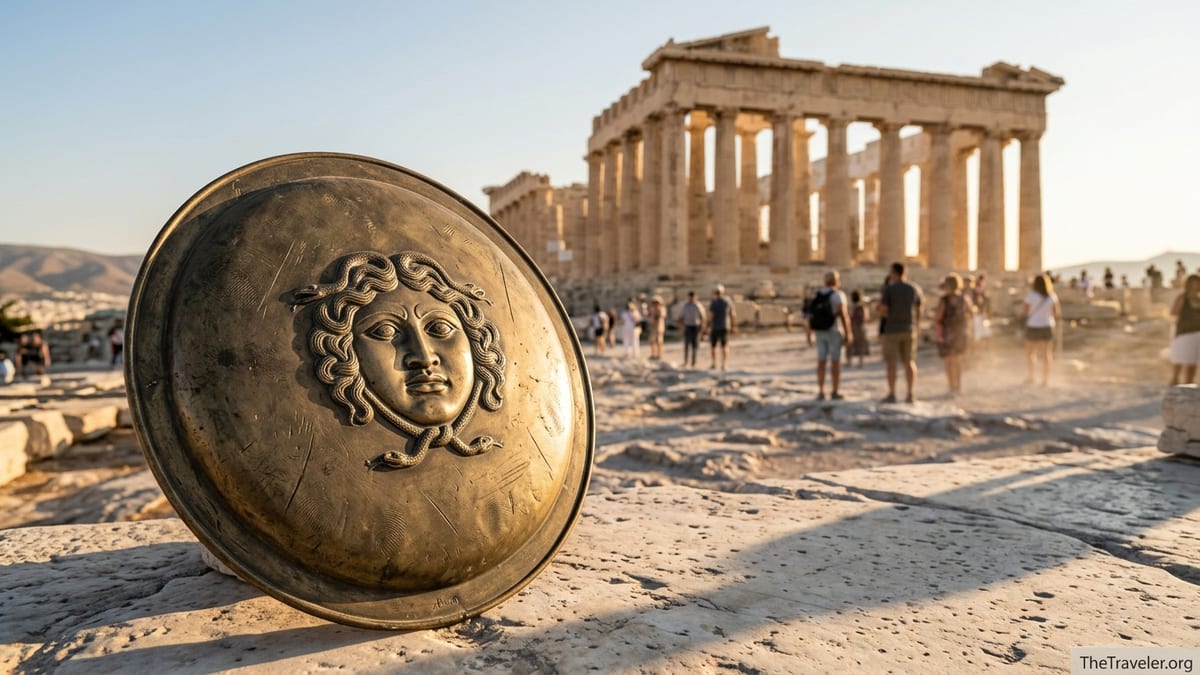
From Monster to Motif: The Earliest Medusa Stories
In the oldest surviving Greek sources, Medusa is not yet the tragic beauty familiar from many modern novels and films. She is one of three Gorgon sisters, a monstrous being with boar-like tusks, a wide grimacing mouth, bulging eyes and snakes for hair. Her stare turns people to stone. For travelers, this early image is easiest to grasp in archaic Greek art: at the Archaeological Museum of Corfu, for example, a huge 6th century BCE temple pediment shows Medusa sprinting forward with a grotesque mask-like face, flanked by her children Pegasus and Chrysaor. Here there is no hint of a mortal girl punished by Athena. Medusa is born a monster, an embodiment of chaos beyond the civilized Greek world.
Ancient poets such as Hesiod place the Gorgons at the edges of the known earth, near the streams of Ocean. That distant, liminal setting matters. For a sailor leaving a harbor like Piraeus in classical Athens, anything beyond familiar sea routes felt dangerous and uncanny. Gorgon imagery captured that fear of the unknown. On real ancient Greek ships, terracotta plaques and painted shields sometimes carried a gorgoneion, the circular face of Medusa, as a protective emblem meant to scare off hostile forces the way modern sailors might hang a blue eye charm in a cabin.
In these early versions, Athena’s role is limited but important. She is the strategist and war goddess who knows how to handle such raw danger. Medusa exists as a force to be overcome, and Athena is aligned with the heroes and with Zeus’s cosmic order. The more sympathetic Medusa, wronged by gods and men, belongs to later storytelling.
Ovid’s Medusa: Beautiful Victim and Divine Punishment
The most influential twist in the story arrives centuries later with the Roman poet Ovid in his "Metamorphoses." Many of the modern summaries you hear from museum guides in Rome or Paris actually trace back to his version. Ovid describes Medusa as once being a stunningly beautiful maiden whose hair in particular was admired by all. Poseidon desires her and assaults her in Athena’s temple. As punishment for this sacrilege, Athena transforms Medusa’s hair into snakes and makes her face so terrible that it petrifies anyone who looks at her.
Seen through a modern lens, this episode raises stark questions about victim-blaming and divine justice. Travelers who visit exhibitions on ancient women at venues like the British Museum or the National Archaeological Museum in Athens will often find panels discussing this very moment. Curators point out that in Ovid’s text, the god who commits the violence, Poseidon, is not punished. Instead the woman is transformed, her beauty taken away and weaponized. The temple, the site meant to represent Athena’s domain of order and rationality, becomes the setting for an unsettling moral reversal.
In Ovid’s telling, Athena appears harsh and unforgiving. She does not comfort Medusa, and she will later help Perseus kill her. Yet Ovid also frames the transformation as a way of making Medusa untouchable. Modern commentators sometimes see in this an unintended hint of protection: no one will ever approach Medusa casually again. This ambiguity helps explain why today, when you walk through a bookstore in Athens or London, you find so many retellings that imagine Athena as secretly on Medusa’s side, even if the ancient text itself presents the change as punishment.
Perseus, Athena and the Mirrored Shield
All major versions of the myth agree on one central episode: the hero Perseus beheads Medusa with Athena’s help. The way he does it is one of the most memorable action set pieces in Greek mythology. Perseus must approach Medusa, whose direct gaze will turn him to stone. Athena therefore lends him a polished bronze shield that functions like a mirror. By looking only at Medusa’s reflection in the shield, Perseus can strike without being petrified.
For visitors, this moment is vividly brought to life in museum collections. At the British Museum in London, an Athenian red-figure hydria shows Perseus standing over Medusa while Athena, armed and helmeted, guides him. In many similar vases scattered across collections from Boston to Berlin, her spear or her outstretched hand aligns almost perfectly with Perseus’s sword, suggesting that she is not merely a patron who loans equipment but an active strategist directing the blow. The polished bronze shield, a real military object in the classical Greek world, becomes the key mythic technology that solves an otherwise impossible problem.
Think of it in practical terms. A hoplite soldier in 5th century BCE Athens might have carried a large round shield made from wood and bronze, heavy enough to stop arrows. Polished bronze could create a decent reflection in strong sunlight. When you visit the reconstructed hoplite panoply displays at the Acropolis Museum, it is easy to imagine Athena’s shield as one of these, shining on a bright Attic morning. The myth turns a real piece of battlefield equipment into a symbol of cleverness: do not fight the monster on its terms, Athena teaches, but change the conditions so its power works against it.
The Aegis: From Goat-Skin to Global Metaphor
After Perseus slays Medusa, he carries her head in a special bag and eventually presents it to Athena in gratitude for her support. Ancient authors describe how Athena then fixes the severed head to her aegis. This is where things become complex, because the aegis is not a single clear object across all sources. Sometimes it is described as a shield, sometimes as a goatskin cloak or breastplate edged with tassels and decorated with the Gorgon head. In sculpture and vase painting, you can see both interpretations: the great lost gold and ivory statue of Athena Parthenos by Phidias, known through Roman copies and descriptions, showed the gorgoneion on her breastplate, while many painted vases display the Gorgon head at the center of a round shield.
For travelers, these variations are more than academic detail. When you stand in front of Roman copies of Athena statues in the Vatican Museums or the Louvre, you can look for the small circular face at her chest or shield and recognize it as Medusa. It is a visual reminder that Athena has taken the terrifying power of the Gorgon and harnessed it. The head that once made Medusa an outcast now belongs to the leading goddess of strategy and civic order. In a sense, the city of Athens walks "under the aegis" of Medusa’s stare every time citizens passed such statues in ancient sanctuaries.
The word "aegis" escaped mythology and entered everyday language. When a gallery in New York stages an exhibition on Greek antiquity "under the aegis" of a major foundation, it is drawing, consciously or not, on this story. The phrase suggests formal protection and patronage, just as soldiers in classical battles might have felt protected marching under Athena’s aegis on their shields and armor. Today, visitors can see modern versions of this in souvenir shops around Monastiraki in Athens, where pendants and bracelets with the Gorgon head are marketed as protective charms against misfortune, echoing the original apotropaic function of the mythic object.
Athena’s Motives: Punisher, Protector, or Political Symbol
Because Athena both transforms Medusa in Ovid’s account and later helps Perseus behead her in all versions, readers often struggle to reconcile the goddess’s motives. In some ancient interpretations, Athena is primarily a defender of sacred spaces. Her anger is directed less at Medusa personally and more at the desecration of her temple. From this angle, inscribing Medusa’s head on the aegis is a warning: violate the goddess’s domain, and your fate will become part of her armory.
Modern retellings have pushed back against this image of the cold, punitive goddess. In popular novels and young adult fiction stocked in major English language bookstores in Athens, Rome and New York, authors imagine Athena as acting out of a complicated kind of care. They suggest that turning Medusa into a monster makes her unapproachable to further male violence, and placing her head on the aegis ensures her power will be remembered rather than erased. These reinterpretations are not found explicitly in ancient poems, but they respond to contemporary discussions about gender, consent and power.
There is also a political dimension. In democratic Athens, Athena represented the city’s ideals of rational debate and measured action. Some scholars point out that by adopting the Gorgon’s face, she absorbs a symbol associated with wild, chthonic forces and puts it in service of civic order. For a visitor walking across the rocky plateau of the Acropolis today, it is worth imagining how Athenians experienced this imagery. Temples, shields, and pottery everywhere repeated the combination of refined goddess and monstrous mask. The message was clear: the city’s protection rests on the ability to confront and control fearsome outside forces.
Medusa in Art, Fashion and Feminist Re-readings
In recent decades, Medusa has become a powerful symbol far beyond classical scholarship. Feminist writers and artists have reclaimed her as an image of female rage and resilience. In this reading, the snakes and petrifying gaze no longer mark her as simply a monster, but as a woman whose anger has finally gained consequences. When you visit contemporary art galleries in cities like Athens, Berlin or New York, you will often find works that explicitly reference Medusa: sculptures with braided, snake-like hair, or photographs that echo the frontal stare of ancient Gorgon masks.
Medusa’s face is also a high-profile logo in the fashion world. Luxury brands have adopted the Gorgon head as a house emblem, plastering it across storefronts from Milan’s Via Montenapoleone to flagship boutiques in central Athens. For many shoppers, the link back to the ancient story is vague, but the underlying message of dangerous glamour and protective power fits the brand image. This contemporary commercial use mirrors how ancient Greeks once placed Medusa on armor or roof tiles to ward off harm.
Modern authors retelling the myth for young readers and adults have further complicated Athena’s role. Some novels publish Medusa’s story in the first person, presenting her as a survivor of divine assault who struggles to make sense of Athena’s transformation. Others imagine conversations between Athena and Medusa, exploring the tension between a female deity tied to patriarchal structures and a mortal woman crushed by them. These books are sold widely in museum shops beside guidebooks and archaeological catalogues, signaling how closely myth interpretation now intertwines with cultural tourism.
Where Travelers Meet Athena and Medusa Today
Understanding the layers of the Athena and Medusa myth can deepen a trip through Greece and Italy. In Athens, start at the Acropolis Museum. On the upper floors, you can find fragments of shields and reliefs that show Gorgoneia, along with explanatory labels that connect them to the protection of temples and warriors. When you step outside onto the museum’s terrace and look up at the Parthenon, imagine the colossal Athena Parthenos statue that once stood inside, a towering gold and ivory figure whose armor carried the Gorgon head as an emblem of the city’s divine backing.
From there, a walk through the Plaka neighborhood reveals how the ancient symbol lives on in the modern city. Jewelry shops display silver and bronze pendants with stylized Gorgon faces, marketed as good luck charms. Street artists sometimes stencil snake-haired women on alley walls off Adrianou Street, blending classical imagery with urban style. Discussing the myth with a local guide on a walking tour, you may hear different personal takes: some guides stress the heroic adventure of Perseus and Athena’s clever tactics, while others emphasize Medusa’s suffering and the injustice of her punishment.
Beyond Greece, Rome offers its own encounters with the story. In the Capitoline Museums, a famous Hellenistic "Head of Medusa" sculpture presents her as both beautiful and anguished, a contrast to the grotesque archaic versions. At the Vatican Museums and the Louvre, statues of Athena or Minerva reinforce the link between the goddess and the Gorgon, with the gorgoneion visible on armor plates. Even city-brand souvenirs, like fridge magnets and scarves, often pick up the distinctive snake-haired head, showing how deeply this ancient symbol has seeped into the visual language of tourism.
The Takeaway
The myth of Athena and Medusa does not exist as a single, fixed story. Early Greek art and poetry treat Medusa as a born monster at the world’s edge. Later Roman literature, especially Ovid, remakes her as a violated beauty punished by a jealous goddess. In every version, Athena aids Perseus and claims the Gorgon’s head for her aegis, turning raw destructive power into a tool of strategic protection.
For modern readers and travelers, these overlapping narratives allow for multiple interpretations. In some, Athena is a harsh enforcer of sacred law. In others, she is an ambivalent figure caught between patriarchal expectations and a desire to protect. Medusa can be a terrifying obstacle for heroes, a warning mask on temple walls, a luxury fashion logo, or a feminist icon of anger and survival. Each time you see her face carved in stone or printed on fabric, you are encountering one thread in a long history of reinvention.
Exploring the different versions of the myth on the ground, in museums and city streets, brings the story out of the realm of pure legend. It becomes a living conversation about power, justice, fear and the ways cultures reframe ancient tales to address new concerns. Whether you stand before an archaic Gorgon on a temple pediment or pass a modern boutique window glowing with Medusa logos, Athena’s mirrored shield is still there in the background, asking you to look again and question what you think you see.
FAQ
Q1. Was Medusa originally a beautiful woman or a monster?
In the earliest Greek sources, Medusa appears as a born monster among the Gorgons, while the version where she starts as a beautiful maiden comes later, especially with the Roman poet Ovid.
Q2. Did Athena punish Medusa or try to protect her?
Ancient texts usually present Athena’s transformation of Medusa as punishment for desecrating her temple, but many modern interpreters argue that the change can also be read as a harsh form of protection.
Q3. Why did Athena help Perseus kill Medusa if she had created her?
Within the traditional mythic framework, Athena’s priority is upholding divine order and supporting heroic quests, so helping Perseus and then using Medusa’s head on her aegis fits her role, even if it appears contradictory to modern readers.
Q4. What exactly is the aegis in the story?
The aegis is a special protective device of Athena (and sometimes Zeus), described variously as a shield, a goatskin cloak or a breastplate, which in later myths bears the Gorgon head given by Perseus.
Q5. How did Perseus avoid being turned to stone by Medusa?
Perseus uses a highly polished bronze shield lent by Athena as a mirror, watching Medusa’s reflection rather than looking directly at her, which allows him to strike safely.
Q6. Where can I see important artworks of Athena and Medusa today?
Key examples include archaic Gorgon sculptures in the Archaeological Museum of Corfu, Athena statues and armor fragments in the Acropolis Museum in Athens, and Medusa heads and Athena figures in major collections such as the Capitoline Museums and the Vatican Museums in Rome.
Q7. Why is Medusa’s head used as a protective symbol?
In ancient Greece, the terrifying Gorgon face was considered apotropaic, meaning it could ward off evil or misfortune, which is why it appeared on shields, temple decorations and later on jewelry and amulets.
Q8. How has the Medusa myth been reinterpreted in modern times?
Recent retellings, academic works and artworks often frame Medusa as a symbol of female rage, trauma and resilience, sometimes portraying Athena as a complicated figure who both harms and preserves her.
Q9. Is there one "correct" version of the Athena and Medusa myth?
No, Greek mythology developed through many local and literary traditions, so different authors and artists offer conflicting accounts, and modern readers and creators continue to add new interpretations.
Q10. How can understanding this myth enrich my travels in Greece and Italy?
Knowing the main versions of the story helps you recognize Gorgon heads, Athena’s aegis and Perseus scenes in museums, temples and city art, turning what might look like decorative motifs into meaningful symbols connected to debates about power and justice.