


Athens International Airport Eleftherios Venizelos (ATH) is the main gateway to Greece and a busy hub for flights across Europe, the Middle East and North America. Departing from Athens is generally smooth, but recent crowding at security and passport control means it pays to know the layout, timings and options before you arrive at the terminal. This guide walks you step by step from check-in to boarding, with real-world examples of where to eat, shop and relax along the way.
Get the latest updates straight to your inbox!
When to Arrive and How Check-In Works at Athens
For most flights from Athens International Airport, plan to arrive at least 2 hours before departure for Schengen and domestic flights, and 3 hours for non-Schengen long-haul routes such as flights to the United States, Canada or the United Kingdom. In peak summer months and during early morning and late evening “banks” of departures, queues can be longer. In late June 2026, some travelers reported needing close to 2.5 hours simply to clear passport control for a flight to New York, which illustrates how much timings can stretch at busy periods.
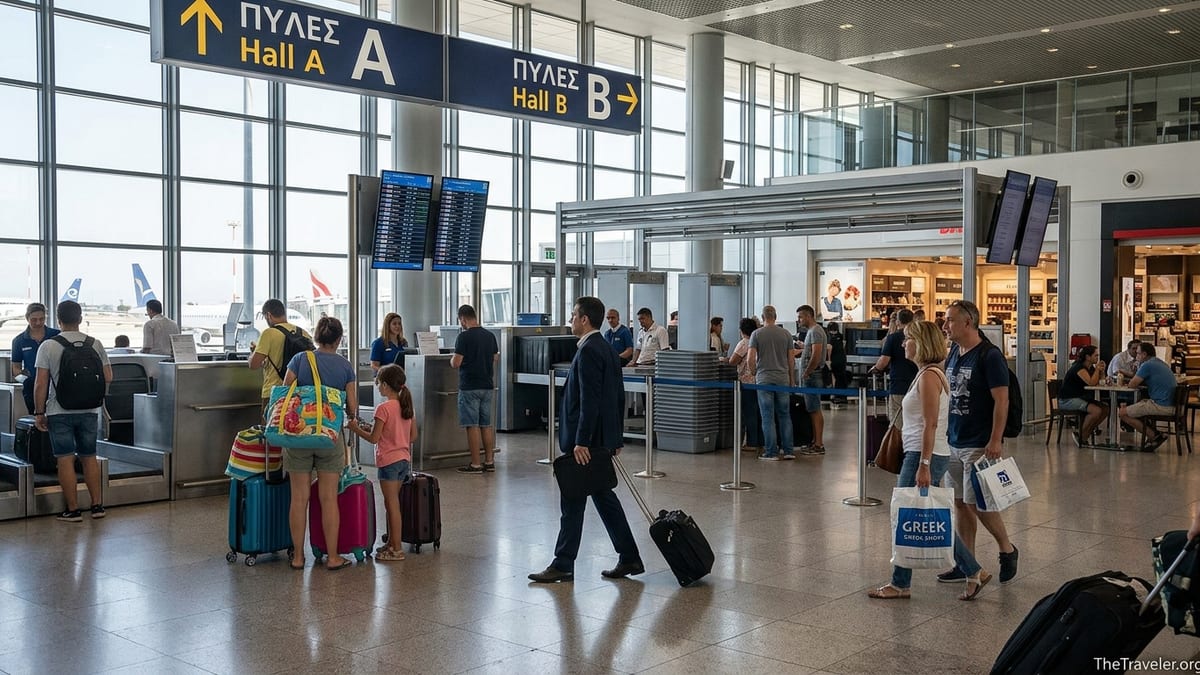
The main terminal is divided into Hall A for non-Schengen flights and Hall B for Schengen and domestic services. Check your e-ticket or airline app to see whether your flight uses Hall A or Hall B before you arrive. For example, an Aegean Airlines flight to Paris or Rome will depart from Hall B, while an Emirates or Delta Air Lines flight to Dubai or New York will use Hall A. Large information boards at the entrance list each flight with the relevant check-in island and hall, but having this confirmed in advance saves time and stress.
Most full-service airlines at Athens open their check-in counters about 3 hours before departure, while many low-cost carriers open 2 hours before. Aegean, Sky Express and other carriers often offer online check-in and mobile boarding passes. If you are traveling hand-luggage only on a Schengen route, online check-in allows you to bypass the check-in hall entirely and walk straight to security in Hall B. For flights with checked baggage, look for the dedicated bag drop counters for your airline, which are usually shorter than full check-in lines once you have already checked in online.
Self-service kiosks are available for some major airlines and alliances, but Athens still relies heavily on staffed counters. If you are connecting from a separate ticket, for instance arriving on a low-cost carrier into Athens and then flying out on a transatlantic flight, allow extra time to collect and re-check your luggage. Local travelers typically aim for 3 hours at the airport before non-Schengen departures in summer to allow for check-in queues, luggage drop and the unpredictable length of passport control.
Navigating Security and the New Passport Control Reality
Once you have checked in, your next priority is security and, if you are leaving the Schengen Area, passport control. For Schengen and domestic flights departing from Hall B, you will go through security only. For non-Schengen flights from Hall A, you typically clear passport control first and then security, although the exact flow can vary by queue configuration. Queues are separated clearly by signage for Schengen and non-Schengen at the entrance to the security area.
Security screening at Athens uses standard European procedures: laptops and large electronics usually need to be removed from bags, and liquids must be in containers of 100 ml or less and placed in a transparent bag. At busy times in July and August, security lines can extend back into the main hall, especially around early morning waves of flights between 05:30 and 09:00. Travelers flying to islands like Santorini or Mykonos often encounter queues filled with tour groups, so having your liquids bag ready and metal items removed in advance will help you move quickly when you reach the scanners.
For passport control, conditions have changed significantly in 2026 with the full rollout of the European Union Entry/Exit System (EES) at the airport. Third-country nationals, such as travelers from the United States, Canada, the United Kingdom and Australia, must have their entry and exit registered, including biometric checks during the first use. In practice this means that when you depart the Schengen Area from Athens, you may experience longer-than-expected lines as officers capture fingerprints and face images, especially for passengers using EES for the first time.
Recent traveler reports describe passport control taking more than 2 hours at peak times for non-Schengen departures, while others on quieter days pass through in 20 to 30 minutes. If you hold an EU, EEA or Swiss passport, you may be able to use automated e-gates where available, which can reduce waiting times. Fast-track security and priority passport control are offered to many business- and first-class passengers, elite-status holders and holders of certain premium credit cards or pre-purchased fast-track passes. In June and July 2026 several travelers credited fast-track lanes with “saving” tight connections to long-haul flights, so consider it if you are traveling in the peak season or have a short connection.
Understanding the Terminal Layout, Halls and Satellite Gates
Athens International Airport’s passenger facilities are centered on a single main terminal, which is then divided into functional zones. The two primary zones for departures are Hall A and Hall B. Hall A handles non-Schengen international flights to destinations such as the United Kingdom, the United States, Canada, the Middle East and destinations beyond Europe. Hall B serves Schengen and domestic departures, such as flights to other EU countries, Switzerland, as well as Greek islands and regional airports.
Both halls are reached from the same landside arrival level and share a central check-in area, but once you proceed to security you will be funneled into separate airside zones. Inside each zone there is a shopping and dining “agora” with duty free and various shops before you reach the boarding gate corridors. Flight information screens show whether your gate is in Hall A, Hall B or the satellite terminal, so check them immediately after security to gauge how far you need to walk.
The satellite terminal is used primarily for certain non-Schengen flights, particularly at busy periods or when extra gate capacity is needed. Gates here are usually labeled with the letter C. Access to the satellite terminal is via an underground walkway or automated people mover from the main terminal once you are already airside. Allow at least 10 to 15 minutes of walking time from the central shopping area in Hall A to the furthest C gates, particularly if you are traveling with children or have reduced mobility.
Wayfinding signage throughout the airport is clear, with directions in Greek and English. If your flight departs from a remote stand rather than a jet bridge, the gate will be marked as such on the screens, and boarding typically involves walking down stairs to a bus that takes you to the aircraft. Airlines like Ryanair, Wizz Air and some charter carriers use remote stands more often, so if you know you are flying with a low-cost airline, aim to arrive at the gate a bit earlier to account for bus boarding procedures.
Duty Free, Shopping and Food Options Before You Fly
Once you are airside, Athens International Airport offers a broad range of shopping and dining, especially compared to many other medium-sized European hubs. The airport’s shopping areas, branded collectively as the Airport Agora, include international duty free stores and a growing number of “Best of Greece” outlets showcasing local products. Hellenic Duty Free Shops operate the main duty free stores, where you can find Greek olive oils, wines, ouzo, Metaxa brandy, and cosmetics from homegrown brands such as Korres and Apivita alongside international labels. Travelers regularly comment that the duty free selection of Greek olive oil and skincare is both wide and convenient for last-minute gifts.
Prices in duty free are generally competitive with downtown Athens for cosmetics, spirits and some local delicacies, though not always dramatically cheaper. A 1-liter bottle of typical mid-range Greek ouzo might run around 12 to 18 euros, and high-quality extra virgin olive oil in decorative tins can range from 8 to 25 euros depending on brand and size. Duty free staff frequently run multi-buy promotions, such as discounts for purchasing two bottles of wine or spirits, though exact deals change regularly.
Food choices vary by hall. In the airside zone of Hall B, you will find familiar international names such as Starbucks and fast-casual sandwich and salad counters, alongside Greek bakeries selling spanakopita and cheese pies, and cafes offering freddo espresso and yogurt with honey. Typical prices include around 4 to 5 euros for a coffee, 3 to 5 euros for a savory pastry, and 8 to 15 euros for a simple sit-down meal like a Greek salad or souvlaki plate. In Hall A, which serves many long-haul passengers, options tend to be slightly more international, with bars, brasseries and grab-and-go outlets catering to travelers seeking a full meal before overnight flights.
Vegetarian and some vegan choices are available, though they may be more limited than in Northern European hubs. You can usually find salads, vegetable pies, fruit cups and plant-based snacks. Gluten-free options are more hit-and-miss, so travelers with strict dietary needs often bring snacks from central Athens or their hotel. Water fountains can be scarce, so many travelers buy bottled water airside, with a typical 500 ml bottle costing about 1 to 1.5 euros at convenience-style outlets.
Lounges at Athens: Locations, Access and What to Expect
Athens International Airport has an unusually rich selection of lounges for its size, including airline-branded lounges and independent facilities that can be accessed via membership programs or paid entry. In Hall A, the non-Schengen area, you will find the Aegean Business Lounge on an upper level near gates A11 to A13, along with independent lounges such as the Goldair Handling Lounge, Skyserv Aristotle Onassis Lounge and the Swissport lounge. These lounges typically offer comfortable seating, complimentary snacks and drinks, Wi-Fi, work areas and flight information screens. The Aegean Business Lounge is particularly appreciated by Star Alliance passengers for its Greek-inspired design and hot buffet selections.
In Hall B, which handles Schengen and domestic flights, both Aegean and independent operators such as Goldair and Skyserv run lounges close to the B gates. For example, the Aegean Business Lounge is located opposite gate B13 and caters mainly to Aegean business-class travelers and Star Alliance Gold members, while a Goldair Handling CIP Lounge in the same zone often welcomes passengers with Priority Pass, LoungeKey, Diners Club and similar products. Additionally, Skyserv operates the Melina Merkouri Lounge in the Schengen area, again typically accessible to passengers via airline invitations or lounge membership schemes.
The satellite terminal serving C gates also features a Goldair Handling lounge, handy for passengers departing from those more distant gates. Access rules vary: some lounges sell walk-up day passes, with recent published starting prices often in the 30 to 50 euro range for a 3-hour stay, while others are restricted to eligible premium-class passengers and elite frequent flyers. For instance, recent documentation from service providers lists Aegean lounge day passes beginning around the high-20 to mid-30 euro range, and Goldair lounges in some zones starting in the mid-40 euro range for 3 hours, though prices can change without notice.
Facilities within lounges typically include a selection of hot and cold dishes, Greek wines and spirits, coffee machines for espresso-based drinks, shower rooms in some locations, and quiet corners with power sockets for working. Reviews from 2025 and 2026 suggest that the Aegean Business Lounges are generally considered the most polished, while independent lounges can be more variable. At busy times, particularly evenings before transatlantic flights, lounges may become crowded, and some operators temporarily restrict entry for walk-up or membership customers if the lounge is close to capacity. If you rely on Priority Pass or a similar card, arrive early in the terminal to improve your chances of being admitted.
Boarding Procedures, Final Checks and Gate Tips
Boarding at Athens generally begins about 30 to 45 minutes before departure for European flights and up to 50 or 60 minutes for long-haul routes. Gates often change, particularly during busy wave periods, so keep an eye on the flight information screens and your airline’s mobile app. It is common for flights to islands or nearby European cities to switch from a jet bridge gate to a bus gate relatively close to departure time as ramp operations shift aircraft around the apron.
Most airlines board by groups or zones, with premium cabins and elite frequent flyers first, followed by families with small children and then the main boarding groups. For example, a United Airlines flight to Newark or a Delta flight to New York may call boarding first for business class and elite members, then proceed through numbered groups. Aegean often boards its Airbus A320 family aircraft using a front and rear door on remote stands, which can speed up the process but requires passengers to climb stairs outdoors. In summer, this short walk can be hot and bright, so keep sunscreen and a hat handy if you are sensitive to the sun.
Remember that liquids purchased in duty free after security must remain sealed in their tamper-evident bags if you have onward connections, especially outside the European Union. Gate agents will check cabin baggage closely on busy leisure routes; low-cost carriers in particular may enforce strict size and weight rules and sometimes require gate-checking of larger roller bags if overhead bins are full. On busy August departures to popular holiday destinations, you may see staff at gates weighing bags or asking volunteers to check hand luggage to avoid boarding delays.
If your flight departs from the satellite terminal C gates, factor in extra walking time back from lounges in the main Hall A or B areas. Many seasoned travelers set themselves a “gate time” 10 to 15 minutes earlier than the printed boarding time on their boarding pass, especially for long-haul flights, to allow for last-minute passport checks or secondary screening at the gate. Some destinations, such as Israel or the United States, can be subject to more intensive gate security interviews and hand baggage inspections, which are usually handled by the airline or contracted security staff at a separate desk before you enter the gate holding area.
Real-World Strategies for a Smooth Athens Departure
To make your departure from Athens as stress-free as possible, combine the official guidelines with what recent travelers have experienced on the ground. In the peak summer months of June through September, treat the recommended 3-hour arrival time for non-Schengen flights as a minimum rather than a suggestion. Arrive 3.5 hours early for popular transatlantic departures if you are checking bags, and at least 2 to 2.5 hours ahead of Schengen flights, even if the airline technically advises less, especially for early morning departures when many flights leave in a short window.
If you are staying at the airport Sofitel or another nearby hotel, check whether your airline allows evening-before bag drop for early morning departures. This can dramatically reduce your time in the check-in hall at dawn. For travelers coming in from the islands on a separate ticket and then flying onward internationally, aim for at least 4 hours between scheduled arrival and departure, and avoid tight 90-minute self-made connections whenever possible. While some travelers report clearing the whole process in under an hour on quiet days, others have missed flights when queues spiked because multiple ferries and domestic arrivals fed into the same departure bank.
Within the terminal, decide early whether you want to invest in lounge access or prefer to spend your time in the public areas. If you plan to work, shower or have a proper meal, a lounge can be worthwhile, particularly on a long layover of 3 hours or more. If your layover is short and you mainly need coffee and a quick snack, the public cafes and bakeries in Hall A and Hall B are usually sufficient and avoid the risk of being turned away from a full lounge at peak times.
Finally, use your waiting time efficiently. Complete any duty free or gift shopping early, then move toward your gate zone around the time boarding is scheduled to start, rather than waiting for a final call announcement. Check your travel documents once more before you approach the gate desk, confirm that your passport has any necessary visas or entry authorizations recorded, and ensure your phone or tablet is charged for digital boarding passes. By combining cautious timing, familiarity with the terminal layout, and a realistic understanding of current queues, you will significantly improve your chances of a calm, on-time departure from Athens.
FAQ
Q1. How early should I arrive at Athens International Airport for departure?
For non-Schengen long-haul flights, arrive at least 3 hours before departure, and consider 3.5 hours in peak summer. For Schengen and domestic flights, 2 to 2.5 hours is usually sufficient, though early morning and evening banks can be busier.
Q2. What is the difference between Hall A and Hall B at Athens Airport?
Hall A handles non-Schengen international flights, such as to the United States, United Kingdom and Middle East, while Hall B is used for Schengen and domestic departures, including most European Union routes and flights to the Greek islands.
Q3. How long does security and passport control usually take at Athens?
Security can take anywhere from 10 to 40 minutes depending on time of day. With the new Entry/Exit System, passport control for non-Schengen departures can range from 20 minutes to over 2 hours during summer peaks, so always build in extra time.
Q4. Are there good food options after security at Athens Airport?
Yes. After security in both Hall A and Hall B you will find cafes, bakeries, fast-casual eateries and bars, offering everything from Greek pies and salads to international snacks. Expect to pay roughly 4 to 5 euros for coffee and 8 to 15 euros for a simple meal.
Q5. What kind of shopping and duty free is available before departure?
Athens offers extensive duty free, especially for Greek products. You will find olive oils, wines, ouzo, brandy, and Greek skincare brands, alongside international perfumes, cosmetics and fashion accessories in the Airport Agora shopping areas.
Q6. Which lounges can I use at Athens and how do I access them?
The airport hosts Aegean Business Lounges in both non-Schengen and Schengen areas, plus independent lounges from Goldair, Skyserv and Swissport. Access may come via business-class tickets, elite status, lounge programs like Priority Pass or paid day passes where available.
Q7. Is it worth buying a lounge pass for a short layover?
For layovers under 2 hours, a lounge pass is often not essential unless you particularly value quiet space, better Wi-Fi or showers. For layovers of 3 hours or more, many travelers find a lounge worthwhile, especially before overnight or long-haul flights.
Q8. How much walking time should I allow to reach the satellite C gates?
From the main shopping area in Hall A, allow about 10 to 15 minutes to reach the furthest C gates in the satellite terminal, more if traveling with children, heavy luggage or reduced mobility. Signs to the underground walkway or people mover are clearly marked.
Q9. Can I rely on lounge access with Priority Pass or similar memberships?
Usually yes, but lounges may restrict entry when very full, especially in peak summer evenings. If you depend on Priority Pass, go to the lounge soon after clearing security and have a backup plan to use public cafes if the lounge is temporarily at capacity.
Q10. What are the biggest mistakes travelers make when departing Athens?
Common mistakes include underestimating passport control queues for non-Schengen flights, arriving with too little time between a domestic arrival and an onward long-haul departure, waiting landside instead of clearing security early, and not checking gate changes regularly on screens or apps.