


More news on this day
Fresh updates to the United Kingdom’s foreign travel advice for Greece in July 2026 have pushed central Athens back into the security spotlight, as recurring protests, firebomb incidents and short-notice rally bans contrast with a largely steady tourism picture on popular islands such as Santorini, Mykonos, Crete and Rhodes.
Get the latest news straight to your inbox!
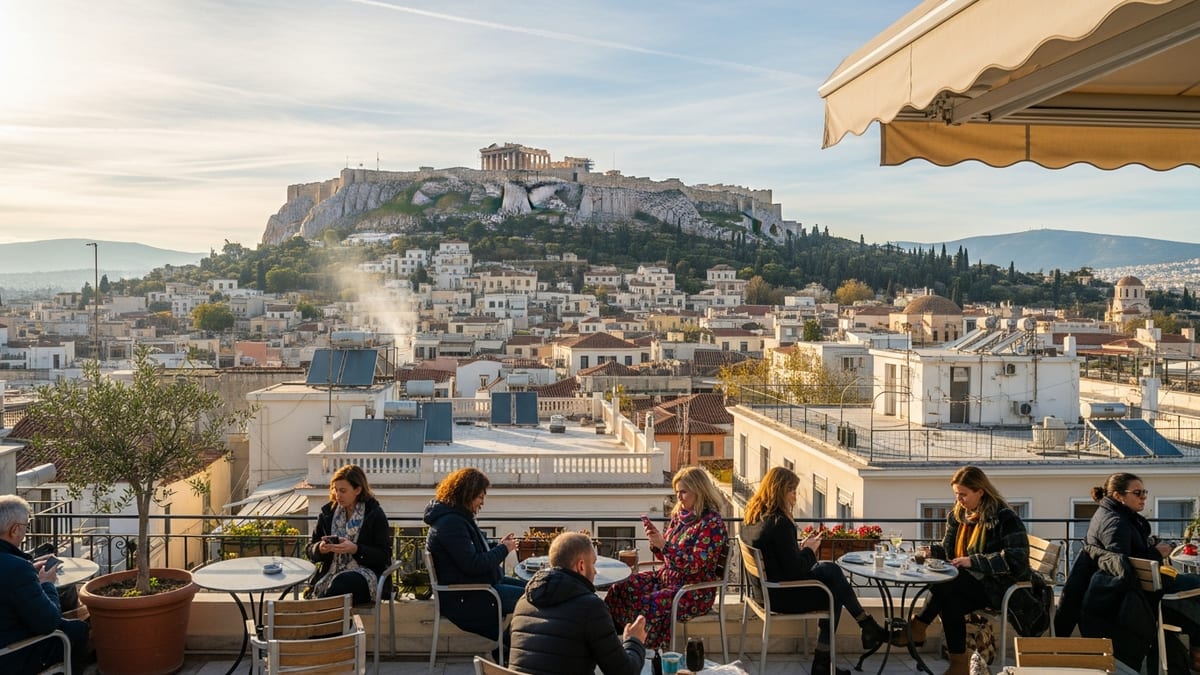
UK Foreign Office Tightens Language on Central Athens
The latest version of the UK Foreign, Commonwealth & Development Office (FCDO) travel advice for Greece, updated in early July 2026, again places particular emphasis on the capital’s political heartland. Publicly available guidance highlights the risk of demonstrations in central Athens, especially around Syntagma Square, Omonia and the Exarchia district, and notes that some protests have involved the use of petrol bombs and fireworks thrown towards police lines.
The wording reflects a pattern documented in recent years by multiple government advisories, which describe largely peaceful protests that can quickly become confrontational in small pockets once night falls. The renewed focus in 2026 comes against a wider backdrop of regional instability and protests linked to foreign policy developments and domestic grievances, some of which have drawn large crowds into the streets of Athens.
Strikes affecting public transport and air travel are also flagged in the current UK guidance as a potential disruption rather than a direct security threat. Travelers are advised, in general terms, to allow extra time for journeys through Athens and to monitor local media for news of protests or industrial action that might affect flights, ferries and metro services.
Protest Bans and Firebomb Incidents Shape Perceptions of Risk
Inside Greece, recent reporting on Athens has focused on both the scale of political mobilization and the authorities’ responses in early 2026. Greek media coverage in late January detailed a four day prohibition on rallies across a large section of central Athens around Syntagma Square, imposed ahead of sensitive commemorations related to Greek Turkish tensions. The decision highlighted official concern that rival groups and counter protests could converge in the historic center and disrupt daily life.
Separate documentation of protest policing practices in Greece, compiled by international human rights observers and released in mid 2026, has described repeated clashes around universities and inner city neighborhoods in Athens and Thessaloniki. Case studies outline instances in which small groups of demonstrators used petrol bombs and improvised incendiary devices against riot police, prompting forceful responses with tear gas and crowd control tactics. These accounts have reinforced the FCDO’s long standing caution that demonstrations near government buildings and university campuses can turn volatile without much warning.
The incidents, while typically confined to defined areas and often occurring late in the evening, have nonetheless shaped international perceptions of Athens as a city where political tensions can occasionally spill onto streets that also serve as gateways for tourists. Travel analysts note that this contrast is particularly stark for first time visitors who may arrive at central metro hubs directly from the airport before continuing on to the islands.
Tourism Data Shows Islands Largely Stable Despite Security Headlines
While attention has concentrated on security language related to Athens, published tourism figures for early 2026 suggest that Greece’s major island destinations continue to perform robustly. Industry data cited by Greek business media indicates that overall international arrivals to Greece rose in the first four months of the year, with Crete standing out as a strong performer and Rhodes reporting resilient booking levels despite higher operating costs and geopolitical uncertainty.
Commentary from regional tourism bodies describes a more uneven picture within the Aegean, where some smaller or highly price sensitive islands are feeling the impact of rising travel costs, while larger hubs with diversified markets have retained or expanded their visitor base. Crete’s long season and wide range of accommodation types are seen as helping to buffer the island from short term shocks, including air fare volatility and shifts in cruise deployment.
Travel safety assessments aimed at individual destinations, including independent 2026 security overviews for Mykonos and broader analyses of Greece as a whole, continue to classify the islands as low risk for most visitors. These guides consistently note that violent crime against tourists remains rare and that the primary concerns are practical in nature, such as summer wildfires, strong seasonal winds and road safety on narrow coastal routes, rather than political unrest.
Santorini and Mykonos Face Overtourism and Capacity, Not Security, Pressures
The main headline challenges for Santorini and Mykonos in 2026 have centered on crowding, environmental pressure and new regulatory measures rather than security. Travel and maritime industry outlets report that the Greek government and local authorities have introduced passenger caps and new fees for cruise arrivals at key hotspots, with Santorini applying some of the tightest limits after several summers in which narrow caldera paths and viewpoints regularly became gridlocked.
Pre season data from port allocation systems referenced in tourism and shipping coverage shows scheduled cruise calls to Santorini falling by nearly one fifth for 2026 compared with the previous year, a change attributed primarily to the new caps and financial disincentives for very large ships. Mykonos, while also embracing management tools, is projected to see a steadier pattern of cruise arrivals, reflecting its established role as a party focused and retail oriented stop on eastern Mediterranean itineraries.
Analysts note that these measures are designed to rebalance visitor flows and improve the experience for overnight guests rather than respond to any specific security concern. Public information from both Greek and international travel advisory sources continues to group Santorini and Mykonos with other popular islands as destinations where routine precautions are sufficient and where political protests are rare and usually limited to local issues when they do occur.
Rhodes, Crete and the Wider Aegean Navigate Environmental Risks
For Rhodes and Crete, the primary risk narratives in 2026 revolve around climate and infrastructure rather than unrest. Recent coverage of Greek civil protection planning highlights renewed wildfire warnings across several Aegean islands, particularly during July and August when high temperatures, drought conditions and strong winds can combine to elevate fire danger levels. Safety advisories emphasize that while fires may lead to localized evacuations or temporary disruption, advance planning and upgrades to warning systems are intended to minimize impact on residents and visitors.
Tourism reports on Rhodes suggest that booking levels have generally recovered after the high profile wildfires of 2023, though hotel associations continue to flag rising insurance and energy costs as pressures on pricing. In Crete, local business commentary points to infrastructure investment around ports and airports as a way to support sustained growth in arrivals, even as global economic uncertainty and shifts in airline capacity remain ongoing risks for the broader Greek market.
Across the Aegean, destination marketers are also responding to a gradual reshaping of travel seasons. Observers highlight a discernible move towards spring and autumn trips, particularly among visitors seeking to avoid extreme summer heat and crowded peak weeks in July and August. This trend has benefited larger islands such as Crete and Rhodes that can offer extended operating seasons and a mix of cultural, culinary and outdoor experiences beyond beach tourism.
Contrasting Realities for Travelers Planning 2026 Greek Itineraries
The resulting picture for prospective visitors in 2026 is one of contrasting realities within a single country. In Athens, updated foreign office language underscores that political protests, occasional use of firebombs in clashes and short notice bans on demonstrations remain a feature of civic life, especially around central squares and government buildings. While such events rarely target tourists directly, they can complicate movement and create an atmosphere that some travelers may find unsettling.
On the islands, by contrast, the biggest talking points are crowd management, pricing and environmental resilience. Reports on Santorini and Mykonos describe regulatory efforts to contain visitor numbers and recalibrate cruise tourism, while data from Crete and Rhodes points to sustained or rising arrivals anchored in diversified source markets and an extended shoulder season.
Travel planners and tour operators are responding by encouraging visitors to factor in extra time and flexibility for stays in Athens, particularly when connecting through the capital at moments of heightened political activity, while continuing to market the major islands as broadly stable, low risk leisure destinations. For many travelers, that means a 2026 Greek itinerary in which a brief, carefully timed urban stay serves as a cultural gateway to a more relaxed and predictable holiday experience on the Aegean and Cretan seas.