


More news on this day
Thousands of air travelers were left stranded at Hartsfield-Jackson Atlanta International Airport after a fresh wave of operational turmoil at Delta Air Lines led to 123 flight cancellations and 591 delays, disrupting journeys to major U.S. cities including New York, Houston, Norfolk and Washington, D.C., as well as international destinations such as Munich.
Get the latest news straight to your inbox!
Major Hub Disruption Ripples Across Domestic and International Routes
Operational data from flight-tracking dashboards on Wednesday showed Delta services at Atlanta experiencing an unusually high concentration of schedule problems, with more than one hundred cancellations and hundreds of additional delays stacked across the day. The disruption was centered on Hartsfield-Jackson, Delta’s largest hub and the world’s busiest airport by passenger traffic, magnifying the impact for travelers connecting onward to multiple regions.
Passengers headed for New York City, Houston, Norfolk and Washington, D.C., were among the hardest hit as a combination of ground holds, rolling crew reassignments and late-arriving aircraft choked departure banks. Long-haul itineraries were also affected, with delays and cancellations reported on transatlantic services including flights between Atlanta and Munich, complicating travel plans for both business and leisure customers.
Publicly available information indicates that many of the affected flights were part of tightly timed connection patterns built around Atlanta’s peak departure waves. When early bank departures stalled, the effect cascaded across later services, leaving aircraft and crews out of position and turning what began as a series of short delays into missed connections, canceled rotations and overnight disruptions.
While a single-day spike in cancellations is not unusual across a large network, the concentration of 123 cancellations and nearly 600 delays at a single hub underlined the ongoing sensitivity of Delta’s summer schedule. Industry analysts note that high aircraft utilization, dense connection banks and limited slack in staffing can leave large carriers vulnerable when even a modest disruption hits a primary hub.
Scenes of Congestion as Travellers Scramble for Alternatives
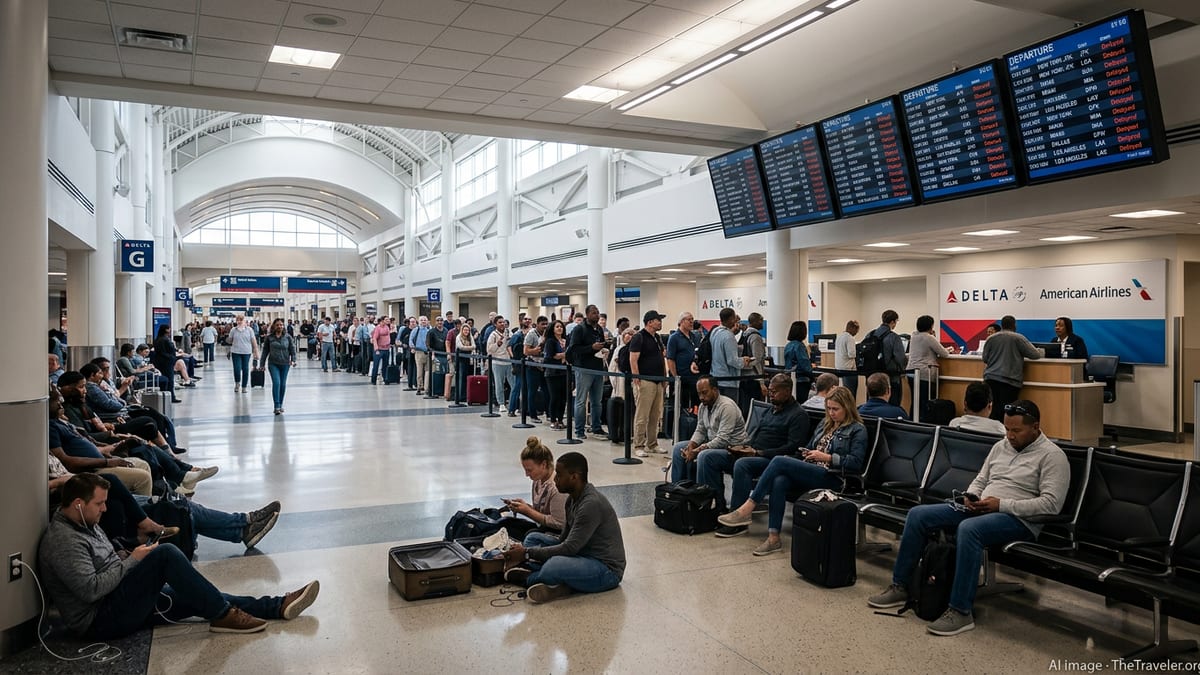
Inside Atlanta’s terminals, images and accounts shared publicly on social media described crowds lining up at rebooking counters, long queues stretching from customer service desks down concourses and departure boards filled with red and orange status updates. Families on school-holiday trips, cruise passengers connecting to East Coast ports and business travelers heading to key markets all reported being caught in the disruption.
Several posts described passengers bound for New York and Washington, D.C., watching their departure times slip in 30- to 60-minute increments over multiple hours before flights were ultimately canceled. Others reported being re-routed via secondary hubs or placed on next-day departures, filling nearby hotels and forcing some travelers to sleep in terminal seating while they waited for open seats.
Travelers scheduled to connect in Atlanta on their way to Houston or Norfolk described a similar pattern, with initial weather or traffic management restrictions evolving into broader operational constraints as crews reached duty-time limits and aircraft rotation plans unraveled. Public comments across travel forums indicated frustration with what many passengers described as limited information at gates and difficulty reaching call centers from crowded concourses.
For those booked on the evening transatlantic bank, including services to Munich, the disruption created a knock-on effect lasting into the following day. Flight-tracking data showed several overnight departures from Atlanta pushed back significantly or canceled outright, leaving Europe-bound passengers facing last-minute changes in arrival times, missed onward rail and intra-European connections, and challenges with hotel reservations at their final destinations.
Weather, Congested Airspace and Operational Strain Under Scrutiny
Official cause codes for individual flights varied across the day, but aviation analysts pointed to a familiar combination of factors behind the Atlanta disruption. Summer thunderstorms frequently trigger ground stops and volume-control programs at major southeastern hubs, slowing departure and arrival rates and forcing airlines to hold flights on the ramp or at gates until traffic management initiatives are lifted.
Reports from previous incidents at Atlanta show that even a short-lived storm cell, particularly one accompanied by hail or lightning, can quickly generate a backlog of aircraft needing inspections or repositioning. When that occurs at a hub as busy as Hartsfield-Jackson, recovery can take many hours, and delays often ripple out to cities with clear skies as aircraft and crew rotations fall out of sync with the timetable.
Recent industry commentary has also highlighted structural pressures within Delta’s operation, including tightly packed schedules and high reliance on overtime to cover peak periods. Public discussions among pilots and frequent flyers in online forums describe increasingly complex crew reassignments and last-minute changes that can leave individual flights waiting on available pilots or flight attendants even after weather has improved.
According to broader aviation data, major U.S. carriers have generally improved their on-time performance compared with the immediate post-pandemic years, but hub-level shocks still expose weak points in airline recovery planning. Analysts say carriers that run especially dense connection banks at a single mega-hub face a greater risk that a localized disruption will cascade across their domestic and international networks.
Delta’s Recent History of High-Profile Disruptions
The latest Atlanta turmoil comes against the backdrop of a challenging operational period for Delta. Publicly available records show that the airline was the hardest-hit carrier during the July 2024 global IT outage linked to a faulty software update, which triggered more than 7,000 cancellations across several days and stranded an estimated 1.3 million passengers worldwide. That event led to a months-long operational recovery effort and renewed scrutiny of Delta’s internal systems.
Subsequent travel seasons have brought additional flashpoints. Travelers have frequently cited Atlanta as a particular pain point, with past weather events and ground stops leaving thousands of passengers sleeping in terminals, queuing for hours at rebooking counters or seeking scarce hotel rooms across the metro area. Online accounts from recent months describe repeated experiences of rolling delays, last-minute cancellations and difficulty securing alternate flights during peak travel windows.
Industry newsletters and aviation-focused outlets have noted that Delta’s cancellation rate in 2026 has remained under pressure, even as the carrier promotes a premium product and invests in upgraded cabins, lounges and digital tools. Commentators argue that while the airline’s brand positioning emphasizes reliability, disruptions at hubs like Atlanta can quickly erode traveler confidence, particularly for those who have experienced multiple misconnected trips in a short span.
The Department of Transportation has recently closed an investigation into Delta’s handling of the 2024 meltdown without imposing penalties, according to specialized aviation coverage, but regulators and consumer advocates continue to monitor how airlines manage large-scale operational failures. The latest surge of cancellations and delays at Atlanta is likely to generate fresh questions around schedule planning, staffing levels and contingency protocols at the carrier’s flagship hub.
What Stranded Travellers Can Do in a Hub Meltdown
For travelers caught in the latest Atlanta disruption, consumer advocates point to several practical steps that can improve the odds of a workable reroute. Public guidance from travel experts consistently stresses the importance of acting quickly when a delay stretches beyond an hour or when early signs suggest a potential cancellation, such as repeated boarding time pushes and crew scheduling issues.
Because Atlanta is a connecting point for a significant share of Delta’s domestic and transatlantic itineraries, same-day alternatives often involve creative routings through other hubs or, in some cases, connections on partner carriers. Experienced travelers recommend using airline mobile apps and third-party flight-tracking tools in parallel, searching for open seats on alternate routes while simultaneously queuing for assistance at service desks.
In situations where overnight stays become unavoidable, public information on airline customer-service policies indicates that compensation, hotel vouchers and meal credits can depend on the defined cause of disruption. Weather-related cancellations are generally treated differently from events attributed to controllable operational issues such as crew scheduling or maintenance. Travelers are often advised to save boarding passes, receipts and written confirmations of disruption details to support any later claims.
With peak summer demand continuing to run high and major hubs like Atlanta operating near capacity, analysts say travelers should expect further pockets of disruption as the season progresses. The experience of thousands of passengers stranded during the latest Atlanta episode serves as a reminder that even in an era of sophisticated scheduling software and real-time data, a single day of concentrated cancellations and delays at a key hub can still derail travel plans across continents.