

More news on this day
A rush hour collision between two southbound passenger trains near Bedford, north of London, has left one person dead and dozens injured, disrupting a major rail artery into the capital on Friday evening.
Get the latest news straight to your inbox!
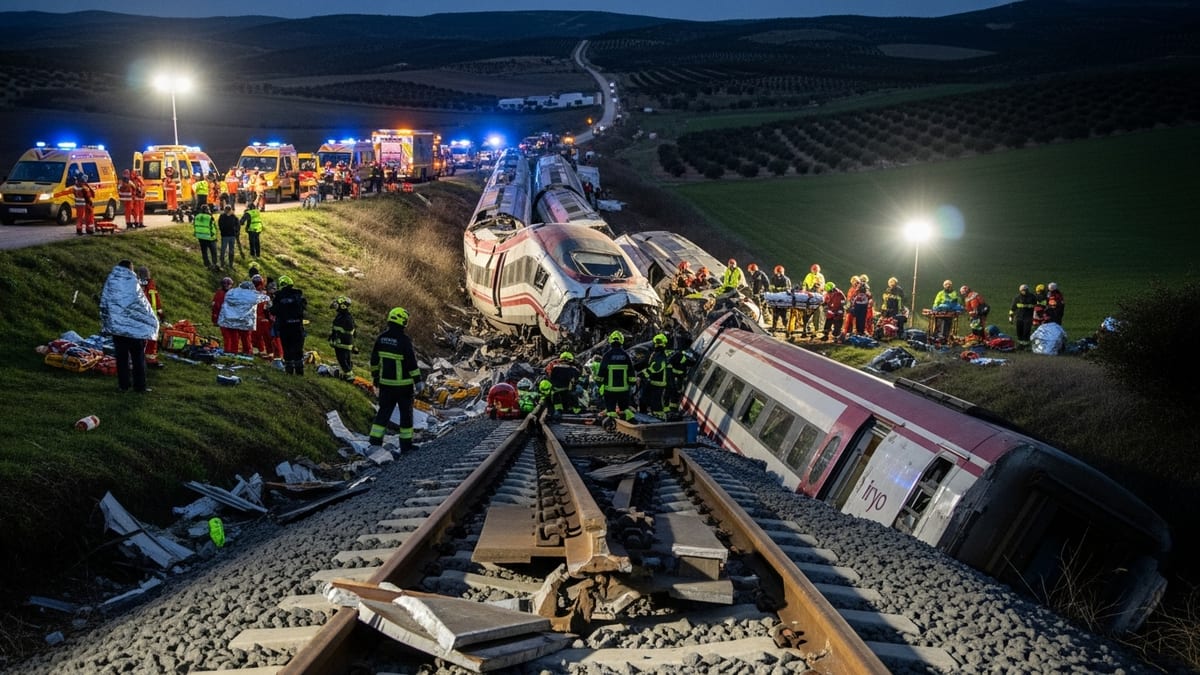
Evening commuter services collide south of Bedford
Publicly available information indicates that the crash occurred in the late afternoon on June 19, when two trains traveling toward London St Pancras collided on the busy Midland Main Line just south of Bedford. Early reports suggest that one service ran into the rear of another train that had been heading in the same direction.
The trains involved are reported to have included a Corby to London St Pancras service and a Nottingham to London St Pancras service, both operated on the key commuter and intercity corridor linking the East Midlands with the capital. Rail tracking data cited in published coverage points to the incident happening shortly after 5 p.m., at the height of the evening peak.
Images and descriptions shared on social media and referenced by news outlets show one train unit partially overriding the rear of another, with visible damage to the leading cab of the rear train. Passengers described a sudden impact that threw people forward in their seats, scattering luggage and personal belongings through carriages.
The stretch of line where the collision took place is one of the main approaches to London from the north, used by long-distance East Midlands Railway services as well as commuter and airport express trains. Services were immediately halted in both directions as emergency teams converged on the site.
Casualties and complex rescue operation
According to published coverage and aggregated passenger accounts, at least one person has died in the collision. Dozens more have been reported injured, with some passengers described as seriously hurt after being thrown against seats, tables and interior fixtures by the force of the impact.
Emergency responders launched a large-scale operation around the trackside location, deploying paramedics, fire crews and specialist rescue teams. Helicopter support, including air ambulance resources, was requested to help transport the most seriously injured to major trauma centers, reflecting the scale of the incident and the number of people on board.
Passengers’ descriptions relayed by broadcasters and online forums speak of crowded carriages, injured travelers lying on the floor and visible fractures and head wounds. Rail operators and local health services have indicated that many other occupants sustained minor injuries or shock and required assessment at the scene or at nearby hospitals.
Local communities near the line reported the sound of the impact and the subsequent arrival of a stream of emergency vehicles along country lanes and access roads. Rail staff and first responders worked carriage by carriage to guide passengers off the trains, some using trackside walkways and temporary steps to reach safe evacuation points.
Major disruption on key London rail corridor
The collision brought immediate and widespread disruption to services on the main north–south artery into London St Pancras. Operator updates cited by broadcasters stated that all lines through the affected area were closed while rescue and recovery operations continued, with passengers advised not to attempt to travel on the route.
Long-distance services linking London with cities such as Nottingham, Sheffield and Derby were suspended or heavily curtailed, while commuter and airport links were also disrupted. Trains already en route were held at intermediate stations, with knock-on delays reported across connecting routes as operators attempted to divert rolling stock and crews.
Passengers stranded on trains and at stations described crowded concourses, improvised bus connections and extended journey times as contingency plans were put in place. Rail industry statements emphasized that the line would remain closed for as long as necessary to support emergency workers and to allow investigators safe access to the site.
As the evening progressed, rail operators encouraged travelers to postpone non-essential journeys, warning that disruption was likely to continue into the weekend. Timetable planners and control centers faced the challenge of rescheduling services around a key section of track that had suddenly become unavailable.
Early questions over cause and train protection
While it is too early for definitive answers, initial attention has turned to how two modern passenger trains came to collide on a busy main line that is equipped with contemporary signalling and protection systems. Publicly available information indicates that both trains were traveling south on the same track when one struck the other from behind, an incident type that rail safety systems are specifically designed to prevent.
Rail experts referenced in media coverage have noted that the line features layered safety measures intended to maintain separation between trains. These include trackside signals, cab signalling displays and automatic systems designed to intervene if a train passes a signal at danger or approaches another train too closely. Investigators are expected to examine whether any element of these systems failed, was overridden or could not react in time under the specific circumstances of this collision.
Technical assessments are also likely to focus on the speed of the trains at the time of impact, the condition of the track and signalling infrastructure, and the performance of the rolling stock, including crashworthiness features at the front and rear of the units. Some rail specialists commenting publicly have pointed out that modern train designs are built to absorb collision forces in designated structural zones in order to protect passenger areas, which may have helped limit the scale of casualties.
Investigators typically retrieve on-board data recorders, sometimes described as the rail equivalent of aircraft “black boxes,” which log speed, brake applications and signalling information. Analysis of these records, combined with signal box logs and eyewitness accounts, will be central to establishing a timeline of events leading up to the crash.
Broader safety record and next steps
The collision near Bedford comes against a backdrop of generally strong rail safety statistics in the United Kingdom, where fatal train-to-train collisions are relatively rare events. Nonetheless, the scale of Friday’s incident and the number of injuries have prompted renewed scrutiny of how well existing protections work on intensively used commuter and intercity routes.
Rail accident investigations in the UK typically proceed through several stages, beginning with evidence gathering at the scene, followed by detailed technical analysis and the publication of interim findings. Past inquiries have often resulted in recommendations covering signalling, driver training, operational rules and rolling stock design, which are then considered by regulators, infrastructure managers and train operators.
For passengers and staff affected by this crash, attention in the coming days will focus on recovery and support, including medical treatment and counseling services. Rail companies are expected to offer assistance to those injured and to relatives of the person who died, alongside practical support for travelers whose plans were disrupted.
Transport observers note that the findings from this investigation are likely to influence future investment decisions and operational practices on the Midland Main Line and potentially across the wider network. As services gradually resume, many regular users of the route will be looking for clear information on what happened, what lessons are drawn and how the rail industry intends to strengthen safety on one of its most important corridors.