


Atlantic City has spent decades promising visitors Las Vegas on the beach: glittering casino towers, big-name concerts and nightclubs, and the bonus of an actual ocean just steps away. In marketing, it is a sun-splashed alternative to the Nevada desert. On the ground, the reality is more complicated. A trip here in 2026 reveals a resort that is at once improving and fraying, where strong gaming revenues coexist with shuttered storefronts, where a few polished mega-resorts sit beside blocks that feel forgotten. Understanding that tension is the key to deciding whether Atlantic City belongs on your travel list, and how to enjoy it if you go.
Get the latest updates straight to your inbox!
Vegas on the Beach: The Promise That Built Modern Atlantic City
Since casino gambling was legalized in Atlantic City in 1976, the city has tried to position itself as the East Coast answer to Las Vegas, using the tagline Vegas on the Beach in advertising and tourism campaigns. The basic pitch is seductive: why fly five hours to the Mojave when you can drive or take a bus from New York or Philadelphia, play at brand-name casinos such as Borgata, Caesars, Hard Rock, and Harrah’s, then walk straight onto a free public beach. Operators lean into the comparison with multi-thousand-room towers, shopping promenades that echo the Las Vegas Strip, and big performance venues hosting classic rock acts and touring comedians.
In recent years the city has doubled down on that image by investing in non-gaming attractions similar to those that transformed Las Vegas. Reports from Stockton University’s Lloyd D. Levenson Institute note that roughly half of the industry’s net revenue now comes from non-gaming sources such as restaurants, entertainment, and retail, with entertainment revenue growing even when room revenue dips. That translates on the ground to venues like the Hard Rock Live at Etess Arena, where a summer Saturday might feature a veteran arena-rock band, or the indoor Island Waterpark at Showboat, billed as one of the largest beachfront indoor water parks in the world and clearly designed to capture the family segment that once went solely to the casinos.
Those efforts have helped Atlantic City’s total gaming revenue, including internet and sports betting, reach record levels near 5.7 billion dollars in 2024 according to state regulators. Individual properties like Borgata and Hard Rock have reported stable or growing net revenue even while costs rise. To visitors, that can look like a success story: busy casino floors on weekends, full concert calendars, and hotel towers lit up well past midnight. From a distance, the Vegas on the Beach promise seems to be working.
Yet the numbers also show the fragility underneath the neon. The same state and academic reports indicate that, adjusted for inflation and costs, operating profits for Atlantic City casinos have fallen by close to ten percent compared with 2023, and only a few properties increased profits in 2024. That squeeze shapes what travelers see and feel: promotions that are less generous than before, fewer low-stakes table games on slow weekdays, and a constant pressure on operators to pack weekends and special events to make the financials work.
The Boardwalk and the Beach: Atlantic City’s True Advantage
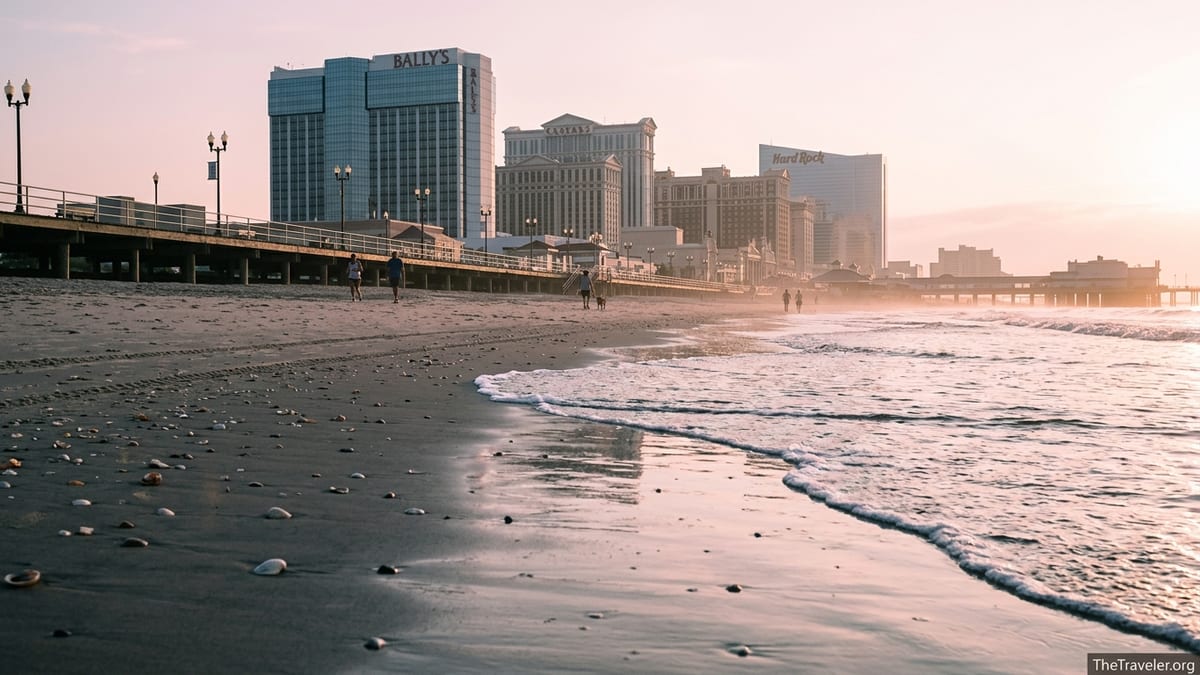
Where Atlantic City unquestionably beats Las Vegas is the thing Nevada simply cannot offer: the beach. On a warm July afternoon you can step out from Bally’s or Caesars, cross the Boardwalk, and be on soft sand with lifeguards, public restrooms, and waves rolling in off the Atlantic. In peak season, that sand is dotted with umbrellas rented by independent vendors and hotel-branded beach chairs. Families build sandcastles while just behind them a DJ spins for a beach bar crowd sipping frozen drinks. It is a feeling you will never get overlooking the Strip.
The Boardwalk itself, which first opened in the 19th century, remains one of the most iconic seaside promenades in the United States. Long blocks are lined with taffy shops, pizza counters, T-shirt stands, arcades, and the occasional high-end restaurant inserted by a casino resort. A summer evening stroll from Tropicana to Hard Rock can take an hour if you stop for Steel Pier rides or to watch street performers. In 2023 and 2024, state and local officials created a Boardwalk Preservation Fund and Boardwalk Improvement Group to address everything from structural repairs to lighting and homelessness, and visitors now see more uniformed security, upgraded decking in certain sections, and targeted enforcement around problem areas.
Beachfront entertainment is another way the city leans into its oceanside advantage. On busy weekends Golden Nugget’s Deck Bayside Bar fills up with locals and visitors listening to tribute bands as the sun sets over the marina, while temporary stages on the actual beach occasionally host summertime concerts that ripple sound down the shoreline. One summer airshow, which sends fighter jets looping over the Boardwalk, is notorious for driving up weekend room prices at Borgata and other casinos because demand surges for that specific midweek date.
Yet even this natural advantage is not guaranteed. Coastal erosion has periodically narrowed sections of Atlantic City’s beach, especially near some of the big Boardwalk casinos. In 2024, operators at Hard Rock and other properties publicly warned that losing too much beach width would hurt their summer appeal. Periodic beach-replenishment projects refill the sand, but if you visit after a major storm or before replenishment is complete, you might find narrower beaches and closed sections with heavy equipment at work. It is a reminder that the Vegas on the Beach promise depends on an ecosystem that is physically, not just economically, fragile.
Luxury Towers and Frayed Edges: A City of Contrasts
Travelers expecting a seamless resort bubble like the central Las Vegas Strip are often surprised by how quickly Atlantic City can change from glittering to gritty. Inside the major properties the experience can feel comparable to Vegas: polished marble lobbies, celebrity-chef restaurants, spa menus featuring treatments at prices similar to mid-tier Strip resorts, and rooms at Borgata’s Water Club or Ocean Casino Resort with sweeping ocean views and contemporary design. On a summer weekend you might pay 300 to 450 dollars plus taxes and resort fees for those ocean-view rooms, especially when a big concert or sporting event is in town.
Step outside, however, and you may walk past vacant lots and older motels before reaching another bright bubble of development. Even stretches of the Boardwalk alternate between ultra-modern casino facades and long, quiet blocks where older hotels have closed and ground-floor shops sit empty. Reddit threads and local commentary frequently point out that visitors who stay mostly within the casino core can have a comfortable, even luxurious experience, while those who wander several blocks inland encounter a much poorer city struggling with abandoned buildings, limited services, and a reputation for crime.
This contrast stems in part from Atlantic City’s unique political and economic structure. The casinos are heavily regulated and recent years have seen significant investment in specific projects: the conversion of the former Showboat from a casino into a hotel and family resort with a large arcade and indoor water park, renovations at Caesars and Tropicana, and ongoing work on the Boardwalk funded by state and federal money. At the same time, city reports and community voices emphasize that basic infrastructure, housing, and small business corridors off the Boardwalk have not kept pace. The result for travelers is a patchwork of highly controlled resort spaces separated by under-maintained urban fabric.
Understanding this patchwork is critical in setting expectations. A first-time visitor who arrives by car to the marina district and spends two nights moving mostly between Borgata, Harrah’s, and Golden Nugget may come away with a very different impression than someone who exits the bus terminal, walks up Pacific Avenue, and passes shuttered storefronts on the way to an aging motel to save money. Both experiences are real, and both are part of Atlantic City in 2026.
Money on the Table: Prices, Value and Who Atlantic City Really Serves
For a long time, one of Atlantic City’s selling points over Las Vegas was cost. East Coast visitors could hop on a 25 or 30 dollar casino bus from Philadelphia or New York, receive slot play vouchers, and gamble for a few hours before heading home. While those buses still exist, the overall economics of a trip have shifted. Rising labor, utility, and marketing costs have pushed operating profits down even as total revenue holds steady, and properties have responded with higher room rates on weekends, leaner comps for casual gamblers, and resort fees that bring Atlantic City closer to Las Vegas pricing than before.
On a prime summer weekend, it is common to see standard rooms at Hard Rock, Ocean, or Borgata listed at 400 dollars or more before taxes and fees, especially when there is an event such as a beach concert or major boxing match. Midweek in shoulder seasons, those same rooms might drop below 150 dollars. Lower-tier properties can still offer value: off-peak nights at older Boardwalk casinos may be under 100 dollars if you book in advance and are flexible on room quality. Parking policies also vary: some casino garages offer flat per-stay rates, with recent discussions among visitors citing around 30 dollars per stay at certain properties for hotel guests in 2026, while day visitors pay per entry.
Gaming value is another area where Atlantic City’s reality diverges from the dream. Table minimums on Friday and Saturday nights can reach 25 dollars at central blackjack or craps tables, with 50 dollar or higher minimums in premium pits, comparable to mid-level Las Vegas resorts. On weekday afternoons in the off-season you can still find 10 dollar tables and low-denomination video poker, but many travelers note that Atlantic City is no longer the bargain-gambling destination it once was. Some casinos have reduced poker room operations or closed them entirely, focusing instead on slots and house-banked table games that generate more consistent revenue.
At the same time, Atlantic City still courts specific value-seeking segments. Bus packages from nearby cities, discounted midweek rooms marketed to retirees, and players club offers for frequent gamblers all remain important. In practice, this means the city can feel like two markets operating side by side: weekenders paying near-Vegas prices for a beachside party, and loyal regulars using comps and promotions to keep costs manageable. Understanding which group you fall into helps determine whether the destination will feel like a good deal or an expensive compromise.
Safety, Social Challenges and the Question of Comfort
Conversations about Atlantic City often circle back to safety and visible poverty. Visitors walking the Boardwalk or the streets just inland will likely encounter panhandling, unhoused individuals, and in some cases open drug use. Local media and community forums have spent the past few years debating how to address these issues as tourism rebounds. In response, the city created the Boardwalk Improvement Group, expanded outreach through the Atlantic City Rescue Mission and other organizations, and increased coordination between police, social workers, and code-enforcement officers, particularly along the Boardwalk and central business district.
In practical travel terms, this means that many visitors report feeling comfortable on the central Boardwalk and within casino properties, especially during busy hours when families and conventioneers are out, but less comfortable in quieter stretches late at night or several blocks away from the ocean. Casinos provide their own security and extensive camera coverage, and hotel towers require keycards for elevator access. Off-property, standard urban precautions apply: stick to well-lit main routes, avoid isolated areas under the Boardwalk or around abandoned structures, and use rideshare or taxis at night if you are not familiar with the area.
The safety picture is further complicated by the city’s economic volatility. While total gaming revenue has reached or exceeded historical highs, some local observers point out that these figures rely heavily on online gambling and sports betting that do not necessarily translate into street-level vitality. A visitor who expects a packed, festival-like atmosphere in all seasons might be surprised to find relatively quiet sidewalks and half-empty bars on a cold Tuesday in February, with much of the activity contained inside the casinos. The perception of emptiness can heighten unease even if crime rates are not dramatically higher than in comparable urban areas.
For many travelers, the key is matching expectations and behavior to the environment. Atlantic City is not a self-contained resort in the way many Las Vegas properties are; it is a small city with real social challenges and a legacy of uneven development. If you plan accordingly, stay in well-managed properties, and treat the surrounding streets the way you would any other working-class city, you are more likely to feel that the excitement outweighs the discomfort.
Who Should Choose Atlantic City Over Las Vegas?
Given these tradeoffs, Atlantic City is not a universal substitute for Las Vegas, but it excels for certain types of trips. If you live within driving distance in the Mid-Atlantic or Northeast, it is one of the most accessible places to combine casino gaming with a true oceanfront experience. A family from suburban New Jersey can drive down for a long weekend, book a standard room at a Boardwalk hotel, spend mornings on the beach, afternoons at the Showboat water park or Steel Pier, and evenings sharing a boardwalk pizza and playing arcade games, all without boarding a plane.
Atlantic City also works as a short, high-intensity adults’ getaway. Groups celebrating birthdays or bachelor and bachelorette parties often choose it because they can arrive by car or train on Friday, check into a single tower like Hard Rock or Borgata, and never need to leave that integrated environment of pools, clubs, and gaming until checkout on Sunday. In that context, the city’s frayed edges matter less because the group essentially stays within one large resort, accessing the Boardwalk only for a quick beach session or photo.
By contrast, travelers drawn to immersive spectacle, meticulously themed environments, and a dense concentration of shows, restaurants, and attractions within a relatively safe, walkable corridor may still find Las Vegas the better fit. The Strip offers more mega-resorts lined up shoulder to shoulder, plus major-league resident shows and a scale of nightlife that Atlantic City does not match. If you are coming from outside the East Coast, the flight time to Vegas may not be much longer than a trip to Philadelphia plus ground transport to Atlantic City, narrowing the accessibility advantage.
Where Atlantic City may shine in the next decade is for visitors who care as much about the ocean and regional culture as about gaming. Many advocates argue that the city’s long-term health depends on diversifying away from pure casino tourism toward a mix that includes conferences, sports, live entertainment, and residential development. The partial conversion of former casinos into family resorts and mixed-use properties hints at this future. For travelers, that could mean more reasons to treat Atlantic City not simply as Vegas on the Beach, but as its own, more complex place.
The Takeaway
Atlantic City’s promise of Vegas on the Beach captures only part of the story. The city does offer modern casino resorts with recognizable brands, serious table games and slots, and headline entertainment, all set against a backdrop of waves and sea breezes that Las Vegas can never replicate. For visitors focused on those assets and willing to pay near-Vegas prices on peak weekends, the experience can feel glamorous and convenient, especially if they stay mostly within a single property or along the central Boardwalk.
At the same time, the reality on the ground is shaped by economic pressure, uneven investment, and longstanding social challenges. Profits lag behind revenue, beach erosion periodically threatens the city’s most valuable asset, and just beyond the casino doors lie blocks of vacant storefronts and struggling neighborhoods. Safety is manageable with normal urban awareness, but visitors should not expect the seamless, master-planned resort environment found on parts of the Las Vegas Strip.
Ultimately, Atlantic City is best approached not as a perfect East Coast replica of Las Vegas but as a hybrid: part traditional seaside town, part aging company town, part evolving regional entertainment hub. If you arrive with eyes open, clear priorities, and a realistic budget, the city can still deliver memorable weekends of surf, slots, and live music. If you arrive expecting a flawless fantasy, the gaps between promise and reality will be hard to ignore.
FAQ
Q1. Is Atlantic City really cheaper than Las Vegas?
In peak summer and on big-event weekends, room rates and resort fees at top Atlantic City casinos can be similar to mid-tier Las Vegas properties, though midweek and off-season deals are often better in Atlantic City, especially for regional visitors who can drive instead of fly.
Q2. How safe is the Atlantic City Boardwalk at night?
The central Boardwalk near major casinos is typically busy and well-patrolled, but side streets and quieter stretches can feel less secure; using common urban precautions, sticking to well-lit areas, and relying on rideshare or taxis late at night is advisable.
Q3. Do Atlantic City casinos offer the same games and limits as Las Vegas?
Most major Atlantic City casinos offer comparable table games and slots, but weekend table minimums can be high at popular pits, poker rooms are fewer than in Las Vegas, and low-limit options are more common midweek or in off-peak seasons.
Q4. Can I visit Atlantic City just for the beach and skip the casinos?
Yes; the beaches are free and open to the public, and you can stay in non-casino hotels or vacation rentals while spending your time on the sand, the Boardwalk, and family attractions like Steel Pier and the indoor water park at Showboat.
Q5. What is the best time of year to visit Atlantic City?
Late spring through early fall offers the best beach weather, with July and August busiest and most expensive; shoulder seasons like May, June, September, and early October can combine milder crowds with reasonable prices and pleasant temperatures.
Q6. Are there good non-gambling activities in Atlantic City?
Beyond casinos, visitors can enjoy concerts and comedy shows, outlet shopping, spas, boardwalk rides, arcades, and nearby coastal towns, along with seasonal events like airshows or beach concerts when they are scheduled.
Q7. How do Atlantic City resort fees and parking costs compare to Vegas?
Many Atlantic City casinos charge nightly resort fees and separate parking charges, so the final bill can resemble Las Vegas once taxes and fees are added, though some offer flat per-stay parking rates or waive certain charges for loyalty members.
Q8. Is Atlantic City a good choice for families?
Families who prioritize the beach, pools, and attractions like the indoor water park or Steel Pier can have a satisfying trip, but parents should be prepared for areas with visible adult nightlife and gambling and plan routes and activities accordingly.
Q9. Why do some people say Atlantic City feels run-down?
While the major casino resorts and parts of the Boardwalk are modern and well maintained, several surrounding blocks feature vacant lots, aging buildings, and limited services, creating a sharp contrast that some visitors interpret as neglect.
Q10. Will Atlantic City become more like Las Vegas in the future?
City leaders and casino operators are investing in entertainment, non-gaming revenue, and infrastructure, but Atlantic City’s smaller size, coastal setting, and local economy mean it is more likely to evolve into a distinct seaside entertainment city than a true replica of Las Vegas.