


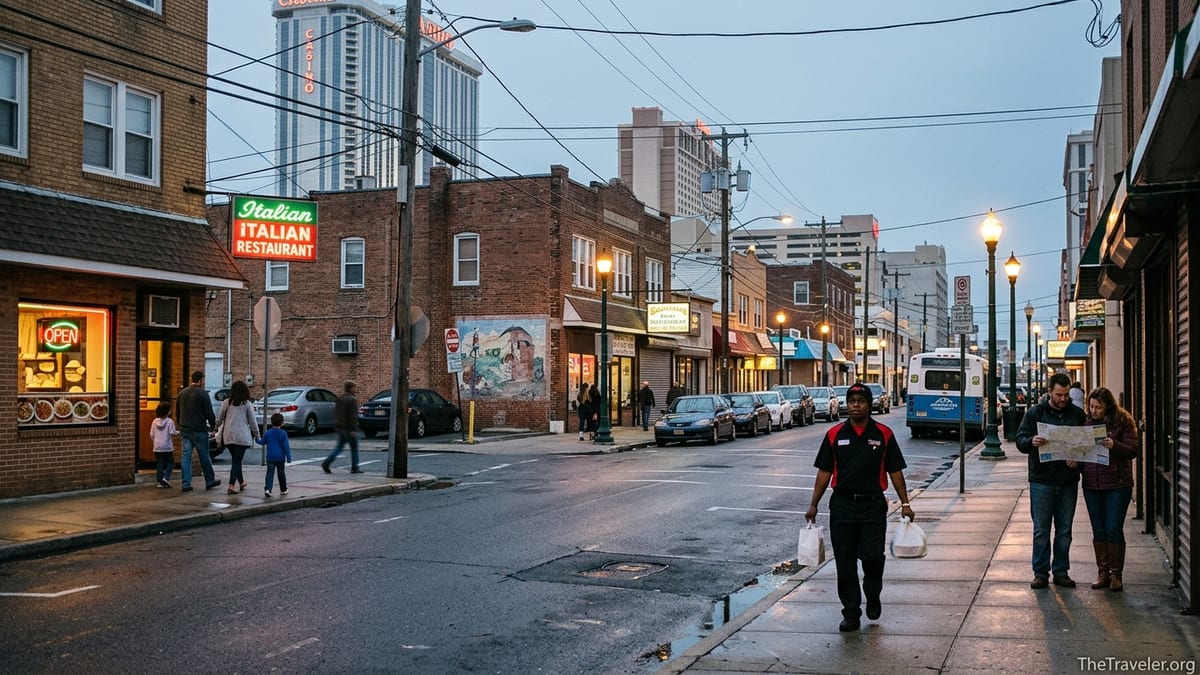
The afternoon I finally stepped off Atlantic City’s famous Boardwalk, it felt a little like walking out of a casino at dawn. The lights and music dimmed, the ocean breeze faded behind me, and the sounds of slot machines gave way to delivery trucks, idling jitneys and kids yelling across side streets. In the space of a single block, the Atlantic City of glossy ads and casino marquees gave way to the Atlantic City where most people actually live.
Get the latest updates straight to your inbox!
From Neon and Salt Air to Traffic and Side Streets
One moment I was between Hard Rock and Resorts, watching a rolling caravan of beach chairs and rental bikes slide past the Steel Pier. A few steps later I turned inland at Tennessee Avenue, and the view changed almost instantaneously. The glittering facades shrank in my peripheral vision, replaced by the practical geometry of surface parking lots, aging motels and low-slung brick buildings facing Pacific Avenue.
On the Boardwalk, the architecture is designed to pull you in: tall glass towers, choreographed lighting, the flash of an LED marquee promising live shows and prime rib. Prices are set to match the spectacle. A cocktail at a casino bar can easily run more than 18 dollars before tip, a Boardwalk pizza slice 7 or 8. Inland, the visual vocabulary shifts. Hand-painted window signs advertise two-dollar coffee and breakfast sandwiches. Bodegas stack Goya beans and five-pound rice bags in the front window. The atmosphere is not hostile, but the choreography is gone. Life here is not arranged for visitors’ benefit.
The transition is so quick it can be jarring. You are still within earshot of the ocean, but you have traded the carefully managed mood of the casino corridor for the unpredictability of a small city’s downtown. On a recent weekday morning, a casino worker in a crisp uniform cut across the street with a plastic to-go cup, while an older resident pushed a shopping cart stacked with recyclables. It is in these couple of blocks between Pacific Avenue and the Boardwalk that Atlantic City’s economic divide becomes impossible to ignore.
The Boardwalk remains a point of pride and a historic landmark, the first of its kind in the United States and still stretching for roughly four miles along the ocean. Yet the moment you leave it, you are reminded that the resort is only one layer of a much more complicated place. That contrast is where the city’s most honest stories are unfolding.
Ducktown: Little Italy in the Shadow of Boardwalk Hall
Walk west along Pacific Avenue and you soon reach Ducktown, historically known as Atlantic City’s Little Italy. Here the skyline is dominated not by hotel towers but by Boardwalk Hall’s massive arched roof and the steeple of St. Michael’s Roman Catholic Church. In between sit low-rise brick rowhouses, a scattering of small apartment buildings and restaurants that have been feeding locals far longer than any celebrity-chef outpost inside the casinos.
At Angelo’s Fairmount Tavern, a family-run institution that dates back to the 1930s, the smell of red sauce and garlic drifts onto the sidewalk most evenings. Inside, diners crowd into wood-paneled rooms over veal parmigiana and heaping plates of linguine. Servers carry bottles of Chianti instead of craft cocktails, and the check for a generous plate of pasta often arrives at less than you would pay for a single steakhouse appetizer on the Boardwalk. Nearby bakeries and delis still serve Italian subs on crusty rolls, sharing block space with newer Latin American and Asian eateries that reflect the neighborhood’s changing demographics.
Ducktown has weathered decades of decline, particularly after many Italian American families moved to the suburbs in the postwar years. Empty lots and tired facades still appear between the success stories. Yet in recent years, a coalition of residents, the Ducktown Community Development Corporation and city partners has pushed a revitalization plan that aims to restore some of the area’s walkable, mixed-use character. Murals are appearing on once-blank walls, sidewalk lighting is improving, and small grants are helping storefronts replace long-faded signage.
For visitors, this translates into a district that feels markedly more lived-in than the casino strips. On a summer evening, you might pass a grandmother on her rowhouse stoop, kids racing scooters up the block, and a pair of hospitality workers still in their uniforms sharing a smoke between shifts. It is possible to stroll from your room at Caesars or Tropicana to Ducktown in ten minutes, yet the change in mood is so complete that many tourists who never leave the Boardwalk have no idea it exists.
The Orange Loop: Atlantic City’s Emerging Indie Corridor
Head inland from the Boardwalk along Tennessee, St. James Place or New York Avenue and you enter what locals call the Orange Loop, named for the orange-colored properties on the classic Monopoly board. Once marked by vacant storefronts and a rough reputation, this cluster of a few beach blocks has become one of the city’s most intriguing experiments in reinventing itself for a new generation.
Here, rather than mega-resorts, you find independent venues and eateries: a brunch spot plating soft scrambled eggs with locally roasted coffee, a beer hall pouring regional IPAs under strings of patio lights, and a rock club that pulls in touring bands more likely to fill indie venues in Philadelphia than casino showrooms. At night, the sidewalks hum with a mix of locals, hospitality workers just off shift and visitors who deliberately sought out something beyond the slot floors.
The Orange Loop’s restaurants and bars are still priced for tourists more than for the average neighborhood diner, but the vibe is notably different from the Boardwalk casinos. You are more likely to find bartenders in T-shirts than waistcoats, and menus that nod to vegan dishes and natural wine. Public art and murals soften the edges of concrete buildings. Outdoor patios capture the ocean breeze without the thudding soundtrack of casino sound systems.
The area is still a work in progress. A half-renovated building may sit next to a polished cocktail bar; a surface parking lot might double as a pop-up event space on weekends. But for travelers willing to walk a couple of blocks off the sand, the Orange Loop offers a glimpse of how Atlantic City could diversify its appeal: not just as a casino town, but as a small, scrappy cultural city by the sea.
Inside the Neighborhoods: Everyday Atlantic City
Venture farther from the shore, and you begin to encounter the parts of Atlantic City that rarely make it into tourism brochures. Neighborhoods like Midtown, Bungalow Park, the Westside and the Inlet are home to the majority of the city’s roughly 38,000 residents. Here, low and mid-rise apartment buildings line long stretches of Atlantic and Arctic avenues. Corner stores, laundromats and modest churches anchor busy intersections. Many blocks show the wear of decades of disinvestment: boarded-up houses, vacant lots tufted with weeds, and sidewalks patched more often than repaved.
Poverty rates in Atlantic City are significantly higher than the national average, and many residents work service and seasonal jobs tied to the very tourism economy that feels distant from their daily concerns. On a weekday morning, the jitney buses that shuttle visitors between casinos also carry housekeepers and kitchen staff to jobs they may reach after one or two transfers. On certain corners, you may see people struggling with addiction or homelessness, a reality that city and county programs have tried to address with varying degrees of success.
For travelers, this can create a tension. The same walk that takes you to an excellent local diner on Atlantic Avenue might also bring you past a cluster of people panhandling or a vacant storefront tagged with graffiti. Some visitors experience this as discomfort; others recognize it as part of the fabric of a small American city still working through the aftershocks of deindustrialization and changing casino fortunes. Either way, it is important to approach these neighborhoods with the same respect and awareness you would bring to any urban environment you do not know well.
Yet it is also in these streets that you will find some of Atlantic City’s most authentic and affordable experiences. A Dominican café serves a plate of roast chicken, rice and beans for the price of a Boardwalk ice cream cone. A barbershop hums with conversation about local politics and last night’s game. On warm evenings, front stoops become living rooms, as families sit outside to catch the breeze that drifts in from the bay.
Food, Prices and Where Your Money Goes
One of the most tangible ways to feel the difference between the Boardwalk and the rest of Atlantic City is through the simple act of ordering a meal. Inside a Boardwalk casino, breakfast might mean a 25 dollar buffet heavy on carving stations and made-to-order omelets, or a sit-down brunch with 18 dollar avocado toast and 6 dollar lattes. You are paying not only for the food but also for the elaborate theming, the air conditioning, the live music and the marketing budgets that brought you through the door.
Two or three blocks inland, the menus look very different. At a no-frills diner on Pacific Avenue, a hearty breakfast of eggs, home fries and toast might run under 10 dollars, with coffee refills included. Family-run restaurants in Ducktown offer large plates of pasta or grilled seafood for under 25 dollars, often enough for leftovers. In Midtown, takeout counters sell empanadas, cheesesteaks or fried chicken in the single digits, catering primarily to locals on lunch breaks.
There is an ethical dimension to these choices as well. Spending an evening in a casino steakhouse funnels most of your money into a corporate balance sheet that may or may not retain profits locally. Choosing a neighborhood restaurant, bakery or bar, by contrast, supports small-business owners whose livelihoods are tied directly to the city’s year-round health. When you sit at the counter of a family-owned pizzeria on Atlantic Avenue, you are not only getting a different slice of the city’s culinary culture; you are also circulating your dollars into communities that see far less of the tourism windfall.
None of this means you should skip the Boardwalk entirely. It remains a singular experience, and many of the resort restaurants employ local residents in good jobs. But alternating your plans, perhaps doing one night in the Orange Loop, another at a Ducktown institution, and balancing casino time with neighborhood strolls, can give your trip both more flavor and more impact.
Safety, Perception and Sensible Street Smarts
Atlantic City’s reputation for crime often looms large in online discussions, and there is some truth behind the anxiety. Reported crime rates within the city limits have historically been higher than in many other New Jersey shore towns, a statistic shaped by both concentrated poverty and the fact that the city serves as a regional hub for nightlife, gambling and social services. At the same time, the core Boardwalk area and casino interiors are heavily patrolled and extensively surveilled, and many regular visitors report feeling comfortable walking along the oceanfront late into the night.
Off the Boardwalk, the picture is more nuanced. Some blocks, particularly near major corridors like Pacific Avenue or around well-trafficked spots in Ducktown and the Orange Loop, see a steady flow of people and businesses that keep informal eyes on the street. Others, especially in more residential sections or areas marked by vacant lots, can feel isolated after dark. For a visitor, the usual big-city precautions apply: stick to lit, busier routes; avoid cutting through alleys or desolate stretches at night; and trust your instincts if a street feels uncomfortable.
Locals often emphasize that context matters. A walk from the Boardwalk to a specific restaurant on a clear summer evening, when the city is buzzing with visitors, is very different from wandering aimlessly through unfamiliar neighborhoods at 2 a.m. Solo travelers who plan out their routes in advance and use rideshares or taxis for late-night returns often report positive experiences exploring off-Boardwalk areas. Many community organizations and city agencies are also working on incremental improvements, from better lighting to streetscape upgrades, to make key corridors more inviting.
Ultimately, recognizing both the challenges and the efforts underway helps frame expectations realistically. You do not need to be afraid of leaving the Boardwalk, but you should approach the rest of the city with the same informed awareness you would bring to any urban destination. When you do, you are likely to find not only a different city but also a more complete one.
How to Experience the “Other” Atlantic City Respectfully
Exploring beyond the Boardwalk is less about checking off sights and more about embracing the city as a living community. Start by reallocating part of your trip budget and time. Instead of booking every meal and activity inside a resort, plan for at least one neighborhood lunch in Ducktown, one evening in the Orange Loop and a late-morning coffee at a local café on Atlantic or Pacific avenues. Ask hotel staff, ride-share drivers or shopkeepers where they like to eat when they are off duty; you will quickly accumulate a list of places that do not appear on casino billboards.
When you visit these areas, bring curiosity and humility. Dress as you would for any city street, keep valuables secure and be prepared for an environment that feels less curated than the casino floor. If someone is clearly in distress or asking aggressively for money, a simple, polite no and moving on is usually sufficient. If you want to support local social services, look up organizations in advance rather than handing out large sums of cash on the street.
Photography is another area where a little sensitivity goes a long way. Murals, historic churches and vintage neon signs make great subjects, but be cautious about photographing people in vulnerable situations without consent. If you are unsure, it is better to lower the camera. Remember that while you are traveling, the people around you are simply living their lives in their own city.
Finally, allow time for unhurried wandering within sensible bounds. Sit in a neighborhood park for ten minutes and watch the rhythms of school dismissal or an evening dog-walk routine. Step into a corner store and chat briefly with the person behind the counter. These small interactions reveal an Atlantic City that exists entirely apart from jackpot tallies and convention calendars.
The Takeaway
The moment you walk off the Atlantic City Boardwalk, you encounter a different city: one of rowhouses and corner delis, long-time churches and emerging music venues, immigrant groceries and Italian taverns, vacant lots and fresh murals. It is a city where the glitter of casino marquees lives alongside very real struggles with poverty, housing and public safety, and where residents and community groups are working, block by block, to shape a more resilient future.
For travelers, acknowledging this complexity is not about seeking out hardship as spectacle. It is about widening the frame. An Atlantic City visit that includes Ducktown dinners, Orange Loop nights and quiet walks along inland avenues offers more than entertainment; it offers context. It turns a quick beach-and-slots getaway into a chance to understand how a resort town and a working city share the same narrow island.
Stepping off the Boardwalk will not always be comfortable. It will occasionally confront you with sights and stories that do not fit the vacation postcard. But if you are willing to walk those extra blocks with open eyes and common sense, Atlantic City will reward you with a far richer portrait of itself, one that lingers long after the sound of the slot machines fades.
FAQ
Q1. Is it safe to walk off the Atlantic City Boardwalk into nearby neighborhoods?
It depends on the time, route and your comfort level. Well-traveled areas like Ducktown and the Orange Loop are commonly visited by locals and tourists, especially in the early evening, but you should use normal city precautions, stick to lit main streets and consider taxis or rideshares late at night.
Q2. Which off-Boardwalk neighborhood is easiest to explore on a short trip?
Ducktown is the most straightforward option, since it begins just a few blocks from major casinos like Caesars and Tropicana and offers a compact mix of long-running Italian restaurants, newer eateries and cultural spots clustered around Pacific Avenue and Mississippi Avenue.
Q3. What is the Orange Loop, and why do people recommend it?
The Orange Loop is a small district centered on the beach blocks of Tennessee Avenue, St. James Place and New York Avenue, where independent bars, restaurants, coffee shops and music venues have been opening. Travelers recommend it for a more local, nightlife-oriented scene than the casino floors.
Q4. Are off-Boardwalk restaurants cheaper than casino dining?
Often yes. While there are exceptions, many family-run diners and neighborhood restaurants serve full meals for what you might pay for a single cocktail or appetizer in a casino, making them attractive options for budget-conscious travelers who still want generous portions and personality.
Q5. How far do I need to walk from the Boardwalk to see a different side of the city?
In many places it takes only one or two blocks. Turning inland at streets like Tennessee Avenue, New York Avenue or Mississippi Avenue quickly brings you from casino entrances and souvenir shops to local businesses, apartment buildings and everyday residential streets.
Q6. Can I rely on public transit rather than walking everywhere off the Boardwalk?
Yes. Atlantic City’s jitney minibuses and taxis are widely used by both residents and visitors. They can be a good alternative for reaching farther-flung neighborhoods or returning to your hotel if you are out later than you would like to walk.
Q7. What should I avoid when exploring off the Boardwalk?
Avoid wandering down poorly lit, largely empty side streets late at night, flashing valuables, or treating residential areas as a spectacle. Plan specific destinations, stay on main corridors like Pacific and Atlantic avenues and be respectful of people’s homes and routine.
Q8. Are there cultural or historical sites to see beyond the Boardwalk?
Yes. St. Michael’s Church in Ducktown, various neighborhood murals, small galleries and historic storefronts all tell pieces of Atlantic City’s story. Community organizations sometimes offer walking tours that highlight these landmarks and the city’s immigrant and working-class heritage.
Q9. How can I support local communities while visiting off the Boardwalk?
Choose independently owned restaurants, cafés and shops, tip fairly, and consider spending part of your entertainment budget at small venues in districts like Ducktown and the Orange Loop. If you want to help beyond that, research reputable local nonprofits before your trip.
Q10. Is it worth leaving the Boardwalk if I only have one night in Atlantic City?
For many travelers, yes. Even a single off-Boardwalk meal or an hour in the Orange Loop or Ducktown can give you a more rounded view of the city and turn a quick casino visit into a more memorable urban experience.