


Atlantic City has long been a symbol of American seaside glamour: wide golden beaches, a storied boardwalk and casinos that once rivaled Las Vegas. In recent decades, though, headlines about casino closures, competition from regional gambling and persistent poverty have raised a fair question for travelers in 2026: is Atlantic City still worth a visit, or are its best days truly behind it? The answer is not simple, but for certain types of travelers, Atlantic City can still deliver a rewarding, good value getaway if you know what to expect and where to focus your time.
Get the latest updates straight to your inbox!
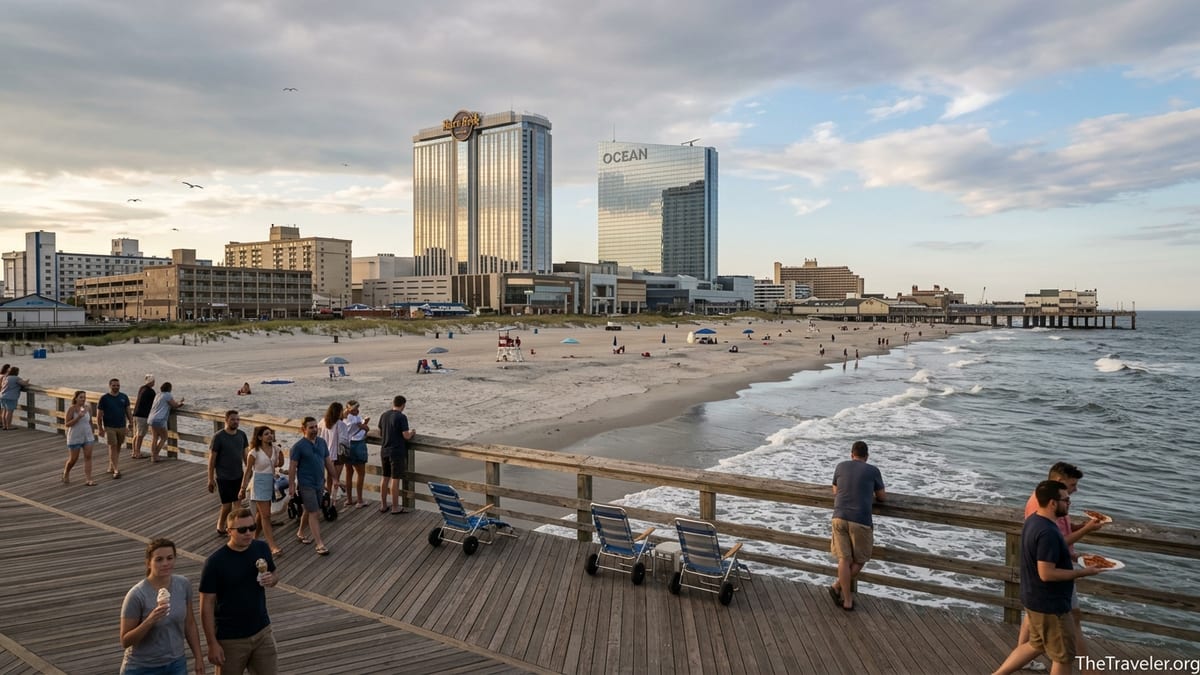
The State of Atlantic City in 2026
To understand whether Atlantic City is worth visiting today, it helps to look at what has changed recently. The city’s core economy is still built on casinos, conventions and summer beach tourism, and brick and mortar casino revenue remains in the billions of dollars annually, even if it has plateaued compared with pre-competition highs. At the same time, New Jersey tourism data shows that overall visitor spending along the shore has continued to grow modestly in the past few years, which suggests that Atlantic City is still drawing crowds, particularly in peak season.
The skyline has also stabilized after the sharp wave of casino closures in the early 2010s. Flagship properties like Borgata, Hard Rock Hotel & Casino Atlantic City and Ocean Casino Resort are investing tens of millions of dollars in upgrades, from renovated hotel rooms to new restaurants and theater lineups. A recent round of summer announcements from the city’s tourism board highlighted a convention calendar with health conferences, trade shows and sports tournaments at the Atlantic City Convention Center, alongside concert bookings such as major touring comedians and legacy rock bands at Borgata, Hard Rock and Ocean. This mix of business and entertainment helps keep midweek room rates competitive for leisure visitors who time their stay carefully.
At street level, however, Atlantic City still shows its economic scars. Population has slowly declined over the last two decades, and several blocks off the boardwalk remain dotted with vacant lots, pawn shops and low-cost motels. For travelers, that means you can no longer arrive expecting a uniformly polished resort town. Instead, you should think of Atlantic City as a small, gritty city with pockets of investment and entertainment that are attractive to visitors, alongside neighborhoods that most tourists will simply not need to enter.
In practical terms, Atlantic City today is a destination that rewards a targeted approach. If you come for a weekend at a well-maintained casino resort, stick largely to the boardwalk and Marina District, and build in some time on the beach or at newer attractions, you can still have a satisfying trip. If you are expecting the lavish comps, broad casino choice and wall to wall glitz of the early 1990s, you are likely to be disappointed.
New Investments: Waterparks, Orange Loop and a Broader Mix of Fun
One of the strongest arguments that Atlantic City’s story is not finished lies in its recent non-gaming investments. The most visible is Island Waterpark at the Showboat Resort, a roughly 100,000 to 120,000 square foot indoor beachfront water park that opened in 2023 on the boardwalk. Billed as one of the largest indoor beachfront water parks in the United States, it cost around 100 million dollars to build and was conceived specifically to diversify Atlantic City’s appeal beyond gambling. For families, it means you can visit in shoulder seasons like April or October and still have a full day of weatherproof activity for kids and teens, from body slides and surf simulators to an indoor “tree house” play structure and zipline.
The Showboat Resort, now operating as a non-casino hotel, has repositioned itself as a family friendly complex, adding a large arcade, go-kart track and event space alongside the waterpark. For a practical example, a family might book a summer weekend with a standard room in the 150 to 250 dollars per night range midweek, then buy day passes to the waterpark rather than relying on the casino floor for entertainment. When paired with a few hours on the free public beach just outside, this can feel more like a traditional shore vacation than a gambling trip.
Another sign of reinvention is the Orange Loop, a walkable cluster of three city blocks near the beach that has become a small but lively dining and nightlife district. Centered on New York Avenue and nearby streets, it features independent spots like Tennessee Avenue Beer Hall, coffee bars, live music venues such as Anchor Rock Club, and newer restaurants that lean more toward chef driven menus than casino buffets. On a warm Saturday, it is one of the few parts of Atlantic City where you will see a relatively balanced mix of locals, visiting concertgoers and food focused travelers bar hopping and listening to bands rather than simply shuttling between slot machines.
Beyond these, Stockton University’s Atlantic City campus, opened in 2018 and expanded with a second student residence in 2023, has brought a steady population of students and faculty living and studying right on the boardwalk near Albany Avenue. Their presence has encouraged the opening of more everyday amenities such as coffee shops and small eateries, and it contributes to a sense that at least part of Atlantic City’s oceanfront is a lived in neighborhood rather than a strip of isolated casinos.
The Boardwalk, Beaches and Classic Casino Experience
For many repeat visitors, the core question is whether Atlantic City’s traditional strengths still hold up. The good news is that the beach and boardwalk remain the city’s most reliable assets. The wide, sandy beaches are free to access, unlike some other New Jersey shore towns where beach tags are required. In summer, you will still find classic rolling beach chairs, saltwater taffy shops and the familiar sight of families toting coolers and umbrellas down from mid-range hotels like Tropicana, Resorts or Bally’s.
Beach conditions do shift from year to year as storms reshape the shoreline. In 2024, for instance, beach erosion temporarily made the sand in front of some boardwalk casinos harder to access directly, requiring visitors to walk a bit farther along the boardwalk to reach a wider stretch of sand. Issues like this are typically addressed with periodic beach replenishment projects funded by the state and federal government, but visitors arriving in 2026 should still be prepared for variation from section to section. The most consistently wide beaches tend to be near the lower end of the boardwalk, around the Tropicana and the Chelsea neighborhood, though on calm summer days the water is inviting along most of the strip.
On the boardwalk itself, the experience is mixed but can still be enjoyable. Summer evenings bring crowds strolling between casinos like Hard Rock and Ocean, families riding the Ferris wheel at Steel Pier, and street vendors selling funnel cakes and pizza slices. Some blocks are lined with souvenir shops, vape stores and discount electronics stands that feel dated or low end, while others, especially near the larger casinos, are more polished. A visitor who plans to walk mainly between major resorts, perhaps stopping at Steel Pier for rides or trying a sit down dinner at a steakhouse inside Hard Rock, will likely come away with a reasonably positive impression.
The casino experience has evolved as well. Atlantic City no longer has the sheer density of gaming options it once did, but remaining properties have invested to stay competitive. Borgata, in the Marina District, still offers one of the best overall combinations of upscale hotel rooms, poker room, spa and dining. Hard Rock leans heavily into live music and celebrity chef restaurants, while Ocean emphasizes contemporary design and ocean views, with many rooms offering floor to ceiling windows over the beach. For gamblers used to Las Vegas, table minimums in peak season can feel comparable, but midweek and in the off-season you can still find more approachable blackjack or roulette tables, and mid-tier rooms can be significantly cheaper than similar quality stays in major desert resorts.
Cost, Value and How Atlantic City Compares With Alternatives
Value is one of the strongest remaining arguments for considering Atlantic City, particularly for travelers within driving distance of New York, Philadelphia or Washington. Hotel rates fluctuate widely by season and day of week, but it is common to find midweek off-season deals under 100 dollars per night at older casinos like Resorts or Bally’s, and even in summer, a Sunday to Tuesday stay at a four star property like Ocean or Hard Rock can sometimes land in the 150 to 250 dollars per night band before resort fees. Comparable oceanfront resorts in northern New Jersey or Long Island often price significantly higher in midsummer, even without the added amenity of large scale entertainment venues.
On the downside, resort fees and parking charges are now standard at most properties, which erodes some of the headline value. Parking in a casino garage commonly runs in the 10 to 25 dollar per day range, and daily resort fees around 30 to 40 dollars are typical, even when your nightly rate appears low. Food costs also mirror national trends: while you can still grab an inexpensive boardwalk slice of pizza or sub sandwich for under 10 dollars, sit down dinners at casino restaurants quickly climb into big city territory, with steaks at well known chains and celebrity venues costing 50 dollars or more before drinks.
When compared with regional competitors, Atlantic City occupies a specific niche. It cannot match the pedestrian friendly polish and family infrastructure of Ocean City, New Jersey or Wildwood, which offer more extensive amusement piers and kid focused activities right on the boardwalk. It also cannot match the variety and safety perception of Las Vegas, which benefits from a denser cluster of attractions and newer megaresorts. What Atlantic City does offer is a relatively affordable combination of beach, legal casino gambling, live entertainment and indoor attractions concentrated in a compact, walkable strip.
For a couple from Philadelphia, for example, a two night Atlantic City trip might involve a 1.5 to 2 hour drive, 350 to 500 dollars in total hotel costs including fees for a higher end property midweek, and the option to spend days on the beach, evenings seeing a concert at Hard Rock and a comedy show at Borgata, and late nights at casino bars. Achieving a similar mix of beach and big ticket entertainment without flying is difficult elsewhere on the mid Atlantic coast.
Safety, Grit and Managing Expectations
Concerns about crime and urban decay are usually the first objections raised by people who have written off Atlantic City. The city’s violent crime rate is significantly higher than the national average, with some estimates placing it several times higher per capita than the United States overall. At the same time, crime is heavily concentrated in certain residential neighborhoods and along specific commercial corridors that most tourists never need to visit. Independent crime data aggregators and local commentary consistently describe the Boardwalk and Marina District as relatively safer pockets, in part because of a heavy police and private security presence, especially during peak season when visitor numbers swell.
In practical terms, visitors should treat Atlantic City like any small city with both tourist zones and struggling residential areas. If you are staying in a casino or oceanfront hotel, you can largely rely on walking the boardwalk, using casino connected walkways, and taking licensed taxis or the local jitney shuttles when moving between the Marina District and the main boardwalk strip. Walking several blocks inland late at night, especially alone, is not recommended, and parking in well lit, staffed casino garages is a better choice than leaving a vehicle on a side street.
Real world traveler reports illustrate this split personality. Many recent visitors describe feeling safe walking the boardwalk between major casinos in the early evening, grabbing pizza or ice cream at well lit stands and watching street performers. Others, particularly during the off season or late at night, find the atmosphere more unsettling, noting panhandling, groups loitering outside of corner stores and stretches of largely vacant blocks between more vibrant nodes. Women traveling alone or with children commonly emphasize sticking to crowded, tourist heavy areas after dark and planning routes that minimize time on quiet side streets.
For those willing to accept some grit, the trade off is access to big city style entertainment and oceanfront views at a lower cash cost than many polished resort towns. For those who prefer a consistently manicured environment, Atlantic City is likely to feel more stressful than relaxing, and alternatives like Cape May, Ocean City or a flight to a Florida beach destination will probably be more satisfying.
Who Atlantic City Still Works For (and Who It Does Not)
Atlantic City in 2026 is not a one size fits all destination. It still makes sense for several types of travelers. Casino focused visitors who enjoy table games or slots and live within a few hours’ drive can still find good value, especially midweek. You might, for example, book a comped or discounted room at Borgata based on previous play, spend afternoons at the spa or indoor pool, evenings at high caliber restaurants, and gamble late into the night without ever needing to step onto the boardwalk. For this type of trip, the city’s broader struggles are largely invisible.
Value oriented couples and friend groups can also do well if they structure their visit around a mix of casino entertainment and low cost beach time. A pair of friends might share a room at a mid range property like Tropicana, split parking fees, spend afternoons on the sand and nights sampling a few different casino bars and lounges, perhaps capping one evening with a reasonably priced local band show in the Orange Loop rather than an expensive headliner.
Families will have the most polarized experiences. For parents who are comfortable navigating an urban environment and are staying at a property that explicitly caters to kids, such as the Showboat Resort with its waterpark and arcade, Atlantic City can provide a few days of relatively affordable fun compared with flying to Orlando or a Caribbean resort. You could spend mornings at the beach, afternoons inside Island Waterpark, order casual dinners on the boardwalk and avoid the casino floors altogether. For families seeking a more traditional, wholesome boardwalk without visible poverty or adult oriented signage, however, towns like Ocean City or Wildwood are better fits.
On the other hand, travelers who prioritize walkable charm, boutique shopping and historic architecture may find Atlantic City underwhelming. While there are pockets of character, such as restored buildings around the Orange Loop and the presence of Stockton University’s campus, much of the cityscape is dominated by large parking decks, mid-rise motels and aging commercial strips. If you are picturing the ambience of a European seaside promenade or even the fairy lit main street of a New England resort, adjusting expectations is essential.
How to Plan a Smart Atlantic City Trip Today
If you decide Atlantic City might still work for you, a bit of planning goes a long way. First, choose your base carefully. For a primarily casino centered trip with less emphasis on the boardwalk, Borgata, Harrah’s and Golden Nugget in the Marina District offer a compact cluster accessible via short taxi or jitney rides, with less exposure to the city’s rougher blocks. For a beach and boardwalk focused stay, Hard Rock, Ocean, Tropicana and Resorts put you directly on the action, while the Showboat Resort is a logical choice for families prioritizing Island Waterpark.
Next, think about timing. Peak summer weekends bring the most vibrant atmosphere, with street performers on the boardwalk, full entertainment calendars and warm ocean water. They also bring the highest room rates, crowded casinos and more visible nightlife. Shoulder seasons, such as late May, June and September, often strike a better balance between value and experience. In those months, you might find room rates 20 to 40 percent lower than mid July, calmer beaches and easier restaurant reservations, while still benefiting from mild weather and many open attractions.
Transportation is another key detail. Many visitors from New York and Philadelphia arrive by car, but once parked in a casino garage, they do not use it again until departure. Within the city, the small green jitney buses run fixed routes between the Marina and boardwalk areas and along Pacific Avenue for a modest cash fare, while taxis and rideshare services provide on demand rides at typical urban prices. For those arriving by air, Atlantic City International Airport offers limited commercial service, so most fliers still use Philadelphia International Airport and connect via rental car, train plus bus, or express coach services.
Finally, build a daily plan that balances indoor and outdoor options and sets spending limits. A realistic sample day in summer might include a mid morning stroll on the boardwalk with coffee from a local cafe, several hours on the beach, a casual lunch at a boardwalk pizzeria, an afternoon nap or spa visit back at your hotel, then a pre booked evening show at Hard Rock or Borgata followed by a capped gambling budget at your preferred casino. Scheduling one afternoon or evening to explore the Orange Loop or to take kids to Island Waterpark gives variety beyond the casino environment.
The Takeaway
So, is Atlantic City still worth visiting, or are its best days gone for good? The truth sits somewhere in the middle. The city no longer offers the sheer novelty it once did as the East Coast’s primary legal gambling hub, and years of economic challenges remain visible in vacant lots, high crime statistics and uneven streetscapes. Anyone arriving with a nostalgic image of the 1980s boardwalk, expecting flawless glamour and generous casino comps, is likely to feel that the magic has faded.
Yet it would be misleading to write Atlantic City off entirely. Significant private and public investments, from the Island Waterpark at Showboat to ongoing casino renovations and the growth of Stockton University’s oceanfront campus, show that money and energy are still flowing into the city. The beaches remain free and inviting, the boardwalk still hums on summer nights, and for travelers within driving distance, Atlantic City continues to offer a distinctive combination of ocean, gaming and big name entertainment at prices that can undercut more polished destinations.
Ultimately, Atlantic City is worth visiting in 2026 if you fit its profile: you appreciate value, can tolerate some urban grit, and intend to spend most of your time in and around the boardwalk and Marina District’s better maintained properties. It is not the right choice if you want a picture perfect, family first resort with minimal visible poverty and no need for street smarts. Framed honestly, though, Atlantic City’s story is less about past glory and more about a work in progress, where savvy travelers can still find rewarding experiences amid the contradictions.
FAQ
Q1. Is Atlantic City safe for tourists in 2026?
Atlantic City’s overall crime rate remains high, but incidents involving tourists are relatively uncommon in the main resort zones. The boardwalk between major casinos and the Marina District is heavily patrolled, especially in summer. Visitors should still use normal big city precautions, avoid walking several blocks inland at night and stick to well lit, busy areas.
Q2. Is Atlantic City family friendly or mainly for gamblers now?
Atlantic City is still primarily geared to adults and gamblers, but it has become more family friendly in recent years. Attractions like Island Waterpark at the Showboat Resort, Steel Pier amusement rides and the free beaches give parents more options. Families who choose kid focused hotels and limit exposure to casino floors can have an enjoyable short break.
Q3. How expensive is a weekend in Atlantic City compared with other beach towns?
Costs vary by season, but Atlantic City often offers better hotel value than many East Coast beach towns, especially midweek. You might find four star rooms for 150 to 250 dollars per night outside peak weekends, compared with higher rates in some smaller resort towns. However, resort fees, parking and casino dining can quickly raise overall trip costs.
Q4. Are the casinos in Atlantic City still busy and worth visiting?
Yes. While there are fewer casinos than at the city’s peak, major properties like Borgata, Hard Rock and Ocean remain busy, especially on weekends. They offer modern gaming floors, spas, pools and a solid lineup of restaurants and shows. For visitors who enjoy nightlife and gambling, these resorts are still the main reason to come.
Q5. What is the best time of year to visit Atlantic City?
The most pleasant balance of weather, prices and crowds is usually in late spring and early fall. May, June and September often bring warm days, cooler nights and lower hotel rates than midsummer. July and August have the strongest beach atmosphere but also the highest prices and biggest crowds, while winter is quiet, cheaper and more casino focused.
Q6. Can you enjoy Atlantic City without gambling at all?
Yes. Non gamblers can spend time on the beach, walk the boardwalk, visit Island Waterpark or Steel Pier, attend concerts or comedy shows and explore the Orange Loop for independent bars and restaurants. Many visitors limit their casino time to dining or spa visits and still find the trip worthwhile.
Q7. How many days do you need in Atlantic City?
For most travelers, one to three nights is enough. A weekend allows time for one or two shows, some beach or pool time and a bit of exploration. Longer stays can work for casino regulars or convention attendees, but Atlantic City is better suited to short breaks than weeklong holidays for most visitors.
Q8. Is it better to stay on the boardwalk or in the Marina District?
Staying on the boardwalk puts you close to the ocean, Steel Pier, Island Waterpark and a variety of casinos and shops. The Marina District is more self contained, with Borgata and Harrah’s offering strong resort facilities in a quieter setting. First time visitors who want the classic Atlantic City feel often prefer the boardwalk, while repeat guests focused on gaming may favor the Marina.
Q9. What are some signs that Atlantic City is improving, not declining?
Recent developments such as the opening of Island Waterpark at Showboat, ongoing casino renovations, the growth of the Orange Loop dining and nightlife area and the expansion of Stockton University’s campus all point to continued investment. While change is gradual, these projects show that Atlantic City is not simply coasting on its past.
Q10. Who should probably skip Atlantic City and choose another destination?
Travelers seeking a perfectly manicured, family oriented beach town with little visible poverty or nightlife will likely be happier in places like Cape May, Ocean City or Wildwood. If you dislike casinos, are uncomfortable with urban grit or want extensive upscale shopping and dining in walkable historic streets, Atlantic City is unlikely to match your expectations.