


For many visitors, Auckland Airport is the launchpad for a bucket‑list New Zealand road trip. Whether you are collecting a compact rental car for two weeks around the North Island or a fully equipped motorhome for a month across both islands, knowing how Auckland Airport’s car rental and campervan systems work will save you time, money and stress. This guide walks you through on‑airport rental desks, off‑airport campervan depots, shuttle logistics, insurance and deposits, and how to decide whether to drive away immediately or stay nearby on your first night.
Get the latest updates straight to your inbox!
How Auckland Airport Is Laid Out For Car Rentals
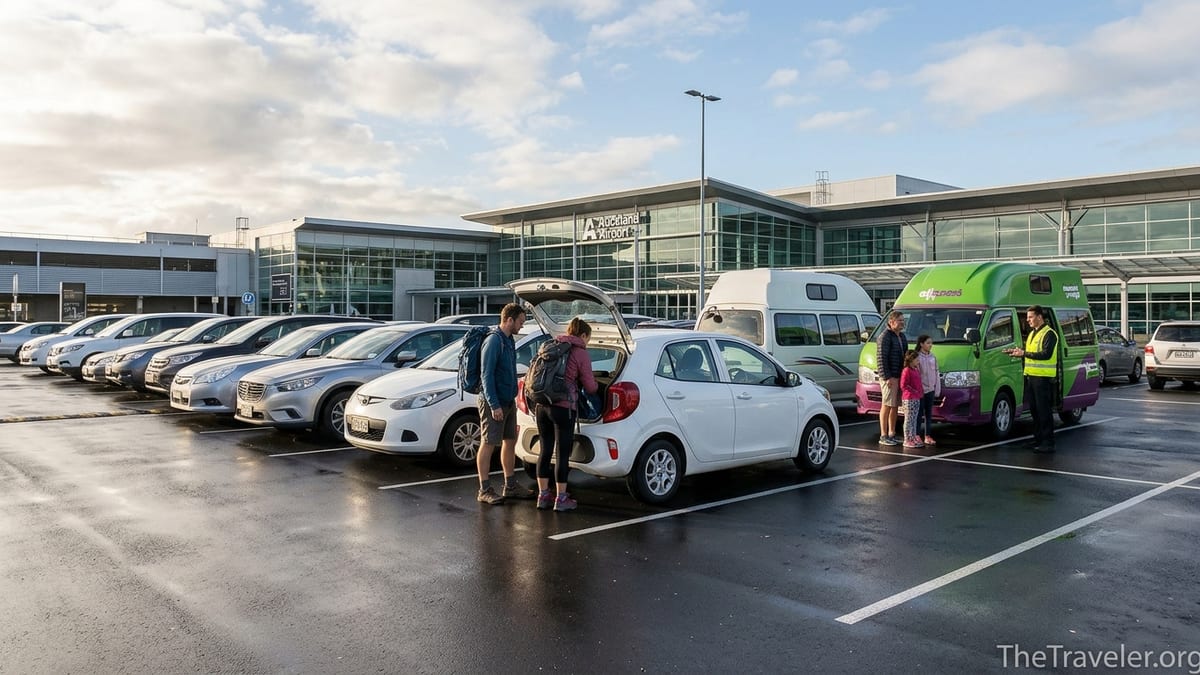
Auckland Airport has two main terminals, international and domestic, but for rental vehicles it effectively functions as a single hub. On‑airport rental car companies share consolidated pick‑up areas close to each terminal, while most campervan and motorhome brands operate from separate depots in nearby Māngere and airport precinct streets. Understanding this layout will help you choose a company and avoid dragging luggage around unnecessarily.
Licensed on‑airport car rental brands include well known internationals like Avis, Budget, Hertz, Europcar, Enterprise, Alamo, National and New Zealand’s own Ezi Car Rental. Their desks are grouped in the Transport Hub by the international terminal and on the ground floor of Car Park R beside the domestic terminal, so you generally walk straight from arrivals to the counters rather than catching a shuttle. These providers tend to be slightly more expensive than some off‑airport operators, but they are convenient if you prefer to step off the plane and be on the road with minimal fuss.
Most campervan and motorhome providers, including Britz, Maui, JUCY, Apollo, Spaceships and others, are based in dedicated depots within a 5 to 15 minute drive of the terminals. For example, JUCY’s Auckland Airport branch is on Richard Pearse Drive, around 10 minutes from the airport by their own shuttle, while Spaceships operates a depot on Aintree Avenue in Māngere, around 4 kilometres from the terminals. These depots usually have more space for vehicle handovers, show‑throughs and accessory fitting than the on‑airport car parks.
A free terminal transfer bus connects Auckland’s international and domestic terminals roughly every 15 minutes, so if you land domestically but your rental is arranged at the international Transport Hub, you can move between them without paying for a taxi. Factor this into your timing if you have a tight schedule on arrival day.
On‑Airport Rental Car Desks And Pick‑Up Process
If you book with one of the on‑airport brands, the process is reasonably standard. After clearing customs or domestic arrivals, follow signs for “Rental Cars” or “Transport Hub.” You will find a cluster of counters with familiar names like Avis, Budget, Hertz and Europcar. During peak summer months, particularly late December through February, queues can be significant when several long‑haul flights land at once, so it is wise to build at least 45 to 60 minutes from landing to driving into your itinerary.
At the desk, you will present your passport, driving licence and booking confirmation. Many companies also ask to physically see the payment card used for the reservation. If your licence is not in English, you will generally need an official translation or International Driving Permit. Staff will confirm your included mileage, fuel policy, insurance excess and any road restrictions such as bans on taking standard cars onto certain ski access roads or long stretches of gravel.
Once paperwork is completed, you are directed to a nearby multi‑storey car park bay to collect the vehicle. For example, vehicles may be parked on specific levels or colour‑coded zones of Car Park R or the Transport Hub, with clear signage for each brand. Some companies position staff in the car park to walk you to the vehicle and conduct a quick damage check. Others hand you a key and a diagram and ask you to inspect the car yourself before exiting. It is in your interest to take photos or video of all sides of the vehicle, including wheels and windscreen, in the car park lighting before you drive away.
Because on‑airport locations pay premium rents and operate larger fleets, they often have better one‑way options between Auckland, Wellington, Christchurch and Queenstown. This can be a strong reason to book a major brand on‑airport if you are planning a classic Auckland to Queenstown one‑way itinerary, where relocation fees can add several hundred dollars with smaller operators.
Off‑Airport Car Rentals And Campervan Depot Shuttles
Off‑airport car rental and campervan operators typically rely on complimentary shuttle buses from the terminals. After landing and collecting your luggage, you follow signs for “Rental Car Shuttles” or check your booking confirmation for specific instructions. Some brands ask you to wait at a designated shuttle lane outside the international terminal, while others use generic shared shuttle bays or a phone board where you dial the company to request pick‑up.
As a concrete example, JUCY runs a bright green and purple shuttle between the terminals and its Richard Pearse Drive branch. The shuttle generally operates during their opening hours, which are often around mid‑morning to late afternoon for campervan pick‑ups, with slightly longer hours for car rentals. Spaceships’ Auckland depot is around a 10 to 15 minute drive from the airport, and they provide detailed instructions and maps on where to wait, including nearby fuel stations you can use before returning your vehicle.
Shuttles usually run every 20 to 30 minutes during business hours, but they are not a 24‑hour service. This matters if you land around midnight or very early morning. Many campervan brands restrict pick‑ups to daytime hours so their staff can complete thorough handovers, explain equipment like gas bottles and heaters, and check your driving licence. If your arrival time falls outside their operating window, you will need to spend the first night in airport‑area accommodation or central Auckland and collect your campervan the following morning.
Off‑airport depots tend to have space for longer briefings and accessory hire. At a motorhome depot for Britz or Maui, for instance, you can expect a 30 to 60 minute session covering how to use the toilet cassette, grey water tank, gas systems, bed conversions and campervan electrics. JUCY and Spaceships often show customers how to set up bed platforms, connect to holiday park power and manage battery usage. This can feel slow when you are tired from a long flight, but it significantly reduces the chance of problems later on the road.
Insurance, Excess And Deposits In New Zealand Rentals
In New Zealand, rental vehicles usually come with basic insurance included in the daily rate, but with a relatively high excess, often in the range of about NZD 3,000 to NZD 7,500 depending on vehicle type and company. This means that if the car or campervan is damaged, you are liable for that amount even if the repair costs more. To manage this risk, most rental companies offer tiered insurance packages that reduce or remove the excess in exchange for a higher daily fee.
A typical example for a compact car rental at Auckland Airport might be: standard cover with a NZD 5,000 excess included in the base rate, a mid‑tier cover at an extra NZD 20 to NZD 30 per day that halves the excess, and a “zero excess” or “Stress Free” package at perhaps NZD 35 to NZD 50 per day that reduces the excess to zero and often covers common issues like windscreen chips and tyre damage. Campervan and motorhome policies are similar, but the excess amounts can be higher given the value of the vehicles, and the daily cost of full cover can be noticeably more.
Many international travellers rely on travel insurance or premium credit cards to cover rental car excess, but coverage for New Zealand is not universal. Some North American credit cards, for example, explicitly exclude New Zealand from their collision damage waiver coverage. Before declining the rental company’s excess reduction, check the fine print of your travel or card insurance and confirm that it covers vehicles in New Zealand and the type of vehicle you are hiring. A motorhome over a certain weight or a 4WD can sometimes be excluded.
Regardless of which insurance route you choose, expect the rental company to place a hold or charge on your credit card as a security bond. For basic cover, this hold can be equal to the full excess, such as NZD 5,000, which is released after you return the vehicle undamaged. With a zero‑excess package the bond may be reduced to a few hundred dollars or even to a small fuel and cleaning bond. If you pay with a debit card, some companies will charge rather than hold the bond, so your funds may not be returned for several working days after drop‑off. It is wise to ensure you have sufficient credit limit or cash buffer before flying into Auckland.
Driving In New Zealand: What To Expect After You Leave Auckland
New Zealand road conditions catch some visitors by surprise. People drive on the left‑hand side of the road, and the default open‑road speed limit is generally around 100 km/h, with typical urban limits between 30 and 50 km/h. Outside cities, many highways are undivided two‑lane roads that twist through hills and along coastlines, with narrow shoulders and occasional one‑lane bridges, especially in rural areas. Travel times can be much longer than they appear on a map, particularly in regions like Northland, the Coromandel Peninsula and the central North Island.
From Auckland Airport, a common first‑day route is south along State Highway 1 toward Hamilton or Rotorua, or north toward Whangārei and the Bay of Islands. Even on these busy corridors you will encounter passing lanes, variable speed zones near small towns, and frequent roadworks during summer. If you are used to multi‑lane freeways, it can feel slow and requires more concentration. New Zealand Police actively enforce speed and drink‑driving rules, and drivers are expected to pull over safely to let faster traffic pass if they are holding up a queue.
In a campervan or motorhome, you will likely be travelling below the posted speed limit on many winding sections. Locals are generally tolerant if you use slow‑vehicle bays and turnouts to let them by. Many rental companies strongly discourage or prohibit driving on unsealed back roads, remote 4WD tracks, or certain alpine routes unless you have a suitable vehicle. Planning your road trip around sealed highways and well‑maintained regional roads will avoid insurance complications and reduce stress, particularly if you are driving on the left for the first time.
Weather can also affect driving. Rain is common year‑round in many parts of the North Island, and strong winds can make driving tall motorhomes challenging, especially on exposed bridges and coastal sections. In winter and early spring, icy patches and occasional snow can appear on higher altitude roads like the Desert Road in the central North Island or around the Central Plateau ski areas. Before setting off each day, it is sensible to check regional road updates and allow flexibility in your schedule.
Should You Pick Up Your Vehicle Immediately Or Stay Overnight?
One of the biggest safety decisions for a New Zealand road trip begins at Auckland Airport: do you drive away immediately after a long international flight or spend your first night nearby? Many aviation and road safety specialists recommend avoiding long drives right after arriving from long‑haul flights from North America or Europe. Jet lag, unfamiliar road rules and left‑side driving can combine to create a high‑risk first few hours behind the wheel.
A sensible compromise for many travellers is to collect an on‑airport rental car but drive only a short distance on day one. For example, you might pick up your vehicle and stay at accommodation in nearby suburbs such as Māngere or in central Auckland, which is around a 25 to 35 minute drive away in normal traffic. This allows you to get used to the car, practice roundabouts and lane positioning, and sleep properly before tackling longer drives to Rotorua, the Coromandel or the Bay of Islands the next day.
With campervans and motorhomes, it often makes even more sense to delay collection. Many campervan depots close by late afternoon and do not permit pick‑ups after dark. If your flight lands in the evening, staying in an airport hotel, then taking the complimentary depot shuttle the following morning, will ensure you are rested during the vehicle briefing and first drive. It also avoids fumbling with gas bottles or power cables in the dark at your first campsite.
Of course, some itineraries and budgets push travellers to hit the road immediately. If you decide to do this, aim for a short, straightforward drive on your first day. From Auckland Airport, that could mean a one‑hour journey south to Hamilton instead of attempting to reach Tongariro National Park or the East Cape in one go. Build regular rest stops into your plan and swap drivers if possible. If any member of your group is feeling too tired or overwhelmed, be ready to change the plan and book a last‑minute motel en route.
Costs, Fuel, And Practical Tips For Auckland Pick‑Ups
Rental prices at Auckland Airport fluctuate by season, demand and vehicle type. In the shoulder seasons of spring and autumn, it is often possible to find compact on‑airport cars at roughly mid double‑digit New Zealand dollars per day if booked well in advance, with SUVs and people movers costing more. In peak summer, rates can climb substantially and campervans in particular can sell out for popular dates. Booking early, being flexible with pick‑up times and comparing on‑airport with nearby off‑airport options can yield significant savings.
Fuel costs are a major component of any road trip budget. Diesel is often cheaper per litre than petrol in New Zealand, but diesel vehicles incur separate road user charges that some rental companies pass on to customers, either embedded in the rate or as an extra per‑kilometre fee. Petrol vehicles do not attract this tax directly, but their fuel consumption may be higher, especially in larger motorhomes. When comparing quotes, check whether diesel road charges, additional driver fees and one‑way relocation charges are already included to avoid bill shock at drop‑off.
Before leaving Auckland Airport, note the locations of nearby fuel stations so you can refuel easily before returning the vehicle. There are service stations on Tom Pearce Drive and other roads close to the airport precinct that are commonly used by renters to top up to “full” under full‑to‑full fuel policies. For campers, it is also useful to know where you can empty grey water and toilet cassettes near Auckland if your rental agreement requires the vehicle to be returned with waste tanks empty and gas bottles refilled.
Small practicalities add up. Having a local SIM card or eSIM with mobile data helps with live navigation and traffic updates. Many travellers use apps to find holiday parks, Department of Conservation campsites and dump stations. In busy travel periods, it pays to pre‑book your first and last campsite near Auckland so you are not searching for a powered site for your campervan in the evening after a full day on the road.
The Takeaway
Auckland Airport is a well established gateway for New Zealand road trips, with a broad mix of on‑airport car rental brands and nearby campervan depots. Your experience will be smoother if you understand where your chosen company is located, how their shuttles operate and what hours they allow pick‑ups. For many visitors, especially those arriving from overnight long‑haul flights, planning a gentle first day with a short drive or an overnight stay near the airport is a smart safety decision.
Insurance, excess and deposits are central to the rental experience. Decide in advance how much risk you are comfortable taking on, confirm whether your travel or credit‑card insurance covers New Zealand, and budget for a security hold on your card. Once on the road, adjust your expectations to New Zealand’s left‑side driving, winding highways and variable weather, and build extra time into every leg of your journey.
With realistic timing, clear understanding of your rental conditions and a cautious approach to your first day’s driving, picking up a car or campervan at Auckland Airport can be straightforward. That leaves you free to focus on the reasons you came: geothermal pools in Rotorua, vineyards on Waiheke Island, surf beaches at Raglan, and the long ribbons of road that tie them all together.
FAQ
Q1. Can I pick up a rental car at Auckland Airport late at night?
Many on‑airport car rental desks align their hours with flight schedules and may stay open for late‑night arrivals, but this is not guaranteed. Some close around midnight or earlier in low season. Campervan and motorhome depots almost always restrict pick‑ups to daytime hours. Always check the specific opening hours on your booking and let the company know your flight number so they can advise what happens if your flight is delayed.
Q2. Do I need an International Driving Permit to rent a car in New Zealand?
If your driving licence is in English and uses a Latin alphabet, most mainstream rental companies at Auckland Airport accept it without an International Driving Permit, provided it is valid and you meet their age requirements. If your licence is not in English, or uses a different script, you will usually need either an official translation or an International Driving Permit carried alongside your original licence. Requirements can vary by company, so check before you travel.
Q3. How much security deposit should I expect to pay for a rental car?
The security deposit, often taken as a credit‑card hold, typically matches the insurance excess on your rental. For standard cover this can be several thousand New Zealand dollars, while with a zero‑excess package the hold may be reduced to a few hundred dollars. Campervans and motorhomes can attract higher bonds because they are more valuable. Make sure your card has enough available limit to cover this without affecting your travel funds.
Q4. Is it safe to start driving a long distance straight after landing in Auckland?
Legally you can, but from a safety perspective it is often unwise after a long international flight. You may be jet lagged, adjusting to left‑side driving and unfamiliar road rules, all at the same time. Many experienced travellers choose to stay in Auckland or nearby suburbs on the first night and begin longer drives the next morning when they are rested and alert.
Q5. Are there age restrictions for renting cars and campervans at Auckland Airport?
Most major car rental companies in New Zealand require drivers to be at least 21, and some charge additional fees or limit vehicle classes for drivers under 25. A few local companies may rent to 18 to 20 year olds under stricter conditions. Campervan and motorhome firms often have similar or slightly higher minimum age rules. Always check your chosen company’s policy before booking to avoid surprises at the counter.
Q6. Can I take my Auckland Airport rental car on gravel or unsealed roads?
Policies differ. Many rental contracts allow short sections of unsealed road to reach a holiday park, trailhead or rural property, but prohibit extended driving on rough gravel, remote forestry roads or 4WD tracks. Some specifically exclude popular but challenging roads. If you plan to explore off the main highways, discuss your intended route with the rental company and read the terms carefully, as damage suffered on prohibited roads may not be covered.
Q7. How long does it usually take from landing to driving away?
Allow at least one hour from scheduled arrival to driving out of the car park for an on‑airport rental, and more in peak summer or if you need to clear international customs. For campervans and motorhomes, factor in shuttle wait times and a full vehicle briefing, so 90 minutes to two hours is common from meeting your shuttle to leaving the depot. Building this buffer into your itinerary reduces stress and the temptation to rush.
Q8. Is fuel more expensive near Auckland Airport?
Fuel prices around the airport are often similar to other parts of Auckland, though individual stations can vary. You may save a little by filling up in suburban areas away from major highways, but the difference is usually modest. For most travellers it is more practical to refuel at a convenient station close to the airport before returning the car, ensuring you meet a full‑to‑full fuel policy and avoid refuelling surcharges.
Q9. Do Auckland rental companies charge extra for additional drivers?
Many do. Some international brands charge a daily fee for each extra named driver, while others include one additional driver at no cost, particularly for spouses or partners. Campervan companies are more likely to let you register multiple drivers without extra charges, although all drivers still need to present valid licences. If you plan to share driving duties, check these fees when comparing quotes.
Q10. Can I return my rental car or campervan to a different city?
Yes, one‑way rentals between Auckland and cities like Wellington, Christchurch or Queenstown are common, especially for longer trips. However, most companies charge a one‑way fee that can range from modest to substantial depending on season and direction. Larger brands with big fleets sometimes run relocation specials in quieter months, where you pay a low daily rate to move a vehicle south or north within a set timeframe. Always confirm one‑way conditions and costs at the booking stage.