


Auckland Airport is New Zealand’s main international gateway, and for many trips the journey starts on a domestic flight from cities like Wellington, Christchurch or Queenstown. That means a landside transfer between the domestic and international terminals at Auckland. This guide explains, in practical terms, how to move between terminals, how the free bus and 10–15 minute walk work, what to do with checked bags, and how much connection time to allow for different types of tickets and airlines.
Get the latest updates straight to your inbox!
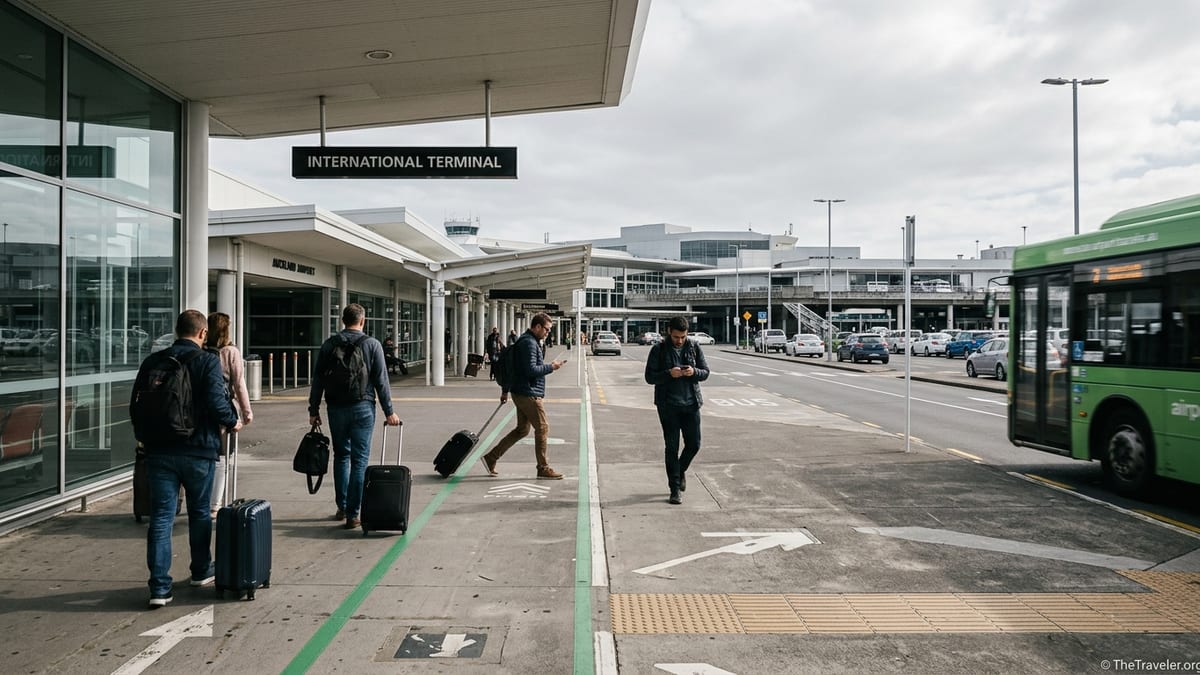
Understanding Auckland Airport’s Two-Terminal Layout
Auckland Airport has a simple two-terminal layout: one terminal for domestic flights and one for international departures and arrivals. The terminals are on the same airport campus but not physically joined inside the secure area. If you are arriving on a domestic flight and leaving on an international flight, you must exit the domestic terminal, move across the airport precinct, and enter the international terminal through its departures level.
The distance between the domestic and international terminals is roughly 900 to 950 metres following the marked walking route often referred to as the Green Line. For most people this is a comfortable 10 to 15 minute walk at a normal pace, slightly longer if you are pushing a stroller or carrying heavy hand luggage. Travellers who prefer not to walk can use the free green terminal transfer bus that runs between the terminal forecourts.
Because the transfer is landside, you are effectively leaving one airport terminal and entering another. That means you must factor in walking or bus time, plus any extra time needed to collect or drop bags and to clear security and exit controls at the international terminal. This is why connection times within Auckland can feel longer than airports where domestic and international flights share a single building.
In practice, locals use this transfer daily. A common example is someone flying Air New Zealand from Wellington to Auckland on a domestic jet, then connecting to a long-haul Air New Zealand or partner flight to Los Angeles, Singapore or Vancouver. Understanding the layout and options will help you make that connection with less stress.
Walking Between Domestic and International: The Green Line Route
Walking between terminals is often the quickest and most predictable option. The signed pedestrian route is approximately 900 to 950 metres and is marked on the ground and signage with a green line. If you are reasonably mobile and have wheeled luggage, you can expect the walk to take around 10 to 15 minutes at an easy pace. Fit travellers walking briskly with a small backpack sometimes do it in under 10 minutes.
The walk is mostly flat and paved, with clear wayfinding signs that say “International Terminal” or “Domestic Terminal.” Coming from domestic arrivals, you exit the terminal to the forecourt, locate the green line markings, and follow them past car parks and the transport hub toward the larger international terminal building. The route is outdoors but partially sheltered in places, so you should be prepared for rain and wind, especially in winter.
For a concrete scenario, imagine you land from Christchurch at 2:00 pm, seated toward the front of the aircraft. You might be off the plane by 2:10 pm, out of the domestic terminal doors by 2:15 pm and walking along the green route. Even with a short pause to adjust your bags or check the airport map, you are likely to reach the international departures doors around 2:30 pm. That leaves ample time to check in and clear formalities for a 4:30 pm long-haul departure.
Travellers with mobility issues or young children may still choose to walk, but they should allow closer to 20 minutes door to door. If you need extra assistance, such as a wheelchair, it is best to request this in advance through your airline so airport staff can help you across the precinct or arrange buggy support where available.
Using the Free Green Terminal Transfer Bus
A free green terminal transfer bus runs between the domestic and international terminals, operating roughly every 15 minutes from early morning to late evening. According to Auckland Airport’s current guidance, the bus typically operates from about 5:00 am to 11:00 pm, though times can be adjusted seasonally. The bus uses clearly marked bus stops outside each terminal, usually signed as the green terminal transfer bus at the domestic forecourt and near the transport hub at the international side.
The actual ride time on the bus is short, often around 5 minutes, but you should budget longer to account for waiting time and boarding. If you walk out of domestic arrivals and just miss a bus, you might wait up to 15 minutes for the next one, then ride for 5 minutes, and spend a couple more minutes getting off and walking into the international departures area. In total, that can easily reach 20 to 25 minutes from terminal exit to terminal entry.
Because of this, many frequent flyers decide in real time whether to walk or take the bus. If the weather is dry and your luggage is manageable, walking is often faster than waiting for the bus. If you are tired from a long journey, travelling with kids, or it is raining heavily, the bus is a welcome alternative. Importantly, the bus is free to use and typically does not require showing a boarding pass; it is a general airport service that shuttles all travellers between terminals.
As an example, a family arriving from Dunedin at 8:30 am for an 11:00 am international departure may choose the bus to avoid shepherding children along a nearly one-kilometre walk. If they reach the bus stop by 8:45 am and catch a bus within 10 minutes, they can be at the international terminal around 9:05 am, giving them plenty of time to check in bags and clear security and passport control.
Baggage Rules: When You Do and Do Not Reclaim Your Bags
Whether you need to collect your checked bags at Auckland during a domestic to international connection depends on your ticket and airline arrangements. If your domestic and international flights are booked on a single through-ticket with the same airline group, your bags are often tagged through to your final destination. For example, if you fly Air New Zealand from Nelson to Auckland and then Air New Zealand again from Auckland to Tokyo on one booking, your suitcase is usually checked in at Nelson all the way to Tokyo. At Auckland you just walk or bus between terminals with your cabin bag.
However, if you booked separate tickets or are mixing airlines without a baggage agreement, you may have to collect and re-check your bags. A common case is a traveller flying Jetstar from Christchurch to Auckland and then a separate Air New Zealand or Singapore Airlines ticket from Auckland to Asia or Europe. In these self-connecting situations, you must collect your bag from the domestic carousel, leave the arrivals area, travel to the international terminal, and check in again from scratch. This adds time and risk, because any delay on the domestic leg is your responsibility.
Air New Zealand and some partner airlines sometimes allow domestic to international through-checking of luggage even when different carriers are involved, but this relies on specific agreements and having a single booking reference. To avoid surprises, check your booking confirmation: if it shows your final destination and includes both flight segments on the same ticket, your bag is likely through-checked. If you hold two separate confirmations and had to pay for checked luggage twice, assume you will need to reclaim and re-check your bags at Auckland.
Cabin baggage rules also matter. Domestic flights within New Zealand sometimes have slightly different cabin baggage allowances than long-haul international services, especially on regional turboprop aircraft with small overhead lockers. You might be asked to gate-check a bag that would otherwise qualify as carry-on. If that bag is tagged to your final destination, you will not see it at Auckland; if it is tagged only to Auckland because of separate tickets, you must retrieve it and bring it with you to international check-in.
Check-in, Security and Border Control Timing
Once you reach the international terminal, you must complete standard departure procedures: check-in and bag drop, security screening and passport control. Most full-service airlines departing Auckland recommend passengers arrive at international check-in at least three hours before a long-haul flight, and at least two hours before shorter flights to Australia or the Pacific Islands. These recommendations are designed to absorb delays at any stage of the process, including busy holiday periods and early-morning banked departures.
Check-in and bag-drop counters usually close 60 minutes before scheduled departure for long-haul flights, and sometimes 45 minutes for shorter international routes. For instance, if you are flying to Los Angeles at 7:30 pm, your airline might close bag drop at 6:30 pm. That means you need to have reached the international terminal, completed your walk or bus transfer, and lined up at the check-in area well before 6:30 pm. Cutting it closer than that leaves no buffer if there are queues at security or passport control.
Security and border control times in Auckland can vary considerably by time of day and season. Some travellers report clearing both in under 20 minutes during a quiet mid-afternoon shoulder season, while others around Christmas or school holidays experience longer queues, sometimes 30 to 45 minutes from the start of security to the exit from passport control. Automated eGates can speed up passport checks for eligible nationalities, but you should never assume a short clearance time when planning your transfer.
To put this into a real-world scenario, imagine you reach international check-in at 5:15 pm for a 7:30 pm long-haul flight. You drop your bag by 5:30 pm, pass through security and passport control by 6:10 pm, and reach the gate around 6:20 pm, which is in the window many airlines recommend: 20 to 30 minutes before boarding. This kind of timeline is realistic and comfortable if you have planned enough connection time from your domestic arrival.
How Much Connection Time to Allow
The right amount of time to allow between a domestic arrival and international departure at Auckland depends on whether your flights are booked on one ticket or as separate self-transfers. For a through-ticket on a single airline or partner combination, the airline’s booking system usually enforces a minimum connection time. At Auckland, this can be as low as around 75 to 90 minutes for some domestic to international pairings, because the airline knows you are protected: if your first flight is late, it will rebook you on the next available service.
That said, if you have any choice in scheduling, most experienced travellers still prefer at least two hours between domestic arrival and international departure, even on one ticket. This allows for minor domestic delays, a 10 to 15 minute walk or 20-minute bus transfer, and time for check-in queues. For example, a Wellington to Auckland flight arriving 3:30 pm connecting to a 6:00 pm departure to Sydney provides a 2 hour 30 minute buffer, which is typically enough even if the domestic sector is 30 minutes late.
For self-transfers on separate tickets, you should be much more conservative. A common rule of thumb is to allow at least four hours between scheduled domestic arrival and international departure when you must collect and re-check bags. This means that if your regional Jetstar flight from Nelson is due into Auckland at 10:00 am, you would look for an international flight no earlier than about 2:00 pm. This buffer allows for possible domestic delays, waiting for bags, the walk or bus, full check-in procedures and unpredictable security and passport queues.
Keep in mind seasonal pressure. Around Christmas, New Year, Easter and New Zealand school holidays, both domestic and international flights are often heavily booked and more prone to knock-on delays. Morning banks of departures between about 7:00 am and 10:00 am can also be busy, as many long-haul flights leave in that window. If your trip falls in these periods, adding an extra hour to your ideal connection time is wise. Missing a separate-ticket long-haul flight can be extremely expensive compared with the cost of taking an earlier domestic flight or choosing a longer layover.
Special Considerations for Different Travellers
Not all passengers face the same challenges when transferring at Auckland. Families with young children may find the 10 to 15 minute walk tiring, particularly if they are pushing prams and carrying multiple bags. For them, the free terminal transfer bus or even a short taxi ride between terminals can reduce stress, though taxis may not be allowed to do such a short run economically at all times. Arriving earlier and giving children time for snacks and bathroom breaks before boarding another long flight is also helpful.
Older travellers or those with reduced mobility should plan ahead with their airline. Most carriers can request wheelchair assistance or buggy support from the domestic gate through to the international check-in area. This is especially important if you have a shorter connection that leaves little room for walking slowly. If you have a pacemaker or medical implants, factor in extra minutes at security screening in case you need a manual pat-down or alternative screening process.
Travellers with duty-free refunds, oversized sports gear or special baggage such as surfboards or bikes should remember that processing these items takes extra time. A passenger flying from Queenstown to Auckland with skis for a connection to Tokyo, for example, might need to visit an oversize baggage counter at both ends. That can add 10 to 15 minutes at each step, which matters if you have a tight schedule. Booking longer layovers avoids having to rush with bulky gear.
If your domestic flight is the last of the day into Auckland and you are self-connecting to an international service, build in maximum margin or consider travelling to Auckland the previous day and staying overnight at an airport hotel. A late cancellation on the domestic leg could otherwise strand you in Auckland with a missed long-haul and no protection from the international carrier, especially during peak travel times when later flights may be full.
The Takeaway
Transferring from Auckland’s domestic terminal to the international terminal is straightforward once you understand the layout and timing. The two terminals are separated by roughly a kilometre, which translates to a 10 to 15 minute walk along a clearly marked route for most travellers, or a short ride on the free green terminal transfer bus that runs every 15 minutes for much of the day. Neither option is complicated, but both require you to think about your bags, your mobility and your ticket type.
The critical factor is connection time. On a single through-ticket, airlines may sell you domestic to international connections as tight as about 75 to 90 minutes, but many travellers feel more comfortable with at least two hours. On separate tickets where you must collect and re-check your bags, aiming for four hours or more is safer, especially in holiday periods or when flying long-haul. Always consider real-world delays rather than best-case scenarios.
By allowing plenty of time, checking whether your bags are tagged through, and choosing the walking route or the free bus based on your circumstances, you can turn what might seem like a stressful transfer into a manageable, even relaxed part of your journey. For most travellers, a little planning before you land at Auckland pays off in a smooth connection from domestic to international, and a calmer start to the long flight ahead.
FAQ
Q1. How long does it take to walk from the domestic to the international terminal at Auckland Airport?
For most travellers it takes around 10 to 15 minutes at a normal walking pace, as the distance along the marked route is just under one kilometre.
Q2. How often does the free terminal transfer bus run between terminals?
The green terminal transfer bus typically operates roughly every 15 minutes from early morning until late evening, with a ride time of around 5 minutes between terminals.
Q3. Do I need to collect my checked bags at Auckland when connecting from a domestic to an international flight?
If your domestic and international flights are on one through-ticket with baggage checked to your final destination, you usually do not need to collect bags. On separate tickets or mixed airlines without an agreement, you should expect to reclaim and re-check your luggage.
Q4. How much connection time should I allow on a single through-ticket?
Airlines may sell connections as short as about 75 to 90 minutes, but many travellers prefer at least two hours between a domestic arrival and international departure to allow for minor delays and queues.
Q5. How much time should I allow if I am self-transferring on separate tickets?
If you must collect and re-check bags, a buffer of at least four hours between your scheduled domestic arrival and international departure is recommended to reduce the risk of missing your flight.
Q6. What happens if my domestic flight is late and I miss my international connection?
If both flights are on one ticket, the airline that sold the itinerary usually rebooks you on the next available flight. If you are on separate tickets, you generally bear the cost and must purchase a new international ticket if you miss the original one.
Q7. When do international check-in counters and bag drop usually close at Auckland?
For many long-haul services, check-in and bag drop close around 60 minutes before departure, and sometimes 45 minutes for shorter regional international flights, though you should always check your specific airline’s rules.
Q8. Is the walking route between terminals suitable if I have a lot of luggage?
The path is flat and paved, so it is manageable with wheeled bags, but if you have several heavy suitcases or young children, the free bus is often more comfortable than walking.
Q9. Can I transfer airside without going landside when going from domestic to international?
No. At Auckland, domestic and international operations use separate terminals with no regular airside connection, so you must exit the domestic terminal and enter the international terminal landside.
Q10. Should I plan extra time during peak seasons like Christmas and school holidays?
Yes. During peak periods, both flights and security areas are busier, so adding at least an extra hour to your usual connection buffer is sensible to avoid tight, stressful transfers.