


More news on this day
Austria is drawing the curtain on one of its most recognisable commuter trains, with the long-serving Class 4020 electric multiple units making their final runs on Vienna’s S-Bahn after nearly five decades of service.
Get the latest news straight to your inbox!
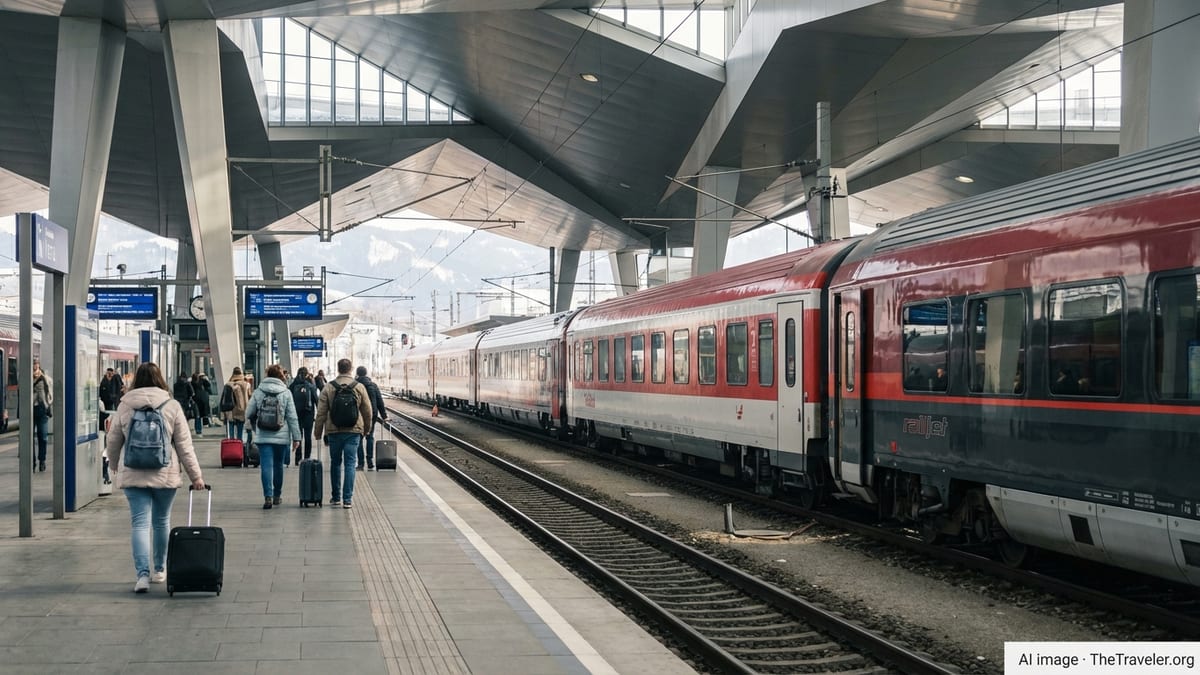
A familiar blue-and-white silhouette leaves the rails
The Class 4020 units, introduced at the end of the 1970s, have been a defining feature of everyday rail travel in and around Vienna. Their blue-and-white livery and angular profile appeared on countless commuter journeys, becoming a visual shorthand for suburban rail in Austria’s capital.
Publicly available information shows that a total of 120 of these three-car sets were built for Austrian Federal Railways and deployed primarily in the Vienna metropolitan area. Over the years they operated on core S-Bahn lines, including the Franz-Josefs-Bahn, where their final scheduled services have now taken place.
Reports indicate that each 4020 train set typically covered several million kilometres over its lifetime, reflecting the intensity of their use on dense, high-frequency commuter routes. For many residents, these trains provided the backdrop to daily routines of work, school and leisure, contributing quietly to the city’s mobility and development.
The farewell comes as part of a broader modernisation of Austria’s rolling stock, in which older fleets are gradually withdrawn in favour of more accessible, energy-efficient and higher-capacity trains across both regional and long-distance networks.
Nearly 50 years of service on Vienna’s S-Bahn
The 4020 series entered service in the late 1970s, at a time when European railways were renewing suburban fleets and shifting toward electric multiple units for fast acceleration and frequent stops. In Vienna, the trains became central to strengthening the S-Bahn concept, providing regular-interval services through the city and into surrounding regions.
According to published coverage of the retirement, the units remained in front-line service well into the 2020s, an unusually long operational span for commuter rolling stock. Their longevity was supported by periodic refurbishments and technical updates, which extended their usefulness even as passenger expectations and safety standards evolved.
Over almost five decades, the 4020s witnessed substantial changes in Austrian rail travel, from the introduction of national integrated ticketing products to the rise of high-speed and night-train services that elevated the country’s profile among rail enthusiasts. While these developments took centre stage, the S-Bahn workhorses continued to shuttle residents reliably across the metropolitan area.
For visitors, the trains offered a straightforward way to reach outlying districts, satellite towns and transfer hubs, providing a first impression of Austria’s wider rail network beyond the flagship Railjet and Nightjet brands.
Cityjet double-decker era begins in eastern Austria
With the last 4020 units now withdrawn, new Cityjet double-decker trains are taking over key routes in the eastern region. These modern sets have been entering service in and around Vienna, including on busy north–south axes and the city’s main line, as part of a phased rollout of upgraded regional rolling stock.
Publicly available information from the operator indicates that the new double-decker trains are designed to offer significantly higher capacity than the outgoing fleet. This is seen as crucial on heavily used commuter corridors where peak-hour crowding has become a regular challenge, especially as more travellers opt for rail over private cars.
The Cityjet trains incorporate low-floor entry, step-free interiors and large multipurpose areas for bicycles, pushchairs and luggage. These features are intended to improve accessibility for passengers with reduced mobility and make multimodal journeys easier for daily commuters and leisure travellers alike.
For international visitors arriving in Vienna and exploring the region by rail, the change means that many local and regional services will now feature interiors and comfort standards that align more closely with Austria’s well-regarded long-distance trains.
What the change means for travellers in and around Vienna
For passengers, the retirement of the Class 4020 units will be most visible in the form of newer trains appearing on familiar routes. Timetables are expected to remain broadly similar, as the change primarily affects the type of rolling stock rather than the structure of S-Bahn services.
The arrival of double-decker Cityjet sets should provide more seats at peak times, reducing pressure on some of the busiest commuter runs into central Vienna. Travellers can also expect more modern onboard amenities, such as improved passenger information systems, brighter interiors and better climate control.
The focus on accessibility reflects a wider trend in European rail operations, as operators update older fleets that can be challenging for passengers with luggage or mobility aids. For tourists using Vienna as a base for day trips by train, easier boarding and more flexible spaces for bicycles and bags may make regional excursions more convenient.
While some rail enthusiasts may miss the characteristic look and sound of the 4020s, the shift underscores Austria’s broader push to strengthen its public transport offer, making everyday train travel more attractive to residents and visitors.
A symbolic moment in Austria’s rolling-stock transition
The farewell to the S-Bahn 4020 trains is the latest in a series of rolling-stock changes that are reshaping how Austria’s railways look and feel. In recent years, the country has invested heavily in new-generation Railjet and Nightjet sets for long-distance and overnight travel, positioning itself as a key player in Europe’s rail renaissance.
According to recent railway industry reporting, this strategy now extends to regional and suburban networks, where the introduction of new multiple units and double-decker trains is gradually retiring older series across the country. The phase-out of the 4020s is therefore both a practical fleet decision and a symbolic marker of this transition.
For TheTraveler.org readers planning rail journeys in Austria, the development highlights how quickly the on-the-ground experience can evolve. A train type that shaped daily life in Vienna for nearly half a century has now moved into railway history, while its replacements seek to make low-carbon, car-free mobility more appealing than ever.
As Austria continues to balance nostalgia for classic rolling stock with the demands of a modern, high-capacity network, the end of the S-Bahn 4020 era stands as a reminder that even the most familiar trains eventually give way to a new generation.