


More news on this day
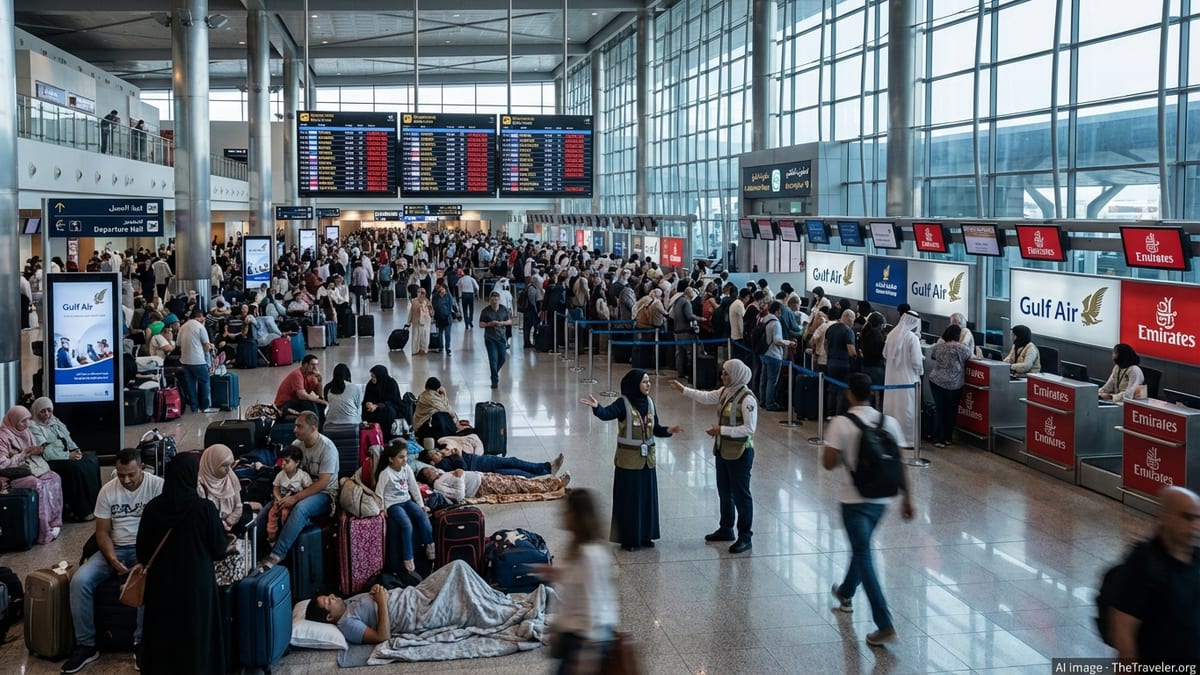
Dozens of travelers were left stranded at Bahrain International Airport this week as 31 flight delays and six cancellations rippled across major routes linking the Gulf with hubs in South and East Asia, according to live airport data and multiple operational reports.
Get the latest news straight to your inbox!
Delays and Cancellations Hit Bahrain’s Key Transit Hub
The latest disruption at Bahrain International Airport comes at a time when the kingdom’s main gateway is already operating under heightened operational constraints. Publicly available flight statistics show that the airport has recorded an elevated level of late departures and unplanned schedule changes in recent weeks, with delay and cancellation rates above its longer-term averages.
On the day of the disruption, airport monitoring platforms recorded 31 delayed services and six outright cancellations on Bahrain’s departure and arrival boards. The affected flights spanned a mix of regional and long-haul operations, underscoring the airport’s dual role as both a Gulf connector and a long-distance transfer point for travelers between Europe, the Middle East and Asia.
While the precise mix of causes varied by flight, operational data and regional reporting point to a combination of constrained airspace, reactionary knock-on delays from earlier disruptions, and schedule adjustments by carriers navigating the current security environment in the Gulf.
Airport analytics covering the last 30 days indicate that more than one in ten flights departing Bahrain have faced delays beyond 15 minutes, with a modest but persistent share of services cancelled outright. These metrics suggest that the latest cluster of 31 delays and six cancellations is part of a broader pattern of operational stress affecting the airport.
Major Gulf and Asia Routes Among Those Affected
The disruption has been particularly visible on routes linking Bahrain with major Gulf neighbors and high-demand Asian destinations. Published coverage and route-tracking data highlight delays on flights to Dubai, Kuwait and Doha, as well as to major South Asian cities including Delhi and Bangalore, and Southeast Asian hubs such as Singapore.
Regional carriers based in the Gulf, along with Asian airlines operating via Bahrain as a transfer point, were among those registering delayed departures and arrivals. Several India-bound flights operated behind schedule, while selected services between Bahrain and major Gulf airports experienced extended ground holds or rolling departure times.
In addition, at least six services were cancelled, including flights on trunk routes that typically carry both point-to-point traffic and large numbers of connecting passengers. The cancellations intensified the strain on rebooking and onward connectivity, especially for travelers relying on Bahrain as a link between Gulf cities and destinations across the Indian subcontinent and East Asia.
Monitoring platforms also show that long-haul itineraries combining Gulf and Asian legs have been especially vulnerable to cascading delays. When an early sector into Bahrain runs late or is diverted, subsequent departures to Asian destinations often lose their assigned slots or exceed crew duty limits, forcing airlines to reschedule or cancel onward services.
Regional Airspace Constraints Amplify Local Disruption
The operational challenges at Bahrain International Airport are unfolding against the backdrop of wider airspace restrictions connected to the ongoing conflict involving Iran. According to publicly available government notices and aviation advisories, portions of Gulf airspace have been intermittently constrained, requiring reroutes, additional clearances or capacity reductions by airlines operating in the region.
Recent notices to airmen and regional guidance indicate that flights transiting the Bahrain Flight Information Region can be subject to special approvals and routing limitations. These measures, designed to manage risk in a volatile security environment, have in turn contributed to longer flight times, holding patterns and altered schedules across several Gulf airports.
Published coverage of the regional situation describes how some carriers have temporarily suspended or reduced services to certain Middle Eastern destinations, while others have diverted aircraft or adjusted flight timings to avoid higher-risk corridors. Bahrain, situated near some of the most sensitive airspace, has been exposed to these shifts both as an origin-destination market and as a transfer point.
In this context, the cluster of 31 delays and six cancellations at Bahrain International Airport reflects not only local operational pressures but also the broader reshaping of traffic flows across the Gulf. Even when Bahrain’s own infrastructure remains intact, upstream disruptions in neighboring airspace can translate into late arrivals, missed connections and lost departure slots on its runways.
Stranded Passengers Face Long Waits and Limited Options
For passengers on the ground, the statistics translate into hours of uncertainty. With delays mounting and multiple flights cancelled, travelers connecting between Gulf cities and Asian destinations have reported extended waits in terminal areas as they sought updated information, meal vouchers and hotel accommodation where eligible.
Accounts shared on social platforms describe travelers stuck overnight after missed connections in Bahrain, particularly on itineraries linking European or Gulf origins to South Asian and Southeast Asian endpoints. Some passengers reported receiving rebookings on later services via alternative Gulf hubs, while others were advised to await restored operations out of Bahrain itself.
Public information from Bahrain’s aviation authorities indicates that passenger rights in cases of delays and cancellations are governed by national civil aviation law and associated regulations. These frameworks typically set out airlines’ responsibilities for care and assistance, including refreshments, accommodation and re-routing, depending on the length of the delay, the cause of disruption and the passenger’s ticket conditions.
Travel industry advisories note that, in complex situations where disruptions are linked to regional security events or airspace closures beyond the carrier’s control, compensation policies may differ from standard delay scenarios. Passengers are often directed to review the terms and conditions of carriage and to retain documentation such as boarding passes, booking confirmations and receipts for any out-of-pocket expenses.
Airlines and Travelers Adjust to a Prolonged Period of Uncertainty
Airlines operating through Bahrain are continuing to adjust schedules and routing in response to the evolving regional picture. Operational dashboards and timetable changes suggest that some carriers have trimmed frequencies on select Gulf and Asia routes, while others have modified departure times to create longer connection windows and allow additional buffer for possible airspace-related delays.
Aviation analysts point out that Bahrain is not alone in facing elevated disruption. Across the Gulf, major hubs have seen increased use of longer detours, higher fuel loads and more conservative scheduling to manage operational risk. These adjustments can compound congestion, as aircraft spend more time in the air and on the ground, consuming finite runway and gate capacity.
For travelers with upcoming itineraries via Bahrain, publicly available guidance from the airport and airlines stresses the importance of checking flight status frequently, arriving early for departures and considering flexible or refundable ticket options where possible. Many carriers are offering limited change-fee waivers or allowing date changes for affected routes within defined travel windows.
Industry observers note that, as long as regional airspace remains constrained and security conditions fluid, episodic clusters of delays and cancellations at airports like Bahrain are likely to persist. The pattern of 31 delays and six cancellations recorded in the latest disruption may therefore be a sign of a new, more volatile operating environment for Gulf and Asia air travel, rather than an isolated event.