


Arriving at Bali’s I Gusti Ngurah Rai International Airport can feel overwhelming, especially when you walk out of customs into a wall of taxi offers and shouting drivers. The good news for 2026 is that both Grab and Gojek now operate officially at the airport, with clearly signed lounges and pickup zones for app rides. This guide walks you step by step through where to go, what to expect, and how prices to Kuta, Seminyak, Canggu, Ubud and beyond usually compare with airport taxis, so you can get from Denpasar Airport to your hotel with minimum stress.
Get the latest updates straight to your inbox!
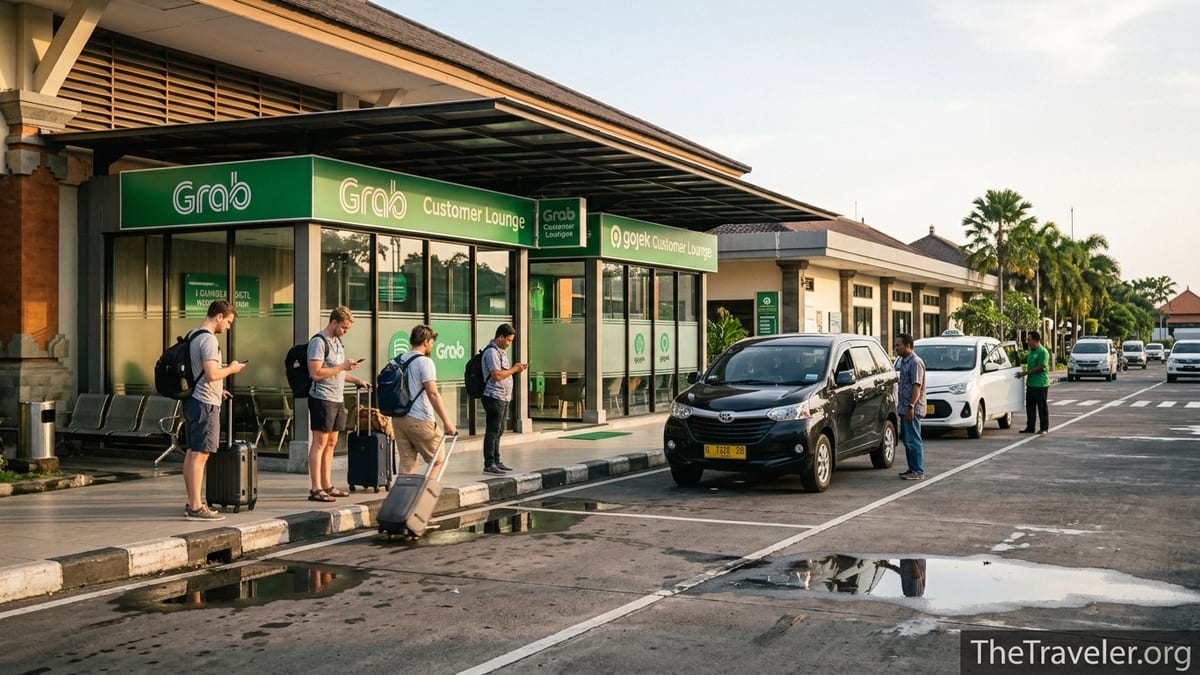
Understanding Bali’s Denpasar Airport Layout
Bali’s main gateway, I Gusti Ngurah Rai International Airport (DPS), commonly called Denpasar Airport or simply Bali Airport, has two passenger terminals that sit next to each other: one for international flights and one for domestic flights. In practice, this means that if you land internationally from Sydney or Singapore and your friend lands domestically from Jakarta, you are in separate but adjoining buildings. Walking between the two typically takes 10 to 15 minutes at a normal pace, using covered sidewalks and pedestrian paths.
Most visitors meet their rides at the arrivals level on the ground floor. Each terminal has a public arrivals hall where you exit after baggage claim and customs, and just outside those doors are the official taxi counters, money changers, and a crowd of freelance drivers. The app-based rideshare areas for Grab and Gojek are not immediately outside these doors. Instead, they are set slightly away from the main crush of drivers in designated pickup zones, which are signposted inside the terminal and on overhead boards.
Knowing roughly how the terminals connect helps you decide where to call your car. Some travelers arriving internationally choose to follow the signs towards the domestic terminal on foot, because the domestic pickup zones can sometimes be less crowded and offer more space to wait. This can be a useful tactic if you are meeting family flying in on a domestic service or if your international arrivals hall feels particularly hectic when you walk out.
The airport complex also includes an on-site Novotel hotel between the terminals and a network of access roads that loop around both buildings. This is relevant for app rides because your driver will generally be directed by Grab or Gojek to specific short-stay pickup areas, and not allowed to stop directly outside the terminal exit unless using the official zones assigned for app-based taxis.
Grab at Bali Airport: Grab Lounge and Pickup Flow
Grab now operates officially at Ngurah Rai Airport with a dedicated Grab Lounge inside the arrivals pickup zones of both the international and domestic terminals. In practical terms, this means you can follow the green Grab signs from baggage claim, arrive at an air conditioned waiting area with staff, order your ride through the app, and then walk a short distance to the marked pickup point when your car is arriving.
On a typical international arrival, you pass immigration, collect your bags, clear customs, and emerge into the public arrivals hall. Once outside, look up for overhead signs that reference “Online Taxi,” “Grab Lounge,” or “Pick Up Zone.” The route can vary slightly as the airport tweaks crowd flow, but as of 2026 you generally walk past the taxi touts toward the side of the hall and then follow arrows down a corridor that leads to a mixed transport area. The Grab Lounge is located within or immediately adjacent to this official pickup zone rather than out on the public street.
Inside the lounge, you can sit while connecting to the airport or your own mobile data, confirm your hotel address, and compare GrabCar categories. For example, a solo traveler heading to Kuta might see a GrabCar Economy quote in the region of 80,000 to 120,000 rupiah depending on time of day and traffic, while a family of four with luggage could be offered a GrabCar Plus or a larger vehicle at a somewhat higher price. The lounge staff are used to first-time visitors and can usually help you translate your hotel address, check that the correct pickup point is pinned, and answer basic questions about cash versus card payment.
When your assigned driver is within a few minutes of arrival, the app will guide you out of the lounge to the pickup curb. You typically scan the license plate and car model against the details shown on your phone before getting in. Because this whole process is handled inside the official airport system, drivers are generally allowed brief curb access without needing to circle the parking structure repeatedly, which reduces the pressure to rush into the wrong car.
Gojek at Bali Airport: Customer Lounge and GoCar Options
Gojek has also been formally integrated into Bali Airport operations, with a branded Gojek Customer Lounge available at both the international and domestic sides. Airport information lists the lounge at the International Drop Zone area as well as in the Domestic Arrival Hall, meaning you can access Gojek support shortly after exiting baggage claim in either terminal. As with Grab, you follow the signs that mention “Online Taxi,” “Gojek Lounge,” or “GoCar Pickup” rather than heading straight into the crowd of freelance taxi drivers.
Inside the Gojek Customer Lounge, you can order GoCar, GoCar XL, or in some cases GoCar Prestige, the higher-end service marketed for more comfortable vehicles and corporate travelers. For a typical arrival to Seminyak, visitors often see GoCar prices in a similar ballpark to Grab, sometimes slightly lower or higher by 10 to 20 percent depending on current promotions. As an example, at a non-peak time a GoCar quote to Seminyak might be in the 90,000 to 140,000 rupiah range, compared with informal quotes of 200,000 or more from drivers just outside the arrivals doors.
For domestic arrivals, the Gojek lounge in the Domestic Arrival Hall can be particularly convenient. Many Indonesian travelers are already familiar with the Gojek app and head straight there, bypassing the taxi counter entirely. International visitors connecting from Jakarta or Surabaya onto a domestic flight can do the same, emerging from baggage claim in the domestic terminal and following the green and white Gojek signage. This is often calmer than re-entering the more chaotic international arrivals hall when your final entry point into Indonesia was already completed earlier.
Gojek also offers motorbike taxis for those traveling incredibly light, but the airport enforces separate pickup points and access rules for motorbikes versus cars. Motorbike pickups are typically located further from the main terminal buildings near airport side roads. For first-time visitors with suitcases, it is generally easier to stick with GoCar from the official Gojek lounge rather than trying to find the motorbike stand outside the main complex.
Domestic vs International Pickup Zones: What Changes in Practice
The core difference between the domestic and international pickup experience is scale and crowd behavior rather than rules. Both terminals now have designated pickup areas where Grab and Gojek are allowed to operate, and both feature some form of lounge or kiosk for app bookings. In the international hall, passenger volumes are often higher and the mix of first-time visitors larger, so you can expect more taxi touts approaching with offers such as “Taxi, where you go?” or “Cheap price, my friend.” This is where following the overhead signs to the official online taxi zones becomes very important.
On the domestic side, the crowd is typically more local and used to app-based transport. You will see travelers step past the taxi offers and head immediately toward the Grab or Gojek lounge without much fanfare. If you are arriving internationally but feel confident navigating the airport, one strategy is to exit customs, ignore the first wave of drivers, and follow internal signage toward the domestic terminal, where you can then use the domestic pickup zone. Some regular visitors report that the domestic curb is calmer and that finding their driver’s car is easier there.
Both terminals share the same overarching rule: drivers cannot simply pull up anywhere along the curb and load passengers for app rides. They must use the specified pickup areas. If your app shows the pickup point as “Airport Pick Up Zone International” or “Airport Pick Up Zone Domestic,” take the extra time to match what is on your phone with the actual signs around you. This small step is what prevents many first-time visitors from waiting in the wrong place or accidentally walking to the general car park instead of the rideshare bays.
Because the terminals are adjacent, your choice of pickup zone also intersects with your hotel direction. If you are heading south to Jimbaran or Uluwatu, the driver may be directed around the southern loop roads, while for Kuta, Seminyak, and Canggu the vehicle tends to exit via the main northern access. The apps handle these routing decisions automatically, but it is useful to understand why your driver might ask whether you are at the international or domestic pickup zone so they can enter the correct side of the terminal loop.
Typical Grab and Gojek Prices from Bali Airport
Exact prices on Grab and Gojek change constantly with demand, traffic, and any temporary app promotions, so you should always treat figures as indicative rather than guaranteed. That said, as of mid 2026 many travelers report broad price ranges that repeat consistently enough to be useful benchmarks when you first open the app at the airport. These examples are for standard economy cars like GrabCar Economy or GoCar during non-peak times.
For short hops to Kuta or Tuban, which are only a few kilometers from the airport, app prices often fall in the 70,000 to 120,000 rupiah range for a regular car. In contrast, airport taxis sold at counters or by freelance drivers in the arrivals crowd might start negotiations at 150,000 to 250,000 rupiah for the same journey. To Seminyak, which is a little further up the coast, travelers frequently see app quotes of around 90,000 to 150,000 rupiah, with some real-world examples close to 100,000 for morning departures or arrivals.
Heading further north to Canggu, Grab and Gojek fares usually increase into the 140,000 to 220,000 rupiah band, again depending on time and traffic. Freelance drivers at the airport can easily quote 300,000 or more for this route, sometimes higher in peak season when new arrivals are tired and less inclined to negotiate. For Ubud, which involves a longer drive inland, app fares often land somewhere between 220,000 and 350,000 rupiah for a standard car. Meanwhile, airport and hotel transfer services can quote fixed prices of 350,000 to 450,000 rupiah or more for the same trip.
If you are arriving very late at night, during major holidays, or during heavy rain when demand spikes, all of these app numbers can move upward. It is not unusual to see a GoCar XL or GrabCar Plus price to Canggu climb toward 300,000 rupiah in such conditions. In those moments, some travelers choose to split a larger car with friends, while others accept an airport taxi at a slightly higher cost to avoid a long wait. Checking both Grab and Gojek apps side by side, as well as considering your luggage and group size, helps you decide what is reasonable on the day.
Using the Lounges and Waiting Areas Like a Local
One of the biggest advantages of the Grab Lounge and Gojek Customer Lounge is the psychological distance they create from the sometimes intense arrivals crowd. Instead of negotiating in your first few minutes in Bali, you can step into a semi-enclosed space, sit down, and open the app in peace. Many visitors use this time to connect to a local eSIM or purchase a tourist SIM card from operators like Telkomsel or XL, which usually have kiosks in or near the arrivals halls, before ordering their ride.
Inside the lounges, you will usually find seating, phone charging opportunities, and staff familiar with both apps. A common real-world scenario is a traveler who typed “Hotel Indigo” instead of the full “Hotel Indigo Bali Seminyak Beach,” resulting in the app proposing the wrong location. Lounge staff can help verify that your chosen pin matches the district you intend, such as Canggu versus Kerobokan, where many guesthouses share similar names. Taking two minutes to double-check the address can save 30 minutes of backtracking later.
Another practical tip is to send a short, polite message to your driver via the in-app chat as soon as you confirm the booking. For example, you might write “Hi, I am waiting at Grab Lounge International pickup zone, wearing a blue backpack” or “I will walk to Domestic pickup zone in 5 minutes.” Indonesian drivers are used to this kind of message and it helps them understand whether to enter the international or domestic loop, especially since both can appear as separate pickup options in the app.
Finally, treat the lounges as part of your contingency plan for delays. If your checked luggage takes longer than expected or your friend’s flight is late, it is perfectly acceptable to wait in the Grab or Gojek lounge for an hour or more, using the space as a soft meeting point. When everyone has arrived, you can then request a single larger vehicle from there, rather than having each person fight through taxi offers alone at different times.
When a Regular Taxi or Private Transfer Is Easier
Despite the clear benefits of Grab and Gojek, there are situations where a traditional taxi or pre-booked private transfer from Bali Airport is simply easier. If you are arriving with small children after a red-eye flight, carrying surfboards or bulky sports equipment, or traveling with elderly parents who move slowly, the idea of walking to the pickup zone and matching license plates may feel like too much. In that case, using the official airport taxi counter or arranging a driver through your hotel can be the least stressful option, even if the price is higher than an app ride.
For example, a family of four with three large suitcases and a surfboard bag flying into Bali at 2 am might find that the only app cars nearby are smaller sedans not suited to their luggage. The airport taxi counter may be able to assign a larger minivan on the spot, with a clear fixed price to Nusa Dua or Sanur. While the quoted fare could be 400,000 rupiah or more for Ubud or Canggu, the trade-off is walking only a short distance to the taxi stand and loading everyone into a single vehicle within minutes.
Private transfers booked in advance, often through hotels or reputable tour operators, can also make sense when you want a driver waiting with a sign in the arrivals hall. Many villas in Ubud or the north coast, for instance, recommend their own drivers who know the exact rural lanes to reach the property. These drivers often charge per car rather than per person, and while their rates are usually higher than Grab or Gojek for the same route, they also provide a sense of accountability and local knowledge that first-time visitors appreciate.
An additional scenario where taxis shine is when you have limited or no mobile data. Although the airport offers Wi-Fi, connections can be patchy during peak arrivals. If your phone cannot receive SMS or app codes to log in, standing in front of a taxi counter quoting a fixed price to Seminyak at 250,000 rupiah might be more realistic than trying to troubleshoot your Grab password with a queue growing behind you.
Practical Tips for Smooth App Rides from DPS
To make the most of Grab and Gojek at Denpasar Airport, prepare your apps before you land. Download both apps at home, update them to the latest version, and add at least one payment method that works in Indonesia, whether that is a credit card or a local e-wallet if you plan to set one up. Many foreign travelers still prefer cash for daily transactions, but having card capability in the apps can be a useful fallback if you have not yet visited an ATM or money changer on arrival.
Once on the ground, move with purpose. After passing customs, ignore unsolicited approaches from drivers until you have oriented yourself. Look up, find the official signs for “Online Taxi” or the Grab and Gojek logos, and follow them even if someone insists that “Grab not allowed here” or “Gojek finished.” These claims may still circulate among drivers who prefer you to choose a more expensive taxi, but the presence of official lounges inside the airport is your reassurance that app rides are supported.
Keep your expectations realistic about timing. In normal conditions, it may take 10 to 20 minutes from confirming your ride in the app to sitting inside the car, including walking from the lounge to the pickup bay and allowing your driver time to navigate security checks. During major holiday periods such as Christmas, New Year, or school holidays when Bali sees spikes in visitor numbers, this can stretch longer. If your hotel is only 15 minutes away in Kuta, spending a similar amount of time arranging a car is not unusual.
Finally, remember that politeness and patience go a long way. Indonesian drivers appreciate clear communication and a friendly greeting. If there is any confusion about where you are waiting, keep messages short, share simple landmarks like “near Grab Lounge sign,” and be prepared to walk a few meters along the curb if asked. The more calmly you handle this first small logistics task, the smoother your introduction to Bali is likely to feel.
The Takeaway
By 2026, Bali’s Denpasar Airport has matured into a far more app-friendly environment than many travelers remember from pre-pandemic years. Official Grab and Gojek lounges in both the international and domestic terminals give you controlled spaces to book rides, confirm addresses, and wait for your driver, significantly reducing the stress of negotiating with taxi touts in the arrivals hall.
In real terms, most visitors now find that Grab and Gojek provide better value to popular areas like Kuta, Seminyak, Canggu, Sanur, Nusa Dua, and even Ubud than airport taxis, often at roughly half to two-thirds of the price quoted by freelance drivers. At the same time, airport taxis and pre-booked private transfers still have their place, particularly for families with heavy luggage, late-night arrivals, or travelers who simply want someone waiting with a sign.
If you arrive with apps installed, a rough idea of fair price ranges, and a willingness to follow the airport signage to the official pickup zones, you can treat your first drive from DPS as just another straightforward step in your journey rather than a stressful negotiation. Whether you slide into a GrabCar, GoCar, or pre-arranged taxi, you will soon be on your way to the beaches, rice fields, and cafes that brought you to Bali in the first place.
FAQ
Q1. Can I use Grab and Gojek directly from Bali Denpasar Airport?
Yes. Both Grab and Gojek now operate officially at I Gusti Ngurah Rai International Airport, with signed lounges and pickup zones at both the international and domestic terminals.
Q2. Where exactly is the Grab Lounge at Bali Airport?
The Grab Lounge is located inside the official pickup zone areas for both terminals. After leaving baggage claim, follow the signs for “Online Taxi” or the Grab logo toward the arrivals pickup zone rather than stopping at the first taxi offers outside customs.
Q3. Where can I find the Gojek Customer Lounge?
Gojek’s Customer Lounge is listed at the International Drop Zone area and inside the Domestic Arrival Hall. Look for green Gojek branding and “GoCar” or “Online Taxi” signage shortly after you enter the public arrivals area.
Q4. How much does a Grab or Gojek ride from Bali Airport to Kuta or Seminyak usually cost?
While prices vary, many travelers see app fares in the region of 70,000 to 120,000 rupiah for Kuta and around 90,000 to 150,000 rupiah for Seminyak in standard cars during non-peak times.
Q5. Are Grab and Gojek cheaper than airport taxis in Bali?
In most cases, yes. App rides are often significantly cheaper than quotes from freelance drivers or fixed-price taxis at the airport, especially to popular areas like Canggu and Ubud, although prices can rise during peak demand periods.
Q6. Do I need mobile data to use Grab or Gojek at Denpasar Airport?
Functional mobile data or Wi-Fi is necessary to request and confirm app rides. You can often connect to airport Wi-Fi or buy a local SIM card from operators like Telkomsel or XL in the arrivals area before heading to the lounge.
Q7. Is it safe to walk from the international to the domestic terminal to meet my app driver?
Yes. The terminals are adjacent and connected by pedestrian paths. It usually takes around 10 to 15 minutes to walk between them, and many travelers choose to use whichever pickup zone feels calmer or more convenient for their situation.
Q8. When is it better to take a regular taxi instead of Grab or Gojek?
A regular taxi or private transfer can be easier if you arrive very late at night, have heavy or oversized luggage, are traveling with small children or elderly relatives, or cannot access mobile data or your rideshare apps.
Q9. Can I pay for Grab and Gojek in cash from Bali Airport?
In many cases you can choose cash payment for app rides, settling the fare directly with the driver at the end of the trip. However, having a working card in the app provides a useful backup if you have not yet withdrawn rupiah.
Q10. How long should I expect to wait for my app driver at Denpasar Airport?
Under normal conditions, expect around 10 to 20 minutes from booking to pickup, including walking from the lounge to the curb. During peak holiday periods or heavy rain, waiting times can be longer due to traffic and high demand.