


Arriving in Bali should feel like the start of a holiday, not the beginning of a battle over taxi fares. Yet for many visitors landing at Denpasar’s Ngurah Rai International Airport, the first hour on the island is spent fending off persistent drivers, decoding conflicting price quotes, and trying to work out which counters are actually official. This guide walks you step by step through the current taxi situation at Bali airport in 2026, with realistic price ranges, where to walk, what to say, and how to avoid the most common traps.
Get the latest updates straight to your inbox!
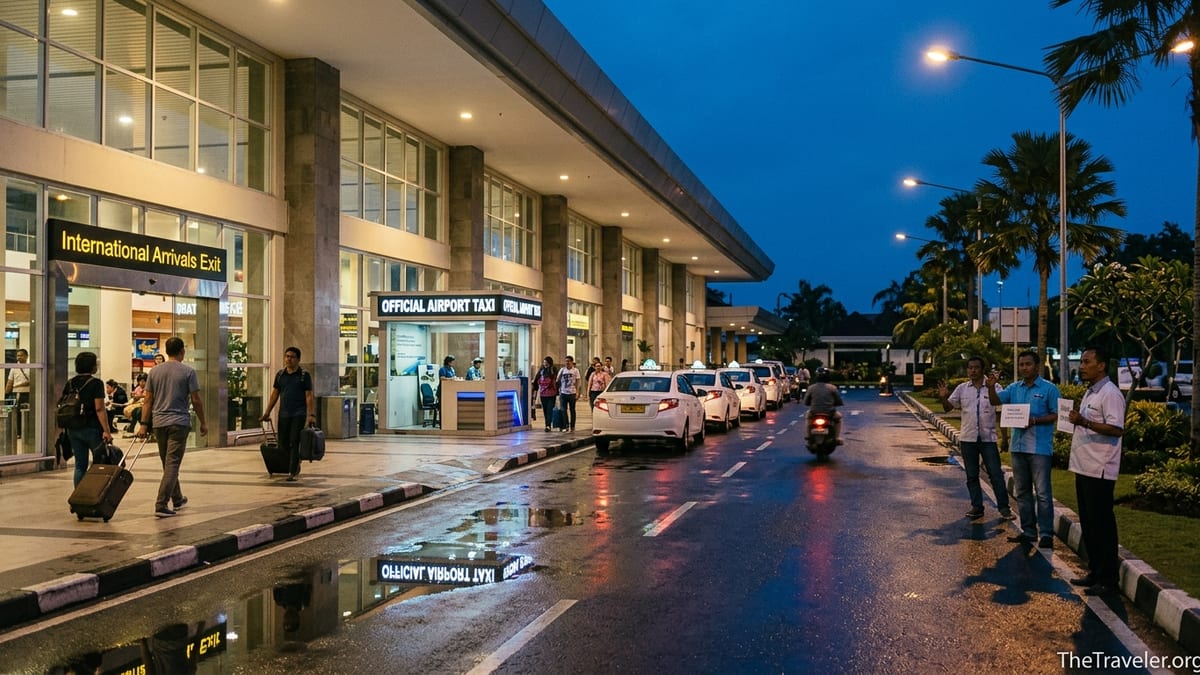
Understanding Bali’s Ngurah Rai Airport Layout and Taxi Options
Ngurah Rai International Airport (often simply called Denpasar or DPS) has a single main international terminal, but the ground floor arrivals area can feel chaotic after a long flight. Once you clear immigration, collect your bags, and pass through customs, you exit into a bright arrivals hall filled with money changers, SIM card booths, tour desks, and a wall of drivers holding name signs. Somewhere beyond this, outside the sliding doors, is the official airport taxi counter. Mixed into the crowd are freelance drivers who will insist they are “official taxi” or “airport taxi” even when they are not.
For most travelers heading to popular areas such as Kuta, Legian, Seminyak, Canggu, Sanur, Nusa Dua, Jimbaran, or Ubud, you will typically choose between three categories of transport: the official airport taxi counter, app-based rides like Grab or Gojek, or a pre-booked hotel or private transfer. Blue Bird, Indonesia’s well-known metered taxi brand, is technically allowed to drop passengers at the airport, but pickups from the arrivals curb are heavily restricted, which is why you will rarely see a Blue Bird rank inside the arrival zone.
The confusion arises because each of these options occupies a slightly different space. The official taxi counter is outside the arrivals doors, app pickups are usually a short walk away in a designated area or in the public car park, and hotel drivers wait behind the barrier with name boards. Understanding where you are headed before you walk out of customs will dramatically reduce the stress and the risk of overpaying.
Think in zones and destinations rather than distance. Bali’s traffic can vary wildly with the time of day, but the airport sits close to Kuta and Jimbaran, a bit farther from Seminyak and Canggu, and well over an hour from Ubud or the Bukit peninsula resorts like Uluwatu. That matters because legitimate fixed prices and app quotes to Ubud or Uluwatu will naturally be several times higher than a quick hop to Kuta.
Using the Official Airport Taxi Counter: How It Works and What It Costs
The safest and simplest choice for many new arrivals is the official airport taxi counter just outside the arrivals hall. Look for a small kiosk with “Taxi” or “Airport Taxi” signage in the public area after you step through the main sliding doors. Staff here work for the airport’s licensed taxi cooperative, sometimes referred to as Ngurah Rai Taxi or ATPM (Airport Taxi Management). You state your destination, they quote a fixed price based on a zone table, you pay at the counter, then receive a ticket which you hand to the driver waiting at the nearby rank.
Rates change periodically, but in early to mid-2026 typical posted prices from the official counter run in the rough range of 100,000 to 150,000 rupiah for close-by areas like Kuta, Tuban, or Jimbaran, around 150,000 to 200,000 rupiah for Seminyak or Legian, and often 250,000 to 350,000 rupiah for Canggu, Sanur, or Nusa Dua. Ubud and the northern or eastern coasts can be significantly more, often between 400,000 and 600,000 rupiah depending on the precise village. These are broad ranges rather than exact figures, but they give you a sense of what is normal so that a quote of 700,000 rupiah to Kuta immediately rings alarm bells.
At the counter you should receive a printed slip showing the destination area and fare. If the staff only tell you a number verbally and refuse to show a rate card, you can politely insist by saying you want to see the price list before paying. The fixed fare covers the ride, fuel, and the airport’s vehicle entry fee. Tipping is not mandatory, but rounding up a small amount for good service is appreciated. For example, if you pay 180,000 rupiah to Seminyak and the driver helps load heavy surfboards or multiple suitcases, adding an extra 20,000 rupiah as a tip is generous without being excessive.
Be aware that a few travelers have reported inflated late-night or “special” prices even at the official counter, especially around midnight arrivals when passengers are tired and the arrivals hall is quieter. If you are quoted something that feels dramatically higher than the ranges above, you can still step aside, open a ride-hailing app on airport Wi-Fi, and compare. You might still settle on the counter taxi if the price gap is small and you value speed, but you will be making an informed choice rather than accepting the first number you hear.
What to Expect in the Arrivals Hall: Pressure, Luggage and Saying No
The first shock for many first-time visitors is the wall of voices as soon as you push your luggage trolley out from customs. Dozens of men will call “Taxi, taxi,” “Transport where?”, “Where you go, boss?”, some walking alongside you. A few carry laminated cards or wear lanyards that mimic official IDs. Some might say “Official price” or “Same price as counter” or “Counter closed now,” even in the middle of the day when it is clearly open behind you.
It is important to understand that engaging in conversation, even with a polite “Maybe later,” is often interpreted as the start of a negotiation. The more you stop and chat, the more difficult it becomes to walk away. A practical approach is to decide your plan before exiting customs, keep your eyes ahead, and say firmly but calmly, “No thanks, I already have a driver” or “No taxi, thank you,” as you walk. You are not being rude; you are simply protecting yourself from pressure sales.
Luggage is another pressure point. Some men will reach for your trolley handles or grab your suitcase while saying “I help you, no problem.” They may walk only 30 meters and then demand a surprisingly high “porter tip,” sometimes equal to a short taxi fare. Bali does have legitimate porters, but you should agree a small fee before allowing anyone to handle your bags. A reasonable ballpark for a legitimate porter helping with a couple of suitcases is on the order of 20,000 to 40,000 rupiah, not 200,000.
If someone already has their hand on your trolley, simply place your own hand back on the handle and say “No thank you, I can manage” with a smile, then continue moving. The same rule applies to anyone steering you toward a particular taxi stand or “information desk.” Unless you have specifically booked that service in advance and recognize the company name on a sign, treat unsolicited guidance as a sales pitch rather than friendly help.
Realistic Fare Examples to Bali’s Main Areas
To put the various offers you will hear into context, it helps to anchor them against real-world fare ranges as of 2026. From Ngurah Rai Airport to Kuta or Tuban, which are only a few kilometers away, a normal early evening fare from the official taxi counter or a ride-hailing app is typically around 100,000 to 130,000 rupiah. If someone in the arrivals hall is pushing 300,000 rupiah for this distance without any special circumstances, you are likely being overcharged.
Seminyak and Legian, popular beachfront areas north of Kuta, usually come in around 150,000 to 200,000 rupiah from the airport with official taxis or apps under typical traffic conditions. Canggu, which sits farther up the southwest coast and is often snarled with traffic, can run roughly 250,000 to 350,000 rupiah. For Ubud, inland and about 35 to 40 kilometers away, a typical fixed fare is often in the 400,000 to 600,000 rupiah range depending on whether you are in central Ubud or farther into the rice fields.
On ride-hailing apps, you will sometimes see even lower numbers in quiet periods. A midday GrabCar ride to Seminyak might show 120,000 rupiah, while a late-night trip to Ubud might be closer to 450,000 rupiah. However, drivers can and do decline long trips if traffic is heavy or they doubt they will find a return fare. When demand spikes, such as after a wave of international arrivals or during big events, prices on apps can surge, occasionally making them more expensive than the official counter for short distances.
Night-time can also trigger supplements. Some airport taxi counters quietly apply a late-night surcharge after roughly 10 p.m., typically around 50,000 rupiah added to the daytime fixed fare. For example, a 180,000 rupiah daytime fare to Seminyak might become 230,000 rupiah after midnight. This is not inherently a scam if it is transparently listed on the rate card, but it does provide cover for individuals to call a normal daytime fare a “special night price” to push it well above what is reasonable. When in doubt, ask, “Is this the night price from the official list?” and decide accordingly.
Unofficial Drivers, Taxi Mafia and Common Scam Patterns
The phrase “taxi mafia” appears in countless traveler reports about Bali, and most of those stories begin at the airport. The problem is not that every non-counter driver is dangerous or dishonest. Many independent drivers are simply trying to make a living. The issue is that the lack of transparent meters, combined with aggressive tactics and coordination among groups of drivers, creates a playing field where tourists rarely know what a fair price is.
One common pattern in the arrivals hall is the “fake fixed price.” A man, often wearing a polo shirt and lanyard, approaches with “Taxi, fixed price, 300,000 rupiah to Seminyak.” He may stand between you and the direction of the official counter or tell you the counter is closed or much more expensive. The 300,000 rupiah is about 1.5 to 2 times a reasonable rate, and once your bags are in his car, you have little leverage to negotiate. Another variation is to agree a price verbally, only for the driver to claim at the destination that the agreed number was “per person” or did not include tolls or luggage.
Fake app rides are another concern. Some touts will tell you they are “Grab” or “Gojek” drivers and offer to take you without the app, claiming it is faster because reception is poor or the official pickup point is “very far.” Without the app, you lose GPS tracking, an electronic fare record, driver identification, and the ability to complain to the platform. In extreme cases, travelers have reported drivers who start a ride on an app at a low price, then add extra “stopovers” inside the app to inflate the final total, pressuring the passenger to approve.
There have also been isolated reports of intimidation when passengers push back against inflated prices. While physical violence against tourists is rare and heavily punished by Indonesian authorities, shouting, door-blocking, and attempts to guilt-trip or embarrass travelers into paying more are not uncommon. The safest defense is to avoid entering a car with any driver whose behavior feels pushy or whose price you have not clearly understood in advance. Once inside the vehicle and moving, your options narrow considerably.
If you do end up significantly overcharged or threatened, you can ask to be taken to your hotel reception rather than arguing on the street. Many hotel staff are used to these disputes and can help translate and defuse the situation. In more serious cases, such as extortion or threats, it is possible to report the incident to local police at a kantor polisi, though this is usually a last resort for more severe behavior rather than disputes over an extra 50,000 rupiah.
Using Grab, Gojek and Blue Bird: App-Based Alternatives
Ride-hailing apps such as Grab and Gojek operate in Bali and are widely used by residents and long-stay visitors. At the airport, their presence is more sensitive because of the official taxi cooperative. Depending on current arrangements, you may find a designated pickup point inside or just outside the terminal, sometimes marked by a small Grab lounge or Gojek waiting area. Staff or signage may direct you to a particular corner of the car park where app drivers are allowed to meet passengers.
To use these services, you will need a working data connection. Some travelers use international roaming, while others buy a local SIM at the airport after clearing customs. Once online, you can compare quotes in the app against the fuzzier numbers you hear in the arrivals hall. On a typical afternoon in 2026, you might see something like 120,000 rupiah for a GrabCar to Seminyak or 220,000 rupiah to Canggu, which immediately tells you that the man shouting “500,000, very cheap” is overselling his service.
Blue Bird, the trusted metered taxi brand, is less visible directly outside arrivals because of airport concessions, but one practical workaround used by some repeat visitors is to go upstairs to the departures level. There, Blue Bird taxis drop departing passengers. When a guest gets out, you can politely ask the driver if they are free to take you to your hotel on the meter or for an agreed fare. This requires a short walk and a bit more confidence but often results in a fair price and a professional driver without navigating the arrivals scrum.
Whichever app or taxi company you choose, always double-check the license plate and driver details before getting into the car. In busy pickup zones there may be multiple cars stopping at once, and it is easy to follow the wrong driver. Confirm your destination and the approximate fare estimate that appears in the app, and avoid paying in foreign currency. Paying in Indonesian rupiah either in cash or via the app helps prevent disagreements over exchange rates and makes it easier to compare what you are paying with normal local prices.
Late-Night Arrivals, Solo Travellers and Extra Safety Tips
Landing in Bali close to midnight or in the small hours of the morning introduces an extra layer of complexity. Fewer flights may be arriving, but counters can be short-staffed, and app availability can dip as some drivers go off shift. At the same time, many passengers are exhausted after long-haul journeys from Europe, North America or the Middle East, which makes them more vulnerable to pressure and confusion.
If your scheduled arrival is after about 10 p.m., strongly consider pre-booking a transfer through your hotel or a reputable transfer service. Many mid-range and higher-end hotels in Nusa Dua, Seminyak, Jimbaran and Ubud routinely arrange airport pickups for a known flat fee, often similar to or only slightly higher than official counter rates. For example, a Seminyak hotel might charge around 200,000 to 250,000 rupiah for a private sedan with a driver waiting in the arrivals hall holding your name sign, which removes the need to bargain with anyone.
Solo travelers, particularly women, often find peace of mind in having these plans locked in before departure. Share your flight details and accommodation address with a friend or family member, and consider sending them a quick message when you get into your pre-booked car along with the license plate number. Inside the vehicle, keep your main valuables such as passports, phones, and wallets on your person rather than in the trunk, and avoid displaying large amounts of cash during the ride.
Even at night, trust your instincts. If the official counter appears to be closed and an individual insists you follow him away from the main terminal lights to a “cheaper car,” you are under no obligation to go. You can go back inside the terminal, sit down, and use airport Wi-Fi to book a ride-hail or contact your hotel. If you feel genuinely uncomfortable with a particular driver, politely decline and wait for another. The short delay is a reasonable trade-off for feeling safe and in control of your first journey on the island.
The Takeaway
Taxi experiences at Bali’s Ngurah Rai Airport range from smooth and uneventful to frustrating or, in rare cases, intimidating. The difference usually comes down to preparation and knowing what is normal before you are surrounded by offers. The official airport taxi counter provides a simple, if occasionally slightly overpriced, way to reach your accommodation without haggling. Ride-hailing apps and trusted brands like Blue Bird can be cheaper and more transparent but require a little more effort to find the right pickup points and verify drivers.
In practical terms, have a plan before you land, whether it is a pre-booked hotel transfer, a screenshot of approximate official fares to your destination, or your ride-hailing apps set up with a payment method and Bali map downloaded. Expect to say “No thank you” multiple times as you walk through the arrivals hall, and do not let anyone grab your luggage or steer you toward a car without your clear agreement.
Remember that most Balinese people you meet will be warm and welcoming, and many drivers are honest professionals providing an essential service. The goal of this guide is not to make you fearful, but to equip you with enough practical knowledge that the first hour of your Bali trip feels like a manageable errand rather than a gauntlet. With realistic price expectations, a firm but polite attitude, and a preference for official counters or app-based rides, you can step out of the airport, into a taxi, and on to the beaches, rice terraces and cafes you came for.
FAQ
Q1. Where exactly is the official taxi counter at Bali airport?
The official taxi counter is located just outside the main arrivals hall after customs. Once you exit the sliding doors into the public area, look for a small kiosk marked as an airport taxi or similar, with staff behind a desk and a taxi queue behind or beside it.
Q2. How much should I expect to pay from the airport to Kuta or Seminyak?
As a broad guideline in 2026, a fixed fare from the official counter or a normal app ride to Kuta is usually around 100,000 to 130,000 rupiah, while Seminyak and Legian are often in the range of 150,000 to 200,000 rupiah under typical traffic conditions.
Q3. Are taxis from Bali airport safe for solo female travelers?
Most rides are uneventful, and violent incidents are rare, but it is wise to use the official airport taxi counter, a pre-booked hotel transfer, or a reputable app such as Grab or Gojek. Share your driver details and license plate with someone you trust and sit in the back seat with your valuables on you.
Q4. Can I use Grab or Gojek at Ngurah Rai Airport?
Yes, both operate at the airport, but pickups are limited to designated areas that may be a short walk from the arrivals exit. Once you have data or Wi-Fi, order through the app, follow the directions to the pickup point, and double-check the license plate and driver details before getting in.
Q5. Should I tip my taxi driver from the airport?
Tipping is not compulsory in Indonesia, but small tips are appreciated. Many travelers round up the fare or add 10,000 to 30,000 rupiah if the driver is friendly, drives carefully, and helps with luggage, especially for late-night arrivals or longer journeys.
Q6. How can I avoid being overcharged by unofficial drivers?
Decide your transport plan before leaving customs, walk directly to the official taxi counter or app pickup area, and politely decline offers in the arrivals hall. If you do negotiate directly, confirm the total price in rupiah for the entire car before getting in and avoid paying in foreign currency.
Q7. Is it better to pre-book a hotel transfer?
For late-night arrivals, families with children, or nervous first-time visitors, a pre-booked hotel or private transfer is often worth the slightly higher price. Your driver meets you with a name sign, the fare is agreed in advance, and you can skip the sales pressure in the arrivals hall.
Q8. What if the driver changes the price at the end of the trip?
If a driver tries to increase the fare by claiming the original quote was per person or did not include luggage, calmly repeat the amount you agreed and offer that sum. If you feel unsafe arguing in the street, pay a reasonable amount, move into your hotel lobby, and ask staff to assist. For severe intimidation or threats, consider reporting the incident to local police.
Q9. Are meters used for airport taxis in Bali?
The official airport taxis typically operate on fixed zone-based fares rather than meters, so you pay a set price by destination area. Blue Bird taxis use meters elsewhere in Bali, but they are rarely allowed to pick up directly at the arrivals curb, which is why most airport trips are on fixed prices.
Q10. What should I do if I arrive and the official counter appears closed?
If the official taxi counter is shut, return inside the terminal, connect to airport Wi-Fi if needed, and either book a ride-hailing car to the designated pickup point or contact your hotel to request an immediate pickup. Decline any driver who pressures you to follow them away from the well-lit public areas, and take your time choosing a safe, clearly agreed option.