


Landing in Bali is exciting, but if you rely on ride‑hailing apps, maps, or instant messaging, you will want mobile data working before you walk out of Denpasar’s Ngurah Rai International Airport. This guide explains exactly how to get connected in 2026, whether you plan to buy a physical SIM at the airport or use an eSIM on your phone.
Get the latest updates straight to your inbox!
How Mobile Coverage Works in Bali Today
Ngurah Rai International Airport, often simply called Denpasar or Bali Airport, is the main gateway to the island and has strong 4G coverage and growing 5G coverage from Indonesia’s major operators. In practice, most travelers find that Telkomsel has the widest and most reliable signal across Bali, especially once you head into Ubud, Canggu, or the north coast, while XL Axiata and Indosat usually offer slightly cheaper data packages but can be weaker in more rural areas.
For a short holiday that stays around Kuta, Seminyak, Canggu, Uluwatu, and Ubud, a prepaid data plan of 10 to 25 GB is usually enough for navigation, social media, and the occasional video call. Heavy users who stream video on mobile networks or work remotely often choose 30 GB or more, or an “unlimited” package with a fair‑use cap. In 2026, prices remain relatively low compared with Europe, North America, or Australia, which is why many travelers prefer buying Indonesian connectivity instead of paying for international roaming from home providers.
It is also worth noting that voice calls and SMS are used less by visitors than in the past. Most travelers rely on WhatsApp, Telegram, and other data‑based apps, so many airport packages are data‑only. However, some eSIM and physical SIM plans that use Telkomsel or Indosat do still include a local number, which can be useful for restaurant bookings or if a villa host insists on having an Indonesian contact.
Buying a Physical SIM Card at Denpasar Airport
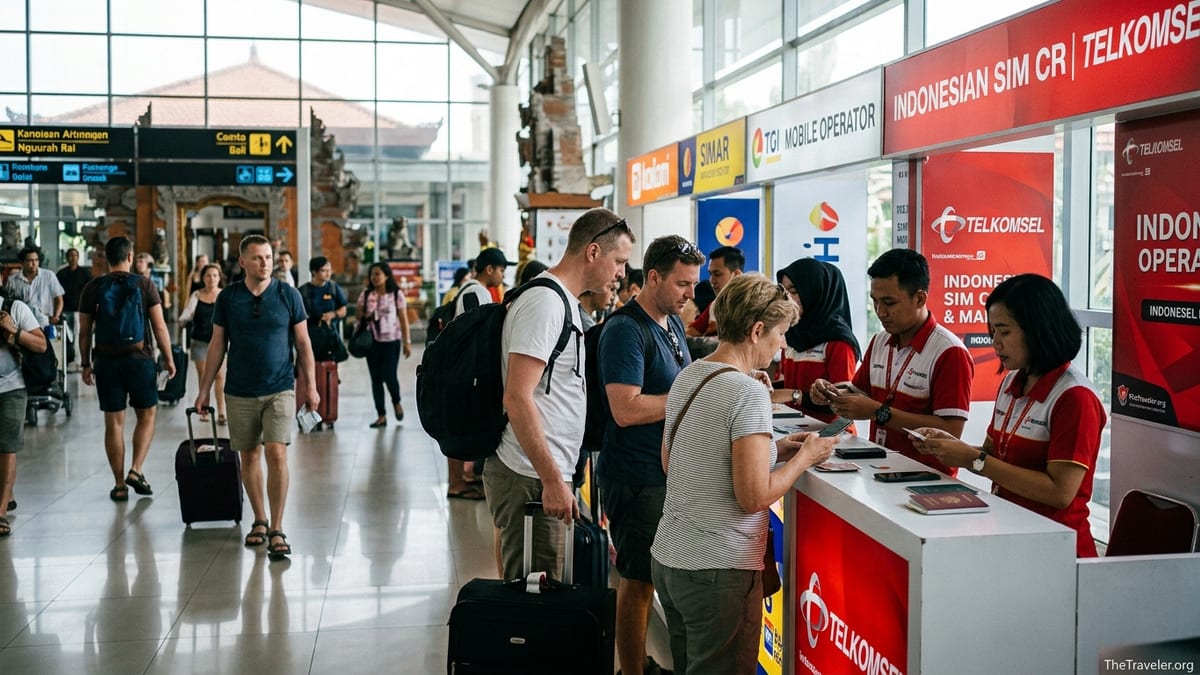
After clearing immigration and customs in the international arrivals hall at Ngurah Rai, you will see several mobile counters and small phone shops on the public side of the terminal. These are typically branded by major operators or by resellers working with them. Common names you will see are Telkomsel, XL, Indosat, and sometimes smaller brands or multi‑brand kiosks selling “tourist SIM” packages that bundle data, some local minutes, and a registration service.
As of mid‑2026, a typical airport package aimed at tourists might look like 25 GB of data valid for 30 days for the equivalent of roughly 15 to 20 US dollars, or 35 to 40 GB for around 25 to 30 US dollars. Travelers often comment that these airport bundles cost more than buying the same operator’s SIM in town, but you are paying for convenience, English‑speaking staff, and on‑the‑spot activation. For example, a similar Telkomsel package bought later at a local GraPARI store or convenience shop in Kuta or Ubud might come closer to 8 to 12 US dollars for 20 to 25 GB, depending on current promotions.
At the counter, staff usually complete the registration for you. They will insert the SIM into your phone, run through the activation steps, and show that data is working before you pay. The process takes about 5 to 10 minutes. Be prepared to hand over your passport and, in many cases, to have a quick photograph taken or fingerprints scanned if the outlet is using biometric registration equipment. This is normal and part of Indonesia’s effort to ensure every SIM is tied to a verifiable identity.
Passport, Registration, and IMEI: What You Need to Know
Indonesia requires all prepaid SIM cards to be registered to an identity, which for foreign visitors means your passport or your limited stay permit if you have one. At Ngurah Rai Airport, the vendor will usually scan or photograph the passport’s bio page and enter the details into the operator’s registration system. Some operators are rolling out biometric registration for foreigners, which means you may be asked to place your fingers on a scanner or briefly look into a camera to verify that you match the passport you present.
In addition to SIM registration, Indonesia has an IMEI registration system for mobile devices used on local networks. Officially this is handled by customs and telecommunications authorities, and it is designed mainly to combat phone theft and grey‑market imports. The rule is applied more strictly for people importing new phones or staying long term. For a typical tourist who arrives with their personal phone and buys a local SIM for a few weeks, the process is usually seamless in the background. Occasionally, travelers staying for several months are asked to go through a simple IMEI registration process, often with help from the mobile shop or an official service point.
For most short‑stay visitors, the practical takeaway is straightforward. Always carry your passport, or at least a high‑quality copy, when buying a SIM. Expect the staff to ask for it, and do not be alarmed if they mention biometrics or IMEI registration. These are standard procedures. If you are only roaming on your home SIM and do not buy any Indonesian SIM or eSIM, then the IMEI process at customs typically does not apply to you and your phone will keep working on your foreign network’s roaming signal.
Airport SIM vs Buying in Town: Which Is Better Value
Choosing between buying a SIM at the airport or waiting until you reach town comes down to how much you value convenience and how comfortable you are navigating local shops without airport‑style hand‑holding. At Ngurah Rai, everything is in one place. You can walk out of arrivals, go straight to a counter, pay with a card, and be online before you meet your driver. The trade‑off is that you may pay a premium of several US dollars compared with buying the same operator’s package in Kuta, Seminyak, Canggu, or Ubud.
In town, especially in tourist areas, mini‑markets and branded stores such as Telkomsel GraPARI or XL Centers offer a wider choice of packages. Travelers report paying the equivalent of 5 to 8 US dollars for around 10 to 15 GB when buying directly from an operator shop in Denpasar or Kuta, and about 8 to 12 US dollars for 20 to 25 GB in 2026, depending on the promotion. The downside is that staff may speak less English, registration might take a little longer, and you will reach your accommodation without data unless you rely on airport Wi‑Fi or roaming in the meantime.
A middle‑ground option is to use a short eSIM or roaming package from home just for the airport transfer and first evening, then visit an operator shop the next day for a cheaper local SIM. For example, some Australian networks charge about 5 to 10 Australian dollars per day for roaming in Indonesia, which quickly adds up on a long trip but can be acceptable for 24 hours while you get settled. Once you are comfortable and know where the nearest Telkomsel or Indosat outlet is, you can switch to a local SIM for the remainder of your stay.
eSIM Options for Bali: Before You Land or After
If your phone supports eSIM, you can avoid the need for a physical card altogether. Several well‑known travel eSIM providers offer Indonesia or Bali‑focused plans in 2026, including Airalo, Holafly, Nomad, Jetpac, and others. These services let you purchase and install an eSIM profile before your flight, then activate it as the plane lands. Coverage is usually provided via major Indonesian networks such as Telkomsel or XL in the background, even though you buy from a global brand.
As an example, recent Indonesia plans from one large provider offer around 5 GB for a little over 13 US dollars and 10 GB for just over 20 US dollars, both valid for 30 days. Another popular brand focuses on unlimited data packages for Indonesia, where a 7‑day unlimited plan might sit in the range of 20 to 25 US dollars, and a 15‑ or 20‑day plan is priced progressively higher. Regional eSIMs that cover multiple Asian destinations are also common; travelers visiting Bali plus Singapore or Thailand on the same trip sometimes prefer a Southeast Asia or “Asia‑Pacific” eSIM that works across several countries with a single data pool.
For many visitors, the key decision factors are whether the eSIM includes a local phone number and whether hotspot tethering is allowed. Some “unlimited” eSIMs restrict personal hotspot data to about 1 GB per day in Indonesia while leaving phone usage unmetered, which is fine for casual use but less ideal if you plan to work from a laptop using your phone’s connection. Data‑only eSIMs without a phone number are perfect for using WhatsApp and ride‑hailing apps, but less convenient if your bank, airline, or rental company insists on sending security codes to an SMS number that can only receive local texts.
Real‑World Scenarios: What Different Travelers Should Choose
To make the decision more concrete, imagine a couple flying from Los Angeles to Bali for 10 days, planning to stay around Canggu and Ubud. They primarily need data for maps, messaging, and social media. In this case, a 10 GB Indonesia or Asia eSIM bought before departure for around 20 US dollars per person is often enough, especially if they use hotel Wi‑Fi heavily. They land, switch data to the eSIM while still on the tarmac, then walk straight to their pre‑booked ride with fully working apps. They never have to queue at an airport counter or hand over their passports to a mobile vendor.
Now consider a digital nomad staying in Bali for two or three months, working from coworking spaces in Canggu and occasionally traveling to Lombok or the Gili Islands. This person will likely burn through more data, often 30 GB or more per month. A physical SIM from Telkomsel or XL, bought in town for roughly 8 to 12 US dollars for a mid‑range data package, usually offers better value over time than unlimited eSIM plans. The nomad might still start with a one‑week eSIM for the arrival phase, then switch to a local SIM once settled, registering with their passport at a proper operator store.
As a third example, a family of four arriving from Sydney for a one‑week resort stay in Nusa Dua could mix strategies. The parents might keep their Australian SIMs active with limited roaming in case schools or banks need to call their usual numbers, while using an Indonesia eSIM for data. The teenage children, who need only social media and messaging, could share one physical Indonesian SIM in a spare handset as a portable hotspot, using a 25 GB data package bought at the airport for around 20 to 25 US dollars. This way, everyone stays connected without paying roaming fees on every line.
Practical Tips for Smooth Setup at Ngurah Rai
Whichever option you choose, a few simple habits make connecting at Denpasar Airport much easier. First, check that your phone is unlocked before you travel. Many older devices from North American carriers are still locked to the home network, which would prevent a local SIM from working. If you are unsure, test with a friend’s SIM card before your trip or contact your carrier to unlock the device. For eSIMs, verify that your phone model supports them and that your home carrier profile will not block adding a secondary eSIM.
Second, take clear photos of your passport’s photo page and store them offline on your phone. While airport counters almost always ask for the physical document, having an image handy is useful if you end up topping up in town or need to re‑register a SIM at a later date. Some operator apps in Indonesia now allow partial self‑service registration using a picture of your passport combined with in‑store verification.
Third, keep roaming switched off on your home SIM to avoid surprise charges as you walk through the terminal. Many eSIM apps recommend turning off data roaming on your home line and turning it on only for the eSIM profile. This way, any mobile data used in Bali is billed to the Indonesia package, while your original number remains reachable on Wi‑Fi or voice only. If you want to receive calls or SMS on your home number, you can keep voice and text roaming on but still disable data roaming specifically.
The Takeaway
For most visitors landing in Bali in 2026, there are three realistic paths to getting connected: buy a tourist SIM at Ngurah Rai Airport as soon as you clear customs, wait until you reach town and purchase a cheaper local package from an operator shop, or install an eSIM before departure and arrive with connectivity already working. All three options are viable, and the right one depends on your budget, length of stay, and comfort level with technology.
Airport SIM desks offer speed and reassurance at a modest premium, which is appealing if you land late at night or are anxious about finding your driver. Buying in town is usually cheaper and gives you more control over package details, but requires at least a little patience and a short period relying on Wi‑Fi or roaming. eSIMs sit in the middle: not always the absolute cheapest, but incredibly convenient, and popular with travelers who move between several countries in the same trip.
Whatever route you choose, try to decide your strategy before you land, check that your phone is unlocked and eSIM‑ready if needed, and carry your passport for registration. That way, your first minutes in Bali can focus on finding your hotel, not hunting for a signal.
FAQ
Q1. Can I buy a SIM card directly at Denpasar (Ngurah Rai) Airport?
Yes. After international arrivals you will find several counters selling tourist SIM packages from major operators such as Telkomsel, XL, and Indosat, with staff who handle activation and registration on the spot.
Q2. Is it cheaper to buy a SIM at the airport or in town?
In most cases, airport prices are higher by several US dollars compared with buying the same operator’s package in Kuta, Seminyak, Canggu, or Ubud, but you are paying for convenience and immediate connectivity.
Q3. Do I need my passport to buy a SIM in Bali?
Yes. Indonesian rules require prepaid SIMs to be registered to an identity, so foreign visitors must present a passport or other valid travel document when purchasing and activating a SIM.
Q4. Will my phone work with Indonesian SIM cards?
Your phone must be unlocked and compatible with local 4G or 5G bands. Most recent iPhone and Android models work without issue, but carrier‑locked devices from some countries may need to be unlocked before your trip.
Q5. Do I have to register my phone’s IMEI at the airport?
For short tourist stays using a local SIM, IMEI handling usually happens in the background and shops assist if needed. Formal IMEI registration is more relevant for new phones or long‑term stays, and roaming visitors typically do not need to register.
Q6. Are eSIMs reliable in Bali?
Yes. Travel eSIM providers that use major Indonesian networks generally offer good coverage across Bali. Performance varies slightly by brand and plan, but most visitors report stable 4G data in major tourist areas.
Q7. Will I get a local phone number with an eSIM?
Many travel eSIMs for Indonesia are data‑only and do not include a local number. A few providers or local operator eSIMs do offer numbers, which can be useful for SMS codes or local calls, so check the plan details carefully.
Q8. How much data do I need for a week in Bali?
Average travelers using mostly maps, messaging, and social media often find 5 to 10 GB enough for a week, especially if they use hotel Wi‑Fi. Heavy streamers or remote workers may want 20 GB or more.
Q9. Can I use my home SIM and just roam in Bali instead?
Yes, but international roaming from many carriers is substantially more expensive than local options. Roaming can be convenient for a very short stay or as a backup on arrival day, but a local SIM or eSIM usually offers better value.
Q10. Is airport Wi‑Fi at Denpasar enough if I do not buy a SIM?
The airport provides Wi‑Fi that is typically adequate for basic messaging while you wait for baggage or a ride, but coverage can be patchy, and it will not help once you leave the terminal, so most visitors still prefer their own data connection.