


Nusa Dua was designed for effortless resort stays, but your first real test comes the moment you step out of Bali’s Ngurah Rai International Airport. The airport is barely 20 kilometers from the gated resort area, yet traffic, unfamiliar transport rules and jet lag can turn a simple transfer into a small ordeal. This guide focuses on one thing only: how to get from Denpasar Airport to Nusa Dua in the smoothest, safest and most resort-friendly way, whether you prefer a fixed-price private car, a metered taxi, app rides like Grab and Gojek, or a luxury hotel pickup.
Get the latest updates straight to your inbox!
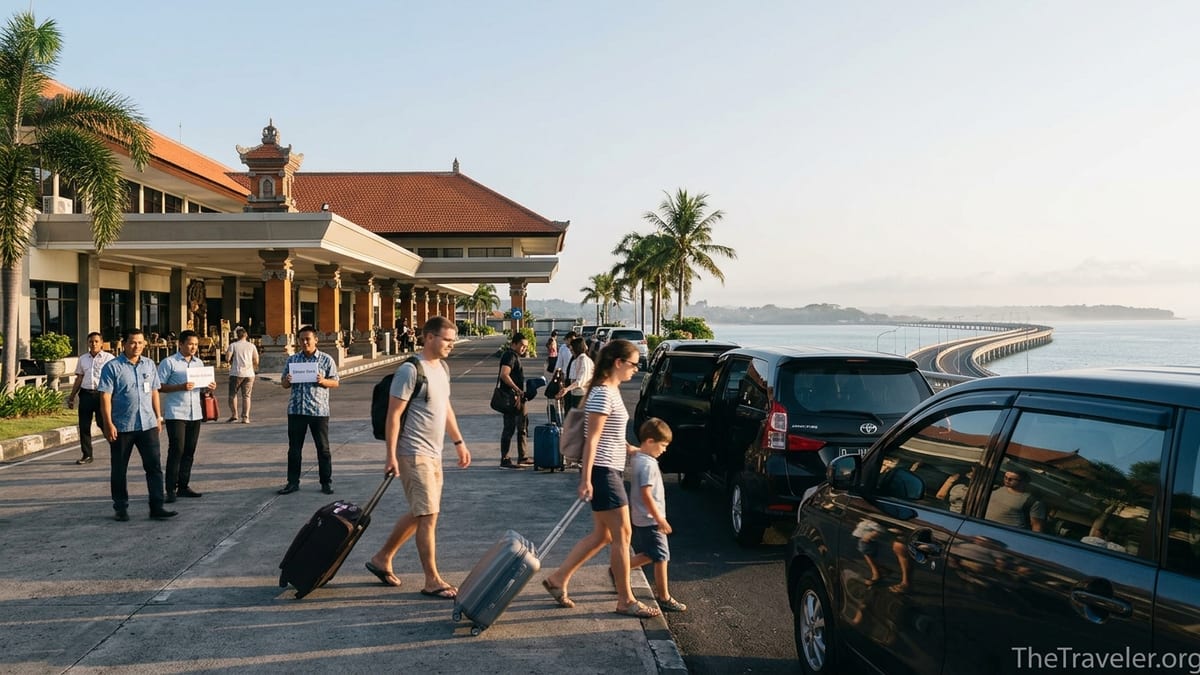
Understanding the Bali Airport to Nusa Dua Route
Ngurah Rai International Airport (often called Denpasar Airport, code DPS) sits in Tuban, just south of Kuta. Nusa Dua lies further south-east, linked to the airport by the Bali Mandara Toll Road, a short bridge highway that crosses Benoa Bay. In light traffic, the drive from the arrivals curb to a Nusa Dua resort can take around 20 to 30 minutes. In the late afternoon or on holiday weekends, that can easily double, which is why choosing the right vehicle and route matters.
Most airport transfers to Nusa Dua use the signed route “Nusa Dua – Ngurah Rai – Benoa,” which is the official name of the toll road. This road is partly elevated over the water and connects straight into the Nusa Dua area, avoiding the older, slower coastal road through Jimbaran. Cars, official taxis and private transfers can all use the toll bridge. Motorbikes, which are common for app rides within Bali, are not a practical option for most resort guests with luggage and children.
From a visitor’s perspective, what makes the route unique is that there are no trains or public buses running directly from the airport to Nusa Dua’s resort strip. Your realistic choices are taxis, private transfers booked in advance, or app-based cars such as Grab and Gojek. Because Nusa Dua is a premium resort zone, many hotels also operate their own cars or vans, which can be booked ahead through the concierge. Deciding between them depends on your arrival time, budget, baggage and appetite for negotiation at the curb.
The final approach to Nusa Dua is straightforward. After you exit the toll road at the Nusa Dua gate, you follow tree-lined boulevards with security checkpoints into areas such as ITDC Nusa Dua and Tanjung Benoa. Here, distances are short but hotel gates are gated and guarded, so door to door service becomes more important than shaving a few dollars off the fare.
Official Airport Taxis and Metered Blue Bird Cabs
The most visible option as you leave the arrivals hall is the airport taxi counter and the cluster of licensed taxis that serve arriving passengers. These “airport taxis” operate on a zone-based price list rather than a meter. For Nusa Dua resorts, the fixed fares typically start around the equivalent of 200,000 to 300,000 Indonesian rupiah per car, depending on the exact address and time of day. You pay the counter or agree at the stand, then receive a ticket and walk with a driver to the car park.
For travelers who want a meter, the best known brand is Blue Bird, a national Indonesian taxi company recognized by its light blue sedans and visible meters. Blue Bird cars can be ordered to the airport using their own app or via ride-hailing apps that partner with them. In practice, a metered Blue Bird fare from the airport to Nusa Dua usually lands in the same broad range as fixed price airport taxis or pre-booked transfers once the toll fee and any airport surcharge are added.
The advantage of going with an airport taxi or a Blue Bird is that everything is official and straightforward. There is a physical counter, English-speaking staff most of the time, and you do not have to rely on your phone working immediately after landing. This can matter if you arrive late at night after a long-haul flight and still need to clear immigration, buy a SIM card and collect baggage. The downside is that prices are rarely the absolute cheapest and, if you go with an unmetered local taxi outside the official stand, you may find yourself negotiating hard in the crowds.
As an example, a family arriving from Sydney with two large suitcases and a stroller might choose the airport taxi desk, accept a quoted fare around the mid-200,000 rupiah mark, and be driven straight over the Bali Mandara Toll Road to a resort such as The Laguna or Melia Bali. The whole process from clearing customs to arriving at the lobby might take under an hour in the late evening, with no need to download apps or compare prices on the spot.
Pre‑Booked Private Transfers: Stress‑Free for Resorts and Families
For many Nusa Dua visitors, especially those on resort stays or family holidays, a pre-booked private transfer is the cleanest solution. These are door to door car services booked in advance through platforms or directly with local operators. A typical price for a private car from Bali Airport to Nusa Dua in 2026 sits in the region of 250,000 to 350,000 rupiah per car for up to four passengers with luggage. This is similar to, or only slightly higher than, what you might pay by combining an airport taxi with the toll road and a small night surcharge.
What you get in return is predictability. A driver waits in the arrivals area with your name board, helps with bags and leads you straight to an air-conditioned car or van. Many transfer companies include the toll fee in the quoted price and build in a generous waiting time in case immigration takes longer than usual. For example, a private transfer service might specify that the driver will wait up to 90 minutes after landing at no extra charge and then add a modest fee per additional hour if needed.
This setup suits resort guests arriving on long-haul flights from Europe or North America, who often land close to midnight local time. Instead of approaching a taxi counter when tired, they walk out knowing exactly who is picking them up and how much the ride will cost. It also works well for families with young children and a lot of gear: car seats can sometimes be arranged ahead of time, and larger vans can handle surfboards, golf bags or multiple suitcases without improvisation.
To picture a real scenario, imagine a family of five staying at a beachfront property in ITDC Nusa Dua. They pre-book an eight-seater van through a Bali-based car service for around the equivalent of 400,000 to 500,000 rupiah, including tolls. The driver tracks their Kuala Lumpur to Bali flight, waits with a name sign near the exit, and loads their three large suitcases, stroller and beach gear. Within half an hour they are checked in at the resort, with the cost split across all passengers and no haggling required.
Using Grab and Gojek from Bali Airport to Nusa Dua
Grab and Gojek, Indonesia’s major ride-hailing apps, are now fully present at Ngurah Rai Airport. Both operate official pickup points and have branded lounges or kiosks at the terminals, where staff can assist with booking a car through the app. This is a significant change from a few years ago, when app drivers had to wait outside the airport perimeter and passengers walked out with their luggage to meet them.
For Nusa Dua transfers, GrabCar and Gojek’s GoCar services can be very competitive in price, particularly outside peak hours. Example fares displayed in the apps for a standard car from the airport to central Nusa Dua often fall somewhere between 120,000 and 200,000 rupiah, depending on demand, time of day and whether you choose a slightly more premium option. The toll charge for the Bali Mandara Toll Road, currently in the low tens of thousands of rupiah for a private car, is sometimes included in the quoted price and sometimes added separately, which is why it is worth checking the breakdown in the app.
In practice, using Grab or Gojek from the airport works best when you already have a local SIM card or roaming data that functions well in Indonesia, and when you are traveling light. You usually need to walk a few minutes from the arrivals exit to reach the designated pickup area. At busy times there can be a queue of travelers waiting in front of the Grab or Gojek kiosk, where staff call cars in sequence. If your phone battery is low or you have multiple young children and more than a couple of suitcases, that short walk and wait can feel longer than it looks on the map.
A realistic example: a couple with carry-on sized luggage lands on a mid-morning flight from Singapore, buys a prepaid SIM from a kiosk after customs, then walks to the Grab lounge near the international arrivals exit. They open the app, see a GrabCar quote of about 150,000 rupiah to a mid-range Nusa Dua resort, accept it, and wait roughly ten minutes for their car number plate to appear on screen. They pay by card saved in the app, and the driver takes them over the toll bridge, dropping them at their resort’s lobby without cash changing hands.
Toll Road Access, Traffic Patterns and Late-Night Arrivals
The Bali Mandara Toll Road is the fastest way to link the airport and Nusa Dua, and most professional drivers will default to it when traffic is heavy. The toll for a small private car is relatively modest, roughly the price of a local café snack, and is sometimes included in fixed transfer rates and app quotes. When comparing options, it is useful to ask explicitly whether the toll is part of the total or will be added on top, especially when dealing with metered taxis or informal drivers.
Traffic is the single biggest variable affecting how long your transfer will take. Morning and late-afternoon rush hours, as well as evenings when multiple international flights land close together, can clog the roads leading to and from the airport. Religious ceremonies, local festivals and sudden tropical downpours also slow traffic more than timetables might suggest. On a quiet night, you might glide from the airport pick-up lane to a Nusa Dua resort in under 25 minutes. On a busy rainy afternoon, the same ride can stretch beyond an hour, even with the toll road.
Travelers arriving on late-night or very early-morning flights enjoy one advantage: lighter traffic. However, they face other challenges such as tired children, closed SIM card kiosks, and reduced staffing at some app lounges. For that reason, late arrivals often favor pre-booked transfers or hotel cars, which guarantee that someone will be waiting even if immigration or baggage delays push you well past midnight. A solo traveler landing at 1:30 a.m. might still be happy to rely on Grab or Gojek, while a couple with toddlers and strollers might feel more comfortable knowing a named driver is on standby with a fixed price agreed before take-off.
If your flight is significantly delayed, reputable transfer companies and hotels track arrival times and adjust pick-up accordingly, though extreme delays can incur extra waiting charges. Ride-hailing apps handle delays automatically as long as you only request a car once you are physically ready to be picked up. In all cases, picking an option that matches your tolerance for uncertainty will matter more than shaving a few minutes off the theoretical route time.
Managing Luggage, Kids and Groups on the Airport Run
For many Nusa Dua visitors, the airport transfer is not just about distance and price but about how comfortably people and luggage fit into the vehicle. A standard sedan or small hatchback can fit two adults with two large suitcases and two carry-on bags comfortably. Once you add golf clubs, surfboards, or a stroller and car seat, you start to push the limits. For families and groups, choosing a larger vehicle in advance usually pays off in a smoother start to the holiday.
Private transfer companies and several ride apps in Bali offer options like “minivan” or “MPV” that can seat six to eight passengers with more room for baggage. These are ideal if you are traveling as a multi-generational group or sharing a car with friends staying in neighboring resorts in Nusa Dua. The cost per person often ends up lower than taking two separate standard taxis, and everyone arrives together to check in and coordinate room assignments.
With young children, consider practicalities such as car seats and snack breaks. Bali law on child seats is not always strictly enforced, and taxi fleets rarely carry them as standard equipment. Some higher-end transfer providers and luxury resorts can arrange rear-facing or booster seats on request, but you typically need to ask and confirm this before travel. Parents who prefer their own equipment sometimes bring a compact travel car seat and install it themselves in the pre-booked car at the airport curb.
A real-world scenario might look like this: two couples and one toddler are booked at a family-friendly Nusa Dua resort with a kids’ club. They pre-arrange a minivan with two child seats with a local transfer company, paying around the equivalent of 600,000 rupiah in total, including the toll. On arrival, the driver meets them inside the terminal, loads four large suitcases, two strollers and hand luggage, and the group travels together instead of juggling two small taxis and trying to keep everyone in convoy.
Luxury Hotel Cars and High‑End Resort Pickups
Nusa Dua is home to some of Bali’s most luxurious properties, including brands that are known worldwide for high-touch service. Many of these hotels operate their own transfer fleets, which can range from late-model sedans and SUVs to executive vans. The prices are higher than regular taxis or app rides, often many times higher, but the service is tailored to guests who prioritize comfort, privacy and seamless coordination over budget savings.
For example, a high-end beachfront resort in Nusa Dua might quote a one-way airport transfer in a luxury SUV or van that costs several times what a standard private transfer would. In exchange, guests receive a meet and greet inside the terminal, assistance with fast-track services where available, cool towels and bottled water in the car, and direct communication with the hotel if a flight is diverted or delayed. Some resorts extend this by packaging airport transfers into villa or suite bookings, presenting them as a complimentary perk at a certain room category.
This style of transfer is particularly attractive for special occasions, honeymoon trips, or corporate groups whose costs are covered by a company travel budget. A couple celebrating an anniversary in a top-tier Nusa Dua resort might request the hotel’s own car, accepting the premium price in return for having everything handled by one point of contact. The driver will already know their arrival time, room category and any special arrangements, and the front office will be updated automatically so that check-in can be prepared while they are still in transit from the airport.
Even travelers who choose more modest transport can sometimes experience a touch of this service. Some mid-range resorts partner with local drivers and brand the cars with hotel logos, while keeping prices closer to regular private transfers. Others offer a tiered choice, such as a simple shared shuttle van at certain times of day, plus a more expensive private car for guests arriving outside fixed windows.
Safety, Scams and Practical Tips for a Smooth Arrival
Ngurah Rai International Airport is busy, occasionally chaotic, but generally safe. Nonetheless, tired newcomers can be vulnerable to confusion and opportunistic overcharging. One of the most common issues is accepting a ride from an unofficial driver who approaches you inside or just outside the arrivals hall with a vague quote that changes by the time you reach Nusa Dua. To avoid this, stick to clearly marked options: the airport taxi counter, the Grab or Gojek lounges, reputable private transfer drivers holding your name sign, or hotel representatives in uniform.
Another point of friction is payment. Indonesian rupiah is the only legal currency for cash payments in taxis and with most local drivers. While many app rides and some hotel transfers can be paid by card, it is wise to carry at least a small amount of rupiah for contingencies such as tipping porters or dealing with minor extras. Currency exchange counters and ATMs are available after customs, but rates and fees vary, so travelers planning multiple cash transactions during their stay often prefer to withdraw from ATMs in town the next day.
Technology plays a role too. If you plan to rely on Grab or Gojek, make sure your phone is charged when you land, and consider buying a local SIM card in the arrivals area. Staff at the SIM kiosks are used to installing cards and setting up data packages for visitors, which can simplify app use on the airport curb and throughout your stay. Those who would rather avoid troubleshooting phones at the airport can lean more heavily on pre-booked transfers or hotel pickups, where communication happens over email or messaging before the trip instead.
Finally, remember that after a long flight, the smoother option often beats the cheapest option. Paying a modest premium for a known driver, a larger vehicle or hotel-coordinated pickup is often worth it once you factor in jet lag, luggage, humidity and the unfamiliar environment. Starting your Nusa Dua stay calm and rested sets the tone for the rest of your time in Bali.
FAQ
Q1. How long does it take to get from Bali Airport to Nusa Dua?
The drive typically takes around 20 to 30 minutes using the Bali Mandara Toll Road in light traffic, and up to an hour or a little more during peak periods or heavy rain.
Q2. How much should I expect to pay for a taxi from the airport to Nusa Dua?
Official airport taxis and metered cabs to Nusa Dua usually fall somewhere in the broad range of 200,000 to 300,000 rupiah per car, depending on exact location, time and whether the toll is included.
Q3. Is it cheaper to use Grab or Gojek from the airport to Nusa Dua?
GrabCar and GoCar often quote slightly lower prices than official taxis, sometimes starting in the 120,000 to 200,000 rupiah range, but final cost depends on demand, toll inclusion and any airport surcharges.
Q4. Can I book a transfer to Nusa Dua in advance?
Yes, many local operators and international platforms offer pre-booked private transfers, typically in the 250,000 to 350,000 rupiah range per car, with a driver waiting in arrivals and toll fees usually included.
Q5. Are there bigger vehicles for families and groups with lots of luggage?
Minivans and MPVs that seat six to eight passengers are widely available through private transfer companies, some hotel fleets and certain ride apps, and are recommended if you have bulky luggage or are traveling as a group.
Q6. Do Nusa Dua resorts offer their own airport transfers?
Many mid-range and luxury resorts in Nusa Dua run their own car services, from shared shuttles to private luxury SUVs, and these can often be booked by emailing the hotel in advance of your arrival.
Q7. What is the Bali Mandara Toll Road and do I have to use it?
The Bali Mandara Toll Road is a bridge highway linking the airport area and Nusa Dua across Benoa Bay. You do not have to use it, but it usually offers the quickest route, with a modest toll added to your fare if not already included.
Q8. Is it safe to arrive late at night and still find transport to Nusa Dua?
Yes, the airport operates 24 hours and taxis, pre-booked drivers and ride-hailing services generally remain available, but for arrivals after midnight many travelers prefer pre-arranged transfers or hotel cars for extra peace of mind.
Q9. Should I wait to buy a SIM card before ordering an app-based car?
If you plan to use Grab or Gojek, it is practical to buy a local SIM after customs, set up data, then order your car so you can track the driver and receive messages reliably.
Q10. What is the best option for a first-time visitor staying at a Nusa Dua resort?
For a first-time visitor, especially after a long flight, a pre-booked private transfer or a resort-arranged pickup usually offers the smoothest balance of price, comfort and simplicity compared with negotiating taxis at the curb.