


More news on this day
Bangkok’s vital Airport Rail Link connection to Suvarnabhumi Airport suffered major disruption on Wednesday after a pre-dawn derailment inside its maintenance depot reduced services and forced operators to roll out emergency transport options.
Get the latest news straight to your inbox!
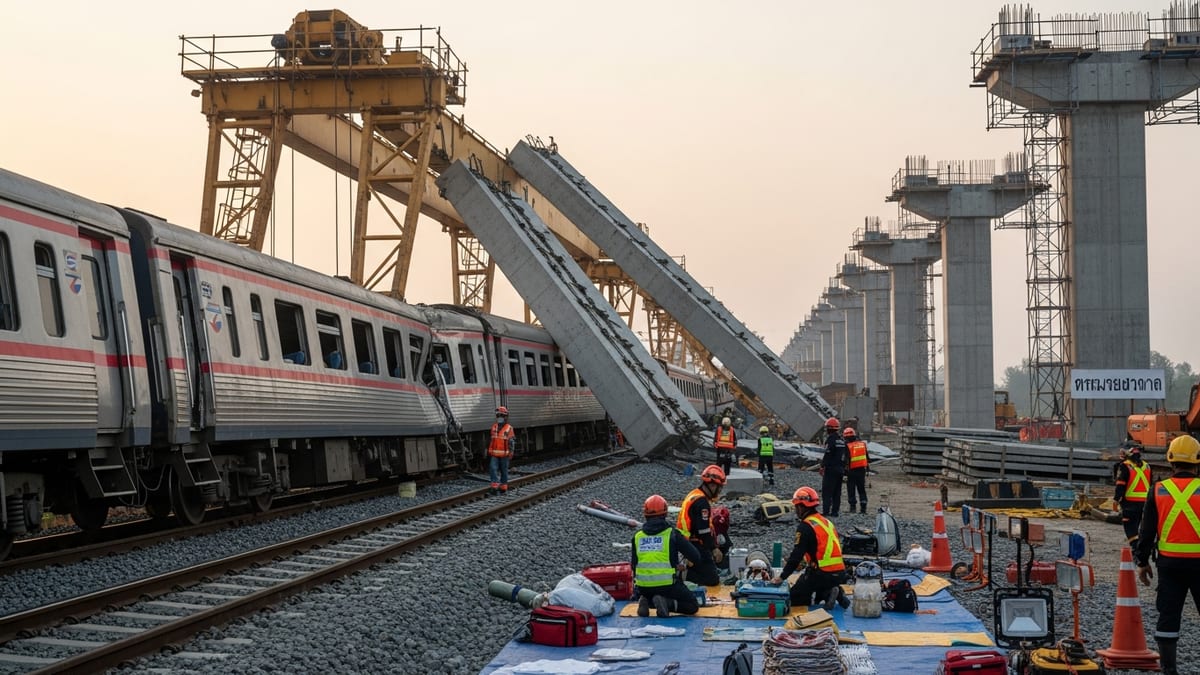
Early-morning derailment inside Khlong Tan depot
According to published coverage, the incident occurred at around 12.47 a.m. on July 22 inside the Khlong Tan maintenance centre, when a four-car Airport Rail Link train returning from service derailed at a track switch in the depot area. Reports indicate that the third carriage left the tracks while the train was manoeuvring through a junction used to turn back and stable rolling stock.
Initial accounts suggest the derailment took place within the confines of the depot rather than on the main passenger line, but the position of the derailed carriage blocked access to key tracks needed to bring trains into regular operation. Publicly available information shows that no passenger injuries were reported, as the train was not in active service at the time.
Engineering teams from the State Railway of Thailand and the Airport Rail Link operator have been working inside the depot to re-rail the affected carriage and inspect track components, including the switch identified in local reports as the focus of the incident. Safety checks on neighbouring tracks and signalling equipment are being carried out before full operations can resume.
The derailment comes at a time when the Airport Rail Link is carrying strong passenger volumes, particularly on morning departures from central Bangkok as travellers head to Suvarnabhumi Airport for regional and long-haul flights.
Severely reduced train frequencies for airport travellers
The blockage inside the maintenance centre quickly translated into service disruption on the main Airport Rail Link corridor between Phaya Thai in downtown Bangkok and Suvarnabhumi Airport. Thai-language and English-language reports describe early-morning operations being cut back to as few as one train circulating on the line while access to additional trainsets remained constrained.
Information published by local outlets indicates that trains that did operate were subject to significant headways and crowding, particularly at key interchange stations such as Makkasan and Ramkhamhaeng. Travellers arriving at Suvarnabhumi and expecting typical city-bound frequencies encountered long queues on platforms and extended waiting times.
The Airport Rail Link usually serves eight stations along a 28 kilometre elevated alignment, providing one of the most direct and cost-effective links between the city and the airport. Under normal conditions, trains run at intervals of roughly 10 to 15 minutes during the day, but Wednesday’s disruption sharply reduced this capacity window while the derailed train remained in place.
Airlines and airport operators have reminded passengers to allow extra time to reach Suvarnabhumi, especially during the afternoon peak, as rail services may still be operating below normal capacity even once additional trainsets are released from the depot.
Emergency buses and extra rail services deployed
In response to the derailment-related bottleneck, public information from Thai transport agencies shows that additional bus and conventional rail capacity has been deployed to support travellers. The Bangkok Mass Transit Authority has introduced supplementary buses running directly between Suvarnabhumi Airport and the Airport Rail Link’s Makkasan station in the city.
Reports indicate that these buses are being offered as a temporary measure to bridge the gap while the number of operating Airport Rail Link trains remains limited. The route is designed to connect with inner-city mass transit and taxi services around Makkasan, giving travellers alternative paths to hotels and commercial districts across Bangkok.
Separately, the State Railway of Thailand has arranged extra services on its conventional rail line between Lat Krabang and Makkasan, roughly paralleling portions of the Airport Rail Link corridor. Publicly available timetables shared in local coverage show additional diesel railcars running to absorb some of the displaced passenger demand during the disruption.
Combined, these measures are intended to maintain a basic level of connectivity between Suvarnabhumi and central Bangkok, though journey times are expected to be longer than the typical Airport Rail Link ride. Travellers are being encouraged to check the latest local advisories and consider taxis or ride-hailing services if travelling on tight schedules.
Recovery timeline and safety inspections
Transport officials cited in domestic media reports indicate that recovery crews are working to clear the derailed carriage and restore track access inside the Khlong Tan depot as quickly as possible. Operations teams are using specialised lifting and re-railing equipment to return the train to the tracks before towing it to a secure position for further inspection.
Public statements summarised in local coverage suggest that the goal is to normalise service by Wednesday evening, subject to engineering assessments and test runs along the affected sections. The timeline remains provisional, as investigators continue examining the condition of the switch involved and the wheels and bogies of the derailed carriage.
Once the train is removed and track repairs are complete, operators are expected to gradually increase the number of trainsets in circulation, reducing headways and easing crowding on platforms. Until that point, passengers may continue to encounter partial operations with limited frequencies, particularly during peak travel periods.
Observers note that a derailment inside a maintenance facility, while less visible than an incident on the mainline, can have a disproportionate impact on service levels if it blocks key access tracks used to move rolling stock to and from stations at the start and end of the day.
Impact on confidence in Bangkok’s airport rail connection
The Airport Rail Link has become an essential component of Bangkok’s broader rail network, playing a critical role in connecting Suvarnabhumi Airport with business districts and interchange hubs. For many international visitors, the line provides their first experience of the city’s public transport system, making reliability a key factor in perceptions of Bangkok as a travel gateway.
Past studies and guidance for visitors have often highlighted the Airport Rail Link as one of the fastest and most predictable options for avoiding road congestion between the airport and central Bangkok. Wednesday’s disruption is likely to prompt renewed scrutiny of maintenance practices, asset condition, and contingency planning within the system.
Commentary in local media has already pointed to the need for clear communication with travellers, especially non-Thai speakers arriving at Suvarnabhumi who may be unfamiliar with alternative routes into the city. Visible signage, platform announcements, and coordination with airlines and airport information counters are being emphasised as important elements of the response.
The derailment also unfolds against a backdrop of longer-term rail investment, including the planned high-speed connection linking Don Mueang, Suvarnabhumi, and U-Tapao airports that is expected to build on existing Airport Rail Link infrastructure. Analysts note that robust safety performance and dependable operations on the current line will be central to public confidence in these future expansions.