


For many visitors, Rome is a whirlwind of the Colosseum, the Trevi Fountain, and the crowded aisles of St Peter’s Basilica. Yet just a short ride on Metro Line B lies a different kind of sacred space: the Basilica of Saint Paul Outside the Walls. Quieter, more contemplative, and deeply tied to the story of early Christianity, it remains one of the city’s four major papal basilicas and a key stop for pilgrims and thoughtful travelers who want to understand Rome beyond its postcard views.
Get the latest updates straight to your inbox!
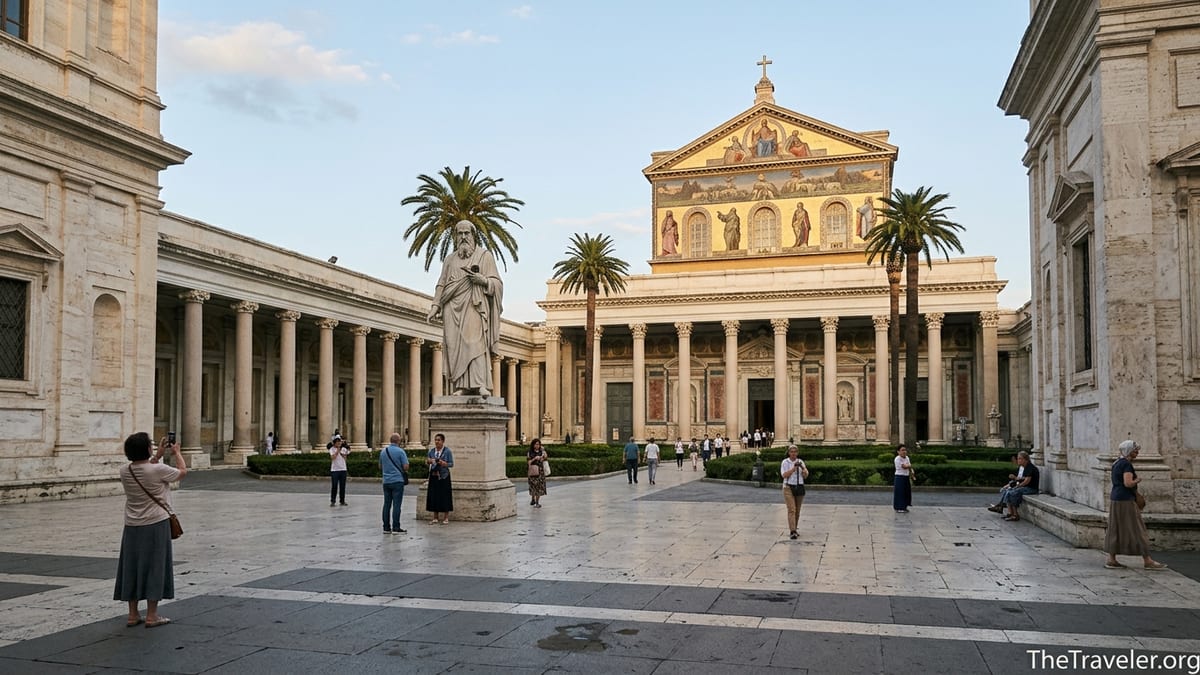
A Major Basilica With a Different Rhythm
The Basilica of Saint Paul Outside the Walls is one of Rome’s four major papal basilicas, alongside St Peter’s, St John Lateran, and Santa Maria Maggiore. It stands on the ancient Via Ostiense, about 2 kilometers outside the Aurelian Walls, over the traditional burial place of the Apostle Paul. Its status as a major basilica means it has a Holy Door and plays an essential role in Jubilee Years, but the atmosphere is remarkably different from the frenzy of the Vatican area.
Step inside on a typical weekday morning and you are more likely to hear footsteps and whispered prayers than the loud shuffling of tour groups. Even in Holy Year periods, travelers report that they can often walk into the nave without the long security lines and ticket checks common at St Peter’s. That sense of calm is one reason many seasoned Rome visitors rank St Paul Outside the Walls among their favorite churches in Italy; it feels grand and papal, yet still accessible and human-scale in its daily life.
For Catholic pilgrims, visiting all four major basilicas is traditionally part of the classic “seven churches” route in Rome. For non-religious travelers, the basilica offers a way to experience the power of sacred architecture without the crush of crowds. It is large enough to awe but quiet enough to invite reflection, whether that means lighting a candle, studying the mosaics, or simply sitting in silence beneath the forest of marble columns.
Why It Matters Spiritually in the Jubilee Era
St Paul Outside the Walls has always been central to Christian pilgrimage, but its significance is especially visible in the context of the 2025 Jubilee. Rome authorities expect tens of millions of pilgrims to visit the city during the Holy Year, and crossing the Holy Doors of the four major basilicas is one of the hallmark devotional acts. The Holy Door of St Paul’s is an integral part of that circuit, yet it usually remains far less crowded than St Peter’s, making it particularly appealing for visitors seeking a more focused spiritual experience.
Recent Jubilee guidelines highlight St Paul’s as a destination for specific events, such as gatherings of youth and consecrated religious communities. Groups from across the world, including large contingents from the United States, are planning Masses and prayer services here. For a pilgrim, attending a liturgy at St Paul’s can feel more rooted and participatory than at the Vatican, where the sheer scale of the crowd can create distance. At St Paul’s, you are more likely to find yourself close to the altar, hearing the chants clearly and perhaps even exchanging a few words with the monks or clergy afterward.
Even outside major events, the basilica’s link to Paul’s story speaks directly to many modern visitors. Paul was a traveler, a writer, and a controversial voice in his own time. Standing near his tomb, under the main altar, gives physical form to a figure most people know only from texts. For many, this encounter makes the New Testament feel less abstract and more like part of the real human history of the Mediterranean world, anchored to a specific place just off a busy Roman traffic circle.
A Living Memory of Early Christian Rome
The origins of St Paul Outside the Walls reach back to the 4th century, when Emperor Constantine ordered a memorial church over what was believed to be Paul’s grave. Over the centuries the structure grew into one of the largest basilicas in Christendom, with a vast nave, side aisles, and a cloister that today still preserves the mood of medieval monastic life. Although a devastating fire in 1823 destroyed much of the original building, the basilica was rebuilt “as it was, where it was,” reusing surviving elements wherever possible. The result is a 19th-century reconstruction that faithfully preserves the scale and layout of the early Christian church.
Travelers who have just seen the more ornate Baroque interiors of central Rome often find St Paul’s architecture surprising. The nave is dominated not by altarpieces or side chapels but by long, open views and repeated rhythms of columns and arches. The apse mosaic, reconstructed after the fire, shines with gold and deep blues that recall Byzantine art. Along the upper walls runs a remarkable frieze of papal portraits, from Peter to the present pope, a visual history lesson that helps visitors grasp the long continuity of the Roman Church.
In the cloister, which usually requires a modest paid ticket, travelers discover a different layer of the story. The delicate twisted columns and carved capitals date largely from the 13th century, and the small museum rooms display fragments rescued from the fire, ancient inscriptions, and devotional objects. Spending half an hour here, away from the main nave, helps visitors feel the survival of the basilica through crisis and renewal, and it is often quietly empty even on days when the nave is busier.
Practical Reasons It Belongs on a Modern Rome Itinerary
For travelers, one of the strongest arguments for visiting St Paul Outside the Walls is how easy and inexpensive it is to reach. The basilica is served by the Basilica San Paolo stop on Rome’s Metro Line B. From Termini, Rome’s main rail hub, the ride typically takes around 15 minutes in the direction of Laurentina. As you exit the station, signs for “Basilica di San Paolo” guide you across a broad piazza and onto Via Ostiense; the church’s façade appears straight ahead, about a 5 to 10 minute walk from the platforms.
Unlike some of Rome’s top attractions, entry to the main basilica is free, though there is the standard security check at the door. This makes St Paul’s particularly attractive to families, budget travelers, and long-term visitors looking for meaningful experiences that are not tied to ticket costs. The cloister and small archaeological area often require a modest fee, typically just a few euros per person, payable on-site at a staffed desk. Travelers who have visited in recent seasons frequently mention that they paid only pocket change to access the cloister, and that the experience felt like exceptional value compared with museum prices in the historic center.
The neighborhood around the basilica, Ostiense, also offers a different slice of Rome. After a visit, you can walk up Via Ostiense to find local cafés serving affordable espresso and sandwiches used by nearby university students and office workers, rather than tourist-priced menus. A typical cappuccino might cost around 1.50 to 2 euros standing at the bar, and panini at neighborhood bakeries generally run 4 to 6 euros, which can make a welcome contrast to the higher prices closer to the Spanish Steps or the Trevi Fountain.
Standing at the Tomb of the Apostle Paul
What makes this basilica spiritually and historically unique is its connection to the tomb of Paul. Beneath the high altar is a marble sarcophagus identified since antiquity as the resting place of the Apostle. Excavations and studies over the past decades have confirmed the presence of a 1st or 2nd-century tomb in this location, aligned with early Christian tradition. Today, visitors can peer down to the sarcophagus through an opening in front of the altar, often surrounded by flowers and flickering candles.
For pilgrims, this moment can be the emotional center of a trip to Rome. Many choose to kneel briefly at the rail, reading a passage from Paul’s letters or offering silent prayer. Others, including travelers with no religious background, find the physical closeness to an ancient historical figure striking. You are not looking at a museum display behind glass but at an active place of veneration where daily Mass is still celebrated.
Small guided tours, sometimes led by English-speaking clergy or lay guides, occasionally include explanations of the tomb area and the archaeological levels beneath the basilica. While availability varies by season, it is worth asking at the information desk inside the basilica if any tours are scheduled in your language. Even without a guide, spending time in the presbytery and reading the multilingual plaques can help situate Paul’s life and martyrdom within the broader story of imperial Rome and the early Christian communities that gathered at the edges of the city.
Art, Architecture, and Atmosphere Beyond the Crowds
Visually, St Paul Outside the Walls offers some of the most photogenic interior vistas in Rome. The central nave, lined with about 80 granite columns, creates a long perspective that naturally draws the eye toward the shimmering apse mosaic. Travelers who bring a camera or a modern smartphone can capture striking images simply by standing near the entrance and shooting toward the altar, especially in late afternoon when side light from the clerestory windows emphasizes the depth of the colonnades.
The papal portrait medallions that ring the upper walls are another unique feature. Each pope from Peter onward is depicted in mosaic, and new portraits continue to be added as history moves on. Observant visitors notice that some of the most recent popes have portraits that are subtly more photographic in style, reflecting modern artistic techniques. Walking slowly along the side aisles and looking up allows you to trace this visual history, which is especially fascinating for travelers who remember particular modern pontificates from news coverage.
The cloister offers a different sort of beauty. Its cosmatesque floor patterns, carved capitals, and small garden evoke a peaceful, enclosed world. On quiet afternoons you might see a handful of art students sketching the twisted columns or photographing small details like carved animals and plant motifs. For photographers, a standard lens in the 35 to 50 millimeter range works well to capture both the intimate details and wider scenes without significant distortion.
Planning Your Visit: Timing, Etiquette, and Nearby Experiences
St Paul Outside the Walls typically opens in the morning and stays accessible through the late afternoon or early evening, though exact hours can vary for liturgical reasons, especially during the Jubilee period. Many experienced visitors suggest arriving before 10 a.m. or in the last hour before closing to enjoy the most serene atmosphere. Midday can see more tour groups, particularly in Holy Year seasons, though it is still far calmer than St Peter’s or the Vatican Museums at peak times.
Dress codes are similar to those at other major churches in Rome. Shoulders and knees should be covered, particularly in summer. Lightweight linen trousers, midi skirts, and a simple cotton shirt or shawl are practical choices that respect local expectations and keep you comfortable in the Roman heat. As with all sacred spaces, maintain a low speaking voice, avoid eating and drinking inside, and be cautious about where you take photographs; flash photography is often discouraged, especially during services.
Combining a visit to St Paul’s with other Ostiense attractions makes logistical sense. A short bus or taxi ride away are sites like the Centrale Montemartini museum, which displays classical sculptures set among former power-plant machinery, and sections of Rome’s modern street art scene along Via del Porto Fluviale. Travelers on a tight schedule often find that a half day in Ostiense, with a morning at the basilica and lunch in a local trattoria, provides a refreshing break from the intense crowds around the Forum and Vatican.
The Takeaway
In a city saturated with world-famous churches, the Basilica of Saint Paul Outside the Walls stands out because it combines major historical and spiritual significance with day-to-day accessibility. It is a place where you can quite literally stand at the tomb of the Apostle Paul, trace the line of popes across the centuries, and experience the architecture of an early Christian basilica, all without the stress and expense that often accompany Rome’s headline attractions.
For pilgrims, especially in the context of the 2025 Jubilee, St Paul’s is a necessary stop to complete the circuit of the four major basilicas and to cross another Holy Door with genuine recollection. For secular travelers, it is one of the rare spots in Rome where the city’s religious heritage feels tangible, understandable, and welcoming rather than overwhelming. A simple metro ride and a short walk transport you from crowded piazzas to a luminous nave where history, faith, and travel intersect in a way that still matters deeply today.
FAQ
Q1. Is there an entrance fee for the Basilica of Saint Paul Outside the Walls?
The main basilica is generally free to enter, with only a small fee charged for optional areas like the cloister or archaeological spaces.
Q2. How do I get to St Paul Outside the Walls from central Rome?
Take Metro Line B toward Laurentina and get off at the Basilica San Paolo stop; from there it is about a 5 to 10 minute walk.
Q3. How much time should I plan for a visit?
Most travelers are satisfied with 60 to 90 minutes, though art lovers or pilgrims who wish to pray at length may want up to two hours.
Q4. Is the basilica suitable for non-religious visitors?
Yes. Many non-religious travelers visit for its art, architecture, and history, and find the quiet atmosphere a welcome contrast to busier sites.
Q5. When is the best time of day to visit?
Mornings before 10 a.m. and the final hour before closing tend to be the calmest periods, with fewer groups and softer interior light.
Q6. Is photography allowed inside the basilica?
Photography without flash is generally allowed for personal use, but visitors should avoid shooting during liturgies and always respect posted signs.
Q7. Are there guided tours available in English?
Guided visits are offered irregularly and may be led by clergy or lay guides; it is best to ask at the information desk on arrival.
Q8. Can I attend Mass at St Paul Outside the Walls?
Yes. Daily Mass is celebrated, and pilgrims are welcome to attend, though they should arrive a bit early to find a seat and observe reverent behavior.
Q9. Is the basilica accessible for travelers with limited mobility?
The main nave is largely accessible via ramps and level entrances, though some areas of the cloister and archaeological zones may involve steps.
Q10. Can I combine a visit here with other nearby sights?
Many visitors pair the basilica with Ostiense neighborhood attractions, such as local street art and museums, for a varied half-day itinerary.