


More news on this day
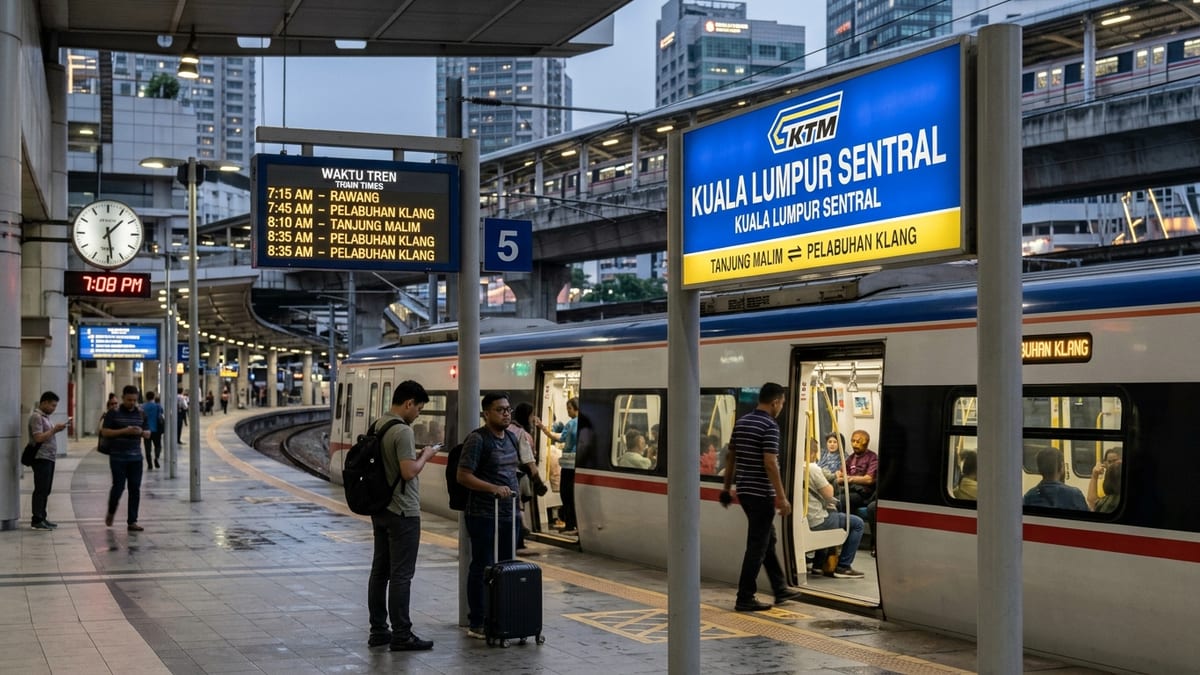
Malaysia’s Keretapi Tanah Melayu Berhad (KTMB) is preparing to roll out a revised KTM Komuter weekday timetable on the Tanjung Malim–Pelabuhan Klang line in early July 2026, a move set to recalibrate commuting patterns across the busy Klang Valley corridor after several years of KVDT2-related disruption and constrained frequencies.
Get the latest news straight to your inbox!
New timetable sits atop a series of KVDT2-era changes
According to KTMB’s public “Train Timetable” portal, the Tanjung Malim–Pelabuhan Klang KTM Komuter line is slated for a new weekday schedule labelled as a “Weekdays Only – New Timetable,” with implementation in early July 2026. The entry for this corridor lists multiple effective dates for 2026, including 4 July and 6 July, covering separate weekday and weekend or public holiday patterns. On publication day, travelers should confirm which of these tagged PDFs is flagged as current for weekday operations before planning journeys.
The upcoming adjustment follows a sequence of interim Klang Valley timetable restructurings since 2025 as KTMB worked services around the Klang Valley Double Track Phase 2 (KVDT2) upgrade. A Port Klang–KL Sentral peak-hour-focused pattern was introduced on 20 January 2025, with six morning and six evening Komuter trips in each direction and headways often stretched to 30 minutes or longer between KL Sentral and Port Klang. That was followed by broader Klang Valley timetable changes at the start of 2026, reflected in weekday timetables dated 1 January and 11 May 2026 for the same line.
The July 2026 change therefore functions less as a one-off shake-up and more as the latest refinement as more sections of upgraded track are brought into service and operating constraints evolve. It is, however, the first clear post-spring 2026 attempt to settle the Tanjung Malim–Port Klang weekday pattern into something closer to a regular all-day service rather than a heavily peaked skeleton around KL Sentral.
What the July 2026 weekday pattern means for key stations
KTMB’s current timetable PDFs and independent timetable summaries for July 2026 show an all-stops pattern between Tanjung Malim and Pelabuhan Klang, serving familiar suburban stations such as Rawang, Sungai Buloh, Kepong, KL Sentral, Klang and several intermediate halts toward the port. Journey times between Pelabuhan Klang and KL Sentral are typically around one hour, while end-to-end trips from Tanjung Malim to Pelabuhan Klang are generally closer to two hours, depending on stopping patterns and crossing windows on sections that still operate on single track.
Compared with the peak-hour-only pattern used on the Port Klang–KL Sentral section in 2025, the July 2026 weekday timetable restores more regular trains throughout the working day. While exact headways vary by time band and must be checked against the live PDF, the structure is designed to reduce long gaps that previously reached 30 to 60 minutes for some suburban stations between KL Sentral and Klang. For many riders, the change should translate into shorter waits, fewer forced detours via bus shuttles or the LRT Kelana Jaya Line, and a clearer sense of when the next Komuter will appear.
At the same time, the first and last train times in each direction are expected to remain broadly similar to earlier 2026 timetables, offering early departures suitable for office workers in central Kuala Lumpur and return options that cover the evening peak. For example, early-morning trains from Port Klang into KL Sentral have in recent timetables departed shortly after 5.00 a.m. local time, with the final evening services leaving the city core for the coast late in the evening. Travelers should note that KTMB can retime specific trips at short notice and should always consult the latest PDF or the MyRailtime function in the KTMB mobile app before travelling.
Commuter impact: more predictable links to ETS, LRT and MRT
The Tanjung Malim–Pelabuhan Klang line is a backbone of the Klang Valley Integrated Transit System, intersecting with LRT, MRT and ETS services at key nodes including KL Sentral, Subang Jaya and Sungai Buloh. A more even weekday pattern from July 2026 should make it easier to plan cross-platform transfers, particularly for passengers combining Komuter with ETS north–south services or with the MRT Putrajaya Line and MRT Kajang Line for trips into employment clusters outside the traditional city core.
Office commuters based near KL Sentral and central Kuala Lumpur stand to benefit from reduced uncertainty over whether a direct Komuter connection to Klang and Port Klang will be available at a given time. The return of a fuller all-day pattern means fewer situations where riders are forced off the rail network mid-day and onto buses or ride-hailing services for part of their trip. For port-area workers and those connecting to onward ferries from Port Klang, a tighter structure of departure and arrival times improves the reliability of same-day connections, even if end-to-end journey times remain constrained by sections of single track.
In the northern part of the corridor, residents of Rawang, Serendah, Batang Kali, Kuala Kubu Bharu and Tanjung Malim gain from having their services knitted more consistently into the wider Klang Valley timetable. In previous KVDT2 phases, irregular crossing slots sometimes produced uneven headways and awkwardly timed services into and out of KL Sentral. With the July 2026 pattern, travelers using these stations should see departure times that align more predictably with work and study hours, though they may still encounter pockets of longer gaps where construction staging dictates fewer trains.
KVDT2 works continue to limit full flexibility
Although the July 2026 timetable marks a significant step towards normality for Klang Valley Komuter riders, the underlying KVDT2 upgrade remains a work in progress. Official statements from Malaysian authorities and KTMB in 2026 indicate that the rehabilitation of the Klang Valley Double Track Phase 2 is now targeted for completion around 2027, earlier than the original 2029 timeframe, but well after the new Komuter timetable comes into force. Until works fully wrap up, single-track operations and temporary speed restrictions will continue to shape how many trains can be threaded through the corridor.
These engineering constraints help explain why the July 2026 weekday pattern, while more generous than the skeletal 2025 schedule, still stops short of pre-upgrade frequency levels on some segments. KTMB must balance Komuter, Electric Train Service (ETS) and freight paths over shared infrastructure that is not yet operating at its final double-track capacity. Commuters may therefore notice that certain peak periods have stronger frequencies than others, or that minor gaps persist where crossing opportunities are limited by work zones or staging areas.
Travelers should also be aware that the July 2026 change applies specifically to weekday services on the Tanjung Malim–Pelabuhan Klang line. KTMB’s timetable portal lists separate entries for weekends and public holidays on the same corridor, with their own effective dates and potentially different train patterns. Those planning leisure trips to coastal destinations or weekend visits along the corridor should confirm whether a separate weekend or holiday timetable PDF applies to their travel date, rather than assuming weekday patterns will hold.
What riders should check before travelling
With several overlapping timetable PDFs now visible on KTMB’s site for the Tanjung Malim–Pelabuhan Klang corridor in 2026, the most important step for travelers is to confirm, on the day of booking or departure, which specific document governs their trip. The KTMB “Train Timetable” page links to line-by-line PDFs labelled with effective dates such as 4 July 2026, 6 July 2026 and later revisions, and the operator may update or supersede earlier files at short notice as KVDT2 works progress.
For the most accurate information, riders should combine the static PDF with a search in KTMB’s online timetable tool or the MyRailtime feature of the KTMB mobile app, both of which reflect the latest operational data including temporary retimings or cancellations. Those making time-sensitive connections to ETS trains, airport services or ferries from Port Klang should build in additional buffer time during the first weeks after the July 2026 change while the new pattern beds in.
Looking ahead, further timetable refinements along the Tanjung Malim–Port Klang corridor remain likely as more sections of the KVDT2 project are commissioned and double-track capacity expands. For now, however, the early-July 2026 weekday schedule offers Klang Valley commuters a notably more regular and predictable Komuter service than during the most disruptive years of the upgrade, provided they keep a close eye on which version of the timetable is in force on the day they travel.