


Landing at Tel Aviv Ben Gurion Airport late on a Friday or during Shabbat can feel like hitting a wall: the trains are quiet, many buses are parked, and the usual easy hop into the city suddenly looks complicated. The good news is that you still have workable options to reach central Tel Aviv, from sherut shared taxis to private cabs and, increasingly, limited weekend bus services. This guide explains what actually operates on Shabbat, what shuts down, how much you should realistically expect to pay, and how to problem-solve if your flight arrives at difficult hours.
Get the latest updates straight to your inbox!
Understanding Shabbat timing and what closes
To plan your journey from Ben Gurion Airport into Tel Aviv, you first need to understand when Shabbat begins and ends, and how it affects transport. In Israel, Shabbat runs roughly from Friday before sunset until Saturday after nightfall. In practical terms for travelers, train service to and from Ben Gurion Airport usually winds down early on Friday afternoon and only resumes late on Saturday night or early Sunday morning. During these hours there is no train from the airport to Tel Aviv’s main stations such as Savidor Center, HaShalom, or HaHagana.
Most intercity and urban bus routes also stop operating during Shabbat, especially those controlled or regulated at the national level. This includes the regular Kavim line 445 between Ben Gurion and Tel Aviv, which runs frequently on weekdays but is suspended from Friday evening through Saturday evening. As a result, you cannot rely on simply tapping your Rav-Kav and boarding a bus or train at the terminal as you would on a Tuesday afternoon.
For visitors who arrive from abroad without knowing this, the surprise can be jarring. A typical scenario is a traveler landing at 21:00 on a Friday expecting to take the 18-minute train ride into Tel Aviv, only to find shuttered ticket machines, dark platforms, and no departures on the board. Avoiding this frustration is mostly about planning: assume that from mid-afternoon Friday until after dark on Saturday there will be no regular rail service and very limited bus service between the airport and Tel Aviv, and that you will need taxis or sherut options instead.
The exact cut-off and restart times can vary slightly with the season because they are tied to sunset. In summer, trains may stop earlier on Friday and resume later on Saturday compared with winter. If you are connecting to a late Saturday-night flight or arriving very close to the end of Shabbat, it is wise to check same-day schedules in a real-time app such as Moovit or the official Israel Railways app to see when the first train or bus back into operation is actually scheduled.
What still runs: sherut and taxis at all hours
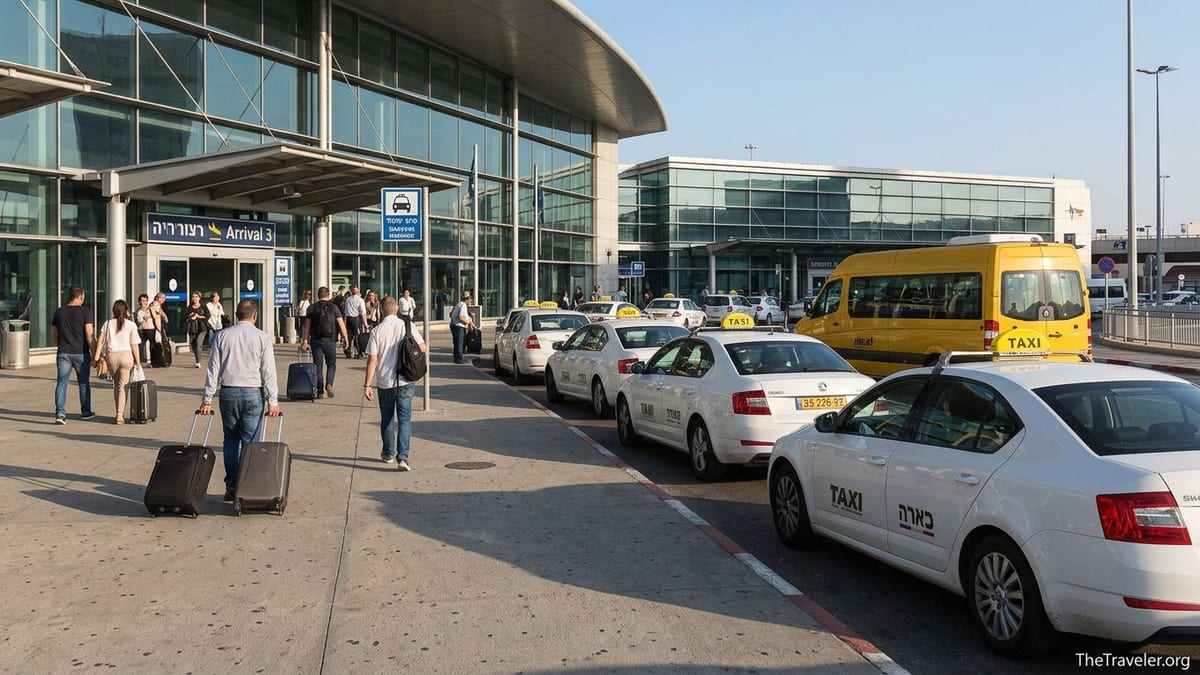
Even when the trains and most buses stop, Ben Gurion Airport does not shut down, and neither do taxis. The most reliable way to reach Tel Aviv city center on Shabbat is by regular taxi from the official taxi ranks just outside Terminal 3 arrivals. These licensed cabs operate 24 hours a day, seven days a week, including Shabbat and holidays. The drivers are used to international travelers and are generally comfortable accepting major credit cards as well as cash in shekels.
Prices fluctuate with official tariffs, night supplements, luggage surcharges, and time of day, but travelers commonly report paying in the region of 150 to 220 shekels for a standard taxi from Ben Gurion to central Tel Aviv on Shabbat, with late-night arrivals at the higher end of that range. For example, a couple landing at 23:30 on a Friday and heading to a hotel near Dizengoff Center might pay around 190–210 shekels, depending on traffic and which tariff band is active. If traffic is light, some journeys end closer to 160–170 shekels.
Alongside regular taxis, shared taxis known locally as sherut sometimes operate between the airport and various cities, although the most consistent sherut activity on Shabbat is for longer-distance routes like Jerusalem or Haifa. Sherut vehicles are typically 10-seat minibuses that depart when full or nearly full and charge by the seat. When a sherut line to Tel Aviv is running, you might pay roughly 35–50 shekels per person instead of the full taxi fare, making it economical for solo travelers or pairs, but you should be prepared for multiple stops in different Tel Aviv neighborhoods as passengers are dropped off one by one.
Unlike regular taxis, sherut services are not centrally coordinated by the airport authority in the same way and can change operator or frequency over time. The practical takeaway is that when you walk out of arrivals during Shabbat you can always count on finding regular metered taxis waiting. Sherut options, if present, are a welcome bonus for price-sensitive travelers but should not be your only plan.
Private transfers, ride apps and pre-booked solutions
For travelers who value predictability, a pre-booked private transfer can take much of the stress out of arriving during Shabbat. Numerous companies operate door-to-door transfers from Ben Gurion to Tel Aviv hotels and apartments. These services generally use modern sedans or minibuses and include a driver who monitors your flight arrival time. Typical prices for a pre-arranged private car for two to three passengers to central Tel Aviv fall somewhere between 220 and 320 shekels on Shabbat, with some premium services charging more for luxury vehicles or larger groups.
One concrete example: a family of four arriving from Europe on a Saturday morning might book a van in advance for about 280–350 shekels, knowing that the vehicle will be waiting even if immigration takes longer than expected. While this is more expensive than taking the train on a weekday, the added cost can be worthwhile if you are traveling with children, bulky luggage, or after an overnight flight when dealing with on-the-spot negotiations feels overwhelming.
Ride-hailing apps in Israel function differently than in some other countries. International brands that many travelers know are not allowed to operate traditional ride-sharing at the airport, so you cannot simply open a familiar app and summon a random driver. However, some local taxi apps allow you to order a licensed cab at fixed or metered rates, and many work in English. The catch is that airport pickups are often subject to specific regulations, meaning that even when you order through an app the driver may need to use the official taxi rank area and comply with airport access rules.
If you have Israeli friends or a local contact, another practical workaround is to coordinate a pickup by private car and then continue into Tel Aviv on local streets. This is common for residents collecting relatives on Shabbat. Just note that parking at the terminal can become busy, and your driver will need to use the designated short-term parking lots and follow airport security guidelines. For most visitors, especially first-timers, sticking with the official taxi rank or a pre-arranged transfer remains the simplest option.
New and evolving weekend bus options
In recent years there has been gradual political and social movement toward limited public transport on Shabbat in parts of the Tel Aviv metropolitan area. Some municipalities have funded free weekend bus networks that operate independently from the national system. More recently, Israeli media have reported that new routes are being piloted to connect Tel Aviv and the suburbs with Ben Gurion Airport on weekends, sometimes including Shabbat day itself. These services are still evolving and may have limited frequency, specific pick-up points, and changing timetables.
For example, a new weekend line might run only every 60 to 90 minutes and use pick-up locations in Tel Aviv such as the Arlozorov area near Savidor station or a central boulevard like Ibn Gabirol, then continue via a suburban town such as Shoham before reaching the airport. Some of these buses have been described in local press as free of charge, funded by municipalities or regional councils, which makes them attractive for budget-conscious travelers who are comfortable navigating local bus stops and schedules in Hebrew.
The challenge for visitors is that these weekend airport buses are still the exception rather than the rule and are subject to political, budgetary, and regulatory shifts. A line that exists one year may be tweaked, rebranded, or even suspended the next. Realistically, you should treat them as a pleasant surprise rather than your primary plan. If you are already in Tel Aviv before Shabbat and hear from your hotel reception, a local friend, or current news that a weekend bus to the airport is running, you can absolutely use it to save money on your departure. But if you are landing at Ben Gurion on Shabbat and need to get into the city, taxis and sherut remain the only options you can confidently rely on without checking same-day updates.
Practical planning therefore looks like this: assume that on Shabbat your baseline is a 150–220 shekel taxi from the airport to central Tel Aviv, then check during the week before your trip if any limited weekend bus lines are reliably operating during your arrival window. Real-time route planners such as Moovit or the official bus aggregation sites in Israel can show if a weekend airport bus is expected and roughly when it will depart, but always build in a backup plan in case of last-minute changes or full buses.
Late Friday arrivals and Saturday-day travel scenarios
Different arrival times on Shabbat create slightly different challenges. A late Friday-afternoon landing, for instance around 15:00 in winter, falls into a gray zone where some daytime trains and buses may still be running for a short window, but they can stop abruptly as Shabbat approaches. If your flight is delayed or passport control is slow, you may emerge into arrivals just as the last train pulls out. In this scenario, it is not worth gambling on making the final departure. Instead, plan from the outset to use a taxi into Tel Aviv and consider the train only if you clearly see multiple upcoming departures still listed and staff confirming that Shabbat service has not yet ended.
Even later Friday arrivals, such as landing at 21:00 from London or 23:45 from New York, mean that Shabbat is fully in effect and there will be no regular train or bus into Tel Aviv. Here the decision shifts from “which mode” to “which price level.” A solo backpacker might look for a sherut minibus and accept that the ride could take up to an hour with various drop-offs, but might cost only 40 shekels instead of the 180 shekels a private taxi might charge at that hour. A business traveler arriving for a Sunday morning meeting might go straight to the taxi rank, valuing time and privacy over saving 100 shekels.
Saturday daytime arrivals have a similar pattern. A mid-morning arrival on Saturday, such as 10:00, will find the airport busy with flights but quiet on the public transport side. Taxis work normally and traffic into Tel Aviv is often lighter than during the weekday rush, so your journey can be quick, around 20–25 minutes to central neighborhoods such as Rothschild, Florentin, or the beachfront. Later in the afternoon, especially in winter when Shabbat ends earlier, you may start to see the first train and bus services reappear in journey-planning apps. These typically resume somewhere between roughly one and two hours after sundown, so an 18:30 Saturday flight arrival in December might allow you to catch one of the first evening trains, while an 18:30 arrival in June might still fall firmly inside Shabbat quiet hours.
Because of the seasonal variation, seasoned travelers sometimes plan their Saturday flights around transport rather than the other way around. One common strategy is to book an arrival late on Saturday night, for instance around 23:00, then ride the train into Tel Aviv once service has restarted. In that case, your cost falls dramatically compared to a Shabbat taxi: a train ticket from Ben Gurion to Tel Aviv Savidor Central typically costs only a fraction of a taxi fare, leaving more budget for hotels and meals.
Costs, payment methods and realistic budgeting
When it comes to budgeting for Shabbat transfers, the key is to think in ranges rather than fixed prices. For a private taxi between Ben Gurion and central Tel Aviv, a sensible working range for most of 2026 is 150–220 shekels including the Shabbat and night surcharges. If your hotel is in a central but not overly congested area, such as near Rabin Square or the beachfront hotels north of Allenby, assume roughly 170–190 shekels. If you are heading to neighborhoods further north like the Tel Aviv Port area or to suburbs beyond the city limits, the fare can creep upward.
Sherut shared taxis, if available, might charge something in the realm of 35–50 shekels per person for the same journey, though actual fares depend on the operator and current fuel and wage costs. From a purely financial perspective, a couple using sherut could expect to pay roughly the cost of a single train ticket each on a weekday, while a family of four might find that the total cost is similar to or only slightly less than booking one regular taxi, especially once you factor in the extra time spent dropping off multiple passengers.
For buses and trains outside Shabbat hours, payment is almost entirely cashless. Israel uses a stored-value smartcard system called Rav-Kav alongside several transport apps that allow fare payment directly by phone. At Ben Gurion Airport, it is possible to buy a physical Rav-Kav card from machines or service desks or to use supported apps if you have a local SIM or roaming data. However, these options matter mainly if you will be using public transport for several days after arrival. During Shabbat itself, you are far more likely to pay a taxi or transfer driver directly than to tap a Rav-Kav.
When paying taxis, most official airport taxis can accept credit and debit cards, but it is still wise to have at least 200 shekels in cash as a backup, especially if your card is new or your bank is sensitive to foreign transactions. Tips are not mandatory but are appreciated for good service; many travelers simply round up to the nearest 10 shekels or add around 5–10 percent on longer rides. If you are quoted a flat cash price by a driver that seems significantly higher than the meter would produce, you can politely insist on using the meter or ask a dispatcher at the rank to confirm the approximate fare before departing.
Problem-solving: backups, overnights and special cases
Occasionally, things do not go to plan: luggage is delayed, a child gets sick mid-journey, or you discover that you left your wallet on the plane. In these edge cases, thinking flexibly can save your trip. One pragmatic option if you are exhausted or unexpectedly stranded on Shabbat is to stay near the airport overnight and continue into Tel Aviv once full public transport resumes. Several hotels in the airport region, including those around the nearby commercial area often called Airport City, market themselves specifically to passengers with awkward arrival times and may offer free or low-cost shuttles between the hotel and Terminal 3.
For example, a traveler landing at 03:00 on Saturday with a long-haul jetlag might find it more comfortable to spend a few hours sleeping at an airport-area hotel, then take the first Sunday-morning train or bus into Tel Aviv for a few shekels instead of a costly night-owl taxi. Similarly, if a strike, security situation, or unexpected disruption temporarily impacts taxi availability, airport staff and information desks can direct passengers toward authorized transfer services, car rentals, or hotel shuttles that are still operating.
Another special case involves travelers on very tight budgets. Students or backpackers sometimes prefer to wait in the arrivals hall or public areas of the terminal until Shabbat ends and the first train starts running, rather than paying for a taxi. Ben Gurion Airport is accustomed to people resting in the terminal for several hours, and there are food outlets and seating areas open around the clock. In practice, if you land late Friday night and are comfortable sleeping on a bench with your luggage locked or close by, you might spend the night at the airport and board the early Sunday-morning train into Tel Aviv for the price of a regular ticket.
Families with small children or older travelers may instead combine solutions. One realistic hybrid plan is to take a taxi from the airport to a southern Tel Aviv neighborhood like HaHagana area on Shabbat, then connect to cheaper urban buses or light rail once regular service restarts that evening or the next morning. This can trim the taxi distance and cost while still avoiding long walks or confusing changes at the airport itself.
The Takeaway
Traveling from Ben Gurion Airport into Tel Aviv on Shabbat requires a different mindset from traveling on a weekday. The fast and inexpensive airport train and the frequent 445 bus are off the table from Friday afternoon until Saturday night, and most of the national public transport network is on pause. What remains is a patchwork of always-on options: official airport taxis, occasional sherut shared taxis, pre-booked private transfers, and, increasingly, a handful of experimental weekend bus lines tied to local municipalities.
If you strip it to essentials, the most reliable plan is simple. First, assume that on Shabbat you will use a taxi from the airport into Tel Aviv, and budget around 150–220 shekels for that ride. Second, before you travel, check whether any weekend bus or shared shuttle options are operating during your exact arrival time, and treat those as pleasant money-saving bonuses rather than guaranteed services. Third, if your schedule or budget is especially tight, consider adjusting your flight times or spending the night near the airport so you can make use of regular trains and buses once they resume.
With these expectations in place, Shabbat no longer feels like a barrier, just a condition to plan around. Whether you arrive to a quiet Saturday-morning terminal or touch down just after the end of Shabbat with the first trains rolling again, understanding what still works and what stops will help you step out of Ben Gurion Airport and into Tel Aviv with confidence.
FAQ
Q1. Can I take the train from Ben Gurion Airport to Tel Aviv on Shabbat?
Generally no. The airport train does not run from Friday afternoon until after Shabbat ends on Saturday night. Service usually resumes late Saturday or early Sunday, with the exact time depending on the season.
Q2. How much should I expect to pay for a taxi from Ben Gurion to central Tel Aviv on Shabbat?
Most travelers pay somewhere in the range of 150 to 220 shekels, depending on distance, time of night, and traffic. Trips to very central areas like Rothschild, Dizengoff, or the beachfront often fall in the mid-range of that estimate.
Q3. Are there sherut shared taxis from the airport to Tel Aviv during Shabbat?
Shared taxis sometimes operate between the airport and major cities, but services are less standardized than regular taxis. When a sherut to Tel Aviv is running, it can be significantly cheaper than a private taxi, though departure times and routes may vary.
Q4. Do any buses run between Ben Gurion Airport and Tel Aviv on Shabbat?
Regular intercity buses, including the usual Ben Gurion to Tel Aviv line, normally do not operate on Shabbat. In recent years, some limited weekend bus routes have been introduced by municipalities, but they are still exceptions and should not be your only plan.
Q5. What is the best option if I land late on Friday night?
If you arrive late on Friday, your most reliable option is a taxi from the official rank at Terminal 3. You might look for a sherut to save money, but you should budget for a taxi in case no shared minibuses are running.
Q6. Is it worth pre-booking a private transfer for Shabbat arrivals?
For many travelers, yes. A pre-booked transfer is more expensive than the train but comparable to or slightly higher than a regular taxi. It guarantees a driver will be waiting, which can be reassuring if you arrive with children, heavy luggage, or after a red-eye flight.
Q7. Can I pay for taxis and transfers by credit card?
Most official airport taxis and reputable transfer companies accept major credit cards, though it is wise to confirm before starting the journey. Carrying around 200 shekels in cash as a backup is recommended in case of card issues.
Q8. What if I am on a very tight budget and arrive during Shabbat?
If funds are limited, you can consider waiting at the airport until Shabbat ends and trains and buses resume, then travel into Tel Aviv for a low public-transport fare. Some budget travelers spend the night in the terminal and catch the first morning train.
Q9. How long does the taxi ride from Ben Gurion to Tel Aviv usually take on Shabbat?
Traffic is often lighter on Shabbat, so journeys are typically around 20 to 30 minutes to central Tel Aviv. Travel times can increase if there are roadworks, accidents, or special events, but the route is straightforward.
Q10. Do I need a Rav-Kav card if I am arriving on Shabbat?
You do not need a Rav-Kav for Shabbat arrivals if you are using taxis or private transfers. A Rav-Kav becomes useful from Saturday night onward, when trains, buses, and light rail resume and you plan to use public transport during your stay.