


Bengaluru’s Kempegowda International Airport can be confusing even for frequent fliers, especially now that almost all international flights and several domestic airlines have moved to the newer Terminal 2. If you turn up at the wrong building, you can lose precious time or even miss a flight. This guide explains in simple terms which terminal you actually need, how domestic and international operations are split, how to use the free shuttle between T1 and T2, and what to do about baggage claim, pickups and wrong-terminal mistakes, using real examples from current operations in 2026.
Get the latest updates straight to your inbox!
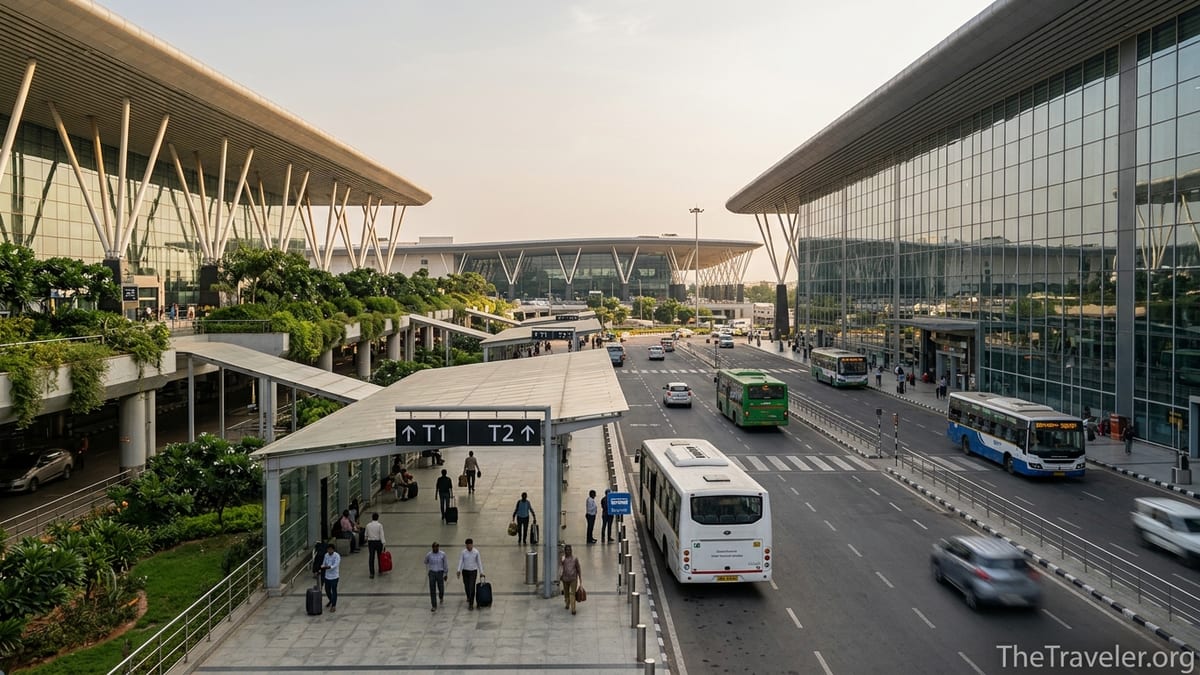
Big Picture: How Bengaluru Airport’s Two Terminals Work
Kempegowda International Airport (BLR) currently operates two passenger terminals: Terminal 1, the older building, and Terminal 2, the newer “garden terminal.” Both are several kilometers apart on the same airport campus, and you cannot realistically walk between them. Instead there is a free inter-terminal shuttle bus that runs around the clock. For most travelers, the main difference is simple: Terminal 1 is now predominantly domestic, while Terminal 2 handles all international flights plus a growing list of domestic services for specific airlines.
In practice, this means you could have two Bengaluru flights on the same day with different terminals. For example, a morning IndiGo flight from Bengaluru to Hyderabad might depart from Terminal 1, while an evening Air India flight from Bengaluru to Delhi will use Terminal 2. A traveler flying Emirates from Dubai to Bengaluru will always arrive into Terminal 2, but if they connect onward to a smaller Indian city on IndiGo or Akasa Air, that second flight is usually from Terminal 1. Understanding that split before you set off for the airport can easily save 30 to 45 minutes of unnecessary terminal-hopping.
The airport layout also affects how you arrive by road or bus. App cabs and private taxis will usually ask whether you need T1 or T2 before they start from the city. Several airport bus routes operated by BMTC’s Vayu Vajra service announce their destination as “Kempegowda Airport, Terminal 1” or “Terminal 2 shuttle stop.” If you just tell the driver “airport” without specifying, you may be dropped at the wrong terminal and then need to transfer using the airport shuttle.
Which Airlines Use Terminal 1 vs Terminal 2
Assignments can change, but as of mid 2026 there is a clear pattern. Terminal 2 is the dedicated international terminal at Bengaluru: all scheduled international flights, across all airlines, arrive and depart from T2. That includes long haul and regional carriers such as Emirates, Qatar Airways, Etihad, Lufthansa, Air France, British Airways, Singapore Airlines, Thai Airways, SriLankan Airlines and others, as well as the international routes of Indian airlines like Air India, Air India Express and IndiGo. If your ticket shows Bengaluru with an international destination or origin, you should automatically think Terminal 2 unless your airline explicitly tells you otherwise.
On the domestic side, Terminal 2 has become the main base for Air India and Air India Express at Bengaluru, covering both their domestic and international operations. Star Air and some other premium or full-service style domestic operators also run from Terminal 2. Several IndiGo domestic flights have moved to T2 over time for operational reasons, even though IndiGo still operates a large domestic bank from Terminal 1. For example, a passenger booked Bengaluru to Mumbai on Air India will check in at T2, while another passenger on the same route with IndiGo might depart from T1 or T2 depending on the specific flight number shown on their ticket.
Terminal 1, by contrast, is now home to the bulk of purely domestic traffic. Low cost and new-entrant carriers such as Akasa Air, SpiceJet and Fly91 primarily use Terminal 1 for their networks out of Bengaluru. Most IndiGo domestic flights, particularly those to tier 2 and tier 3 cities like Coimbatore, Mangaluru, Vijayawada or Ranchi, still operate from T1. This is why it is common to see a traveler arrive on an international airline at T2, then transfer across to T1 for a domestic connection on IndiGo or another domestic carrier booked separately.
Because there are exceptions and airline strategies evolve, always check the latest terminal shown on your booking confirmation or airline notification within 24 hours of travel. For example, Air India has issued official notices confirming that all its Bengaluru flights, both domestic and international, use Terminal 2. Meanwhile, independent tracking sites show that some new regional routes for carriers such as Fly91 are firmly based in Terminal 1. Rely on what your airline app and boarding pass say, and if in doubt, call the airline before leaving for the airport.
Domestic vs International: How Operations Are Split
The simple rule is that international flights at Bengaluru use Terminal 2 from start to finish: check in, immigration, security, boarding and arrivals with immigration and customs. The international wing of Terminal 2 is clearly marked, with dedicated immigration counters and baggage belts for overseas arrivals. For example, a Japan Airlines passenger flying from Tokyo to Bengaluru disembarks directly into T2’s international arrivals area, clears immigration, collects baggage and passes through customs without ever seeing Terminal 1.
Domestic operations are spread across both terminals, depending on the airline. In Terminal 2, domestic passengers still go through a standard domestic security screening and board from domestic gates, but they share the check in hall and landside area with international travelers. A traveler flying Air India from Bengaluru to Kolkata, for instance, will use T2 but follow the domestic signs, and will not go through immigration. Meanwhile, a passenger on Akasa or most IndiGo flights to the same destination will be handled entirely in T1, using that terminal’s check in hall and security queues.
Where the split really matters is during connections. If you are flying domestic to international on separate tickets, such as Chennai to Bengaluru on IndiGo and then Bengaluru to Paris on Air France, your domestic flight will usually arrive into Terminal 1, while your international departure leaves from Terminal 2. In that situation you must plan time to collect your baggage at T1, exit the terminal, take the inter-terminal shuttle to T2, and then re-check in for your long haul flight. If both flights are on one ticket and interlined, your airline may through-check baggage to the final destination, but you still need to physically move yourself from T1 to T2.
The same applies in reverse for international to domestic connections where the domestic sector is on a different airline or separate booking. A traveler from Dubai arriving on Emirates will always land at T2. If they then connect to an IndiGo domestic flight from Terminal 1, they must complete immigration and customs at T2, collect their luggage, and then use the shuttle to reach T1 for fresh check in. Many travelers on early morning arrivals report that immigration and baggage at T2 can be quite fast outside peak hours, making a 3 to 4 hour self-connection to T1 workable, but shorter gaps are risky.
Getting Between T1 and T2: Free Shuttle, Timing and Tips
The only practical way for most travelers to move between Bengaluru’s two terminals is the free inter-terminal shuttle bus operated by the airport. The service is designed for passengers and airport staff and runs 24 hours a day. Buses operate frequently during busy periods, often in the range of every 10 to 15 minutes, and slightly less often late at night when traffic is lighter. In real terms, travelers typically report a total door to door transfer time of around 20 to 30 minutes, including waiting, travel and walking at each end.
At Terminal 2, the shuttle stop is located outside the arrivals area. After you exit customs, follow the signs for “Inter Terminal Shuttle” or ask an airport marshal. You join a marked queue where buses labeled for T1 and other airport facilities arrive. At Terminal 1, the shuttle stop is similarly positioned near the arrivals forecourt, close to where city buses and taxi lanes operate. Airport staff often refer to the vehicle as a “white shuttle” or “inter-terminal Volvo,” and some regular fliers mention that even in the early hours around 3 am they have found buses operating.
If you are connecting flights, you should always factor the transfer into your schedule. For a domestic to international self-connection that requires a terminal change, most experienced travelers aim for at least 3 hours between scheduled arrival and departure. That allows time for possible domestic delays, baggage claim, the shuttle, check in, immigration and security at T2. For international to domestic moves, 3 hours is still a sensible buffer; although T2 immigration can be efficient at quieter times, queues build quickly when multiple wide body flights land together. Examples shared by recent travelers describe smooth T2 to T1 transfers in about 90 minutes door to door on quiet evenings, but also warn of peak morning waves where 2 hours felt tight.
One key point: the shuttle is outside the secure zone, so you must exit the arrivals hall to use it. There is no airside corridor or people-mover between T1 and T2. If your flights are on a single ticket and the airline has arranged an internal domestic transfer counter in T2, you may be able to drop bags for a T1 flight before taking the bus, but final boarding and security for that domestic leg will still occur in Terminal 1. Always verify this at the transfer desk in T2, since not all airlines or routes support such arrangements.
Baggage Claim, Transfers and Through-Checked Luggage
For point to point journeys where you start or end in Bengaluru, baggage is straightforward. If you land on a domestic flight into Terminal 1, you collect your bags at the T1 baggage reclaim area and exit into the arrivals hall. If you arrive on any international flight, you collect your baggage in Terminal 2’s international arrivals zone, pass through customs, and then enter the public arrivals hall. The baggage belts are clearly labeled by flight number, and airport staff are available to assist with oversized items.
Where it becomes more complex is during connections, particularly when tickets are on different airlines or separate bookings. If you arrive at T2 on an international flight and continue domestically from T1 on a separate ticket, your bags will not be through-checked. You must pick them up at T2, clear customs, and physically take them with you on the shuttle bus to T1 to check in again. This is a common scenario for travelers who book an international ticket with a foreign carrier and then a separate domestic low cost ticket on IndiGo, Akasa or SpiceJet. The same rule applies for domestic to international connections that move between terminals on separate reservations.
When your flights are on a single PNR and interlined, such as an Air India domestic leg connecting to an Air India or Star Alliance international flight, your airline may check your baggage all the way to the final destination. In those cases you still need to move yourself between terminals if the operating flights use different buildings, but you can usually skip baggage claim at the intermediate point. For example, a passenger flying Coimbatore to Bengaluru on Air India, then Bengaluru to London on Air India, will typically check their bag in Coimbatore and see it again only in London, even though they physically change from a smaller domestic gate area to the international side of T2.
Real life experience shows that rules around through-checking can vary by airline and by staff training. Some passengers report that certain carriers insist on reclaiming baggage at Bengaluru when changing terminals, even on linked itineraries, because customs for arriving international luggage must occur at the first port of entry in India. To avoid surprises, always confirm at check in how your bags will be handled, and if you know you must change terminals at BLR, travel with hand luggage only whenever practical. That can reduce connection stress substantially, particularly during late night or early morning transfers when you may be tired.
Pickup, Drop-off and Ground Transport at Each Terminal
Both terminals at Bengaluru have separate forecourts for private vehicles, app cabs and buses, which is why knowing your correct terminal in advance is so important. If you are arriving by app cab services like Uber, Ola, Rapido or BluSmart, the app will usually present two options: “BLR Terminal 1” or “BLR Terminal 2.” Choosing the wrong one can add 20 to 30 minutes in backtracking, especially at busy times. Many local taxi drivers still use the older habit of saying “old terminal” for T1 and “new terminal” for T2, so clarify with them by mentioning your airline and whether your flight is international or domestic.
On arrival, each terminal has designated pickup zones where app-based taxis and pre-paid taxis collect passengers. In Terminal 1, this is just outside the arrivals hall alongside the bus bays where the BMTC Vayu Vajra airport buses stop. The T1 area feels more utilitarian but is densely served by city buses that run to major parts of Bengaluru, including routes like KIA-8 towards Electronics City or KIA-4 towards Hebbal and Majestic. In Terminal 2, the arrivals forecourt is more landscaped, with separate lanes for app cabs, hotel shuttles and the inter-terminal bus. Some airport bus routes stop directly at T2, while others terminate at T1 and require you to hop on the shuttle to reach T2.
If you are being picked up by friends or family, give them your terminal and door number from your message board or arrival confirmation. For example, you might text “Arriving T2, International, exit gate 5” so they know which ramp to use. Relatives waiting at the wrong terminal are a common sight at Bengaluru, especially when passengers on Air India domestic flights land at T2 but their families still associate “international” with that building and mistakenly drive to T1. In such cases, it is quicker for the passenger to stay put and for the driver to circle to the correct forecourt, rather than trying to move between terminals on foot.
For drop-offs, both T1 and T2 have dedicated departure ramps where private cars can stop briefly to unload. Security is strict about dwell time, and cars cannot wait for long on the departure deck. If you are early, it is better for your driver to use the parking area and walk over. When coming by bus, listen for the on-board announcements that specify Terminal 1 or Terminal 2. Some long distance private buses and airport shuttles serving neighboring cities such as Mysuru or Salem also specify their drop points as “near T1” because that side of the campus has long been the main surface transport hub.
When You Go to the Wrong Terminal: Real-world Scenarios
Ending up at the wrong terminal is surprisingly common at Bengaluru, particularly since the opening of Terminal 2 changed long-standing habits. For example, a traveler with a domestic Air India ticket to Mumbai might automatically instruct their cab driver to go to “domestic terminal” and be dropped at T1, only to find that Air India has moved its domestic operations to T2. In that case, the fix is straightforward but time consuming: exit the building, locate the inter-terminal shuttle stop and take the free bus to T2. If you arrive 2 hours before departure, a mistake like this can reduce your comfortable buffer to a stressful 60 to 70 minutes once the transfer and new security check are done.
There have also been instances of buses or ground staff accidentally mixing up arrival gates for international passengers, which created confusion. A well publicized case in the Indian press described how a group of SriLankan Airlines passengers were mistakenly taken to the domestic arrivals gate at Terminal 1 instead of the correct international arrivals area. Although such operational errors are rare, they illustrate why officials at the airport are now extra conscious about directing travelers correctly between domestic and international streams and between T1 and T2. If you ever feel you are in the wrong area after an international flight, ask the nearest security officer or airline representative immediately.
For connections, a wrong-terminal start can be the difference between making and missing a flight. Take the example of a passenger landing from Delhi into T1 on IndiGo with a separate onward Air France ticket to Paris from T2, with exactly 3 hours between flights. If they mistakenly follow signs for domestic transfers within T1 instead of exiting to catch the shuttle, they could lose 20 to 25 minutes before realizing they actually need T2. By the time they reclaim their baggage, wait for the inter-terminal bus, ride across and clear T2 security and immigration, boarding might already have begun. This is why, whenever you have a mixed-terminal itinerary, it is wise to study the airport’s terminal map, ask cabin crew on the inbound flight, and confirm airline counters on arrival as early as possible.
The good news is that staff at Bengaluru are now familiar with these issues, and there are multiple layers of signage and announcements aimed at preventing mistakes. Shuttle bus drivers, security guards at terminal entrances and airline ground teams routinely redirect people who show up at the wrong building. Still, at peak times there can be queues to enter the terminal itself due to security screening of bags at the door, so even a simple redirect can cost 15 to 20 minutes. Avoid unnecessary tension by adding at least 30 minutes extra to your “leave home” time if there is any chance of terminal confusion in your plan.
The Takeaway
The most important fact about Kempegowda International Airport in 2026 is that all international flights now use Terminal 2, while domestic services are split between T1 and T2 according to airline. Terminal 1 is still the workhorse for most low cost and regional domestic routes, but Air India, Air India Express, Star Air and many international carriers have consolidated at the newer Terminal 2, and a number of IndiGo routes straddle both buildings. That means the terminal printed on your booking or boarding pass is the final authority, not your memory of past trips.
Because the two terminals are physically separated and joined only by a free shuttle bus running outside the secure area, every terminal change eats into your connection time. A realistic domestic to international or international to domestic self-connection that requires moving between T1 and T2 needs at least a 3 hour gap, and more if you are unfamiliar with the airport or traveling with checked baggage. When in doubt, privilege longer layovers, hand luggage and single-ticket itineraries that allow through-checked baggage over risky tight connections split across terminals.
On the ground, always tell your taxi driver or bus conductor exactly which terminal you need, and double check that friends or family picking you up know whether you will emerge from T1 or T2. If you do end up at the wrong building, use the official inter-terminal shuttle immediately instead of trying to improvise. With a little awareness about how Bengaluru’s two terminals share the workload, you can avoid most of the common pitfalls and spend your time enjoying the airport’s lounges, gardens and dining instead of racing between buildings.
FAQ
Q1. How do I know if my Bengaluru flight uses Terminal 1 or Terminal 2?
The fastest way is to check your booking confirmation or airline app 24 hours before departure. As a rule of thumb, all international flights use Terminal 2, while most low cost and regional domestic routes still use Terminal 1. Air India and Air India Express operate from Terminal 2 for both domestic and international flights.
Q2. Can I walk between Terminal 1 and Terminal 2 at Bengaluru Airport?
No. The terminals are several kilometers apart on the airport campus, with highway and airside infrastructure in between. Walking is not practical or permitted for passengers, so you must use the free inter-terminal shuttle bus or be driven between the buildings.
Q3. How long does it take to transfer from T1 to T2 using the shuttle?
Most travelers report a total transfer time of 20 to 30 minutes, including waiting, the ride and walking at each end. During busy periods you should budget longer, especially if you are unfamiliar with the layout or traveling with checked baggage.
Q4. Is the inter-terminal shuttle between T1 and T2 free and 24/7?
Yes. The official airport shuttle between Terminal 1 and Terminal 2 is complimentary and operates around the clock. Frequency is higher at peak times, with buses often every 10 to 15 minutes, and slightly less frequent late at night.
Q5. If I arrive on an international flight at T2 and have a separate domestic ticket from T1, what happens to my baggage?
You must clear immigration and customs at Terminal 2, then collect your checked baggage at the T2 carousel. After exiting into the arrivals hall, you take your bags on the shuttle to Terminal 1 and check in again for your domestic flight. Your luggage will not be automatically transferred between terminals on separate tickets.
Q6. I mistakenly went to Terminal 1, but my Air India domestic flight departs from Terminal 2. What should I do?
Exit the T1 departures area, follow signs to the inter-terminal shuttle pickup zone and board the bus to Terminal 2 as soon as possible. Allow for at least 20 to 30 minutes for the transfer plus time for security at T2. If your departure time is close, inform Air India staff immediately after you reach T2.
Q7. Do app cabs like Uber and Ola pick up from both terminals?
Yes. App-based taxis serve both Terminal 1 and Terminal 2, with separate pickup lanes outside each arrivals hall. When booking, select the correct terminal in the app so the driver is directed to the right forecourt and you do not waste time searching for each other.
Q8. Are there lounges in both T1 and T2, and can I use them during a transfer?
Both terminals have passenger lounges, though Terminal 2 offers a wider choice and newer facilities, especially on the international side. If you are connecting between flights and have enough time after completing immigration, customs and security, you can access a lounge in the terminal where your next departure is scheduled, subject to your ticket, status or lounge membership.
Q9. How early should I arrive at the airport if I am unsure about my terminal?
If you are at all uncertain, plan to reach the airport at least 3 hours before a domestic flight and 4 hours before an international flight. This gives you a buffer to correct a wrong-terminal drop-off using the shuttle and still complete check in and security without rushing.
Q10. Are domestic flights ever handled at Terminal 2 even if they do not connect to an international service?
Yes. Air India and Air India Express operate all their Bengaluru domestic services out of Terminal 2, and some other domestic carriers also use T2 for selected routes. Even if your flight is purely domestic, always rely on the terminal printed on your ticket rather than assuming that “domestic means T1.”