


Landing in Bengaluru and staring at a 35 to 45 kilometre ride into the city can make any traveller nervous about costs. The good news is that the BMTC Vayu Vajra airport bus network offers a reliable, air conditioned and comparatively affordable way to reach most major neighbourhoods without haggling with drivers or worrying about tolls. This guide walks you through how the airport buses work in 2026, which routes to look for, what fares to expect, how to manage luggage and when the bus is a smarter choice than a taxi.
Get the latest updates straight to your inbox!
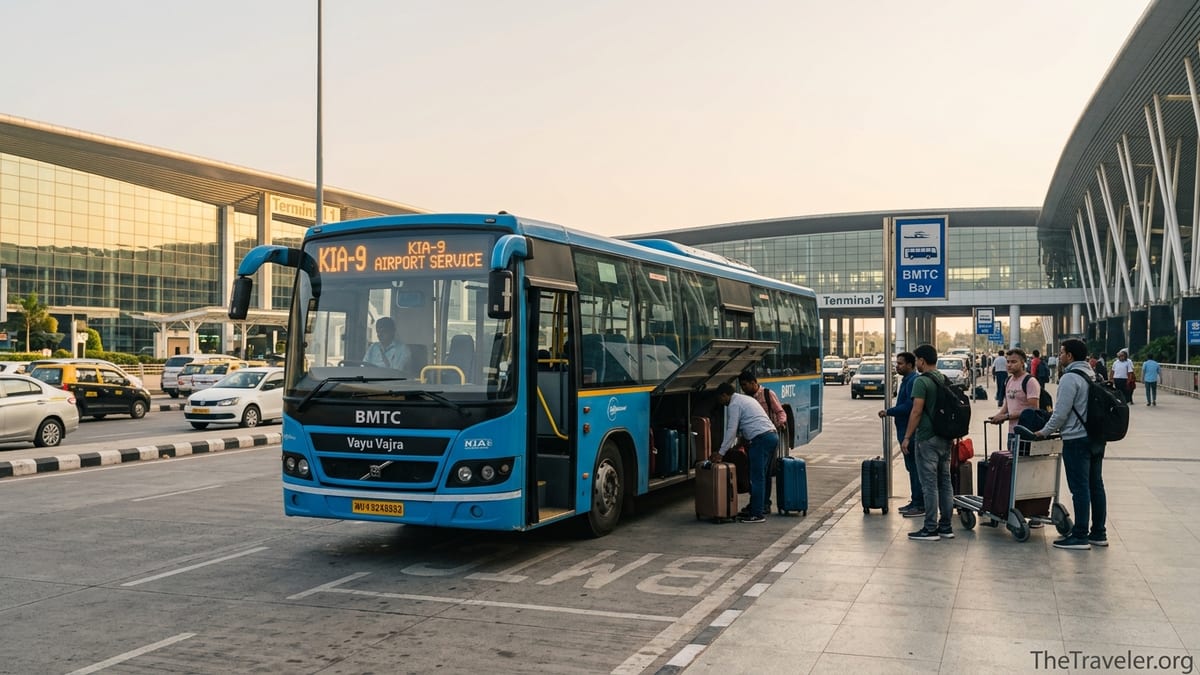
What Is the Vayu Vajra Airport Bus and How It Works
Vayu Vajra is the premium airport bus service operated by Bengaluru Metropolitan Transport Corporation, connecting Kempegowda International Airport with major corridors across the city. The fleet is made up of blue air conditioned buses with cushioned seats, overhead hand racks and under-floor luggage bays. These services are branded with “KIA” route numbers such as KIA-9, KIA-5 and KIA-8, all dedicated to airport connectivity rather than regular city commuting.
The buses run to and from both Terminal 1 and Terminal 2 of Kempegowda International Airport. Dedicated BMTC bays are located in the ground transport area outside arrivals, with signboards showing “Vayu Vajra” and route numbers. Recent layout changes at Terminal 1 have reduced the number of bays, so you may see buses sharing fewer platforms than before, but the core routes are still operating and clearly marked.
Compared with regular BMTC city buses, Vayu Vajra operates as a semi-express airport service. Routes typically follow major flyovers and signal-free corridors where possible to reduce travel time, though within the city they still serve a sequence of advertised stops so local commuters can board. From a traveller’s perspective, that means you get a blend of point-to-point airport connectivity and the flexibility to get off close to home or hotel.
Importantly, your Vayu Vajra fare already includes the highway toll charged on the airport expressway. You do not need to pay anything extra at toll plazas, and there is no surcharge for night travel. This makes the bus far more predictable than some taxi arrangements where tolls, night charges and surge pricing can change the final bill substantially.
Key Vayu Vajra Routes and Where They Go
The airport bus network is organised around several KIA routes that radiate from Kempegowda International Airport to different parts of Bengaluru. Route numbers and patterns may be tweaked periodically, so always confirm the latest route list on the BMTC website or app, but a few core services are especially useful for visitors and budget-conscious residents.
For the traditional city centre, KIA-9 connects the airport with Kempegowda Bus Station, better known as Majestic. This is the main intercity and local bus hub, sitting next to KSR Bengaluru City railway station and the Majestic metro interchange. If you are staying around Gandhinagar, Chickpet or heading to the interstate bus terminals, KIA-9 is often the most straightforward option. As of mid-2026, a full end-to-end ride between Majestic and the airport is quoted at just under 300 rupees, which is typically a fraction of what an app taxi would charge for the same distance.
For the southern residential belt including Jayanagar and JP Nagar, BMTC operates KIA-5 and related variants. Many travellers take a short auto rickshaw ride from inner lanes to a key hub like Banashankari TTMC or Jayanagar 4th Block to board the airport bus directly. This two-step approach is popular among students and families because it keeps the airport leg on a predictable, air conditioned service while using a cheaper local ride for the short internal hop.
The tech corridors to the east and south east are covered by KIA services running via Marathahalli, Whitefield and Electronic City. For example, a Whitefield commuter can board at stops like Graphite India or ITPL on a KIA route and travel directly to the airport without having to switch buses in the city centre. Sample schedules show early morning departures around 4:00 am from these IT clusters to match the first wave of flights, then steady frequencies through the day.
Typical Fares, Tickets and How to Pay
Vayu Vajra fares are higher than regular city buses but significantly lower than taxis for the same airport distance. BMTC uses a stage-based system where the price increases with distance, so your fare depends on where you board or get off along the route rather than a flat airport premium. For many inner city boarding points, travellers in 2026 report fares in the range of roughly 200 to 320 rupees for a one way airport trip, with the higher end covering long hauls like Majestic or Electronics City.
To give a concrete benchmark, a full KIA-9 ride from Majestic to Kempegowda International Airport is currently around 290 rupees. By comparison, a metered or app-based taxi for the same stretch easily crosses 900 to 1,200 rupees once tolls and night surcharges are included, especially during peak demand. For a solo traveller or a couple with light luggage, that price difference alone often makes the bus the better value despite the slightly longer travel time.
Tickets can be purchased directly from the conductor on board using cash. In practice, this is still the simplest method for visitors just arriving at the airport who have not set up local digital wallets yet. Some buses also accept Karnataka-based smart cards and UPI payments, but readiness can vary by vehicle and time of day, so carrying some cash in small denominations remains wise.
Frequent flyers and city residents who use the airport bus regularly can explore BMTC’s dedicated airport or combined passes, which are periodically offered to reduce per-trip costs. These passes are typically valid across Vayu Vajra and, in some cases, on regular Vajra and non-AC services too, making them attractive for commuters who shuttle between the airport and IT clusters several times a month.
Finding the Right Bus at Terminals 1 and 2
Kempegowda International Airport currently operates two main passenger terminals. Terminal 1 handles a large share of domestic traffic, while the garden-themed Terminal 2 has taken over most international flights and a growing proportion of premium domestic services. Each terminal has its own ground transport area, and BMTC Vayu Vajra buses call at both, so you should not need to transfer between terminals by yourself just to catch a bus.
After exiting arrivals at Terminal 1, follow the signs to the bus bays. The BMTC helpdesk and bay area are near the main curbside, where you will also see KSRTC long-distance coaches and private taxis. Look for blue buses marked “BMTC Vayu Vajra” with KIA route numbers displayed on electronic or board signages at the front. In busy hours, multiple KIA routes may be lined up, so always confirm the number and key destination on the bus header display before boarding.
At Terminal 2, buses typically operate from a ground transportation centre slightly offset from the main arrival doors. Directional signage points you toward “BMTC bus” or “Public transport.” If you are uncertain, asking airport staff for the current Vayu Vajra bay is the fastest way to avoid confusion, especially as the airport continues to tweak passenger flows around new construction and roadworks.
In both terminals, expect some walking with luggage, particularly if construction has temporarily altered the closest bays. The good news is that once you have boarded and stowed your bags, the rest of the trip is straightforward. The conductor will usually call out major stops in Kannada and English, and if you mention your area when buying a ticket, staff often give a heads-up when your stop is approaching.
Luggage, Seating and Onboard Comfort
Vayu Vajra buses are designed to handle airport-style luggage rather than just backpacks and office bags. Most vehicles have a dedicated luggage bay below the passenger floor that can take medium to large suitcases. The conductor will usually open this compartment at the airport and at key city stops where multiple travellers are boarding or alighting with baggage.
Inside the cabin, there is overhead space suitable for small backpacks, laptop bags and soft cabin trolleys, but not for heavy checked-in size suitcases. If you are carrying one medium suitcase and a cabin bag per person, the usual practice is to place the big suitcase in the under-floor bay and keep valuables and essential items with you on your seat. This balances security and comfort while keeping aisles clear.
For families with strollers or travellers with sports equipment, it is wise to allow a bit of extra time at boarding. Folded strollers can generally go into the luggage bay, while fragile items are better kept upright inside the cabin if space allows. On crowded runs, especially during festival seasons or Monday morning peaks, you may find the bus fairly full from early city stops, so boarding early at a major hub like Majestic, Banashankari or ITPL increases your chances of a comfortable seat.
Seating is standard forward-facing bus seating, not recliner-coach style, but the air conditioning makes a big difference in Bengaluru’s warm season. Compared with a packed non-AC city bus or a small shared cab, Vayu Vajra feels closer to a long-distance coach experience, especially on the elevated expressway section between Hebbal and the airport where the ride is smoother and faster.
Timings, Late-Night Service and Reliability
BMTC operates Vayu Vajra as a 24-hour network, but frequency varies sharply between daytime, late evening and the early-hours window. Through most of the day and evening, popular routes such as those serving Majestic, central business districts and large IT parks have buses roughly every 20 to 40 minutes, with more frequent clusters around typical flight banks.
At night, services thin out but do not fully stop. Many travellers arriving in the late evening still find buses leaving the airport close to midnight. After that, there is usually a gap of a few hours before early morning trips resume, often around 4:00 am to match the first departures and arrivals. Real-world reports from 2025 and 2026 suggest that if your flight lands after about 1:00 am and you clear the terminal closer to 2:00 or 3:00 am, you should be prepared for a longer wait or switch to a taxi if the next bus is too far away.
Within the city, peak traffic on corridors such as Outer Ring Road, Whitefield Road or the stretch around Hebbal can affect travel times significantly. A run that takes 1 hour 15 minutes in light traffic may stretch to nearly 2 hours in the evening rush. When planning your airport arrival, it is safer to build in an extra 30 to 45 minutes on top of the official timetable, especially if you are travelling in the morning or evening peak from IT belts.
To check live or near-real-time schedules, travellers often rely on a combination of BMTC’s website or mobile app and mapping services that integrate BMTC data. Several local developers have also built independent tools that show nearest Vayu Vajra stops and next departures. Before committing to the bus, it is a good habit to confirm that a KIA service is actually scheduled within a reasonable window for your terminal check-in time.
When the Bus Beats a Taxi, and When It Does Not
There are many situations where the Vayu Vajra airport bus is clearly the smarter choice than a taxi. If you are a solo traveller or a couple with modest luggage staying near a major corridor like MG Road, Indiranagar 100 Feet Road, Marathahalli, Whitefield, Malleswaram or Jayanagar, the bus can get you within a short auto ride or walking distance of your accommodation at perhaps one third of the taxi cost.
A practical example: a software engineer flying into Bengaluru for a week-long project in Whitefield can board a KIA route at the airport, get off near Graphite India or ITPL, and then spend a minimal amount on a local auto to reach an office on EPIP Zone. The total door-to-door cost might stay under 400 rupees, compared with 1,200 to 1,500 rupees for a direct cab from the airport at peak evening hours.
The bus also shines in predictable traffic windows. On a Sunday afternoon to early evening, or at midday on a weekday, the airport expressway and many arterial roads move relatively smoothly. In these periods, the time gap between bus and taxi can shrink to just 15 or 20 minutes, while the price gap remains large. For budget travellers and students, that trade-off is very attractive.
On the other hand, taxis still win in some scenarios. Families with very young children, multiple large suitcases and perhaps a late-night arrival can struggle with the walk to the bus bays and the possibility of standing if the bus is crowded. Likewise, if you live in an inner neighbourhood not directly served by a KIA route, with narrow lanes and irregular autos, a point-to-point cab may save significant hassle. And if you land after 1:00 am and do not see a bus scheduled soon, a taxi is usually the only time-safe option for making it home or to a hotel without a long wait.
Practical Tips for First-Time Users
For first-time visitors, a little preparation can make the Vayu Vajra experience smooth. Before you fly, note the name of your neighbourhood or nearest main road and look up which KIA route serves it. For example, if your hotel is near MG Road, Church Street or Cubbon Park, you will likely be best served by a route that passes through central Bengaluru rather than one dedicated to the southern suburbs.
On arrival, get some local currency at the airport ATM or exchange counter; carrying at least 400 to 500 rupees in small notes makes paying the conductor simple. When you board, tell the conductor your target area, such as “Indiranagar 100 Feet Road” or “Banashankari TTMC,” and they will issue a ticket for the correct stage and may also tell you how long it will take to reach.
If you have a tight flight check-in window on your way out of the city, aim for an earlier bus than the last theoretically possible one. For instance, if your international flight from Terminal 2 closes check-in at 11:30 pm and the route timetable shows a bus that should deliver you around 10:45 pm in perfect conditions, consider catching the previous bus to allow for traffic or minor delays. It is far easier to spend 30 extra minutes at the airport lounge than to negotiate with airline staff about a missed counter closure.
Finally, keep a backup plan in mind. If you reach your nearest KIA stop and the next departure is too far away for comfort, be ready to call an app-based cab or share an airport taxi with another traveller heading in the same direction. The beauty of the Vayu Vajra system is that it gives you an affordable baseline option, which you can combine with flexible choices depending on traffic, time and your own comfort level.
FAQ
Q1. Do Bengaluru’s Vayu Vajra airport buses run 24 hours a day?
Yes, the Vayu Vajra network operates round the clock, but frequency drops sharply late at night. Many routes have buses up to around midnight, then resume with early morning services from roughly 4:00 am onward.
Q2. How much does a typical airport bus ride cost compared with a taxi?
Most one way Vayu Vajra trips from the inner city to the airport cost roughly 200 to 320 rupees depending on distance, while taxis often range from 900 to well over 1,200 rupees once tolls and surcharges are included.
Q3. Can I board a Vayu Vajra bus at any city stop or only at major hubs?
You can usually board at any advertised stop along the KIA route, not just at terminals or big junctions. However, major hubs like Majestic, Banashankari, Marathahalli or ITPL are more likely to have space for luggage and seating, especially during busy times.
Q4. Are the airport buses safe for solo travellers at night?
Vayu Vajra buses are widely used by airport staff, students and business travellers, and are generally considered safe. As with any big city, sit in well lit sections, keep valuables close and, if you feel uncomfortable with a long wait at a deserted stop, consider using a taxi instead.
Q5. Is my luggage secure in the under-floor bay of the bus?
Thousands of passengers use the luggage bays daily without issues, but you should still avoid placing valuables like laptops, passports or cameras there. Keep important items with you on your seat and use the bay only for clothes and non-critical belongings.
Q6. Do the buses go to both Terminal 1 and Terminal 2 at the airport?
Yes, BMTC Vayu Vajra services serve both terminals. Each route has designated bays at Terminal 1 and Terminal 2, and staff or signboards at the airport will indicate the correct boarding point for your terminal.
Q7. Can I pay for my ticket using a card or mobile wallet?
Cash remains the most universally accepted option on board. Some buses and conductors support smart cards or mobile payments, but availability is not fully consistent, so carrying cash in small notes is strongly recommended.
Q8. What if my area does not have a direct KIA route?
Many residents take a short auto rickshaw or regular BMTC bus to the nearest KIA stop or bus terminal, then transfer to the airport bus. For example, people living in interior Jayanagar often ride to Jayanagar 4th Block or Banashankari TTMC to catch KIA-5.
Q9. How early should I leave for the airport if I am using the bus?
Plan to reach the airport at least 3 hours before international flights and about 2 hours before domestic departures, then add a 30 to 45 minute buffer on top of the published bus travel time to cover traffic and delays.
Q10. Is the Vayu Vajra worth it for families, or should we just take a taxi?
For a family of four with several large suitcases, the price gap between one taxi and four individual bus tickets narrows. If you value convenience and door-to-door comfort, a cab may be better. If your group travels light, stays near a KIA corridor and is comfortable with a short walk or auto ride, the bus can still save a noticeable amount.